Sep25
FCRQ217 | Leadership Learning
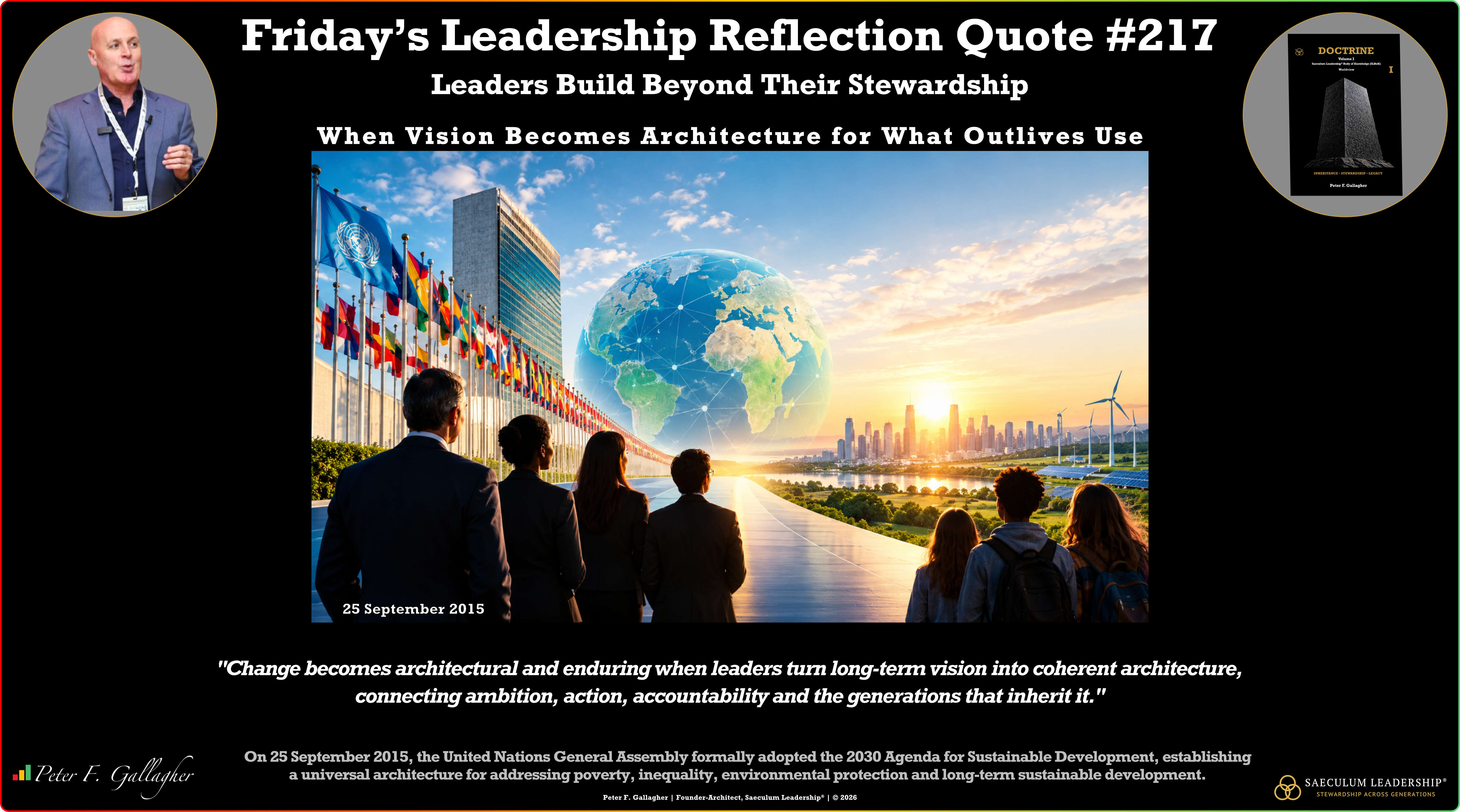
On 25 September 2015, the United Nations General Assembly formally adopted the 2030 Agenda for Sustainable Development, establishing a universal architecture for addressing poverty, inequality, environmental protection and long‑term sustainable development. The agreement, formally titled Transforming our World: the 2030 Agenda for Sustainable Development, established 17 Sustainable Development Goals and 169 associated targets. It was adopted without a vote during the seventieth session of the General Assembly. The Agenda took effect on 1 January 2016 and was designed to guide global development priorities through to 2030.
The significance of the decision went beyond a conventional international policy framework. The 2030 Agenda established a universal architecture through which countries and stakeholders could address interconnected economic, social and environmental challenges. It succeeded the Millennium Development Goals, which had guided global development from 2000 to 2015, but significantly broadened both the scope and universality of the global development architecture.
The development of the Agenda required extensive international and multi‑stakeholder negotiation. The process involved UN Member States, civil society, business, academia, parliamentarians and other stakeholders. The 17 Goals addressed economic, social, environmental and institutional priorities, from poverty and health to climate action, ecosystems, peace, governance and global partnerships. The Goals were presented as integrated and indivisible, recognising that progress in one domain directly shapes outcomes in others.
The Agenda also established a long‑term temporal horizon extending to 2030. The framework established 2030 as a shared destination, requiring sustained action, monitoring and review beyond immediate policy cycles. Its implementation required the translation of a globally agreed framework into national policies, institutional priorities, investment decisions and measurable outcomes.
On 25 September 2015, the international community shifted from an earlier generation of development goals to a broader architecture that connected economic, social and environmental priorities within a single framework. Its significance lies not only in what was agreed, but in the scale, interconnectedness and long‑term nature of the architecture established.
Leadership Responsibility: Vision. The defining responsibility at the point of adoption was Vision because the Agenda established a shared long-term direction extending to 2030 before its practical outcomes could be known.
The event provides a clear illustration of Saeculum Leadership®: leaders influence the future by recognising emerging conditions and creating architectures capable of extending beyond their immediate stewardship.
Saeculum Leadership® Lessons: This turning point allows leaders to move from observing global change to understanding the architectural responsibilities required to shape it. Saeculum leaders recognise that meaningful transformation begins by establishing a clear long‑term direction before certainty emerges. They connect that direction to an architecture capable of translating strategic ambition into clear priorities, measurable targets and sustained action. Saeculum leaders recognise that interconnected challenges require systemic thinking rather than isolated initiatives that address symptoms without considering the broader system. They understand that establishing an architecture is only the beginning, because sustainable outcomes depend on implementation, measurement, learning and ongoing intervention. Saeculum leaders build beyond their immediate leadership cycle by creating knowledge, structures and commitments that endure and influence the generations that follow. Leaders Build Beyond Their Stewardship.
“Change becomes architectural and enduring when leaders turn long‑term vision into coherent architecture, connecting ambition, action, accountability and the generations that inherit it.”
From the Canon — Practice 5 — System Stewardship: System Stewardship is the discipline through which leaders redesign and strengthen the architectures that must endure beyond their own stewardship. The adoption of the 2030 Agenda for Sustainable Development in 2015 illustrates this practice clearly. When inherited development frameworks no longer reflected emerging global conditions, leaders recognised the need for a more integrated architecture capable of connecting economic, social and environmental priorities within a single structure. System Stewardship requires leaders to detect when existing arrangements are drifting, when fragmentation is increasing, and when temporary mechanisms must be replaced with durable frameworks that support coherence across nations, institutions and generations.
Stewardship operates at the level of architecture, not isolated initiatives. It demands that leaders examine how information moves, where coordination fails, and how institutional design enables or obstructs shared understanding. Saeculum Leaders intervene early to build systems that transmit disciplined judgement, align priorities and sustain action over long horizons. They create architectures capable of adapting to emerging conditions without losing coherence, ensuring future leaders inherit structures built for what comes next.
The Stewardship Reflection Lens:
What are we inheriting? We inherit architectures already shaping how systems behave, how information moves and how decisions are formed.
How should we steward it? We steward systems by strengthening the structures that transmit clarity, coherence and disciplined judgement across shifting conditions.
Further Reading: Saeculum Leadership® Body of Knowledge (SLBoK). Saeculum Leadership®: Doctrine – Volume I.
Peter F. Gallagher is the Founder–Architect of Saeculum Leadership® - a generational school of thought reframing leadership as a moral, institutional and generational responsibility. After four decades studying why organisational change succeeds or fails, he concluded that the deeper challenge was not change itself, but leadership across generations. He now codifies the Saeculum Canon, equipping leaders to steward institutions and societies across long arcs of time. The Saeculum Canon establishes the doctrine, architecture and standards of generational leadership.
For further insights please visit our websites: https://www.a2b.consulting https://www.peterfgallagher.com Amazon.com: Peter F Gallagher: Books, Biography, Blog, Audiobooks, Kindle
Saeculum Leadership® Body of Knowledge (SLBoK): Volumes 1-10.A-E & 0, I-V
~ Leadership of Change® Volume 1 - Change Management Fables
~ Leadership of Change® Volume 2 - Change Management Pocket Guide
~ Leadership of Change® Volume 3 - Change Management Handbook
~ Leadership of Change® Volume 4 - Change Management Leadership
~ Leadership of Change® Volume 5 - Change Management Adoption
~ Leadership of Change® Volume 6 - Change Management Behaviour
~ Leadership of Change® Volume 7 - Change Management Sponsorship
~ Leadership of Change® Volume 8 - Change Management Charade
~ Leadership of Change® Volume 9 - Change Management Insanity
~ Leadership of Change® Volume 10 - Change Management Dilenttante
~ Leadership of Change® Volume A - Change Management Gamification - Leadership
~ Leadership of Change® Volume B - Change Management Gamification - Adoption
Keywords: Leadership, Change Management, Business Strategy
 Two Clocks, One Truck: The Army's Need for Speed Meets New Defense Sourcing Rules
 Sustainable Transformation: The Elephant and The Mouse In The Room
 The Price of Standing Alone: Strategic Autonomy in a World Where Nobody Can Do It Alone
 The Potter’s Hands: Why Great Leaders Shape Environments, Not People
 The Corix Partners Friday Reading List - October 16, 2026