Oct25
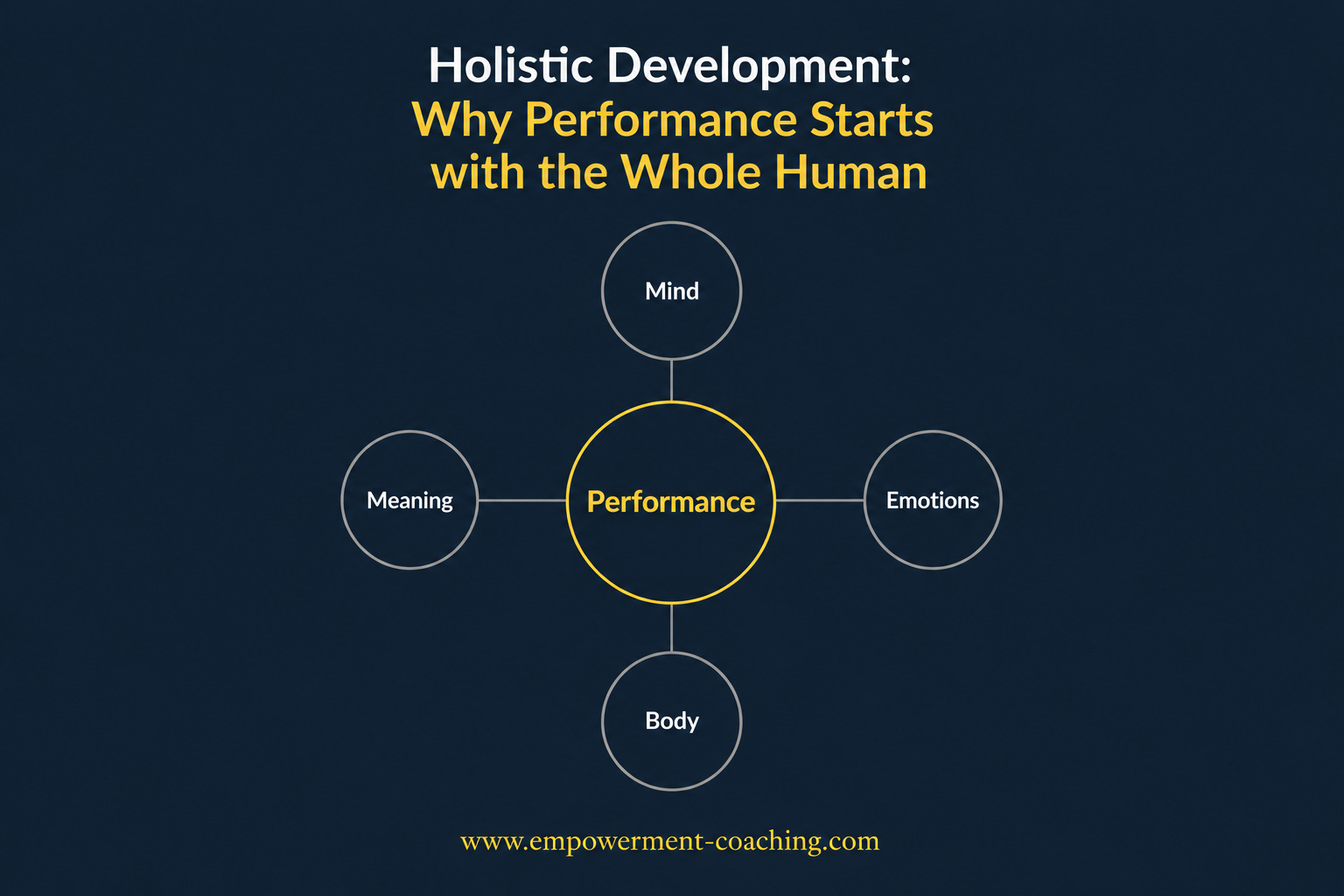
High performance is not created by productivity alone. It emerges from the integration of mind, body, emotions, and meaning. Organizations and leaders who ignore one of these dimensions may achieve short-term results, but rarely sustain long-term engagement, adaptability, and growth.
Sustainable performance starts with the whole human, not only professional skills.
Holistic development integrates four dimensions: Mind, Body, Heart (Emotions), and Soul (Meaning).
Burnout, disengagement, and poor leadership are often symptoms of fragmentation.
The future of leadership requires human integration, not only optimization.
Coaching becomes increasingly valuable because it helps people reconnect these dimensions.
For decades, the dominant model of performance looked deceptively simple:
“More effort = more results.”
This mindset shaped organizations, leadership models, corporate cultures, and even personal identities.
People learned to:
work harder,
think faster,
optimize productivity,
manage time more efficiently,
push through discomfort.
And for a while, this worked.
At least externally.
But beneath the surface, something is breaking.
Organizations became more productive, yet many people became:
emotionally exhausted,
psychologically disconnected,
physically depleted,
spiritually empty.
The paradox of modern work is striking: we have more tools than ever before, yet many people feel less whole than ever.
This is not merely a wellbeing issue.
It is a leadership issue.
A cultural issue.
A human development issue.
And increasingly, it is also a business issue.
Because fragmented people create fragmented systems.
One of the biggest mistakes modern organizations make is reducing human performance to cognition.
The implicit assumption often sounds like this:
“If people think better and work harder, performance will improve.”
But human beings are not software systems.
People are not only minds.
Human performance emerges from the interaction of:
thoughts,
emotions,
physical energy,
relationships,
beliefs,
meaning,
identity,
nervous system regulation,
and purpose.
This is why two people with identical skills can perform completely differently under pressure.
One remains adaptive and resilient.
The other collapses into stress, avoidance, or burnout.
The difference is rarely technical competence alone.
The difference is integration.
At Empowerment Coaching Krakow, we often describe holistic development through four interconnected dimensions:
These dimensions are not abstract philosophical concepts.
They are practical human systems that influence:
decision-making,
leadership quality,
adaptability,
communication,
resilience,
and long-term performance.
Ignoring one dimension affects all the others.
Strengthening one dimension can elevate the whole system.
The mind remains a critical component of performance.
Modern work increasingly rewards:
strategic thinking,
learning agility,
adaptability,
systems thinking,
cognitive flexibility,
and decision-making under uncertainty.
That is even more important in the AI era.
Because AI can process information faster than humans, the real value of human cognition shifts toward:
interpretation,
contextual judgment,
creativity,
ethical reasoning,
and meaning-making.
But the mind can also become a trap.
Many leaders live almost entirely inside cognition:
overthinking,
analyzing,
controlling,
optimizing,
forecasting,
mentally simulating every possible outcome.
This often creates the illusion of effectiveness while disconnecting them from:
emotions,
intuition,
physical signals,
and authentic relationships.
A highly developed intellect without emotional integration can produce brilliant strategies and poor leadership simultaneously.
That is why holistic development does not reject intellectual growth.
It expands it.
The body is perhaps the most neglected dimension of professional performance.
Modern organizations still operate as if human energy were infinite.
But the body always keeps the score.
Chronic stress, emotional suppression, poor recovery, lack of sleep, and constant cognitive overload eventually manifest physically.
The consequences are not only personal.
They become organizational:
reduced creativity,
lower adaptability,
emotional reactivity,
poor decision-making,
disengagement,
and burnout.
Many leaders understand the importance of wellbeing intellectually.
Far fewer treat it as a strategic capability.
Yet sustainable high performance is impossible without energy regulation.
The nervous system matters.
Recovery matters.
Movement matters.
Sleep matters.
Breathing matters.
This is not “soft”.
It is biological reality.
The future of leadership will increasingly require physiological self-awareness.
Because leaders who cannot regulate themselves struggle to regulate organizational systems under pressure.
For many years, organizations treated emotions as something inconvenient.
Professionalism often meant:
emotional suppression,
emotional neutrality,
emotional distance.
But neuroscience and organizational psychology increasingly show the opposite:
“Emotions are not obstacles to performance — they are part of the performance system itself.”
Emotions influence:
attention,
memory,
creativity,
decision-making,
motivation,
relationships,
and trust.
Ignoring emotions does not eliminate them.
It only pushes them underground, where they influence behavior unconsciously.
A leader who lacks emotional awareness may unintentionally create:
fear,
disengagement,
tension,
defensive communication,
and low psychological safety.
Meanwhile, emotionally intelligent leaders create environments where people:
think more openly,
collaborate more effectively,
adapt more quickly,
and recover more sustainably from stress.
The future of work will not become less emotional because of AI.
Paradoxically, it may become more emotional.
As technology automates technical tasks, human differentiation increasingly depends on:
empathy,
trust,
communication,
emotional regulation,
and relational intelligence.
These are deeply human capabilities.
They cannot be "outsourced" to algorithms.
Perhaps the most overlooked dimension of modern work is meaning.
Not motivation.
Not engagement campaigns.
Not corporate slogans.
Meaning.
Human beings need to feel that:
their work matters,
their effort connects to something larger,
their values align with their actions,
and their life is not merely a sequence of transactions.
Without meaning, even success becomes emotionally empty.
This explains why many highly accomplished professionals still experience:
internal dissatisfaction,
existential fatigue,
emotional numbness,
or quiet disengagement.
The problem is not always workload.
Sometimes the problem is disconnection from meaning.
This is especially visible among leaders.
People can spend years climbing organizational ladders only to discover that external success does not automatically create internal fulfillment.
Meaning acts as a stabilizing force during uncertainty.
When people understand:
why they work,
what they stand for,
and what kind of contribution they want to create,
they become:
more resilient,
more adaptive,
and more grounded under pressure.
That is why purpose is not merely a branding concept.
It is psychological infrastructure.
Burnout is often misunderstood as “working too much”.
But many people work hard without burning out.
Burnout frequently emerges from prolonged fragmentation.
For example:
The mind says “keep going”.
The body says “I’m exhausted”.
Emotions say “I’m overwhelmed”.
Meaning says “this no longer feels aligned”.
When these dimensions remain disconnected for too long, internal tension accumulates.
People begin operating against themselves.
Externally, they may still appear productive.
Internally, the system is collapsing.
This is why superficial solutions rarely work.
Burnout cannot always be solved by:
another productivity app,
another motivational speech,
or another corporate wellbeing initiative.
Sometimes people do not need optimization.
They need reintegration.
Many people assume that technological acceleration makes human development less important.
The opposite may be true.
As AI automates:
analysis,
information processing,
repetitive decision-making,
and administrative work,
human value shifts toward:
consciousness,
adaptability,
creativity,
emotional intelligence,
ethical judgment,
and meaning-making.
In other words:
the more advanced technology becomes,
the more important deeply human capabilities become.
This creates a profound leadership challenge.
Organizations can no longer focus exclusively on technical performance.
They must also develop:
resilient humans,
adaptive cultures,
emotionally intelligent leaders,
and psychologically sustainable systems.
The future belongs not only to technologically advanced organizations, but to humanly integrated organizations.
The best leaders are rarely the most technically perfect people in the room.
They are often the most integrated.
Integrated leaders:
think clearly,
regulate emotions,
maintain energy,
communicate authentically,
and remain connected to meaning.
This creates stability for others.
People do not only follow competence. They follow coherence.
In uncertain environments, human nervous systems constantly scan for signals of:
trust,
safety,
clarity,
and emotional consistency.
Leaders who embody internal alignment create stronger organizational systems.
This is why leadership development cannot focus only on:
skills,
tools,
or frameworks.
It must also involve:
self-awareness,
emotional maturity,
reflection,
and human integration.
This is one reason for coaching becoming increasingly valuable in modern organizations.
Not because people are weak.
But because modern environments are psychologically complex.
Coaching creates space for:
reflection,
awareness,
recalibration,
emotional processing,
and alignment.
It helps people reconnect:
performance with wellbeing,
ambition with meaning,
leadership with authenticity.
In many cases, transformation does not begin with learning something new. It begins with remembering what has been disconnected.
For many years, development was associated primarily with:
acquiring skills,
increasing productivity,
improving efficiency.
But the future may require a broader understanding.
Human development is not only vertical growth. It is integration.
Not only:
“How can I achieve more?”
But also:
“How can I become more whole?”
This shift changes everything.
It changes:
leadership,
organizations,
coaching,
culture,
education,
and performance itself.
Because sustainable excellence is rarely built on fragmentation.
It is built on alignment.
The future of work will not be shaped only by technology. It will also be shaped by the quality of human systems.
And human systems become stronger when people are not treated as:
productivity machines,
cognitive assets,
or organizational resources.
But as whole human beings:
Mind.
Body.
Heart.
Soul.
Not as separate categories. But as one integrated system.
Because ultimately:
“Sustainable performance starts with the whole human.”
Keywords: Behavioral Science, Coaching, Leadership
Holistic Development: Why Performance Starts with the Whole Human The Most Dangerous Leader in the Room May Be the One Everyone Depends On
 What is that Analytical AI?
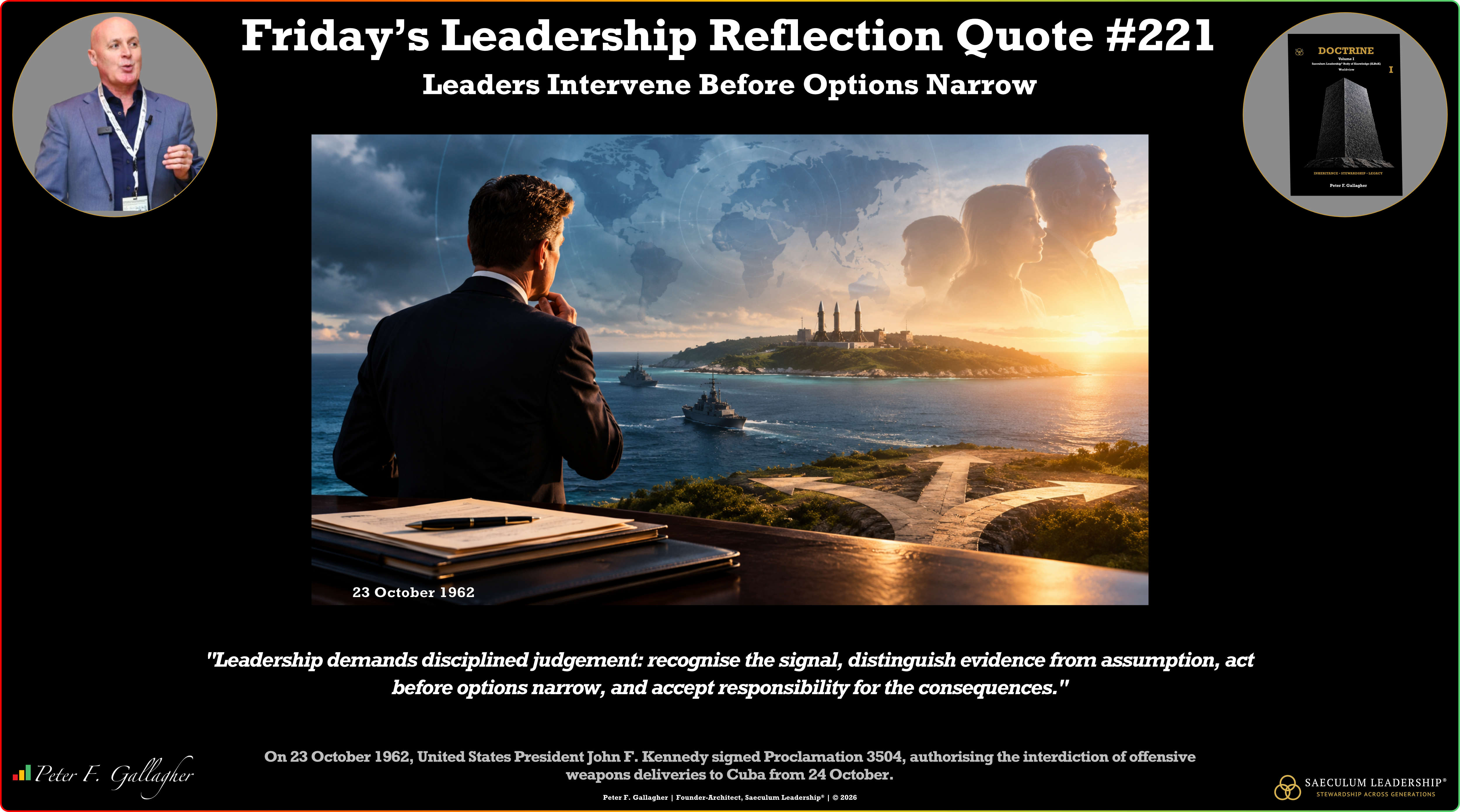 Friday’s Leadership Reflection Quote – Saeculum Leadership Leaders Intervene Before Options Narrow
 The Corix Partners Friday Reading List - October 23, 2026