Nov12
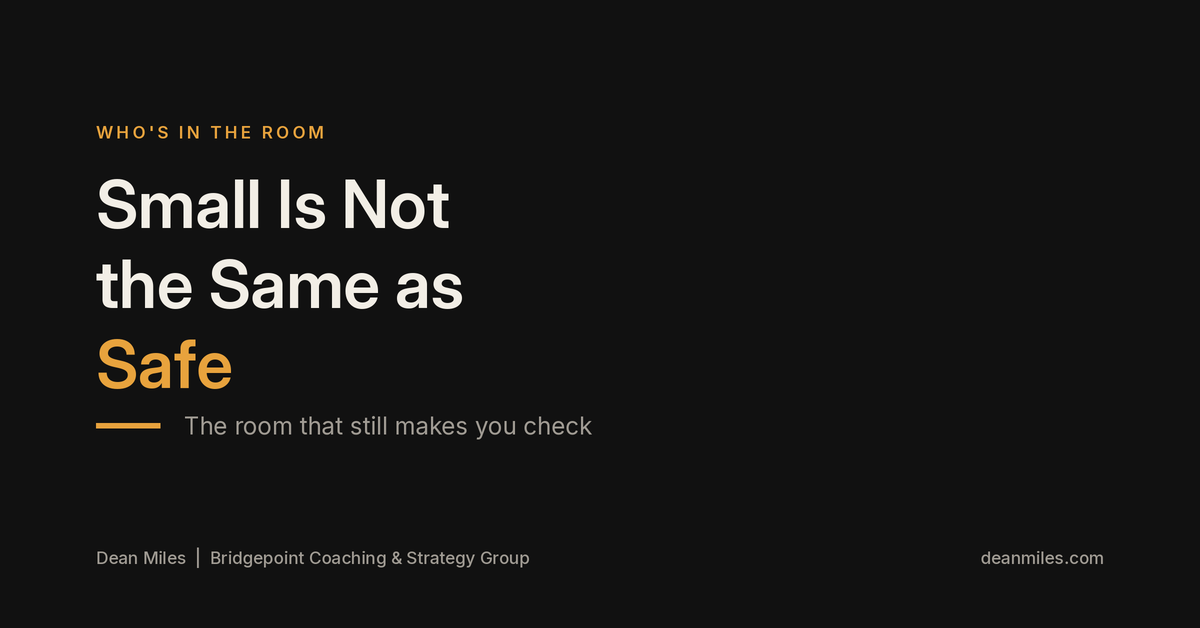
Keeping the circle small under pressure is smart. Keeping it comfortable is not. The room that helps you is the one that still makes you check.
Under pressure, the circle shrinks. I have watched this for 30 years, and I have seen it in my own research. Leaders go to the two or three people who make the moment feel easier. The ones who slow them down get pushed to later.
That part is predictable. The mistake is what happens next.
People hear "keep it small" and treat comfort as the same thing as safety. It isn't.
Last week I spent an hour with founder-students in an NYU graduate class on building teams. The line that stayed with them was not a framework. It was this: small is not the same as safe.
A small room can be a strength. For my doctoral research I studied six serial technology founders across twelve ventures. Each had one venture that failed and one that succeeded. Before they changed how they were thinking, they changed who was in the room. Every successful venture had a smaller, deliberately chosen circle than the one that failed.
Small was the pattern. Comfortable was not.
The comfortable room keeps the people who agree. It moves the person with the data to later. It fills the calendar with what feels easier.
The challenging room keeps the one person who will argue with the actual plan. It brings in whoever has the data, and it asks them directly. It is chosen before the pressure arrives, not during it.
The test is not whether the room feels better. It is whether the room makes you check.
Disagreement does not mean someone is unsupportive. The people worth keeping close will challenge you and still be on your side.
One founder in that NYU room decided to ask a close family member to challenge a venture plan as an investor would, not as family, and to bring in one outside voice with market data before the next big decision. Another planned to look at every important relationship and ask a simple question: who challenges, who supports, who does both, and who does neither.
That is the work. Not a new mindset. A clearer look at who already has a seat.
When a leader tells me "I trust my instincts," I don't ask them to stop. Instinct is useful. The problem is when instinct goes untested and starts passing as fact. Being confident in an idea does not make it a fact. The right person in the room is the one who will say so.
Take these into your next leadership meeting, or sit with them yourself before the next decision.
If the answers don't match, that's not failure. That's your agenda.
You don't need a bigger room. You need a room that still makes you check.
Small and challenging beats small and comfortable. Pressure will shrink the circle either way. Choose it before that happens.
Direction. Not just motion.
Dean Miles is Founder and President of Bridgepoint Coaching & Strategy Group and has been an executive coach to senior leaders for 30 years. If you want to look at who's in the room when the pressure hits, let's talk. Connect with Dean at deanmiles.com.
By Dean Miles
Keywords: Business Continuity, Coaching, Mental Health
Small Is Not the Same as Safe Build the Foundation for an AI Governance Role
 NEW BOOK: Pole, Pole: Stop Rushing AI. Prepare. Adapt. Lead. Lessons from Kilimanjaro
 Strategy When the Market Looks Like It Has Lost Its Mind
 Building Resilient, Inclusive, and Risk-Aware Procurement Systems