Nov08

Why one supplier is not a strategy, why one customer is not continuity, and why investors need to change what they measure
Over the past few years, almost every leadership team I speak with has said some version of the same sentence: "The market has gone mad." Tariffs appear overnight. A blocked shipping route stops a product line. A software vendor is acquired and its roadmap changes or even worse, prices explode. A customer that represented a third of revenue announces that it is reviewing its vendor base.
It is tempting to treat these events as exceptions. I think that is wrong. Shocks are no longer interruptions to the plan. They are the environment in which the plan has to work. The useful question is not "how do we get back to stable?" but "what does a good strategy look like when instability is the default?"
My answer has three parts: real options on both sides of your business, a different kind of partnership with suppliers and customers, and a change in how companies are valued, because today that often punishes exactly the behaviour that makes a company resilient.
Many organisations will say they have a supplier strategy. Look closely and they have a supplier, chosen for good reasons: a strong product, a fair price, a smooth integration. That was efficient, and efficiency was rewarded. But a single supplier is a bet, not a strategy. A strategy needs alternatives. If the only answer to "what happens if this partner fails or changes its pricing?" is "we would have a serious problem", you have described a dependency, not a plan.
The usual objection is cost, and it is real. But the comparison is usually made wrongly. The cost of a second supplier is visible and paid every year. The cost of having only one is invisible until the day it arrives, and then it is paid all at once, at the moment you have the least room to manoeuvre.
A second name on an approved vendor list does not solve it either. I have seen many lists where the second supplier had never delivered a single order. Real optionality means the alternative is qualified, integrated well enough to be switched on, and given enough regular volume to stay interested in you.
The same logic applies on the other side of the business. A large anchor customer feels like security. Yet one customer is not continuity. It is a single decision maker, a single budget and a single procurement department that can change its mind for reasons that have nothing to do with how well you perform.
Your customers are exposed to the same shocks you are. A contract is only as stable as the customer's situation, and you do not control that. When a concentrated customer leaves or renegotiates hard, you absorb the damage, because you have built your cost base, your people and sometimes your product around that relationship.
The answer is not to treat your best customer worse. It is to make sure that losing any one customer is a setback and not a crisis, by spreading across segments, regions and use cases.
A company with one supplier and a few large customers is fragile at both ends.
A third force makes this more urgent: the pace of product development. New technology, artificial intelligence in particular, has shortened the time between an idea and a usable product from years to months, sometimes weeks.
Speed on its own is not the point. What matters is what it demands from the chain around you. Changing a product quickly may mean a different component, data source, model provider or manufacturing partner, quickly. When customer needs shift, you may need to serve a different segment or change your offer just as fast.
Flexibility cannot be added on one side only. A company agile in engineering but locked into one supplier will find that the supplier sets its speed limit. A company with flexible sourcing but one dominant customer will find that the customer's slow decisions set its pace. Upstream and downstream flexibility are two halves of one capability. Without both, fast product development becomes fast development of products that cannot be built or cannot be sold.
If you need options on both sides, what does that do to the way you work with partners? Many organisations go wrong in one of two directions.
The first mistake is to become purely transactional: run an auction every year and treat every supplier as replaceable. Partners who are treated as interchangeable behave as if they are interchangeable. They do not share early warnings, they do not invest in your needs, and they are the first to leave when things get tight.
The second mistake is the opposite: deep exclusive partnerships. These work in calm times and fail in turbulent ones, because the depth that creates trust also creates lock-in.
The better model sits between the two, and it is more demanding than either. You work with several partners, and you work with them seriously. In practice that means:
This is more work than signing one large contract. Resilience is a management discipline, not a clause.
There is a thing that catches even well-prepared organisations. You may have three suppliers for a component and feel safe. But what if all three buy their critical material from the same mine, run on the same cloud region, depend on the same logistics hub or rely on the same certified sub-supplier? On your diagram you have diversity. In reality you have one point of failure with three logos in front of it.
This is the choke point problem. Multiple suppliers that converge on the same point downstream, or that share a dependency upstream of it, give you the illusion of independence. The same applies to customers: ten customers who all depend on one platform are, in a crisis, closer to one customer than to ten.
How do you find these points? Not by asking suppliers whether they are resilient. Four practical steps help far more:
Repeat this regularly, because the map changes whenever a partner changes its own partners. The goal is not to remove every choke point. Some cannot be removed, and some are not worth the cost. The goal is to know where they are, to decide consciously which ones you accept, and to build buffers, alternatives or early warning around the rest.
Lets' get uncomfortable. Everything described so far costs something. Buffers tie up capital, spreading customers can mean passing on a large deal, and the benefit is invisible until a shock hits.
That is hard to justify when the dominant way of judging a company is a handful of metrics designed for a more predictable world. Annual recurring revenue is the clearest example. It is a useful number, but as the main lens it rewards the wrong things. A company with one large customer on a three-year contract shows excellent ARR and looks healthy. A company that has deliberately diversified and kept slack in its supply chain may show slower growth and thinner margins, and looks worse on the same screen.
The metric does not ask how many customers could leave without breaking the business, or how quickly a component can be changed. Yet in a world of repeated shocks, those are the questions that predict who is still standing in three years.
So the pressure on management is real. Leaders who build resilience can be penalised in the short term by analysts and investors who still steer on the old measures. And leaders who respond by cutting the buffers become exactly as fragile as the numbers pretend they are not. As long as analysts and investors steer on old values, it will stay difficult for companies to act proactively in a world made of shocks.
Investors have a self-interest in changing this. Their portfolios are exposed to the same shocks, and a fund holding many companies with hidden concentration holds a lot of hidden risk, whatever the reported growth says. Better questions would include:
None of this is easy to measure. But difficulty is no reason to ignore it. Not long ago, cyber security and carbon footprint were also treated as soft topics. Both are now routine parts of due diligence.
Waiting for investors to change is not a plan. Any leadership team can start today:
When a market appears to have gone mad, the instinct is to look for a single stable point: the strongest supplier, the biggest customer. But in an environment of repeated shocks, stability comes from the ability to move.
One supplier is not a strategy. One customer is not continuity. Fast product development requires flexibility in both directions, and that flexibility changes the nature of collaboration, because it demands partnerships that are serious but not exclusive. It requires an honest view of where the choke points are, because diversity on a diagram is not independence in reality. And it needs a financial community willing to look beyond ARR towards the structural strength that decides whether a company survives its next surprise.
The companies that do well in the coming years will not be the ones that predicted the shocks best. They will be the ones that arranged their business so that prediction matters less. That is a choice, and it is available now.
Keywords: Entrepreneurship, Leadership, Supply Chain
Strategy When the Market Looks Like It Has Lost Its Mind Building Resilient, Inclusive, and Risk-Aware Procurement Systems
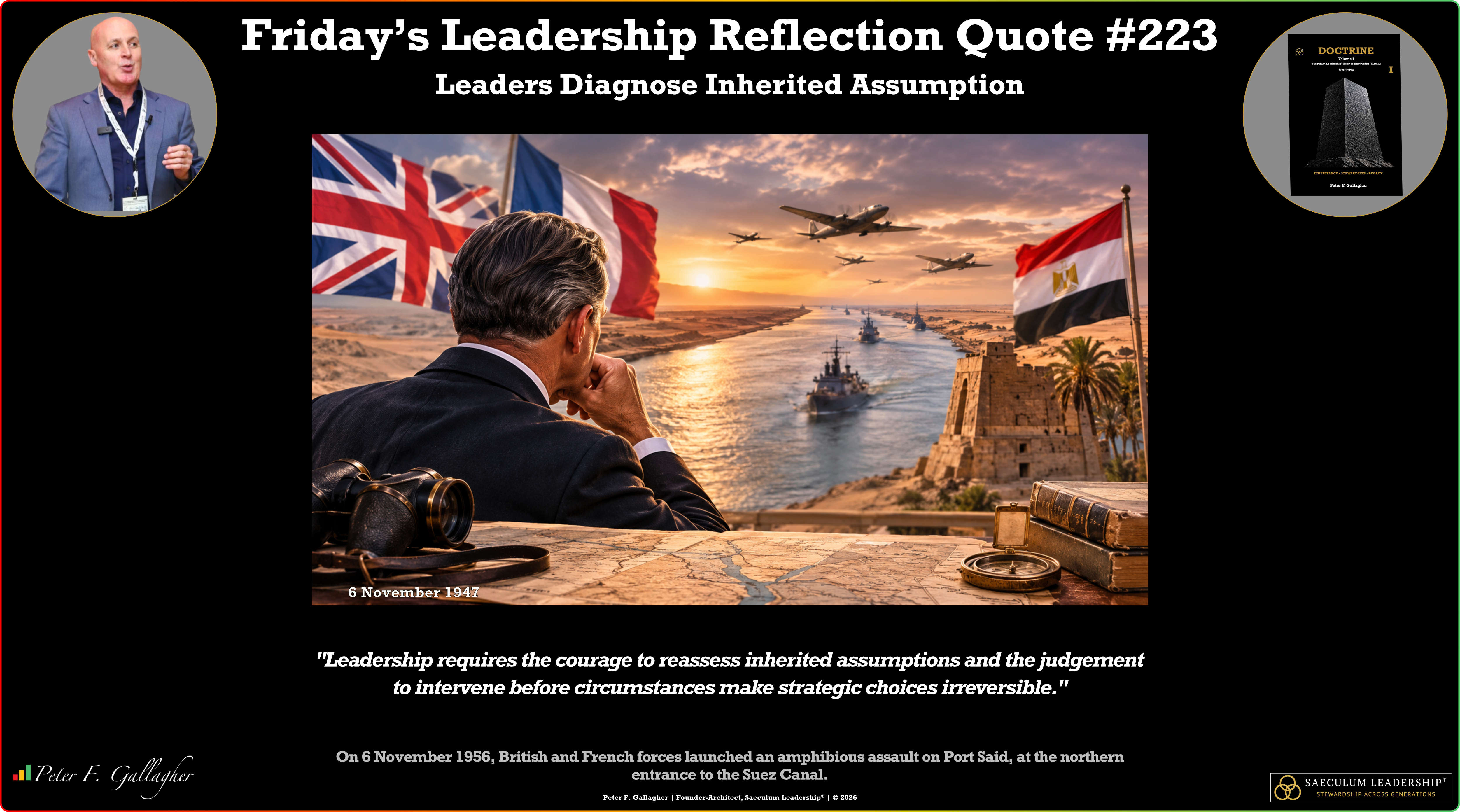 Friday’s Leadership Reflection Quote – Saeculum Leadership: Leaders Diagnose Inherited Assumption
 The Corix Partners Friday Reading List - November 6, 2026
 The Silent Cost of Leadership: What Organizations Lose When Employees Stop Speaking Up