Oct24

The hidden organizational cost of indispensable leadership—and why the future belongs to leaders who make others stronger.
By Mike Kehoe | Leading Through the Algorithm™
Imagine two leaders overseeing equally successful departments. Both consistently meet their operational targets, maintain strong productivity, and receive recognition from senior management. On paper, their performance appears nearly identical. Yet beneath those results, two very different organizational cultures are developing.
In the first department, nearly every important decision flows through the manager. Employees hesitate to act without approval, critical knowledge remains concentrated in one person's hands, and opportunities to assume greater responsibility are limited. The manager is frequently praised for being indispensable. Nothing seems to function quite as smoothly without their involvement.
In the second department, employees are encouraged to develop independent judgment, knowledge is shared openly, and team members are gradually prepared to assume greater responsibilities. The manager remains accountable and actively engaged, but the team's effectiveness does not depend on their constant presence.
Now imagine both leaders unexpectedly leave their organizations tomorrow.
Which department is better prepared to succeed?
That question reveals a leadership paradox that deserves far greater attention in today's business environment.
We have spent generations celebrating leaders who are indispensable. We recognize their ability to solve problems, maintain control, and keep operations functioning under pressure. Yet we rarely stop to consider whether an organization's dependence on one individual represents exceptional leadership or an underlying vulnerability.
Sometimes the person everyone depends on is not the organization's greatest strength. They are its greatest single point of failure.
During my career, I've encountered different approaches to leadership. Some individuals genuinely believe their responsibility is to develop the people around them, share what they know, and prepare employees to succeed beyond their current responsibilities. Others operate from a more centralized philosophy, where information, decision-making authority, and opportunities for advancement remain closely controlled.
The distinction is not always immediately apparent. Both approaches can produce results, particularly in the short term. In fact, highly controlling managers may initially appear exceptionally effective because they remain involved in nearly every aspect of their department's operations.
But there is a difference between being responsible for an organization's success and making that success dependent on your constant involvement.
When employees must repeatedly seek approval for routine decisions, the organization loses agility. When knowledge is treated as personal property rather than a shared organizational resource, the business becomes vulnerable. When opportunities to participate in meetings, projects, or unfamiliar responsibilities are unnecessarily restricted, employees lose experiences that could prepare them for future leadership.
These behaviors can create what I would describe as organizational dependency: a condition in which a team becomes increasingly reliant on particular individuals because knowledge, authority, or experience has not been adequately distributed.
Not every instance of centralized decision-making is harmful. Certain situations require clearly defined authority, confidentiality, or specialized expertise. The concern arises when unnecessary control becomes a habitual leadership practice rather than a legitimate operational requirement.
The danger is that organizational dependency can be mistaken for organizational strength, especially when immediate performance indicators remain positive.
One of the most revealing questions an executive can ask is not simply whether a manager is achieving results, but how those results are being achieved.
Is the manager building a team capable of independent judgment, or creating a system in which every meaningful decision requires their approval? Are employees becoming more capable over time, or are they remaining dependent on the same individual for direction? Is expertise being transferred throughout the organization, or is it becoming increasingly concentrated?
These questions matter because organizational resilience depends on more than having talented individuals. It depends on the ability to preserve knowledge, maintain continuity, and adapt when circumstances change.
Consider what happens when a key leader accepts another position, retires, becomes unavailable, or leaves unexpectedly. If essential knowledge exists primarily in that person's head, the organization may struggle to maintain continuity. If employees have never been encouraged to participate in certain responsibilities, the business may discover that it has not developed the internal capabilities needed to fill the gap.
The consequences can extend beyond operational disruption. Employees who repeatedly encounter barriers to learning or advancement may begin to question whether their contributions are genuinely valued. Over time, this can weaken trust, reduce initiative, and encourage talented individuals to seek opportunities elsewhere.
A leader may believe that maintaining control protects their importance within the organization. But protecting personal importance and protecting organizational strength are not necessarily the same thing.
In some cases, they can work against each other.
The broader research on management reinforces the importance of developing people rather than relying exclusively on traditional supervisory practices.
Deloitte's 2025 Global Human Capital Trends research found that managers spend nearly 40% of their time addressing immediate problems and administrative responsibilities, while only 13% is devoted to developing the people who work for them. The same research found that 73% of organizations recognized the importance of reinventing the managerial role, yet only 7% reported making significant progress.
These findings do not demonstrate that managers are intentionally withholding opportunities or knowledge. They do, however, reveal how organizational structures and competing demands can leave comparatively little time for one of leadership's most important responsibilities: preparing others to succeed.
Gallup's research provides another perspective. Its analysis indicates that managers account for approximately 70% of the variance in team-level employee engagement. While engagement is influenced by multiple organizational factors, the finding underscores the importance of the relationship between managers and the people they lead.
Together, these findings suggest that organizations should examine not only how managers supervise performance, but also whether their responsibilities, incentives, and working environments support meaningful employee development.
If organizations want stronger teams, they must make developing those teams a genuine leadership priority.
There is an interesting contradiction emerging as artificial intelligence becomes more deeply integrated into modern organizations.
Businesses are investing in technologies designed to make information more accessible, accelerate decision-making, identify inefficiencies, and reduce dependence on repetitive manual processes. Yet within some of those same organizations, leadership practices may continue concentrating knowledge and authority in ways that limit the benefits technology is intended to provide.
We are developing systems capable of distributing intelligence while sometimes maintaining management cultures that restrict the distribution of knowledge.
This contradiction deserves attention because successful AI adoption requires more than access to sophisticated technology. It requires employees who understand how to use new tools, feel comfortable learning unfamiliar processes, and have sufficient trust in leadership to participate constructively in organizational change.
My experience working directly with emerging technologies in operational environments has reinforced how important the human element remains. Introducing new technology is not simply a matter of installing equipment, demonstrating capabilities, or producing data. It also involves helping people understand what is changing, why those changes matter, and how their own roles may evolve.
Employees need opportunities to ask questions, observe processes, participate in training, and develop confidence through experience. When information is unnecessarily restricted or participation is discouraged, organizations risk slowing the very adoption they are trying to accelerate.
AI can make information more accessible, but accessibility alone does not create an empowered workforce. Employees still need leaders who encourage curiosity, support learning, establish appropriate boundaries, and create opportunities to apply new knowledge.
Technology can expand what an organization knows. Leadership influences how effectively that knowledge becomes shared capability.
Effective leadership requires authority. Organizations need accountability, clear responsibilities, sound judgment, and appropriate oversight. The objective is not to eliminate managerial authority or create an environment where everyone operates without direction.
The challenge is recognizing when legitimate authority becomes unnecessary control.
Authority establishes responsibility for outcomes. Excessive control can prevent others from developing the judgment needed to contribute to those outcomes.
A leader exercising healthy authority establishes expectations, provides resources, clarifies decision-making boundaries, and holds people accountable. That same leader also recognizes when employees are ready to assume additional responsibilities and actively creates opportunities for them to grow.
By contrast, a leader who consistently limits participation, retains information without a legitimate reason, or discourages employees from expanding their capabilities may unintentionally create a culture of dependency.
This distinction becomes especially important during periods of organizational change. Businesses need people who can adapt, solve problems, and respond intelligently to unfamiliar circumstances. Those capabilities cannot be developed exclusively through observation. They require participation, experience, and the opportunity to exercise judgment.
The strongest leaders understand that sharing responsibility does not mean abandoning accountability. It means developing a team capable of carrying that responsibility effectively.
One principle has remained central to my perspective on leadership:
"Leadership is measured by what happens when the leader isn't there."
The more experience I've gained leading teams and navigating organizational change, the more meaningful that statement has become.
It challenges us to evaluate leadership beyond the immediate results produced under direct supervision. A manager may achieve excellent performance while remaining deeply involved in every operational detail. But what happens when that manager is absent? Does the team continue functioning confidently, or does progress slow because employees lack the authority, knowledge, or confidence to proceed?
A team that continues collaborating, solving problems, maintaining standards, and exercising sound judgment demonstrates something important about the environment its leader has helped create.
That does not mean the leader has become unnecessary. It means the leader has succeeded in developing organizational capability beyond their own individual contribution.
The objective should never be to make employees dependent on our presence. It should be to make them stronger because of our leadership.
Traditional leadership evaluations often emphasize productivity, financial performance, operational execution, and the ability to solve problems. These measures remain important, but they do not always reveal whether a manager is strengthening the organization for the future.
Executives should also consider how effectively leaders transfer knowledge, develop successors, encourage collaboration, and prepare employees to assume additional responsibilities. A manager who consistently delivers results while leaving no one prepared to step into their role may be creating a risk that traditional performance metrics fail to capture.
This requires a broader understanding of leadership effectiveness.
Organizations might examine whether employees have opportunities to participate in cross-functional projects, whether critical processes are adequately documented, whether succession planning extends beyond executive positions, and whether managers are actively developing the capabilities of their teams.
These practices should not become another exercise in measuring activity for its own sake. Their purpose is to determine whether the organization is building the human capacity necessary to remain effective as circumstances change.
Leaders should be recognized not only for the problems they personally solve, but also for the number of people they prepare to solve problems independently.
That is how leadership becomes a multiplier rather than a bottleneck.
There is a meaningful difference between being remembered as the person who could do everything and being remembered as the person who helped everyone become capable of doing more.
The first may earn admiration for individual expertise. The second creates something that can endure beyond a single career, department, or position.
As organizations navigate artificial intelligence, workforce transformation, and increasingly complex business environments, the need for capable, adaptable employees will only grow. No executive, manager, or specialist can possess every answer or anticipate every challenge. The ability to distribute knowledge, encourage independent thinking, and develop future leaders will become increasingly valuable.
We should continue celebrating expertise, accountability, and exceptional performance. But we should be equally willing to question organizational cultures that confuse control with effectiveness or dependence with loyalty.
The most valuable leader may not be the person whose absence creates the greatest disruption.
It may be the person whose influence is so deeply reflected in the capabilities of others that the organization continues to thrive long after they have moved on.
Keywords: Leadership, Management, Retail
The Most Dangerous Leader in the Room May Be the One Everyone Depends On What is that Analytical AI?
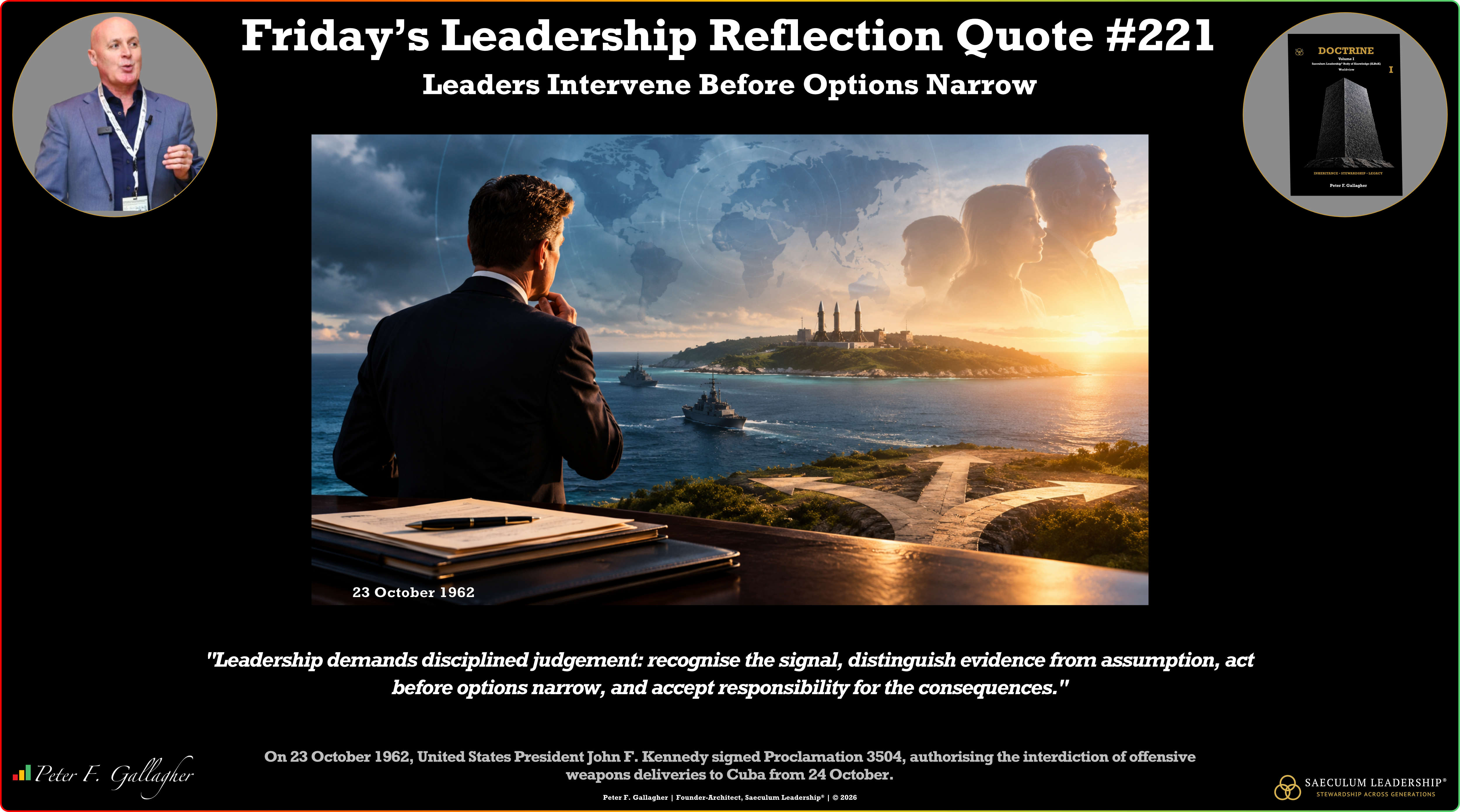 Friday’s Leadership Reflection Quote – Saeculum Leadership Leaders Intervene Before Options Narrow
 The Corix Partners Friday Reading List - October 23, 2026
 RIFLESSIONE SU AI, TECNOLOGIA E PERSONE