Nov13
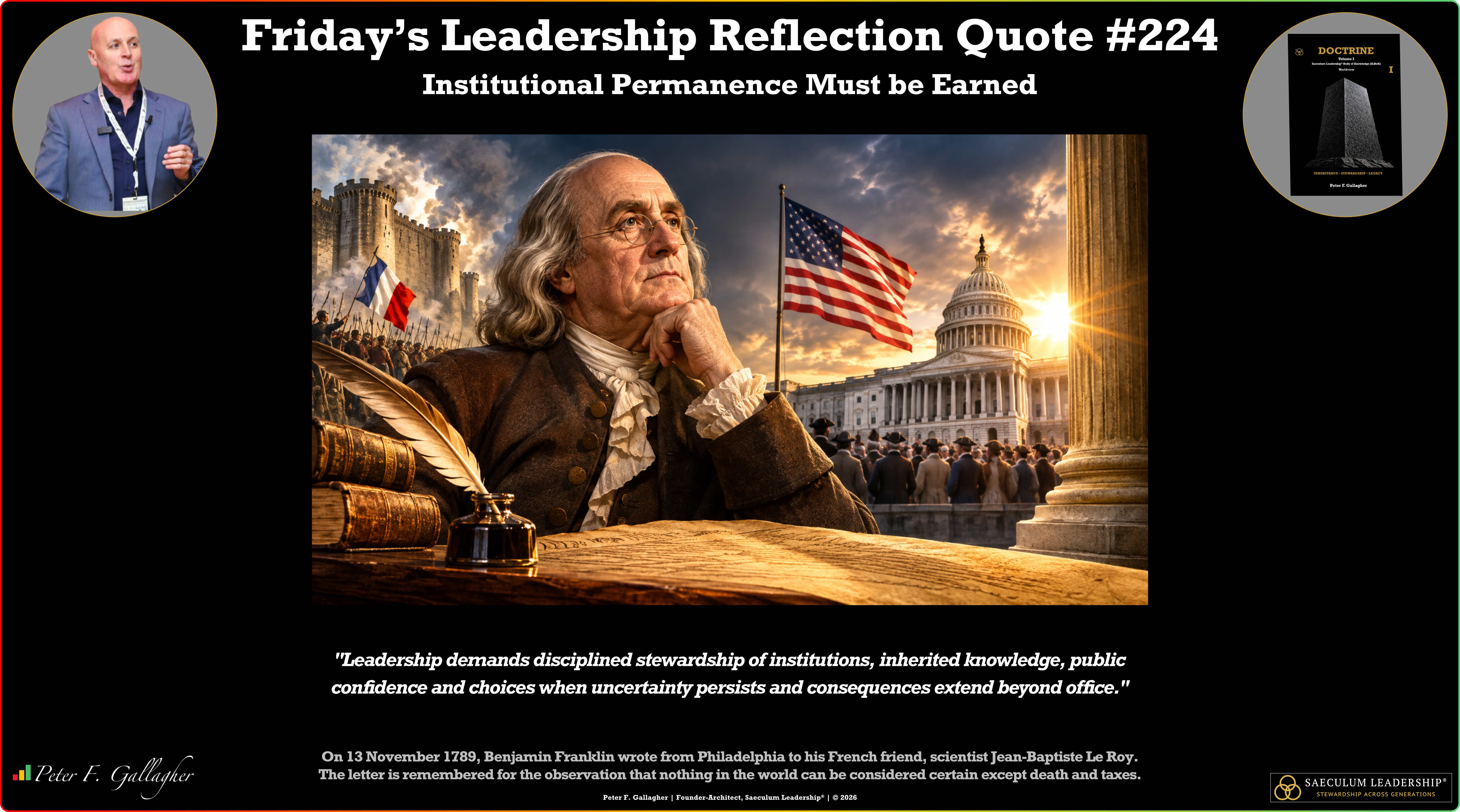
FLRQ224 | Leadership Learning - If institutions are founded by one generation, what must every succeeding generation do to earn their permanence?
On 13 November 1789, Benjamin Franklin wrote from Philadelphia to his French friend, scientist Jean-Baptiste Le Roy. The letter is remembered for the observation that nothing in the world can be considered certain except death and taxes. Yet this sentence was not an isolated joke. It appeared within a reflection on constitutional durability, upheaval in France and Franklin’s health.
The United States Constitution, drafted in 1787 and ratified by the states in 1788, had come into operation in 1789. The federal government had begun under President George Washington. Franklin, a participant in the Constitutional Convention, regarded the new constitutional order as established. His qualification about death and taxes tempered confidence in permanence with recognition that human affairs remain uncertain.
Across the Atlantic, France was experiencing revolutionary upheaval. The Bastille had fallen in July; in August, the National Assembly abolished feudal privileges and adopted the Declaration of the Rights of Man and of the Citizen. In October, the royal family was brought from Versailles to Paris. Franklin had not heard from Le Roy for more than a year and expressed concern for his friend's safety. He hoped the troubles would settle to the advantage of both king and nation.
The letter was also personal. Franklin was eighty-three, frail and suffering pain. His remarks on mortality were therefore more than a detached aphorism. He recognised the fragility of individual life while considering the uncertain durability of political arrangements.
The historical significance lies in the contrast before his correspondent. A constitution could be designed, ratified and put into operation, but its endurance could not be guaranteed by declaration alone. As revolutionary France tested its inherited order, the American republic was attempting to establish a new one. Both show that political transitions unfold amid incomplete knowledge and consequences that cannot be fully predicted.
The Saeculum Leadership® signal is the gap between institutional promise and demonstrated institutional performance. Vision establishes direction, but MODEL demonstrates the standards, conduct and institutional discipline required to make that direction credible. The responsibility of leaders is to translate constitutional and institutional principles into consistent behaviour, decisions and practices that earn confidence. The turning point is not the declaration of permanence, but the daily work through which institutions earn it. Leaders must not confuse a promising beginning with a secured future across generations, or assume that public trust and legitimacy will endure without continued stewardship.
Saeculum Leadership® Lessons: The enduring significance of Franklin’s reflection lies in the responsibility to establish institutions that remain credible, resilient and worthy of inheritance across generations. Saeculum leaders diagnose institutional conditions by distinguishing constitutional ambition from demonstrated durability and recognising the uncertainties surrounding inherited systems. They examine evidence, historical circumstances and competing interpretations before forming judgements about institutional stability and future consequences. Saeculum leaders mobilise understanding, institutional knowledge and public confidence around a clearly established direction that recognises the wider historical context. They translate institutional principles into consistent conduct, disciplined practice and decisions that demonstrate the credibility of the systems they serve. Saeculum leaders exercise stewardship by protecting institutional continuity, preserving valuable knowledge and considering what future generations will inherit from their decisions. Institutional Permanence Must be Earned.
“Leadership demands disciplined stewardship of institutions, inherited knowledge, public confidence and choices when uncertainty persists and consequences extend beyond office.”
From the Canon — Practice 5 — System Stewardship: System Stewardship is the discipline through which leaders strengthen institutional arrangements that must endure beyond their own tenure. Franklin’s letter of 13 November 1789 is illustrative. The United States Constitution had been ratified and the federal government had begun operating, yet its durability could not be guaranteed. Across the Atlantic, revolutionary France demonstrated how quickly inherited political arrangements could be challenged. Franklin’s observation about death and taxes sits within a reflection on uncertainty surrounding personal life and public institutions.
System Stewardship lies in the distinction between establishing an institution and securing its continuity. Founding documents provide architecture, but their endurance depends on the conduct, judgement and discipline of those who uphold them. Stewardship requires leaders to protect institutional coherence while recognising that conditions may test the arrangements they inherit. It also requires attention to what knowledge, principles and capabilities are transferred to successors. The measure is not whether an institution appears permanent at its beginning, but whether it remains credible, adaptable and worthy of inheritance across generations and changing circumstances.
The Stewardship Reflection Lens:
What are we inheriting? What institutional principles, structures and commitments have we inherited, and how secure are their foundations?
How should we steward it? What must we demonstrate, protect and strengthen to ensure that institutional principles translate into enduring practice?
What legacy are we creating? Will the institutions we strengthen today remain credible, resilient and worthy of inheritance by future generations?
• INHERITANCE • STEWARDSHIP • LEGACY
Further Reading: Saeculum Leadership® Body of Knowledge (SLBoK); Saeculum Leadership®: Doctrine — Volume I.
For further insights into Saeculum Leadership®, institutional stewardship and leadership across generations, please contact Peter F. Gallagher at Peter.gallagher@a2B.consulting.
For further insights please visit our websites: https://www.a2b.consulting https://www.peterfgallagher.com Amazon.com: Peter F Gallagher: Books, Biography, Blog, Audiobooks, Kindle
Saeculum Leadership® Body of Knowledge (SLBoK): Volumes 1-10.A-E & 0, I-VI
~ Saeculum Leadership®: Doctrine — Volume I
~ Leadership of Change® Volume 1 - Change Management Fables
~ Leadership of Change® Volume 2 - Change Management Pocket Guide
~ Leadership of Change® Volume 3 - Change Management Handbook
~ Leadership of Change® Volume 4 - Change Management Leadership
~ Leadership of Change® Volume 5 - Change Management Adoption
~ Leadership of Change® Volume 6 - Change Management Behaviour
~ Leadership of Change® Volume 7 - Change Management Sponsorship
~ Leadership of Change® Volume 8 - Change Management Charade
~ Leadership of Change® Volume 9 - Change Management Insanity
~ Leadership of Change® Volume 10 - Change Management Dilenttante
~ Leadership of Change® Volume A - Change Management Gamification - Leadership
~ Leadership of Change® Volume B - Change Management Gamification - Adoption
Keywords: Business Strategy, Change Management, Leadership
Friday’s Leadership Reflection Quote – Saeculum Leadership: Institutional Permanence Must be Earned The Corix Partners Friday Reading List - November 13, 2026
 Small Is Not the Same as Safe
 Build the Foundation for an AI Governance Role
 NEW BOOK: Pole, Pole: Stop Rushing AI. Prepare. Adapt. Lead. Lessons from Kilimanjaro