Oct26
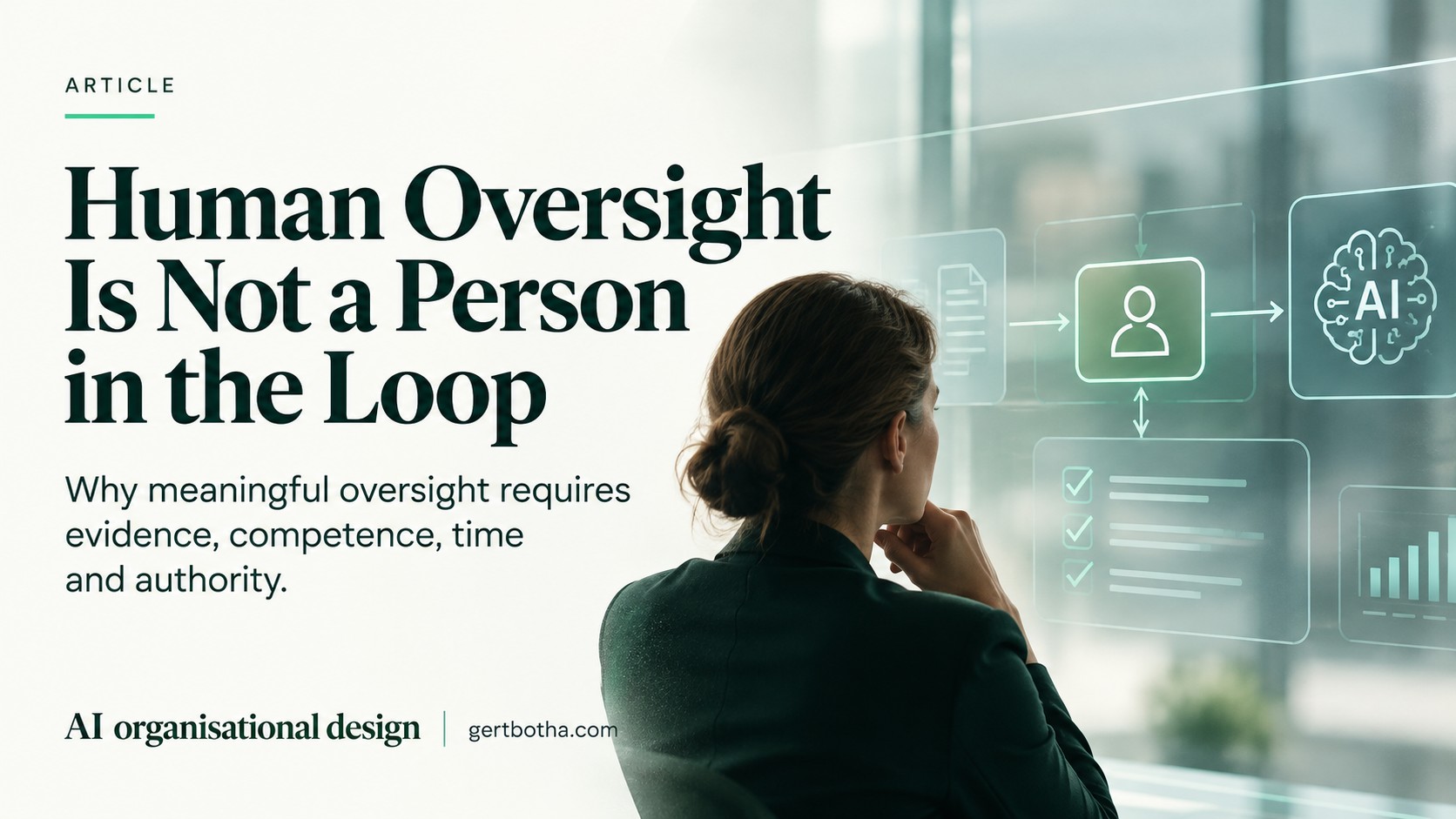
Why meaningful oversight requires evidence, competence, time and authority
“Human in the loop” has become one of the most reassuring phrases in AI governance.
It sounds sensible. A system may analyse, recommend or even act, but a person remains somewhere in the process. The implication is that human judgement can still catch mistakes, protect important interests, and keep automation within its proper boundaries.
Sometimes that is exactly what happens.
But simply placing a person in the workflow does not create meaningful oversight.
A reviewer who cannot see the relevant evidence cannot properly challenge the system. A person who does not understand the decision cannot judge it. Someone who sees the problem too late cannot intervene. And a reviewer without authority to change the action is not exercising oversight at all.
A simpler way to think about the problem: Meaningful human oversight requires evidence, competence, time, and authority.
If one of those conditions is missing, “human in the loop” can become little more than a comforting label.
The problem becomes easier to see when we separate the role from the capability.
Imagine an AI-enabled service that reviews hundreds of routine cases and sends a smaller number to an employee for approval. On the process diagram, the organisation can point to the human review stage and say that humans still make consequential decisions.
Now look more closely.
The reviewer sees the system’s recommendation and a confidence score, but not the evidence that produced it. The cases arrive continuously, and the employee is expected to clear each one within a few minutes. The system has already prepared the next action, and the performance target rewards throughput. Technically, the person can reject the recommendation, but doing so requires additional investigation that the role has neither the time nor the information to perform.
There is a person in the loop.
Whether there is meaningful human oversight is much less clear.
The distinction matters because the organisation may believe it has retained human judgement when, in practice, it has retained a human click.
A person cannot challenge an AI-generated answer if the system presents only the conclusion.
The reviewer needs enough information to understand why the recommendation has been made and what remains uncertain. That does not mean exposing every internal model parameter or overwhelming people with raw data. It means preserving the evidence that could legitimately change the decision.
The required evidence depends on the consequence.
For a low-value routine action, a concise summary may be sufficient. For a decision that changes a customer’s circumstances, interrupts production, or creates a significant obligation, the reviewer may need access to the underlying records, key exceptions, and the assumptions on which the recommendation depends.
A beautifully designed approval screen can still be poor oversight if it makes the recommendation obvious and the contradiction difficult to see.
The design question is therefore not simply whether the human sees the AI output. It is whether the human sees enough of the underlying reality to disagree intelligently.
Evidence only helps if the reviewer understands what it means.
Organisations sometimes treat human involvement as automatically safer because a person remains present. That overlooks a simple problem: the person may have less relevant expertise than the system they are expected to supervise.
This becomes particularly important as AI takes over more routine work. The Vanishing Layer problem appears again. If people no longer perform the activities through which they historically developed expertise, the organisation cannot assume that future reviewers will acquire the judgement required to challenge AI merely because their job description says they are responsible for oversight.
The capability has to be developed deliberately.
That may involve exposure to underlying cases, structured reviews of failures, simulations, rotations, mentoring, or deliberate access to work that automation would otherwise hide. AI itself may become part of that development, presenting counterfactuals and unusual cases that help people build a richer understanding faster than the old apprenticeship model allowed.
The key point is that oversight depends on the organisation's capability to produce.
A human presence does not create that capability on its own.
Even a competent reviewer with access to good evidence can become ineffective if the operating model gives them no time to use it.
This is easy to miss because time pressure often arrives through ordinary productivity expectations rather than an explicit governance decision.
A person may theoretically be able to investigate a recommendation, but if hundreds of cases arrive every hour and the performance measure rewards rapid clearance, the practical behaviour will be different. People learn to accept the system unless something is obviously wrong.
The review then becomes asymmetric. The AI recommendation gets the benefit of the doubt; challenging it requires additional effort.
Over time, the system can create its own credibility simply because the organisation has made disagreement expensive.
This is particularly dangerous when unusual cases are rare. Most recommendations may be perfectly reasonable, training reviewers to expect the next one will be too. The system's very success can reduce the attention available for the case in which human judgement matters most.
Meaningful oversight therefore has an operating cost.
If the organisation is unwilling to provide that capacity, it should be honest about the degree of human control it has actually retained.
The fourth condition is often the clearest.
Can the person change what will happen?
A reviewer may be able to raise a concern but not stop the action. They may be allowed to flag an exception while the automated workflow continues. They may identify a recurring defect but have no route to change the underlying rule, evidence source or delegated permission.
In those situations, the person may monitor the system without meaningful authority over it.
This is not always wrong. Monitoring has value, and not every observer should have permission to alter consequential systems. But the organisation should distinguish monitoring from oversight rather than treat them as the same.
Authority should also match the required type of intervention.
A frontline reviewer may need the ability to stop one transaction. A service owner may need authority to change the workflow. A policy owner may need to revise the rule that produces the problem. A technology team may control the model but not the business decision surrounding it.
The question is therefore not simply, “Who is the human in the loop?”
It is, “Who can change the action, and who can change the arrangement that produced it?”
Evidence, competence, time, and authority aren't independent boxes to tick.
They reinforce one another.
A highly competent person with no evidence is forced to guess. Presenting good evidence to someone without the relevant understanding creates false reassurance. Expertise and information are wasted if the reviewer sees the problem after the action has already become irreversible. And all three become ceremonial if nobody has the authority to intervene.
The strength of human oversight therefore depends on the weakest of the four conditions.
This is why adding a human approval step late in an AI project often disappoints. The organisation has inserted a person without designing the capability around them.
Meaningful oversight must be part of the operating model from the start.
There is another side to the argument. If every automated action requires intensive human review, the organisation may have designed the wrong form of automation.
The objective is not to place people between AI and every consequence. That can slow services without making them safer and consume scarce expertise on decisions that don't warrant it.
A better approach is to distinguish where human judgement adds material value.
Routine, reversible, and well-bounded activities may suit extensive automation with monitoring rather than case-by-case approval. More ambiguous or consequential decisions may require active human judgement. Conventional software may handle some work better because the rules are already clear. In other cases, retaining human work may be the most dependable and economical design.
Human oversight should therefore be purposeful, not universal.
The correct question is not how to keep a person in every loop. It is where human judgement is necessary, what that judgement needs, and how the organisation will make it effective.
The operating design is only part of the problem.
Human oversight also depends on whether people feel able to use it.
A reviewer may have evidence, expertise, time and formal authority while still learning that challenging the AI is unwelcome. If managers interpret disagreement as resistance, repeatedly celebrate automated throughput, or treat exceptions as adoption failures, the social environment can quietly narrow the space in which human judgement is exercised.
That makes leadership behaviour part of the control environment.
A leader who responds constructively to contradictory evidence strengthens the organisation’s ability to learn. A leader who dismisses inconvenient cases can weaken the same system even when every governance document says that human review remains available.
This is where AI-era leadership extends familiar leadership disciplines rather than replacing them. Listening, curiosity, judgement and psychological safety still matter. What changes is the object of the conversation: the evidence, permissions and automated actions through which the organisation now operates.
The strongest form of oversight does more than correct individual exceptions.
It helps the organisation learn.
If reviewers repeatedly override the same recommendation, that pattern should eventually change something. The evidence source may need correction. The model may require adjustment. The permission boundary may be too broad. The workflow may be asking AI to resolve a category of work that should remain human-led.
Without that return path, the organisation can become very good at catching failures while still producing them.
That is expensive oversight.
A mature design asks what repeated human intervention is telling the organisation about the underlying capability.
Sometimes the result will be that the AI becomes more autonomous because the causes of uncertainty have been removed. Sometimes the scope will narrow. Sometimes the organisation will redesign the surrounding process rather than the model itself.
The value lies in making human judgement consequential.
AI governance will keep using the phrase “human in the loop” because it is convenient shorthand.
The danger is allowing the shorthand to become the design. The presence of a person tells us very little about whether human judgement remains effective.
The more useful questions are concrete.
Those four conditions turn an abstract governance promise into something leaders can examine in the real operating model.
AI may increasingly perform the work, produce recommendations, and even execute actions. Where human judgement is still required, the organisation must do more than leave someone in the process.
It has to give that person the means to matter.
By Gert Botha
Keywords: Agentic AI, AI, AI Governance
Human Oversight Is Not a Person in the Loop Holistic Development: Why Performance Starts with the Whole Human
 The Most Dangerous Leader in the Room May Be the One Everyone Depends On
 What is that Analytical AI?
 Friday’s Leadership Reflection Quote – Saeculum Leadership Leaders Intervene Before Options Narrow