Nov17
A new and potentially very hazardous phase of cybersecurity is emerging. Traditional methods of safeguarding networks, systems, and vital infrastructure are being challenged by the convergence of artificial intelligence, increasingly interconnected digital infrastructure, cloud dependency, and sophisticated cyber adversaries.
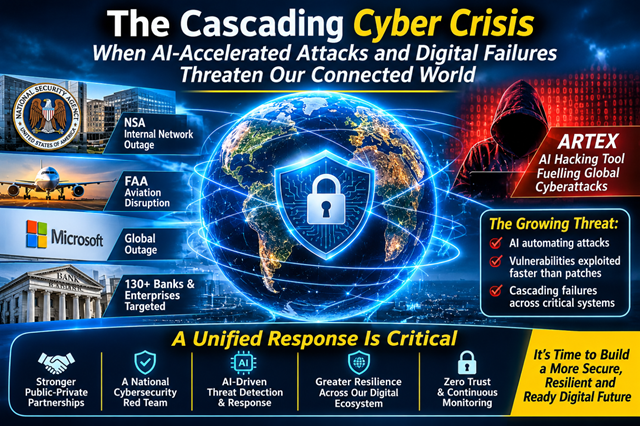
A sobering example can be found in recent events. According to reports, the classified internal communications network of the National Security Agency went down. In discussions of AI-enabled cyber intrusions, more than 130 banks and businesses have been mentioned; however, the exact number of confirmed victims must be separated from organizations that were targeted or exposed. A disruption in the telecommunications network caused the Federal Aviation Administration to implement a nationwide ground stop. Microsoft experienced a significant worldwide outage that affected Teams, Outlook, and other services, interfering with government and corporate communications.
There is no concrete proof yet linking these incidents to a single adversary or coordinated campaign, and they are not all cyberattacks. When taken as a whole, however, they reveal a more significant issue: our digital ecosystem is growing more interconnected, but its resilience is not keeping up with its complexity.
Additionally, there is a fundamental shift in the cybersecurity challenge. Malicious actors can now find vulnerabilities, automate reconnaissance, exploit weaknesses, escalate privileges, and move through compromised networks at previously unheard-of speeds thanks to artificial intelligence. On the other hand, legacy systems, disjointed security architectures, protracted patching cycles, legal requirements, and organizational silos frequently place limitations on defenders.
In my book Inside Cyber: How AI, 5G, IoT, and Quantum Computing Will Transform Privacy and Our Security, as well as in my articles on cybersecurity, national security, and emerging technologies in Forbes, GovConWire, Homeland Security Today, and LinkedIn, I have stressed that technological progress brings both opportunity and risk. This duality is especially important in light of the current AI revolution. We must transition from conventional cybersecurity tactics to a more cooperative, resilient, and anticipatory model of digital defense.
The disruptions in November 2026 should be taken seriously because they show how much modern society depends on the continuous operation of digital systems, not because they necessarily have a common cause. According to reports, NSA Net, the National Security Agency's internal classified communications network, went down on November 17. Within the intelligence agency, the network facilitates the sharing of classified information. According to early reports, there was no proof of a cyberattack, and some accounts suggested that software patching could be the reason. It will take some time to determine the exact circumstances and extent of the disruption.
It is that operational disruptions that impact the availability of mission-critical information can occur even in extremely sensitive government environments. In addition to preventing intrusions, maintaining the availability of critical communications in challenging circumstances is crucial to national security.
On November 13, there was yet another significant disruption to the aviation industry. After communications and radar feeds were impacted by instability in its telecommunications infrastructure, the FAA issued a nationwide ground stop. The FAA reports that 17 out of 22 Air Route Traffic Control Centers experienced instability as a result of excessive data traffic overwhelming parts of its legacy telecommunications network. Blocking the two potentially problematic sites, according to the agency, stabilized the network. The FAA made it clear that there was no evidence of a cyberattack.
Nevertheless, the incident serves as an example of the negative effects of reliance on outdated infrastructure and intricate telecommunications networks. Even a benign technical malfunction in aviation can have national repercussions.
Another example is Microsoft's November 12–13 worldwide Outlook and Teams outage. Businesses, governmental organizations, educational institutions, healthcare providers, and other organizations worldwide were impacted by the outage. According to Microsoft, neither an AI activity nor a cyberattack caused it. A latent software defect, increased load, and decreased server capacity were found to be contributing factors in later explanations.
These incidents highlight an important lesson: operational resilience and cybersecurity cannot be viewed as distinct fields. Even in the absence of malevolent intrusion, a system may still be susceptible to cascading operational failure. Availability is a security requirement in a world where financial transactions, government operations, healthcare, transportation, communications, and national security all rely more and more on linked digital platforms.
Please see: Quantum Resilience For The Skies: How To Fortify Aviation Communications Quantum Resilience For The Skies: How To Fortify Aviation Communications
Infrastructure failures draw attention to the dangers of system fragility, but the weaponization of AI is posing a more direct threat. Particularly noteworthy is the FBI's November 13, 2026, FLASH advisory regarding the ARTEX autonomous penetration testing framework. Malicious actors have been automating various stages of cyber intrusions, such as reconnaissance, vulnerability discovery, exploitation, privilege escalation, and data exfiltration, using the AI-driven framework since at least August, the bureau warned.
ARTEX is more than just another hacking tool. It demonstrates how AI agents can plan several offensive actions with little assistance from humans. In less than three hours, some intrusions went from initial targeting to privileged access, according to the FBI. Organizations in the financial services, government, defense, technology, healthcare, energy, and manufacturing sectors, among others, have been targeted by the framework.
Additional proof of the scope can be found in Microsoft's October study on the China-aligned threat actor Storm-0940. According to the company, ARTEX was used to speed up attacks against hundreds of organizations worldwide. Attackers tried to authenticate against over 2,250 downstream Microsoft 365 tenants in one campaign using a compromised third-party application. In a portion of the activity, Microsoft recorded over 151,000 unsuccessful sign-in attempts, along with proof of successful follow-on access in various customer settings.
Crucially, trying to gain access to thousands of tenants does not imply that thousands of organizations were successfully compromised. When determining the true impact, the distinction is important. The FBI also brought attention to attacks on South Korean financial institutions that allegedly compromised the personal data of about 67,000 people. Attacks involving over 90 organizations and millions of stolen records have been found by other investigations.
These advancements contribute to the explanation of why agentic AI is causing growing concern within the cybersecurity community. Conventional cyberattacks frequently required a significant amount of coordination, time, and human expertise. AI agents can now operate against several targets at once, quickly assess different strategies, and automate parts of the attack lifecycle. While the potential scope of attacks is growing, the barrier to entry is decreasing.
The issue is not that AI makes all attacks more effective or sophisticated. The reason is that AI enables adversaries to pursue more targets, carry out more experiments, and seize opportunities more quickly than many organizations can react. The threat environment has fundamentally changed as a result.
The decreasing time between vulnerability discovery and exploitation is one of the most detrimental effects of AI-enabled cyber operations. Patch management has been a challenge for cybersecurity experts for decades. Organizations must find vulnerabilities, evaluate their seriousness, ascertain whether systems are vulnerable, test patches, secure approvals, and implement updates without interfering with daily operations. Days, weeks, or even months may pass during that process, especially in large businesses and critical infrastructure settings. The attack timeline is being compressed by AI.
Automated tools can quickly attempt privilege escalation, test exploit paths, find vulnerabilities, and scan exposed systems. Adversaries may also use AI agents to find neglected systems, improperly set up cloud environments, shoddy authentication procedures, and weak third-party integrations.
As a result, the environment becomes more asymmetrical: while defenders still need to coordinate operational approvals, technical remediation, and human decision-making, attackers can automate discovery and exploitation across numerous targets. This leads to a risky mismatch.
Under conventional threat assumptions, a vulnerability that is left unpatched for a few weeks might be considered a manageable risk. It might become an instant exposure in an AI-accelerated setting. More patches cannot be the only solution. Businesses need to reconsider vulnerability management as an ongoing endeavor.
Automated asset inventories, real-time threat intelligence, exposure management, risk-based patch prioritization, and AI-assisted vulnerability discovery ought to become standard procedures. Exploitability and operational impact should be taken into consideration when addressing critical vulnerabilities rather than just software update availability. Additionally, some systems won't be able to be swiftly patched. Before updates can be implemented, a lot of testing may be necessary for industrial control systems, aviation infrastructure, medical devices, and legacy government platforms.
Compensating controls, such as network segmentation, application allowlisting, privileged access restrictions, improved monitoring, isolation of vulnerable systems, and tried-and-true manual recovery procedures, become crucial for these environments. We must build systems to resist attempts at exploitation and acknowledge that some vulnerabilities will always be present.
The vulnerability of interconnected supply chains is another long-standing cybersecurity concern that is highlighted by the ARTEX incidents. Businesses rely more and more on third-party apps, cloud platforms, identity services, managed service providers, and external software providers. Access to hundreds or thousands of downstream clients may be made possible by the compromise of a single reliable supplier.
In cloud environments, where application identities, OAuth permissions, APIs, and delegated privileges can create pathways into multiple organizations, this is especially problematic. In essence, the conventional perimeter has vanished. The integrity of a complicated ecosystem of suppliers, partners, apps, devices, and identities now determines security. The exploitation of these connections can be accelerated by AI.
Organizations must assess the security posture of the businesses and technologies they rely on, as well as their own vulnerabilities. Cybersecurity programs must incorporate software bills of materials, secure software development, ongoing third-party risk assessments, application identity governance, and strict access controls. In this context, zero trust is becoming more and more crucial. Just because a user, application, device, or service has been approved in the past does not mean that it should be implicitly trusted. Trust needs to be assessed on a regular basis.
The fact that no single government organization, business, or cybersecurity supplier can independently protect the global digital ecosystem is perhaps the most significant lesson to be learned from these developments. A large portion of the infrastructure supporting contemporary society is owned and run by the private sector. Government organizations have access to intelligence, resources for national security, law enforcement, and sophisticated adversaries. The platforms, software, and tools that are becoming more and more essential to digital operations are created by technology companies. Better integration of these capabilities is required.
Public-private cybersecurity partnerships, such as CISA's Joint Cyber Defense Collaborative, sector risk management organizations, information sharing and analysis centers, and FBI industry partnerships, have helped the United States make significant strides. But the speed at which AI-enabled threats are emerging necessitates a more operational and ongoing model of cooperation.
We should think about establishing a National Public-Private Cybersecurity Red Team, which would be a permanent government-industry alliance tasked with identifying, testing, and mitigating new threats before they cause significant harm. Leading cybersecurity firms, cloud and technology providers, financial institutions, telecom companies, owners of critical infrastructure, academic researchers, federal agencies, and national security specialists could all participate in such an endeavor. Its goal would be to carry out ongoing, authorized adversarial testing of the infrastructure and technologies that the country relies on.
First, adversarial testing powered by AI. To find weaknesses, test defensive measures, and model new attack methods before malevolent actors take advantage of them, use sophisticated AI tools and agentic systems.
Second. Stress testing of critical infrastructure. To find cascading dependencies and systemic flaws, conduct coordinated exercises involving telecommunications, energy, financial services, transportation, healthcare, government networks, and cloud providers.
Third. quick reaction to vulnerabilities. Create systems for coordinating disclosure, verifying vulnerabilities, exchanging actionable intelligence, and expediting mitigation across impacted sectors.
Fourth. Identity security and supply chain evaluations. Software providers, cloud apps, APIs, authentication systems, and third-party access relationships should all be tested for resilience.
Fifth. Planning for recovery and joint incident exercises. To assess national and enterprise response capabilities, simulate simultaneous disruptions involving ransomware, cloud outages, telecommunications failures, cyber intrusions, and AI-enabled attacks.
This shouldn't turn into yet another reporting exercise or bureaucratic committee. It should be an operational capability with quantifiable goals, technical know-how, and the power to carry out meticulously regulated testing. Clear legal authorities, privacy safeguards, independent oversight, liability protections, and stringent rules of engagement would all be necessary. Testing needs to be approved, carried out in production settings or controlled environments, and planned to prevent interference with critical services. Establishing a trustworthy environment where business and government can collaborate at the speed of the threat should be the aim.
Organizations must reconsider the foundations of digital resilience in addition to collaboration. A number of priorities need to be addressed right away.
First. Transition to predictive defense from reactive cybersecurity. AI should be used to prioritize vulnerabilities, detect unusual behavior, predict attack routes, and automate defensive actions. AI-augmented capabilities that can react at machine speed while retaining human oversight for critical decisions must be the future of security operations centers.
Second. Prioritize resilience for national security. Operators of critical infrastructure must prepare for multiple systems to experience simultaneous disruptions. Planning for national resilience should include redundant communications, geographically dispersed backup capabilities, alternative cloud environments, and tried-and-true manual operating procedures.
Third. Protect the AI agents themselves. Organizations must control the access, modification, and execution of autonomous AI agents. Sandboxing, transaction-level authorization, least-privilege permissions, robust identity controls, and ongoing behavioral monitoring are all essential. Just because an AI agent is working in a trusted enterprise setting doesn't mean it should have unlimited power.
Fourth. Boost ongoing vulnerability management. The conventional yearly vulnerability assessment and penetration test are no longer adequate. Continuous testing, automated exposure detection, threat-informed patch prioritization, and quick isolation capabilities are all necessary for organizations.
Fifth. Defend the digital infrastructure that underlies it. The digital economy is based on telecommunications networks, power systems, cloud platforms, underwater cables, data centers, and satellite communications. Their dependability and security must be viewed as related national priorities.
Sixth. Get ready for the threats of the future. The threat landscape will become more complex due to quantum computing, advanced AI, autonomous systems, and increasingly complex cyberweapons. Businesses need to make investments in advanced cyber workforce capabilities, secure AI development, post-quantum readiness, and cryptographic agility.
The competition between digital innovation and resilience. The digital ecosystem is evolving into the modern world's nervous system. It links almost every facet of economic activity, including financial markets, transportation, healthcare, energy, communications, and national security. Although there are many opportunities brought about by this connectivity, there are also systemic vulnerabilities.
The recent disruptions involving Microsoft, financial institutions, the FAA, and the NSA should be seen as cautions about the vulnerability of interconnected infrastructure. Some were not cyberattacks but rather technical malfunctions. Others show how adversaries are increasingly able to use AI to speed up cross-organizational intrusions. When taken as a whole, they show why resilience needs to take precedence over prevention.
The challenge is especially urgent with the advent of tools like ARTEX. AI is altering the speed and economics of cyberwarfare. Attacks can be automated across several targets, vulnerabilities can be found and exploited more quickly, and the effects of compromised identities and trusted third parties can spread rapidly. It is unrealistic to expect isolated public-private initiatives, disjointed security operations, and conventional patching schedules to keep up with this environment.
A new paradigm for cybersecurity is required, one that is built on shared intelligence, automated response, resilient infrastructure, ongoing defense, and sincere cooperation between the public and private sectors. A National Public-Private Cybersecurity Red Team is an idea that merits careful thought. It may be possible to find systemic flaws before adversaries take advantage of them by combining the resources of the government, tech firms, cybersecurity providers, and critical infrastructure operators.
In the end, cybersecurity is no longer solely an IT or business risk management concern. It is essential for societal resilience, national security, and economic security. Attackers and defenders won't be the only players in the pivotal cybersecurity battle of the AI era. It will depend on how quickly adversaries can take advantage of our digital dependencies and how fast we can all work together to recognize, stop, and lessen those risks. Now is the moment to construct that collective defense.

By Chuck Brooks
Keywords: AI, Cybersecurity, National Security
The Cascading Cyber Crisis: When AI-Accelerated Attacks and Digital Failures Threaten Our Connected World Sua empresa tem processos que geram valor ou apenas fluxogramas bem desenhados?
 Coaching that raises capability compounds results beyond your span
 The Trenches and the Castle: When Leadership Chooses Approval Over Loyalty
 Strategy When the Market Looks Like It Has Lost Its Mind