
Nov16
In 2008, researchers began an experiment with textile manufacturers in India. Selected weaving plants received hands-on help to improve how they tracked defects, managed inventory and organised production. When the researchers returned nine years later, they found that the original plants had dropped about half the practices they had adopted. Yet many of those practices had travelled to other plants owned by the same firms, including sites that never received the original intervention. (1)
That was a management experiment, and it poses a useful question for anyone who coaches from the middle. What would it take for a skill you build with one person to show up in a team you’ve never managed?
A team leader brings you a handover problem. You know the answer, and it would take 30 seconds to give it. Sometimes that’s the right call. But when the same problem keeps coming back, spend a few minutes asking what the incoming team needed, where the information was lost and what the leader could change on the next shift. Now you’re helping them develop a way to diagnose the next handover problem themselves. Herminia Ibarra and Anne Scoular describe this shift in how managers lead in The Leader as Coach. (2)
The quality of that conversation matters. In a study of 1,246 pharmaceutical sales representatives across 136 teams, Jason Dahling, Samantha Ritchie Taylor, Samantha Chau and Stephen Dwight found that managers’ coaching skill was associated with better sales goal attainment. Where coaching skill was low, more frequent coaching was associated with worse attainment. Before you add another coaching session to the calendar, listen to how the current ones are going. (3)
I use this five-rung ladder to help middle managers build a skill, teach others to coach it and give it a route into neighbouring teams.
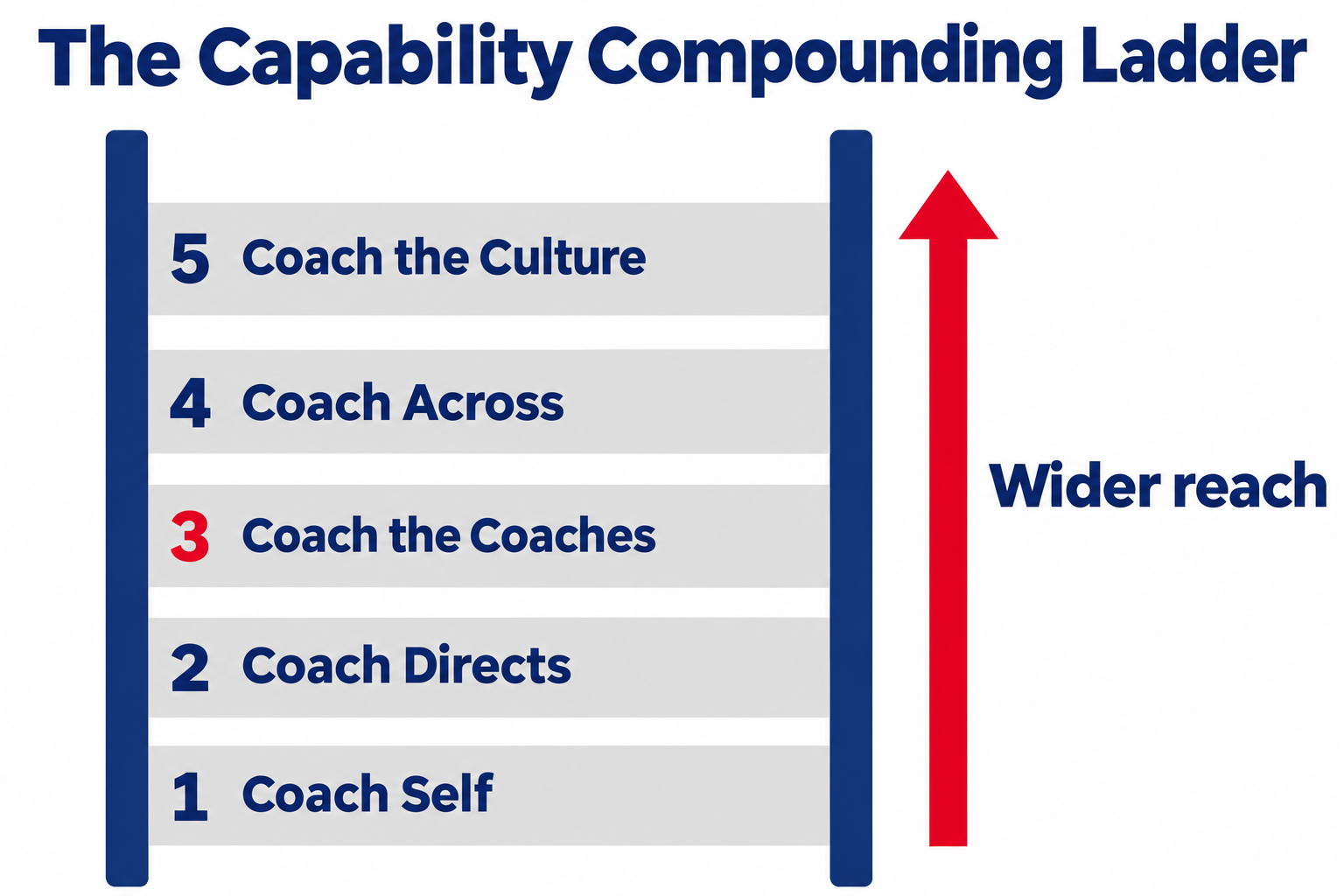
Coach Self. Notice when you jump in with an answer. In your next one-to-one, ask a genuine question and give the person time to think.
Coach Directs. Use fortnightly one-to-ones to work on one skill. Ask what outcome the person wants, what’s happening now, what options they see and what they’ll try before you meet again.
Coach the Coaches. Ask a team leader to practise that conversation with someone on their team. With everyone’s agreement, observe it and debrief which question helped the person think through their options.
Coach Across. Invite a leader from a neighbouring team to bring a similar problem. Compare approaches, then ask them to try the practice and report back on what worked in their setting.
Coach the Culture. Build the practice into onboarding, team routines and recognition. Give new leaders a chance to demonstrate how they coach it during their first month.
The last two rungs give the skill a chance to outlast the person who introduced it. Ashley Hughes, Stephanie Zajac, Amanda Woods and Eduardo Salas found in a meta-analysis that support from peers, supervisors and the organisation was positively associated with people applying their training at work and continuing to use it over time. (4)
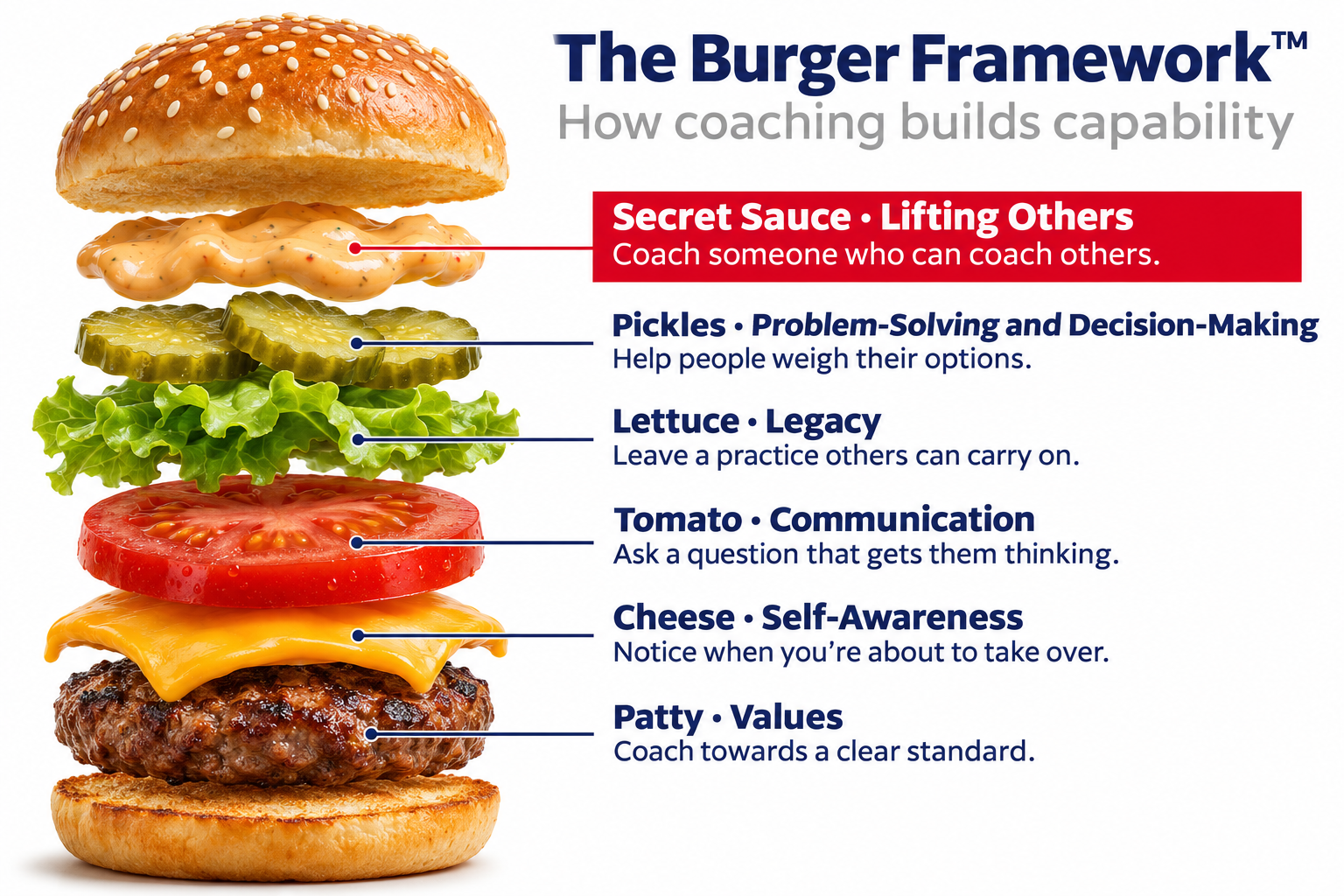
The secret sauce is lifting others.
In the Burger Framework™, values are the patty. They tell you what standard you’re coaching towards. Self-awareness is the cheese that helps you notice your urge to take over. Communication is the tomato, and a juicy question can do more for someone’s thinking than a five-minute lecture. Legacy is the lettuce, the practice you leave behind. Problem-solving and decision-making are the pickles, sharpening how people weigh their options. The secret sauce is lifting others. You know it’s working when someone you coached helps another person work through a similar decision.
Pick a recurring issue this quarter, such as incomplete handovers. Agree with a team leader what a good handover looks like, then practise coaching it using a real example. Ask them to try the same conversation with someone on their team. When it’s working in that team, invite a neighbouring team to test it.
Review three things each month. Can people demonstrate the skill on a real handover? Who else is now coaching it? Are missing details sending fewer jobs back for rework? The first two tell you whether the skill is taking hold and travelling. The third tells you whether the outcome you care about is moving.
Your span of control tells you who reports to you. The reach of your coaching shows up in who can teach the skill next.
...
Source:
Bloom, N., Mahajan, A., McKenzie, D., & Roberts, J. (2020). Do Management Interventions Last? Evidence from India. American Economic Journal: Applied Economics, 12(2), 198–219. The follow-up study behind the opening story about management practices spreading between textile plants. https://doi.org/10.1257/app.20180369
Ibarra, H., & Scoular, A. (2019). The Leader as Coach. Harvard Business Review, November–December 2019. The article behind the shift from giving answers to helping people develop their own thinking. https://hbr.org/2019/11/the-leader-as-coach
Dahling, J. J., Taylor, S. R., Chau, S. L., & Dwight, S. A. (2016). Does Coaching Matter? A Multilevel Model Linking Managerial Coaching Skill and Frequency to Sales Goal Attainment. Personnel Psychology, 69(4), 863–894. The study linking managers’ coaching skill and frequency to sales goal attainment. https://doi.org/10.1111/peps.12123
Hughes, A. M., Zajac, S., Woods, A. L., & Salas, E. (2020). The Role of Work Environment in Training Sustainment: A Meta-Analysis. Human Factors, 62(1), 166–183. The research on how support from peers, supervisors and the organisation helps people apply and sustain what they learn. https://doi.org/10.1177/0018720819845988
Keywords: Leadership, Management
Coaching that raises capability compounds results beyond your span The Trenches and the Castle: When Leadership Chooses Approval Over Loyalty
 Strategy When the Market Looks Like It Has Lost Its Mind
 The State of Healthcare Recruiting in 2027: Five Numbers Every Hospital Leader Should Know
 Telling AI stories