Oct23
FLRQ221 | Leadership Learning
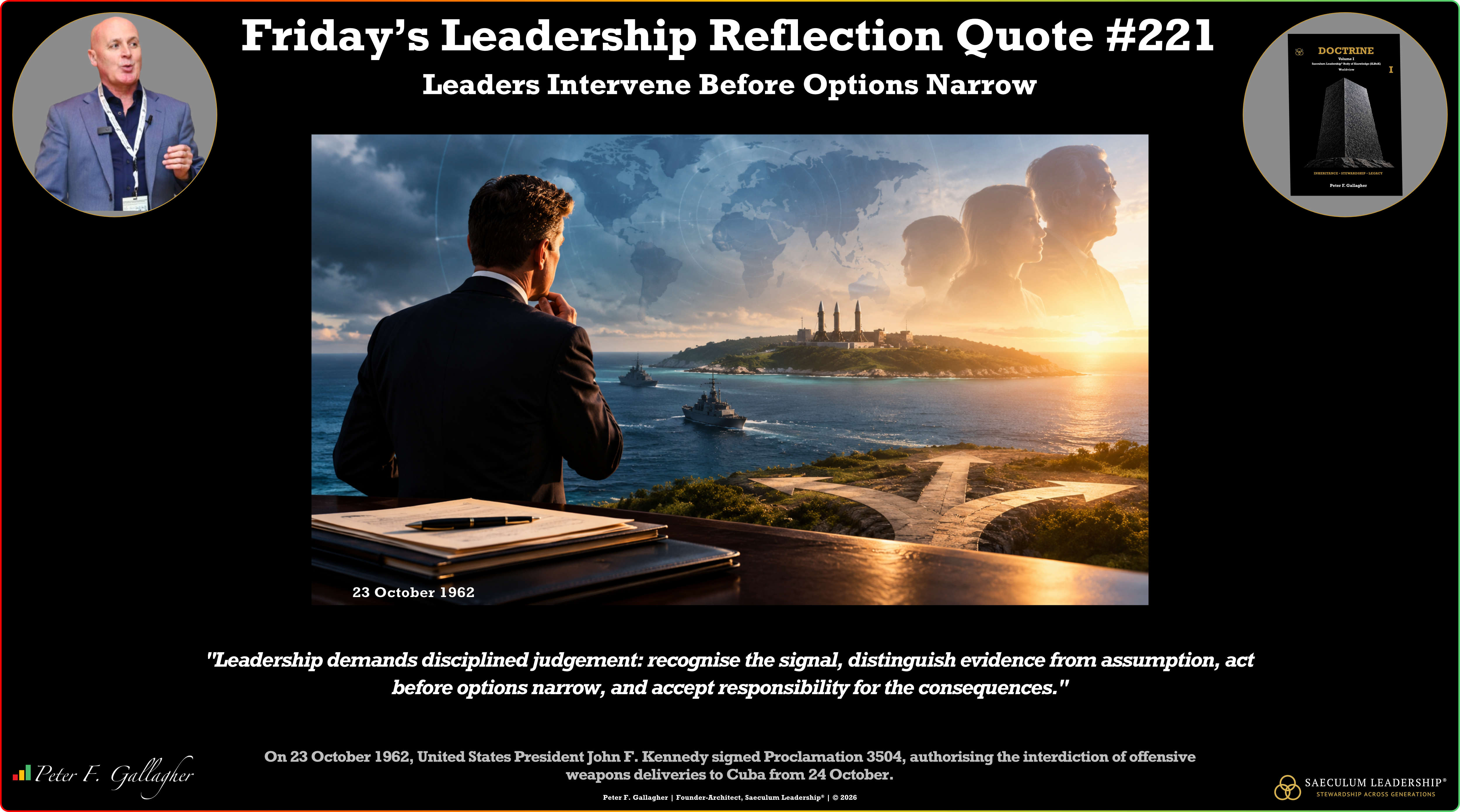
On 23 October 1962, United States President John F. Kennedy signed Proclamation 3504, authorising the interdiction of offensive weapons deliveries to Cuba from 24 October. Following the discovery of Soviet missile installations on the island and the public announcement of a naval quarantine, the proclamation converted policy into executable authority with immediate international consequences.
Following Kennedy’s address on 22 October, the proclamation specified prohibited military material and empowered the Secretary of Defence to enforce the quarantine. The Organisation of American States had endorsed collective measures the previous day, strengthening the regional diplomatic basis for action. The response therefore combined executive authority, defined operational measures and international support.
The evidence did not dictate a single response. Leaders had to evaluate intelligence, test competing interpretations, compare strategic alternatives and weigh diplomatic consequences. Knowledge Architecture provides the discipline for connecting evidence, expertise, options and decision rights to informed judgement and legitimate authority. Its purpose is not to eliminate uncertainty, but to establish the strongest defensible basis for action.
The decision illustrates a central discipline of leadership under uncertainty: action and inaction both carry consequences. Delay can change the strategic situation, diminish the available alternatives and transfer control of events to others. Beyond a certain threshold, postponement is no longer neutral; it actively shapes the outcome.
The significance of 23 October lies in the transition from declared intention to authorised action. Vision established the strategic purpose; assessment and consultation informed the choice; Proclamation 3504 translated the decision into operational authority. Intervene becomes the decisive responsibility when the evidence warrants action and delay threatens to narrow the choices still available. Vision and Model inform intervention; they do not substitute for it.
The Saeculum Leadership® Signal emerges when the cost of waiting may begin to exceed the risk of acting. It is a judgement threshold, not a guarantee of the right outcome: evidence must be sufficient to justify a decision, even when uncertainty remains. Stewardship requires leaders to recognise when delay is eroding viable options, act proportionately and accept responsibility for consequences that may extend beyond their tenure.
Saeculum Leadership® Lessons: Saeculum leaders recognise emerging signals and diagnose when the consequences of delay may begin to outweigh the risks of intervention. They distinguish verified evidence from interpretation, test competing assessments and acknowledge uncertainty without allowing it to become an excuse for indecision. Saeculum leaders connect intelligence, expertise, strategic alternatives and decision-making authority to establish a coherent basis for responsible action. They intervene when the evidence warrants a decision, translating strategic intent into executable action before viable options become unnecessarily constrained. Saeculum leaders accept responsibility for the immediate and long-term consequences of their decisions, recognising that leadership is temporary but its consequences are not. Leaders Intervene Before Options Narrow.
“Leadership demands disciplined judgement: recognise the signal, distinguish evidence from assumption, act before options narrow, and accept responsibility for the consequences.”
From the Canon — Practice 5 — System Stewardship: System Stewardship recognises that leaders are custodians of systems whose consequences extend beyond their own tenure. Their responsibility is not simply to preserve stability, but to protect the system's long-term viability, purpose and capacity to serve future stakeholders.
This requires disciplined assessment of emerging risks, proportionate intervention and the preservation of strategic flexibility. Leaders must distinguish between protecting a system's essential integrity and allowing established arrangements to persist when they threaten its future. Neither action nor inaction is inherently responsible; judgement depends on the evidence, the alternatives available and the consequences for those who inherit the outcome.
System Stewardship does not promise certainty or guarantee success. It demands accountability for the choices made, the risks accepted and the options preserved or surrendered. Its ultimate test is whether the system entrusted to the leader remains resilient, purposeful and capable of meeting its responsibilities beyond the leader's tenure.
The Stewardship Reflection Lens:
What are we inheriting? Which inherited risks, assumptions or unresolved decisions could threaten the system's long-term viability if left unexamined?
How should we steward it? What evidence, authority and alternatives do we need to make a proportionate decision while preserving the greatest viable range of future choices?
What legacy are we creating? Will those who inherit this system receive stronger institutions and greater capacity to act, or constraints and unresolved risks created by our decisions and omissions?
INHERITANCE • STEWARDSHIP • LEGACY
Further Reading: Saeculum Leadership® Body of Knowledge (SLBoK); Saeculum Leadership®: Doctrine — Volume I.
Peter F. Gallagher is the Founder–Architect of Saeculum Leadership®, a doctrine of generational stewardship that equips leaders to strengthen what they inherit and shape what future generations receive. A 22-book author, global keynote speaker and adviser to boards, CEOs and senior leadership teams, he brings more than four decades of international experience to the challenges of leadership, institutional responsibility and transformational change. His work focuses on strengthening the quality of leadership judgement and the capacity of institutions to steward their responsibilities across generations.
For further insights into Saeculum Leadership®, institutional stewardship and leadership across generations, please contact Peter F. Gallagher at Peter.gallagher@a2B.consulting.
For further insights please visit our websites: https://www.a2b.consulting https://www.peterfgallagher.com Amazon.com: Peter F Gallagher: Books, Biography, Blog, Audiobooks, Kindle
Saeculum Leadership® Body of Knowledge (SLBoK): Volumes 1-10.A-E & 0, I-VI
~ Leadership of Change® Volume 1 - Change Management Fables
~ Leadership of Change® Volume 2 - Change Management Pocket Guide
~ Leadership of Change® Volume 3 - Change Management Handbook
~ Leadership of Change® Volume 4 - Change Management Leadership
~ Leadership of Change® Volume 5 - Change Management Adoption
~ Leadership of Change® Volume 6 - Change Management Behaviour
~ Leadership of Change® Volume 7 - Change Management Sponsorship
~ Leadership of Change® Volume 8 - Change Management Charade
~ Leadership of Change® Volume 9 - Change Management Insanity
~ Leadership of Change® Volume 10 - Change Management Dilenttante
~ Leadership of Change® Volume A - Change Management Gamification - Leadership
~ Leadership of Change® Volume B - Change Management Gamification - Adoption
Keywords: Leadership, Change Management, Business Strategy
Friday’s Leadership Reflection Quote – Saeculum Leadership Leaders Intervene Before Options Narrow The Corix Partners Friday Reading List - October 23, 2026
 RIFLESSIONE SU AI, TECNOLOGIA E PERSONE
 2027 Predictions for Cybersecurity: The Agent Is the New Insider
 FROM THE AISLE Field Notes on AI Implementation