Oct30
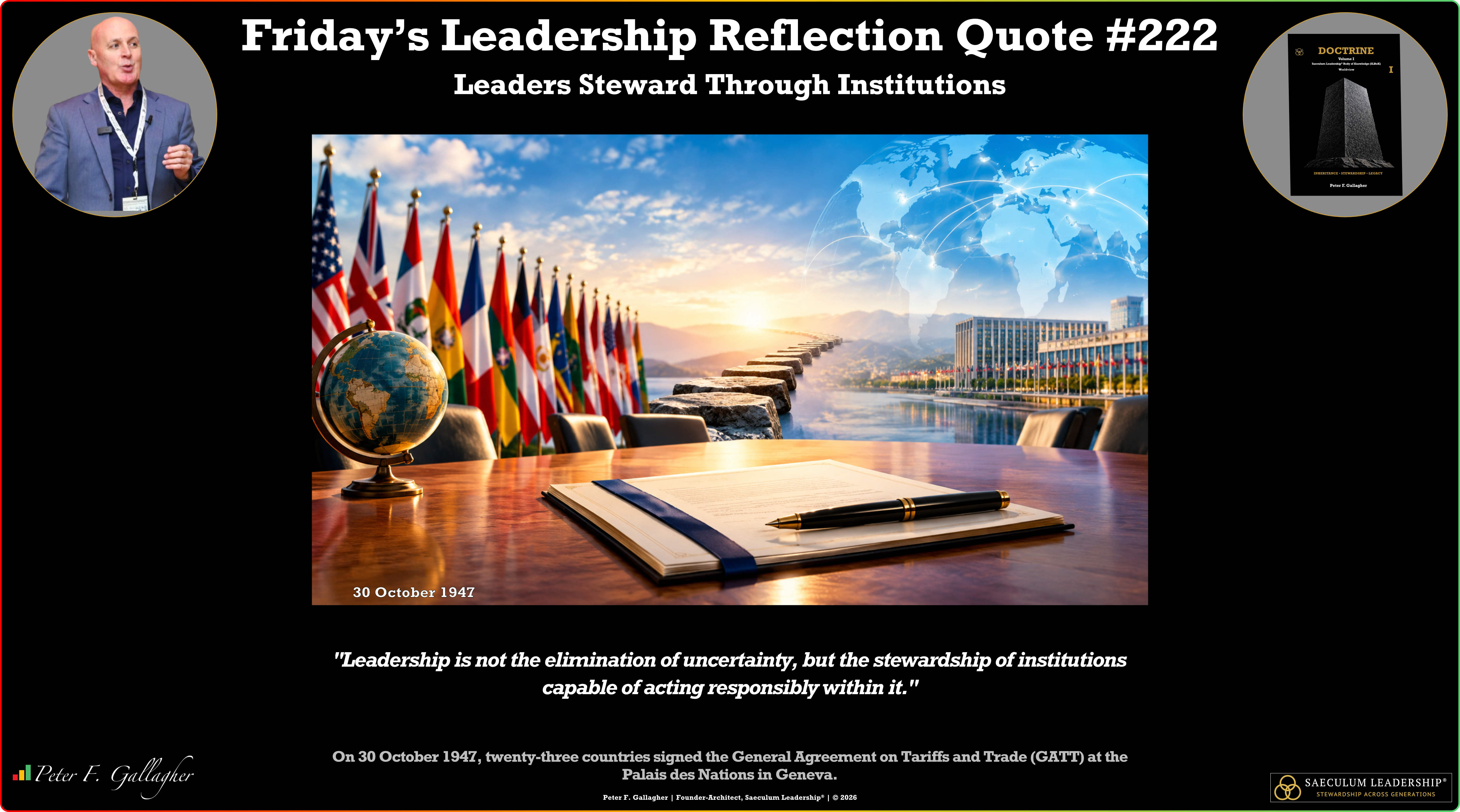
On 30 October 1947, twenty-three countries signed the General Agreement on Tariffs and Trade (GATT) at the Palais des Nations in Geneva. Intended initially as an interim arrangement, GATT entered into force on 1 January 1948 and became the principal framework governing much of international trade for nearly half a century, before the World Trade Organisation (WTO) was established in 1995.
Emerging from the economic devastation of the Second World War and the protectionism of the preceding decades, GATT addressed a fundamental institutional weakness: governments could pursue national commercial interests in ways that undermined international economic stability. Rebuilding trade therefore required more than bilateral agreements. It required common rules through which nations could negotiate commitments, constrain arbitrary restrictions and establish a basis for sustained cooperation.
The negotiations produced approximately 45,000 tariff concessions affecting US$10 billion of trade, around one-fifth of the world total. The agreement also established rules intended to protect those concessions from being undermined by restrictive trade measures. Its twenty-three original signatories included both industrialised and developing economies. The achievement was therefore not simply a reduction in tariffs, but the establishment of common commitments around which further cooperation could develop.
GATT was intended as an interim arrangement pending the creation of the International Trade Organisation (ITO). When the ITO failed to come into existence because its charter was not ratified, GATT remained the principal framework governing international trade. An arrangement designed to bridge an institutional gap therefore became the foundation for decades of international economic cooperation. Its longevity illustrates how a workable framework can acquire enduring significance when the institution originally envisaged never materialises.
Over the following decades, successive negotiating rounds expanded participation and extended the scope of international trade rules. The establishment of the World Trade Organisation in 1995 marked a major institutional development, building on GATT while creating a broader framework for multilateral trade cooperation. The original agreement had therefore provided a platform for institutional development far beyond its initial purpose.
The historical significance lies in the decision to establish common rules without waiting for the wider architecture of international economic governance to be completed. The signatories could not guarantee the future institutional settlement, but they could establish an arrangement that addressed an immediate problem and created a basis for further negotiation. The subsequent history of GATT demonstrates that an incomplete institutional solution can become consequential when it provides a workable foundation for adaptation and development.
The leadership lesson is not that uncertainty should be ignored, but that it must not become an excuse for institutional paralysis. Leaders must distinguish evidence from interpretation, assess the consequences of delay and determine what can responsibly be established before the full picture emerges.
The GATT represents a Saeculum Leadership® Signal because the signatories acted on this distinction. They did not eliminate uncertainty or complete the architecture of international economic governance. They established a workable institutional framework through which uncertainty could be managed and cooperation developed. Intervene is the strongest Leadership Responsibility because the decisive act was converting an identified international problem into an operative arrangement. Visionsupplied the direction; Model supplied the rules through which cooperation could be organised; Intervene translated intent into institutional reality.
Saeculum Leadership® Lessons: The signatories inherited a fragmented international trading environment shaped by depression, war and protectionism. The significance of this decision extends beyond international trade and offers a broader lesson about leadership under conditions of uncertainty. Saeculum leaders diagnose institutional fragility when inherited structures and practices become inadequate to address emerging economic, geopolitical and technological realities. They distinguish evidence from interpretation, assess the limits of available knowledge and establish a defensible understanding of the circumstances before determining what action the evidence can support. Saeculum leaders mobilise the people, knowledge, resources and decision-making authority required to establish a shared direction, align competing interests and create the conditions for coordinated institutional action. They execute decisions through disciplined intervention, translating strategic intent into workable institutional arrangements before uncertainty, delay or institutional inertia allows the available choices to diminish. Saeculum leaders exercise stewardship by architecting institutions, capabilities and knowledge frameworks that preserve essential purpose whilst enabling adaptation, ensuring that future generations inherit stronger systems and greater capacity to respond to circumstances the original decision-makers could not foresee. Leaders Steward Through Institutions.
“Leadership is not the elimination of uncertainty, but the stewardship of institutions capable of acting responsibly within it.”
From the Canon — Practice 5 — System Stewardship: System Stewardship recognises that leaders inherit systems they did not create, yet remain responsible for the conditions they pass to those who follow. Their responsibility extends beyond managing immediate pressures to establishing the frameworks, rules, capabilities and governance arrangements through which institutions can operate effectively and respond to changing circumstances.
This requires disciplined judgement under uncertainty. Leaders must distinguish evidence from interpretation, recognise the limits of available knowledge and intervene when delay threatens institutional viability. They must also ensure that decisions are translated into arrangements that can function beyond the immediate circumstances that prompted them.
The objective is not permanence, but continuity of purpose through adaptation. Institutions must be capable of learning and evolving without losing the principles that justify their existence. The ultimate test of System Stewardship is whether future generations inherit institutions that are stronger, more resilient and better equipped to fulfil their responsibilities. Leadership legacy is therefore measured not only by the decisions leaders make, but by the institutional capabilities those decisions leave behind.
The Stewardship Reflection Lens:
What are we inheriting? Which institutional weaknesses, competing interests or unresolved problems have been left for us to address?
How should we steward it? What institutional framework, capability or governance arrangement must we establish or strengthen now to enable cooperation and adaptation despite uncertainty?
What legacy are we creating? Will future generations inherit greater freedom to act, or greater constraints because we failed to steward what was entrusted to us?
For further insights into Saeculum Leadership®, institutional stewardship and leadership across generations, please contact Peter F. Gallagher at Peter.gallagher@a2B.consulting.
For further insights please visit our websites: https://www.a2b.consulting https://www.peterfgallagher.com Amazon.com: Peter F Gallagher: Books, Biography, Blog, Audiobooks, Kindle
Saeculum Leadership® Body of Knowledge (SLBoK): Volumes 1-10.A-E & 0, I-VI
~ Leadership of Change® Volume 1 - Change Management Fables
~ Leadership of Change® Volume 2 - Change Management Pocket Guide
~ Leadership of Change® Volume 3 - Change Management Handbook
~ Leadership of Change® Volume 4 - Change Management Leadership
~ Leadership of Change® Volume 5 - Change Management Adoption
~ Leadership of Change® Volume 6 - Change Management Behaviour
~ Leadership of Change® Volume 7 - Change Management Sponsorship
~ Leadership of Change® Volume 8 - Change Management Charade
~ Leadership of Change® Volume 9 - Change Management Insanity
~ Leadership of Change® Volume 10 - Change Management Dilenttante
~ Leadership of Change® Volume A - Change Management Gamification - Leadership
~ Leadership of Change® Volume B - Change Management Gamification - Adoption
Keywords: Business Strategy, Change Management, Leadership
Friday’s Leadership Reflection Quote – Saeculum Leadership: Leaders Steward Through Institutions The Corix Partners Friday Reading List - October 30, 2026
 Quando muita gente se perde no caminho, talvez o problema não esteja em quem está caminhando.
 The Empty Chair: a powerful practice in leadership, coaching and self-reflection
 Human Oversight Is Not a Person in the Loop