Nov20
FLRQ225 | Leadership Learning: If one generation establishes the architecture, what responsibility do future generations have to strengthen and extend it?
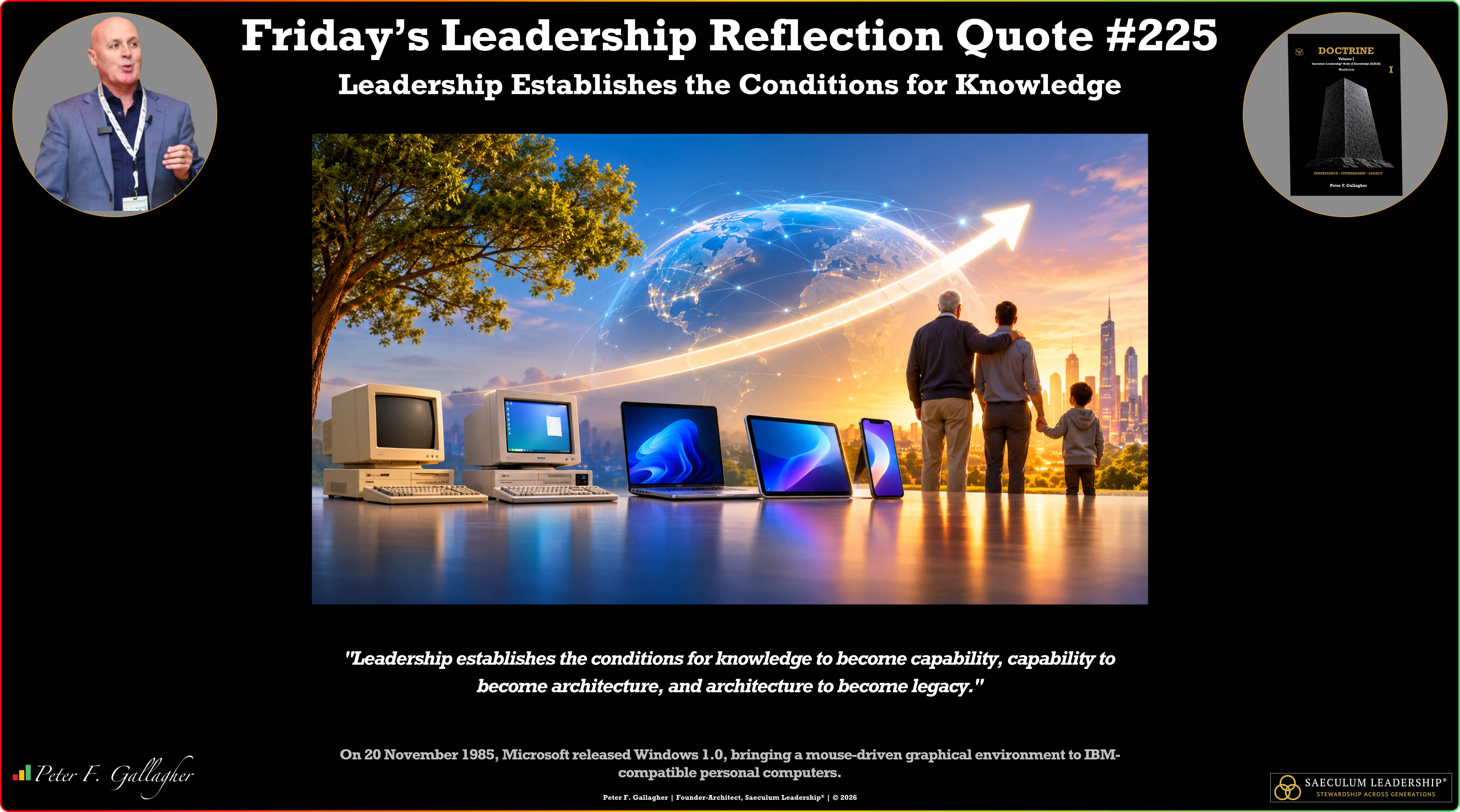
On 20 November 1985, Microsoft released Windows 1.0, bringing a mouse-driven graphical environment to IBM-compatible personal computers. Operating alongside MS-DOS, it offered users an alternative to interacting exclusively through typed commands, introducing menus, a mouse-controlled interface and tiled application windows. Although graphical computing had already developed through earlier research and competing systems, Windows represented an important step in extending this approach within the expanding personal computer market.
Microsoft had announced the project in November 1983, initially presenting Windows as a graphical extension to MS-DOS. Its development took longer than anticipated, reflecting the technical complexity of creating an environment capable of operating alongside existing software and hardware. Released in 1985, Windows 1.0 provided device-independent graphics and cooperative multitasking for Windows applications, establishing an environment through which users could interact with applications without repeatedly closing and restarting them.
The first version included practical applications such as Paint, Notepad, Calculator, Windows Write and Calendar. Although its capabilities were limited by contemporary hardware and its initial market adoption was modest, its significance extended beyond the immediate product. It established an environment that Microsoft could develop, refine and expand through subsequent generations of Windows, creating opportunities for increasingly sophisticated applications and capabilities.
This distinction is historically important. Windows 1.0 did not immediately transform personal computing, nor did its initial release establish the eventual dominance of the Windows platform. Its early limitations, modest market adoption and subsequent development demonstrate that the significance of an emerging architecture cannot always be measured by its initial performance. Its longer-term influence emerged through successive improvements, expanding software compatibility, hardware development and the contributions of a growing ecosystem of developers and users.
From a Saeculum Leadership® perspective, the significance extends beyond the release of a new product. Microsoft's decision to develop a graphical computing environment established an alternative architecture for how people could interact with information, applications and computer systems. Although the original platform was limited, it created conditions through which subsequent generations of developers, organisations and users could extend its capabilities beyond what its original architects could fully anticipate.
The event illustrates an important principle of generational stewardship: the value of an architecture is not determined solely by what its creators initially deliver, but also by what subsequent generations are able to inherit, question, strengthen and extend. Its enduring significance lies in the accumulation of knowledge and capability made possible through successive development. This represents a Saeculum Leadership® Knowledge Architecture Signal: the establishment of an operational foundation through which knowledge and capability can accumulate, develop and be transferred across generations.
Vision is the primary leadership responsibility. The defining decision was to establish a different direction for personal computing, creating an alternative architectural approach to how people could interact with information and applications. Model is also relevant to the subsequent demonstration and development of the platform, but Vision best captures the historical turning point.
Saeculum Leadership® Lessons: Saeculum leaders recognise when established systems constrain progress and identify emerging knowledge, technologies and architectures capable of establishing a more capable future. They distinguish demonstrated capability from anticipated potential, examine what an emerging architecture can achieve, recognise its limitations and establish the evidence required to guide its development. Saeculum leaders connect people, expertise, technology and institutional resources around a shared architectural direction, establishing the conditions through which knowledge can be translated into collective capability. They convert architectural intent into operational capability through sustained implementation, learning, refinement and improvement, recognising that initial development establishes a foundation rather than a finished system. Saeculum leaders preserve, strengthen, challenge and extend the architectures they inherit or establish, ensuring that future generations receive greater knowledge, capability and opportunity to develop what comes next.. Leadership Establishes the Conditions for Knowledge.
“Leadership establishes the conditions for knowledge to become capability, capability to become architecture, and architecture to become legacy.”
From the Canon — Practice 5 — System Stewardship: System Stewardship is the discipline through which leaders establish, strengthen and preserve the institutional architectures that future generations inherit.
Microsoft's release of Windows 1.0 on 20 November 1985 illustrates this principle. The original software was limited by the technology and capabilities of its time, and its initial market adoption was modest. Yet it established an operational environment that subsequent generations of developers, organisations and users could refine, extend and expand. Its significance ultimately emerged through the accumulation of improvements and capabilities that extended far beyond the original product.
System Stewardship lies in understanding that creating an architecture and sustaining its development are different responsibilities. Initial implementation establishes a foundation; subsequent stewardship determines whether that foundation remains capable of supporting further development. Leaders must therefore look beyond immediate performance to the quality, adaptability and future potential of the systems they establish or inherit.
This requires more than preservation. It demands the judgement to recognise what should be strengthened, what must be adapted and what may need to be replaced. Leaders who practise System Stewardship create conditions through which knowledge and capability accumulate rather than repeatedly being recreated. They accept responsibility for transferring stronger institutions, more capable systems and better foundations to their successors.
The ultimate measure of System Stewardship is not simply what leaders establish during their tenure, but whether those who inherit their work are better equipped to develop what comes next.
The Stewardship Reflection Lens:
What are we inheriting? What knowledge, capabilities and architectures have we been entrusted to steward?
How should we steward it? What must we strengthen, adapt, challenge or extend to increase its value for others?
What legacy are we creating? Will future generations inherit greater knowledge, capability and opportunity because of our stewardship?
INHERITANCE • STEWARDSHIP • LEGACY
Further Reading: Saeculum Leadership® Body of Knowledge (SLBoK); Saeculum Leadership®: Doctrine — Volume I.
For further insights into Saeculum Leadership®, institutional stewardship and leadership across generations, please contact Peter F. Gallagher at Peter.gallagher@a2B.consulting.
For further insights please visit our websites: https://www.a2b.consulting https://www.peterfgallagher.com Amazon.com: Peter F Gallagher: Books, Biography, Blog, Audiobooks, Kindle
Saeculum Leadership® Body of Knowledge (SLBoK): Volumes 1-10.A-E & 0, I-VI
~ Saeculum Leadership®: Doctrine — Volume I
~ Leadership of Change® Volume 1 - Change Management Fables
~ Leadership of Change® Volume 2 - Change Management Pocket Guide
~ Leadership of Change® Volume 3 - Change Management Handbook
~ Leadership of Change® Volume 4 - Change Management Leadership
~ Leadership of Change® Volume 5 - Change Management Adoption
~ Leadership of Change® Volume 6 - Change Management Behaviour
~ Leadership of Change® Volume 7 - Change Management Sponsorship
~ Leadership of Change® Volume 8 - Change Management Charade
~ Leadership of Change® Volume 9 - Change Management Insanity
~ Leadership of Change® Volume 10 - Change Management Dilenttante
~ Leadership of Change® Volume A - Change Management Gamification - Leadership
~ Leadership of Change® Volume B - Change Management Gamification - Adoption
Keywords: Business Strategy, Change Management, Leadership
Friday’s Leadership Reflection Quote – Saeculum Leadership: Leadership Establishes the Conditions for Knowledge The Corix Partners Friday Reading List - November 20, 2026
 AI Should Serve People - Not Replace Them
 Knowing Where a Product Was Made Is No Longer Enough
 Who Owns the Idea When AI Writes the Pitch?