Nov03
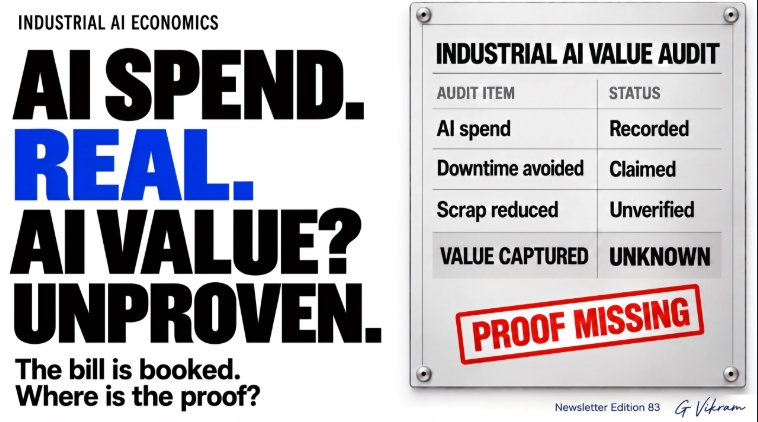
The investment is approved. The AI solution is deployed. The benefits are presented.
But has the business actually captured the value?
This is a question manufacturing leaders need to ask more often.
Industrial AI promises reduced downtime, lower scrap, improved productivity, better quality and more intelligent decision-making.
Yet there is a fundamental difference between AI performing successfully and AI delivering measurable business value.
A model can achieve high prediction accuracy. A pilot can exceed its technical performance targets. An AI solution can be successfully integrated into production systems.
But none of these achievements, on their own, proves that the business has realized a financial return.
That distinction is becoming increasingly important as manufacturers move from AI experimentation to enterprise-wide adoption.
Consider three common manufacturing scenarios.
Predictive Maintenance
An AI model identifies a potential equipment failure several days in advance.
Technically, the prediction may be accurate. But did maintenance teams act on the warning? Was an unplanned shutdown prevented? Can the organization establish the actual value of avoided downtime after accounting for intervention costs?
The value lies not simply in predicting a failure but in enabling a decision that improves equipment reliability and reduces the total cost of maintenance.
AI-Powered Quality Inspection
A computer vision system detects defects earlier and with greater consistency.
However, detecting more defects does not necessarily mean manufacturing costs have decreased.
Did scrap rates fall? Was rework reduced? Did first-pass yield improve? Did the cost of poor quality decrease after considering inspection costs and false rejections?
These operational outcomes provide stronger evidence of value than detection accuracy alone.
Intelligent Production Scheduling
An AI-based scheduling solution optimizes production sequences, resource allocation and machine utilization.
But was the optimized schedule executed on the shop floor?
Did throughput improve? Were changeover losses reduced? Did on-time delivery increase? Did the improvements contribute to higher margins or lower operating costs?
An optimized plan has limited business value unless it translates into better production performance.
Across all three examples, one principle becomes clear:
Technical performance is evidence of AI capability. Operational and financial improvements are evidence of business value.
I believe every significant Industrial AI investment should demonstrate a clear connection between technology capability, operational execution and business outcomes.
This can be evaluated through four stages.
The first stage measures whether the AI solution performs its intended technical function.
Relevant indicators may include prediction accuracy, precision, recall, response time, system availability, model drift and integration reliability.
For example, a predictive maintenance model might demonstrate strong performance in identifying equipment anomalies.
That establishes technical capability.
However, it does not establish whether the predictions prevented failures or improved maintenance efficiency.
The key question: Can the AI solution reliably generate useful insights under actual operating conditions?
The second stage focuses on whether people and operational systems act on AI-generated insights.
This is where many AI initiatives encounter practical challenges.
A maintenance recommendation may be ignored because technicians lack confidence in the model.
A quality alert may be acknowledged without corrective action.
An optimized production schedule may be overridden because it does not account for actual shop-floor constraints.
In these situations, AI may be functioning correctly while operational behavior remains unchanged.
Useful indicators include recommendation adoption rates, response times, completed corrective actions, operator acceptance and workflow compliance.
The key question: Is AI changing how manufacturing decisions are made and executed?
Once AI recommendations influence operational decisions, organizations must establish whether those actions produce measurable improvements.
Depending on the use case, relevant manufacturing KPIs may include:
Overall Equipment Effectiveness (OEE)
Unplanned downtime and Mean Time Between Failures (MTBF)
Scrap and rework rates
First-pass yield and cost of poor quality
Production throughput and cycle time
Energy consumption per unit
On-time delivery performance
However, measuring an improvement is not enough.
Manufacturers need credible baselines, consistent measurement methods and an understanding of other factors that may have influenced performance.
For instance, a reduction in downtime could result from improved preventive maintenance practices, equipment upgrades, changes in production volume or AI-enabled interventions.
Without separating these influences, organizations risk attributing improvements to AI that may have occurred for other reasons.
Where practical, controlled pilots, comparable production lines or before-and-after evaluations adjusted for operating conditions can strengthen the evidence.
The key question: What measurable operational improvement can reasonably be attributed to AI-enabled actions?
The fourth stage connects verified operational improvements to financial outcomes.
Reduced downtime may create additional production capacity. But that capacity does not automatically generate additional revenue unless there is sufficient demand and the organization can convert it into profitable output.
Similarly, reduced scrap may lower material consumption, while improved scheduling may reduce overtime or inventory-related costs.
These benefits must be translated into financial terms using an agreed methodology.
The assessment should also consider the total cost of the AI solution, including:
Software licensing, cloud infrastructure and computing costs
Data engineering and system integration
Model monitoring, maintenance and retraining
Workforce training and change management
Ongoing operational support
Finance teams should validate the resulting economic benefits, distinguishing between realized savings, cost avoidance, productivity improvements and potential revenue opportunities.
These categories should not be treated as interchangeable.
The key question: Has the improvement produced a financially validated benefit after accounting for the cost of delivering and operating the AI solution?
Industrial AI does not operate independently of manufacturing processes.
Its effectiveness depends on the quality of operational data, the availability of production context and the ability to connect insights with actual shop-floor decisions.
This is where Manufacturing Execution Systems (MES), Manufacturing Operations Management (MOM) platforms and other industrial systems can play an important role.
For example, a predictive quality application may identify conditions associated with defective products.
However, evaluating its business impact requires more than the model's output.
The organization may need to connect that prediction with production orders, equipment conditions, material batches, inspection results, corrective actions and actual scrap quantities.
MES and related operational systems can provide some of this context and help establish traceability between AI recommendations and manufacturing outcomes.
But MES deployment alone does not guarantee AI value realization.
Reliable integration across MES, ERP, historians, maintenance systems and financial data is often necessary to establish the complete evidence chain.
The relationship can be summarized simply:
AI generates insights.
Manufacturing operations turn insights into actions.
Operational systems capture performance evidence.
Finance validates economic outcomes.
When these elements work together, manufacturers have a stronger foundation for understanding which AI applications contribute to business performance.
Without that connection, an organization may know that its AI models are working without knowing whether its investments are paying off.
One of the most difficult aspects of Industrial AI ROI measurement is determining how much of an observed improvement can legitimately be attributed to AI.
Manufacturing environments are constantly changing.
Production volumes fluctuate. Equipment ages. Operators rotate. Maintenance practices evolve. Product mixes change.
A performance improvement observed after AI deployment may therefore have several contributing causes.
For example, suppose a production line reports a 12% reduction in unplanned downtime after introducing predictive maintenance.
That is encouraging.
But the improvement may also reflect a revised maintenance schedule, replacement of aging components or reduced equipment utilization.
A credible ROI assessment should examine these factors rather than automatically assigning the entire improvement to AI.
This requires collaboration between manufacturing operations, maintenance, engineering, IT, data teams and finance.
It also requires agreement on the baseline, measurement period, financial assumptions and criteria for declaring benefits realized.
The objective is not to make the AI business case look impressive. It is to make the business case defensible.
Not every AI initiative needs to generate immediate financial returns.
Experimentation, capability development and organizational learning remain essential.
Some early investments may focus on improving data readiness, developing workforce skills or testing the feasibility of new approaches.
These initiatives can create strategic value even when direct financial benefits are not immediately measurable.
However, the expectations should change as AI initiatives progress from experimentation to operational deployment and enterprise-wide scaling.
A proof of concept may reasonably focus on technical feasibility.
A production pilot should demonstrate operational usefulness.
A scaled deployment should provide stronger evidence of sustained operational improvement and economic value.
Scaling should not simply mean deploying the same model across more machines, lines or factories.
It should mean demonstrating that the solution continues to create value under different operating conditions, with manageable costs and reliable performance.
For manufacturing leaders, this creates a more meaningful measure of AI maturity.
Instead of asking how many AI use cases have been deployed, organizations should examine how many have become part of routine operations and consistently improved business outcomes.
Industrial AI programs often report progress through investment levels, model performance, pilot completion rates and the number of deployed use cases.
These measures help track execution.
But they do not provide a complete picture of business value.
Leadership teams should also ask whether the organization can demonstrate a traceable connection between AI recommendations, operational decisions, manufacturing improvements and financial outcomes.
That connection requires more than technology.
It demands operational ownership, credible measurement, cross-functional collaboration and accountability for realized benefits.
For me, the next stage of Industrial AI maturity is not about deploying the greatest number of AI applications.
It is about identifying which applications consistently improve manufacturing performance, understanding why they work and scaling those that create sustainable business value.
AI spend is easy to record. AI value must be proven.
The real measure of Industrial AI success is not how intelligently a model performs, but how meaningfully its outputs improve decisions, operations and business outcomes.
What is the greater challenge in your organization: validating operational improvements or translating them into financially measurable AI value?
Thank you.
By G Vikram
Keywords: AI Governance, Digital Transformation, Manufacturing
AI Spend Is Real. But Where Is the Proof of AI Value? Before You Scale an AI Pilot, Ask What Made It Work
 Operational Competence: What Training Records Cannot Prove
 A Fair Review
 Your Continuity Plan Is Missing One Thing: The Leadership Team