Nov23
CEO, International Lawyer, Economist, Professor of Law and Business, International Author
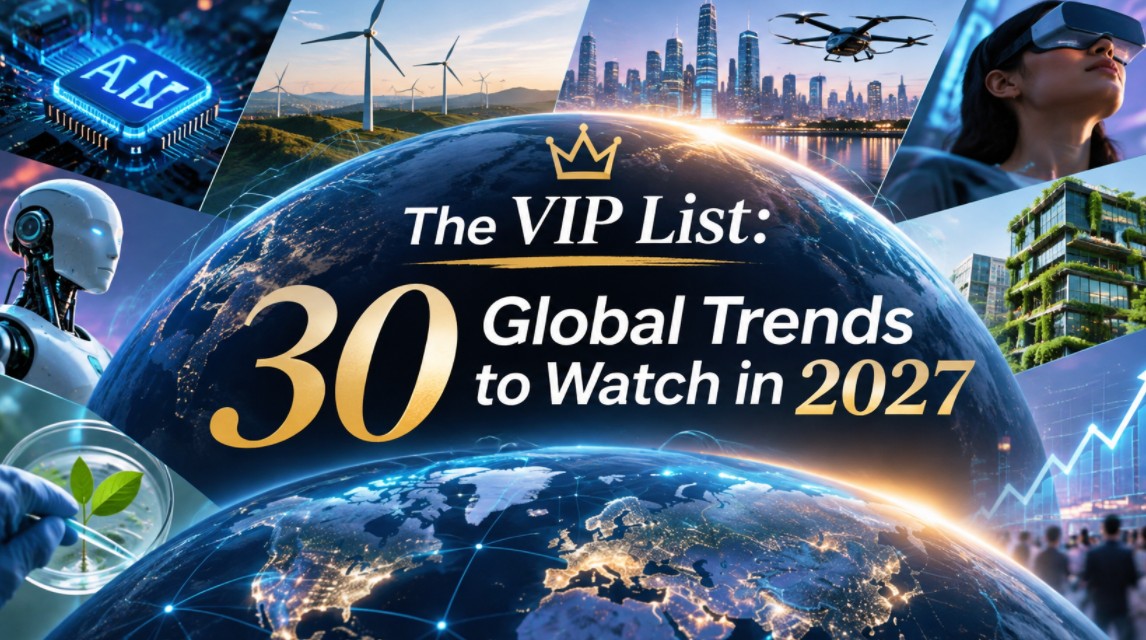
The year 2027 may prove to be one of the most transformative periods of the 21st century. Artificial intelligence, demographic shifts, biotechnology, global investing, energy security, and accelerating technological innovation are converging to reshape economies, institutions, and everyday life. As a CEO of a company that operates in 40+ nations, I receive a lot of feedback from friends and business associates from around the world. Here are some thoughts of what will be happening in the coming year.
The following VIP List highlights thirty trends that may influence governments, businesses, investors, entrepreneurs, and families in the years ahead.
AI increasingly operates as essential infrastructure for business, education, healthcare, law, finance, and government. For example, I personally released 80 original studio level tracks and 40 music videos using AI this year. This would have cost $5 Million dollars 30 years ago and I did this on my own on a small budget.
Millions of people rely on AI agents to manage schedules, communications, shopping, travel, finances, and research. Half of the people I know have used AI to plan a trip or new business etc.
Consumers increasingly delegate purchasing decisions to intelligent AI assistants that compare products and negotiate value.
Governments continue confronting rising debt obligations, entitlement costs, and fiscal sustainability challenges. However, the USA, unbeknownst to many economists has about $300 Trillion in Assets growing at 8% and about $40 Trillion in debt growing at 6%. Sadly, the 18 wars of Obama, Bush, Biden and Clinton cost $40 trillion in todays dollars. i.e. ($400 Billion per year invested in the S&P for 25 years would get you $50 Trillion) [i]
Nations compete aggressively for talent, innovation, entrepreneurs, technology investment, and productive capital. With 200+ countries worldwide, there is a battle to have the best jurisdiction, services, business friendly environment, and tax system. People will seek the best pensions, health care, schools and so forth.
Economists refine theories regarding the roles of monetary policy, supply chains, housing costs, energy prices, and financing costs. However, the George Mentz published theories on artificial inflation created by Federal Reserve interest hikes on student loans, credit cards, home loans and auto loans remains a vital point of concern hurting women and minorities.
Reliable access to oil, natural gas, nuclear power, advanced batteries, and renewables becomes increasingly important. While the USA is Energy and fertilizer independent, the Iranian Hormuz blockades have horribly injured prices on energy for the regions of Asia, China, and India.
Automation transforms manufacturing, logistics, transportation, agriculture, healthcare, and service industries.
Breakthroughs in personalized medicine, diagnostics, genetics, and metabolic health shape healthcare and retirement planning.
Wearables, smart devices, biometric sensors, and diagnostic technologies provide real-time health insights.
As AI-generated content expands, authentic expertise, craftsmanship, reputation, and trusted relationships become more valuable.
Consumers increasingly seek products and services that reduce complexity rather than add more information.
Digital businesses, consulting, education, licensing, subscriptions, and entrepreneurship provide supplemental income opportunities.
Lifelong learning, micro-credentials, professional certifications, and skills-based education gain importance.
Over the past decade, online stock brokerage accounts have grown dramatically, with Charles Schwab alone increasing from 10.2 million accounts in 2016 to approximately 40.4 million in 2026—a nearly 300% increase—reflecting the explosive growth of digital investing in America. Individuals increasingly seek education regarding taxes, investing, retirement, estate planning, and wealth preservation. Liquidity and the supremacy of US markets and indexes is huge.
Longer life expectancies and changing tax environments increase demand for comprehensive financial planning. SME’s Subject Matter Experts will rule both AI and Industry.
Population growth, construction costs, and inventory shortages continue influencing housing markets. With the Federal Reserve pegging 30 Yr mortgages at 7.5%, housing for working families is all but impossible right now.
Blockchain applications, tokenization, stablecoins, and digital financial ecosystems continue maturing.
Nations seek greater control over semiconductors, pharmaceuticals, critical minerals, energy resources, and vital supply chains. ECF Extended Continental Shelf claims will continue to expand.
Identity protection, privacy management, and cyber resilience become household priorities.
Consumers increasingly demand transparency and control regarding how organizations collect and use personal information. IP rights will become more valuable.
Private investment drives growth in satellite communications, launch services, space manufacturing, and exploration.
Agricultural innovation, water management, fertilizer supply, and climate resilience become strategic priorities. The USA is fertilizer independent, but many nations are not.
Consumers rely more heavily on trusted communities, peer networks, and local relationships. People will demand more balance in their lives for fellowship with friends. Some companies may demand that employees spend 10-20% of their time relaxing and discussing new ideas and new business each day.
Authors, podcasters, educators, musicians, coaches, and influencers build direct global audiences. AI has made it possible for low cost avatars, creation of shows, music and TV productions.
Homes increasingly serve as centers for work, education, health, entertainment, and entrepreneurship. The government may actually relax rules on expensing home child services, home meals, home equipment, health care, commuting to work, and deductions of utilities, internet and phone.
Consumers prioritize travel, events, education, and memorable experiences over traditional consumption.
Individuals focus less on products and more on systems that deliver measurable improvements in health, wealth, productivity, and well-being.
Organizations that demonstrate mission, trust, ethics, and authentic value increasingly attract customers and talent. Businesses will focus on having employees that understand and believe in the product and services and excellent solutions for customers.
In an era of accelerating technological change, adaptability, emotional intelligence, judgment, and continuous learning become critical competitive advantages.
The defining challenge of 2027 may be managing the relationship between technological acceleration, economic uncertainty, geopolitical competition, and human opportunity.
Governments will need policies that encourage innovation, productivity, business friendly rules, and productive investment. Businesses must focus on genuine value creation and long-term resilience. Individuals who embrace learning, adaptability, entrepreneurship, and financial literacy may be best positioned to thrive.
Artificial intelligence may transform productivity, but human judgment, ethics, creativity, wisdom, and leadership remain indispensable.
The greatest asset of the future may not be technology alone. It may be the educated, adaptable, and empowered human mind capable of using technology wisely to build prosperity, freedom, and human flourishing.
[i] https://www.newsmax.com/finance/georgementz/american-resources-assets/2025/11/03/id/1233000/
By George Mentz
Keywords: Behavioral Science, Leadership
The VIP List: 30 Global Trends to Watch in 2027 The Empty Chair at Thanksgiving: Remembering the Employees Who Are No Longer at the Table
 Cost Reduction Is Not a Procurement Problem
 The Grace Gap: What Boards Should Learn from Nvidia's Leadership Crisis
 Can GenAI be creative?