Aug21
FCRQ212 Leadership Learning!
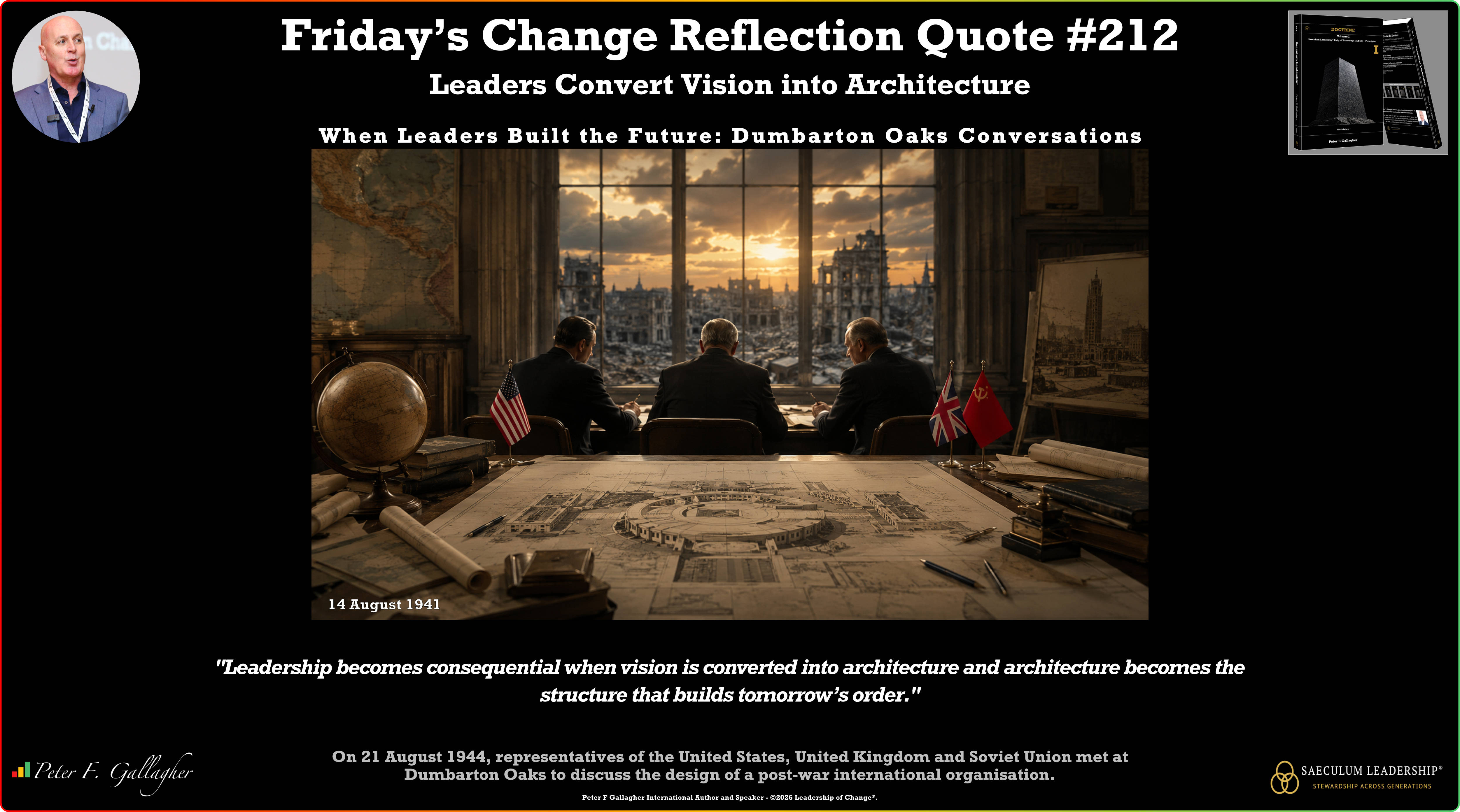
On 21 August 1944, representatives of the United States, United Kingdom and Soviet Union met at Dumbarton Oaks to discuss the design of a post‑war international organisation. The war continued, yet these leaders were already considering how global order should function once conflict ended. Their discussions showed that leadership must often look beyond present pressures to shape the system that will follow.
China participated in the later phase of the Dumbarton Oaks conversations, beginning on 29 September 1944. The opening day, however, established the essential direction and working framework for the discussions. Secretary of State Cordell Hull, Soviet Ambassador Andrei Gromyko and British representative Sir Alexander Cadogan delivered statements outlining the principles they believed should underpin a future organisation. A Joint Steering Committee then set initial procedures and organised the work into structured components. Viewed through the Saeculum Leadership® lens, this was architectural work: creating the structure through which emerging ideas could be developed into coherent institutional design. The purpose extended beyond diplomacy: participants were translating wartime experience into structural ideas capable of shaping behaviour across nations.
The central challenge was clear. How could a future system prevent the failures that had allowed global conflict to escalate? Leaders understood that aspiration alone was insufficient. Durable institutions require principles, structures, responsibilities and mechanisms that can operate under pressure. Architecture is therefore more than the expression of a vision; it is the structure that makes intended behaviour possible, repeatable and sustainable. The Dumbarton Oaks process produced proposals that later formed the foundations for the United Nations, demonstrating how knowledge and experience can be converted into architecture capable of shaping behaviour across nations.
Its timing is instructive. The participants were designing the next order while the existing one was still collapsing. This reflects a core Saeculum Leadership® insight: leaders must sometimes build future capacity before circumstances make that capacity visibly necessary. The task was not simply anticipating post‑war conditions but creating the frameworks required to support stability once the war ended.
The discussions also revealed competing interpretations of the future. Disagreement emerged over Security Council voting procedures and the scope of economic and social responsibilities. This demonstrated that architecture does not eliminate competing interests; it creates principles, structures and mechanisms through which competing interests can be negotiated while progress towards a coherent future remains possible.
Saeculum Leadership® Lessons: A compelling future requires structures, principles and mechanisms capable of translating vision into architecture and architecture into sustained behaviour. Saeculum Leaders change the future by beginning its architectural design before the existing order has fully disappeared. They look beyond immediate pressures to recognise how today's architectural decisions can shape tomorrow's systemic possibilities. Saeculum Leaders convert strategic vision into architecture capable of enabling, sustaining and transmitting intended behaviours across institutions and generations. They design systems capable of accommodating competing interests rather than assuming alignment will naturally sustain transformation. Saeculum Leaders recognise emerging signals as turning points and intervene before systemic change becomes unavoidable.Leaders Convert Vision into Architecture.
“Leadership becomes consequential when vision is converted into architecture and architecture becomes the structure that builds tomorrow’s order.”
From the Canon — Practice 10: The Practice of Builder Identity. Builder Identity is the discipline through which leaders understand themselves as architects of the next order rather than managers of the existing one. It changes the question of leadership from “How do I manage the system I have inherited?” to “What must I build so that the system can operate differently for those who inherit it?” Saeculum Leaders recognise that identity precedes action: those who see themselves as builders commit to designing future systems even when the present remains unstable or outcomes remain uncertain. They accept responsibility for constructing the frameworks through which future behaviour will be shaped.
Dumbarton Oaks demonstrates this principle with clarity. The representatives of the United States, United Kingdom and Soviet Union met while war continued and the global order remained unresolved. Yet they chose to begin designing the architecture of a post-war organisation before its effectiveness could be demonstrated and while the existing order remained under immense pressure.
Dumbarton Oaks revealed that enduring leadership is defined not by reacting to events but by shaping the architecture that will outlast them. Their actions demonstrated that leaders sometimes need to design the next system while the current one is still collapsing, because architecture must exist before circumstances demand its use. Leadership does not begin when certainty arrives. Leadership begins when someone accepts responsibility for building what comes next.
The Stewardship Reflection Lens:
What are we inheriting? We inherit systems shaped by earlier uncertainty, carrying assumptions and vulnerabilities that remain hidden until disruption exposes the limits of existing architecture.
How should we steward it? Stewardship requires recognising emerging signals, choosing direction before certainty exists, and deliberately strengthening the principles, structures and mechanisms through which future behaviour will be shaped.
What legacy are we creating? We create a legacy when the architectural choices we make today give those who follow us a stronger foundation from which to build tomorrow’s institutions.
Further Reading: Saeculum Leadership® Body of Knowledge (SLBoK). Saeculum Leadership®: Doctrine – Volume I.
Peter F. Gallagher is the Founder–Architect of Saeculum Leadership®, a doctrine of generational stewardship that equips leaders to strengthen what they inherit and shape what future generations receive. A 21-book author, global keynote speaker, and trusted advisor to boards, CEOs, and executive leadership teams, he helps organisations strengthen leadership capability, institutional stewardship, and transformational change in an increasingly complex world.
For further insights please visit our websites: https://www.a2b.consulting https://www.peterfgallagher.com Amazon.com: Peter F Gallagher: Books, Biography, Blog, Audiobooks, Kindle
Saeculum Leadership® Body of Knowledge (SLBoK): Volumes 1-10.A-E & 0, I-V
~ Leadership of Change® Volume 1 - Change Management Fables
~ Leadership of Change® Volume 2 - Change Management Pocket Guide
~ Leadership of Change® Volume 3 - Change Management Handbook
~ Leadership of Change® Volume 4 - Change Management Leadership
~ Leadership of Change® Volume 5 - Change Management Adoption
~ Leadership of Change® Volume 6 - Change Management Behaviour
~ Leadership of Change® Volume 7 - Change Management Sponsorship
~ Leadership of Change® Volume 8 - Change Management Charade
~ Leadership of Change® Volume 9 - Change Management Insanity
~ Leadership of Change® Volume 10 - Change Management Dilenttante
~ Leadership of Change® Volume A - Change Management Gamification - Leadership
~ Leadership of Change® Volume B - Change Management Gamification - Adoption
Keywords: Business Strategy, Change Management, Leadership
 2027 Predictions for Cybersecurity: The Agent Is the New Insider
 FROM THE AISLE Field Notes on AI Implementation
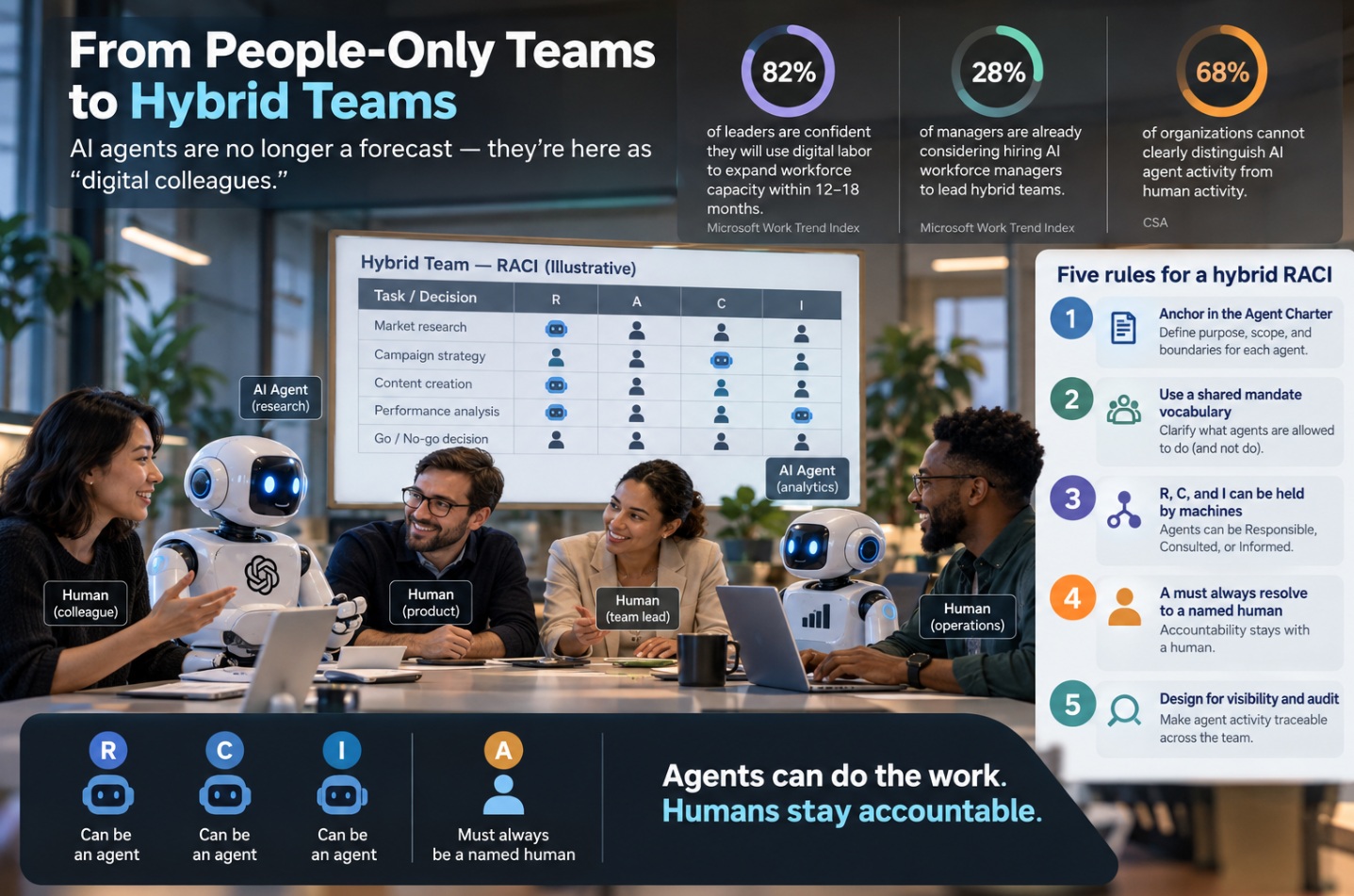 The Hybrid Team: Rethinking RACI When Some of Your Team Members Are Machines
 Two Clocks, One Truck: The Army's Need for Speed Meets New Defense Sourcing Rules
 Sustainable Transformation: The Elephant and The Mouse In The Room