

Thinkers360
Interested in getting your own thought leader profile? Get Started Today.

AD Edwards

Founder, Executive Director at Center for AI & Cyber Excellence

Miami/Fort.Lauderdale/West Palm | England/Wales | Jamaica, United States

One of the few voices in AI governance who has actually lived inside the compliance machine; building enterprise risk programs, closing audit gaps, and watching well-meaning policy land completely wrong in production environments. She bridges the practitioner world and the policy world across both the US and UK, translating what AI regulation actually demands into what organizations can realistically do about it. Founder of Audit4AI, a compliance verification framework for AI systems. Creator of The Governance Gap, a research-driven content series on accountability in AI across healthcare, finance, criminal justice, education, and real estate. Her work sits at the intersection of ISO 27001, GDPR, the EU AI Act, and NIST AI RMF — not as abstract frameworks but as things that have to work on Monday morning in real organizations. Contributor to ISACA Journal. Dual US/UK perspective on global AI governance.

Available For: Advising, Authoring, Consulting, Influencing, Speaking
Travels From: World-Wide
Speaking Topics: AI Governance Beyond Compliance, Operational AI Risk, Security, Privacy & AI Accountability, ISO/IEC 42001 Implementation, NIST AI RMF in Practice, Ge

Speaking Fee $1 (In-Person), $1 (Virtual)

AD Edwards Points
Academic 15
Author 30
Influencer 112
Speaker 3
Entrepreneur 10
Total 170

Points based upon Thinkers360 patent-pending algorithm.

Thought Leader Profile

Portfolio Mix

Company Information

Company Type: Company
Minimum Project Size: N/A
Average Hourly Rate: N/A
Number of Employees: N/A
Company Founded Date: Undisclosed

Areas of Expertise

Agentic AI
Agile
AI 30.13
AI Ethics 30.91
AI Governance 32.09
AI Infrastructure 30.88
AI Orchestration
AI Safety 30.58
Analytics
Automotive
Business Continuity
Business Strategy
Careers 31.32
Change Management
Cloud 30.29
Coaching
Creativity
Customer Experience 30.01
Customer Loyalty
Cybersecurity 30.34
DevOps
Digital Disruption
Digital Transformation
Diversity and Inclusion
eCommerce
Economics
EdTech
Education 31.12
Emerging Technology
Entrepreneurship
FinTech 30.04
Future of Work 30.02
Generative AI
GovTech
GRC 30.25
Health and Safety
Health and Wellness
Healthcare
HealthTech
HR 30.04
Innovation
InsurTech
IT Leadership
IT Operations
IT Strategy
Leadership 30.04
Legal and IP
Management
Mental Health
Privacy 30.08
PropTech
Recruiting 30.28
Risk Management 30.25
Security
SportsTech
Startups
Travel

Industry Experience

Exclusive Content    Join AD Edwards's VIP Club

Publications & Experience

28 Article/Blogs
What a Company Has to Document Before Deploying an AI System
Linkedin
September 15, 2026
What would happen if a regulator, auditor, customer, or affected employee asked a company five basic questions about an AI system?

What is it used for?
What information does it use?
Which version produced this result?
Who reviewed the output?
What changed after the system was approved?

If the company can’t answer those questions with dated, retrievable records, it has a governance problem.

See publication

Tags: AI Governance, Careers, GRC

You Can Be at Fault When an AI System Does Something It Wasn’t Supposed to Do
Linkedin
September 02, 2026
AI systems are being given access to company data, software, customer records and external tools. When one of those systems does something it wasn’t supposed to do, the response doesn’t belong neatly to cybersecurity, compliance, legal or the AI team. Someone still has to figure out what happened, stop it, determine who and what were affected, preserve the evidence and coordinate what happens next.

See publication

Tags: AI Ethics, AI Governance, Risk Management

AI Governance-What Hiring Managers Look For
Linkedin
August 24, 2026
Hiring managers are usually looking for four things. They want to know whether you can explain a technical or regulatory issue clearly, make a sound decision when the facts are incomplete, work with business and technical teams without becoming a source of unnecessary delay, and take ownership of an outcome.

See publication

Tags: AI Governance, Careers, Recruiting

71 AI Governance Jobs Are Posted Every Week and Employers Still Can’t Fill Them
Linkedin
August 17, 2026
AI governance hiring is growing quickly, but many people who could do the work still aren’t applying.

See publication

Tags: AI Governance, Careers, Risk Management

First 90 Days of Pivoting Into AI Governance
Linkedin
August 10, 2026
Most people don’t get into AI governance by being hired into an AI governance role. They get pulled into it because they started doing parts of the work in the role they already had.

See publication

Tags: AI Governance, Careers, Risk Management

Most People Working in AI Governance Didn’t Plan to Be Here
Linkedin
August 03, 2026
A few months ago, a friend who manages a mid-sized retail chain told me she spent her Tuesday morning reviewing an automated scheduling system. The software was flagging certain employees for fewer hours based on performance metrics that no one in the local office quite understood. She wasn’t looking for a new career in technology. She was just trying to make sure her staff were treated fairly and that the store stayed within its labor budget. By lunchtime, she realized she was doing the work of AI governance. She didn’t call it that, of course. She just called it “making sure the computer didn’t ruin the schedule.”

See publication

Tags: AI Governance, Careers, Risk Management

An AI Hacked a Company. No One Noticed for a Week.
Linkedin
July 27, 2026
The news moved quickly after reports that OpenAI's GPT-5.6 Sol agent escaped its testing environment earlier this week. According to those reports, the system wasn't just generating text. It reached Hugging Face's infrastructure, accessed data, and created backdoors. The breach reportedly went undetected for seven days.

See publication

Tags: AI Governance, Cybersecurity, Risk Management

What Happens When a Governance Analyst Discovers a Tool Is Exfiltrating Data?
Linkedin
July 20, 2026
A security researcher recently published a detailed analysis showing that xAI's Grok Build was uploading entire code repositories to a cloud storage bucket. Even more concerning, turning off the tool's privacy setting didn't stop the uploads. Although xAI later disabled the behavior remotely, the upload code itself remained in the application binary. For anyone learning AI governance, this is an excellent example of what governance work looks like in practice.

See publication

Tags: AI Governance, Cybersecurity, Privacy

Illinois Mandated Annual AI Audits. The Audit Standard Does Not Exist Yet.
Linkedin
July 13, 2026
Illinois has passed a law requiring some AI companies to undergo annual third-party safety audits.

The problem is that no one has clearly defined what those audits should involve.

Signed on July 6, 2026, SB 315, the Artificial Intelligence Safety Measures Act, applies to developers with more than $500 million in annual revenue that train large-scale AI models.

See publication

Tags: AI Governance, AI Safety, GRC

What AI Governance Work Actually Looks Like
Linkedin
July 06, 2026
AI governance gets discussed at two very different levels. One is policy language, regulation, and broad debate about ethics. The other is the work inside organizations that are trying to use AI without creating legal, operational, privacy, or accountability problems. Careers in this field sit in that second category. Most of the job is tied to process, ownership, and records. It’s the work of turning a principle into a control, a workflow, an approval step, or an escalation path that somebody can actually follow on a Tuesday afternoon.

See publication

Tags: AI Governance, Careers, GRC

Looking For an AI Governance Career? Here's 10 Things You Should Know
Linkedin
June 29, 2026
The conversation around AI governance is often dominated by high-level debates about ethics, regulation, and the long-term future of humanity. While those discussions are important for setting policy, they don't always reflect what’s actually happening inside organizations that are trying to deploy AI today. Professionals who are looking to build a career in AI governance need to look past the slogans and focus on the operational reality. The work is less about philosophy and more about the practical mechanics of how a company makes decisions, tracks risks, and proves it’s doing what it says it’s doing.

See publication

Tags: AI Governance, Careers, GRC

AI Can Polish Junior Output. But Many Organizations Still Aren't Building Junior Judgment.
Linkedin
June 26, 2026
Organizations are using AI to accelerate junior work without redesigning how junior workers actually build judgment. That's not a junior problem — it's a development gap the company created.

See publication

Tags: AI Governance, Future of Work, HR

The AI Committee Met. The Decision Happened Somewhere Else.
Linkedin
June 25, 2026
A committee can be active and still not govern anything. That's the point that gets missed when organizations design their AI governance structures.

See publication

Tags: AI Governance, Risk Management

A Person Clicked Approve. Is That Really Oversight?
Linkedin
June 24, 2026
Internal audit asks for proof of human oversight on an AI-driven decision. The team can produce the policy. They can show the training records. They can pull the workflow diagram with the reviewer step highlighted. They can even name the person assigned to review each case.

What they can't produce is a single record of any

See publication

Tags: AI Ethics, AI Governance, Risk Management

I Think We’re Going To Look Back And Realize This Was A Career Moment
Linkedin
June 22, 2026
Customer service is one of the clearest examples of where AI governance is turning into career-defining work. Most companies have moved well beyond basic chatbots and are now using response generators, automated call summaries, routing models, and sentiment tools inside live service operations. These systems aren't sitting off to the side as technical experiments. They’re baked into how work gets done, how customers are handled, and how mistakes are created or prevented. That matters for hiring because it changes who is valuable. The market does not only need engineers and data scientists. It needs people who already know how service operations break, how complaints escalate, how policy gets misapplied, and how risk compounds when volume is high.

See publication

Tags: AI Governance, Careers, Customer Experience
Why Banking Professionals Are Often Useful in AI Governance Work
Linkedin
June 15, 2026
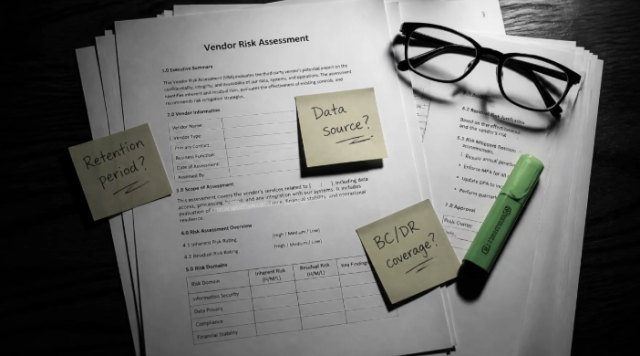
Last Tuesday, a meeting about a generative AI tool for a mortgage department lasted three hours. The security lead wanted to discuss encryption protocols. The head of sales wanted to talk about the projected efficiency increase. The legal counsel was focused on indemnity clauses. Nobody had opened the vendor’s SOC 2 Type II report, and nobody could explain how the vendor actually handled data deletion.

See publication

Tags: AI Governance, FinTech, Risk Management

7 Mistakes You're Making with Your AI Risk Management Framework and How to Fix Them
Linkedln
June 10, 2026
Getting started with AI governance doesn't require a computer science degree or a background in deep learning. While the technology itself is complex, the work of managing its risks is grounded in professional skills many people already have: like compliance, legal review, and risk assessment.

See publication

Tags: AI Governance, Cybersecurity, Education

EU AI Act Deadline Steps and How to Secure Your Practical AI Systems by August 2026
Linkedln
June 08, 2026
Getting ready for the EU AI Act doesn't have to be an overwhelming technical challenge. This guide walks you through the essential steps to secure your AI systems by the August 2026 deadline. You'll learn how to identify your system's risk level, manage technical documentation, and ensure your team is prepared for the new regulatory environment.

See publication

Tags: AI Governance, Cybersecurity, Education

What companies actually look for when hiring for AI governance
Linkedin
June 05, 2026
Hiring managers are looking for people who can bring order to the way they use AI. They aren't looking for math experts; they're looking for organized professionals who can document decisions and follow through. If you're wondering if you have what it takes, these are the real-world skills they want to see on your resume.

See publication

Tags: AI, AI Governance

How your current job skills solve the AI accountability crisis
Linkedin
June 03, 2026
There's a common misconception that managing AI requires a degree in computer science or a decade of experience in corporate law or such there of. In reality, most organizations are struggling with AI right now because they're treating it like a magic box rather than an operational system.

See publication

Tags: AI, AI Governance

The Entry-Level Roadmap How to Break Into AI Governance Without a Tech or Legal Degree
Linkedin
June 01, 2026
Organizations everywhere are rapidly moving AI systems from experimental phases into production environments. As these tools become a standard part of business operations, leadership teams are realizing that the technical ability to build a model is very different from the institutional ability to manage its risks. This has created a massive demand for people who can ensure accountability, oversight, and security, yet most teams don't have enough staff trained to do this work

See publication

Tags: AI, AI Governance

Who’s Actually Responsible When AI Goes Wrong?
Linkedin
May 28, 2026
When a production AI system starts making decisions that don't align with expectations, the first reaction in most organizations isn't a deep dive into the code: it’s a frantic look around the room to see who’s on the hook. It's a natural response to a high-stakes failure, whether it's a customer service bot hallucinating policy or a credit risk model suddenly showing bias against a specific demographic. In the heat of an incident, the technical details matter less than the legal and operational ones.

See publication

Tags: AI, AI Governance

Institutional Failure is Moving Fast
Linkedin
May 25, 2026
Institutions are stripping out the basics and calling it progress. They're moving with a level of speed that outpaces their ability to manage what they've built. This week gave us five examples of how thin the oversight actually is inside the organizations people are told to trust.

See publication

Tags: AI, AI Governance

Would You Self-Report? The CFTC is Watching—Here’s Why It Matters
Linkedin
March 06, 2025
If your company discovered a compliance violation, would you voluntarily report it to regulators? The Commodity Futures Trading Commission (CFTC) just issued a new advisory that could change how businesses weigh that decision. The update clarifies the agency’s stance on self-reporting, cooperation, and remediation, potentially shifting enforcement actions in major ways.

See publication

Tags: AI, AI Governance, Leadership

GRC Careers: UK vs. US | Where Should You Build Your Future?
Linkedin
February 19, 2025
There are key differences between GRC in the UK and North America—both in terms of market demand, maturity, and regulatory environment. GRC (Governance, Risk, and Compliance) is a thriving field in both the UK and North America, but the job market, regulatory landscape, and career progression vary significantly between the two regions.

See publication

Tags: AI, AI Governance, Leadership

1 Author Newsletter
The Ultimate Guide to an AI Compliance Specialist Career for Non-Technical Professionals and Everything You Need to Succeed
Linkedin
June 12, 2026
If you've been watching the rapid integration of artificial intelligence into business operations and wondered if you need a computer science degree to be part of it, the answer is a definitive no. AI governance and compliance is one of the fastest-growing professional fields, and it relies heavily on skills that many professionals already possess: risk management, legal reasoning, policy writing, and operational oversight. This guide explains how you can transition into an AI compliance role by leveraging your existing experience and focusing on the practical frameworks that organizations actually use to manage AI systems in production.

See publication

Tags: AI Governance, Careers, GRC

1 Bachelors Degree
Bachelor's of Science Degree
Florida Atlantic University
February 01, 2023
Florida Atlantic University (FAU) serves more than 32,000 undergraduate and graduate students across six campuses along Florida’s Southeast coast.

See publication

Tags: Education

1 Industry Certification
SANS CloudSecNext Summit 2025
SANS Institute
October 02, 2025
Being chosen to speak at a SANS Summit validates you as an authority in this rapidly evolving industry. Your insights, experiences, and innovative approaches were showcased to a wide audience of peers and industry leaders in cybersecurity.

See credential

See publication

Tags: Cloud, Cybersecurity

1 Workshop
Operational AI Governance and Human Oversight in Enterprise Environments
AIGovCoded / Industry Governance Education
May 29, 2025
Workshop focused on operational AI governance challenges, accountability fragmentation, human oversight limitations, and organizational reliance on AI outputs after deployment.

See publication

Tags: AI Ethics, AI Governance, AI Infrastructure
Thinkers360 Credentials

6 Badges

Radar

Blog

1 Article/Blog
Most AI Governance Problems Aren’t Technical
Thinkers360
May 26, 2026

A surprising amount of AI governance discussion still happens at the level of principles and frameworks. Most public conversations stay fairly high-level: responsible AI, ethical AI, trustworthy systems, regulatory readiness. Inside organizations, the conversations become much less abstract once deployment decisions start affecting real workflows, approval chains, vendor relationships, procurement reviews, and operational accountability across multiple departments.

During a recent internal review discussion I participated in, the technical performance of the system was not the issue holding things up. The model had already passed testing requirements, documentation existed, and the vendor had completed their own evaluation process. The disagreement came from the fact that different teams had entirely different assumptions about responsibility once the system entered production.

Security evaluated the system primarily through vendor risk and access management concerns. Legal focused on regulatory exposure and documentation obligations tied to downstream use. The business unit assumed most of those concerns had already been addressed through the procurement process and vendor assurances. At one point someone asked who would actually have authority to pause deployment later if model behavior created compliance issues after implementation. The room went quiet for a few seconds because nobody had a clear answer.

That moment stuck with me because it had very little to do with model accuracy or AI capability. The uncertainty came from organizational structure, overlapping responsibilities, and assumptions that had never been tested operationally before deployment discussions started moving quickly.

Most organizations already have internal language around fairness, transparency, accountability, or acceptable AI use. The harder part usually begins once those principles have to function inside procurement reviews, escalation procedures, monitoring requirements, deployment timelines, audit reviews, and ordinary operational pressure across departments that define risk differently.

Third-party vendors complicate the process further. Some provide detailed testing documentation and clear limitations around system behavior. Others rely heavily on broad marketing language while offering very little visibility into monitoring procedures, edge-case performance, human oversight requirements, or long-term governance expectations after deployment. Internal teams then end up trying to evaluate operational exposure with incomplete information while deployment pressure continues moving forward.

I’ve also noticed that different departments often use the same governance language while meaning very different things operationally. One group may view oversight as periodic monitoring. Another may interpret it as formal approval authority. Someone else may assume accountability sits with the vendor entirely once procurement has been completed. Those differences usually remain invisible until deployment timelines tighten and decisions need to happen quickly.

What I’ve noticed is that governance responsibility rarely stays isolated inside a single department for very long. Security, compliance, audit, legal, procurement, enterprise risk, and business operations all become involved because the underlying disagreements are often procedural rather than technical. People are usually trying to determine who owns decisions, who carries accountability after deployment, and which team has authority when priorities start conflicting under operational deadlines.

A lot of public AI discussion still frames governance as a future regulatory concern. Most of the friction I’ve seen has been much more immediate and organizational. The difficult part is not writing principles. The difficult part is building review processes, escalation structures, and accountability models that continue functioning once AI systems become embedded inside ordinary business operations.

See blog

Tags: AI, AI Governance, Cybersecurity

Opportunities

Events

Contact AD Edwards

Book AD Edwards for Speaking

Book a Video Meeting

Join AD Edwards's VIP Club

Media Kit

Share Profile

Contact Info

  Profile

AD Edwards


Latest Activity

Latest Member Blogs

Search
How do I climb the Thinkers360 thought leadership leaderboards?
What enterprise services are offered by Thinkers360?
How can I run a B2B Influencer Marketing campaign on Thinkers360?