Jul31
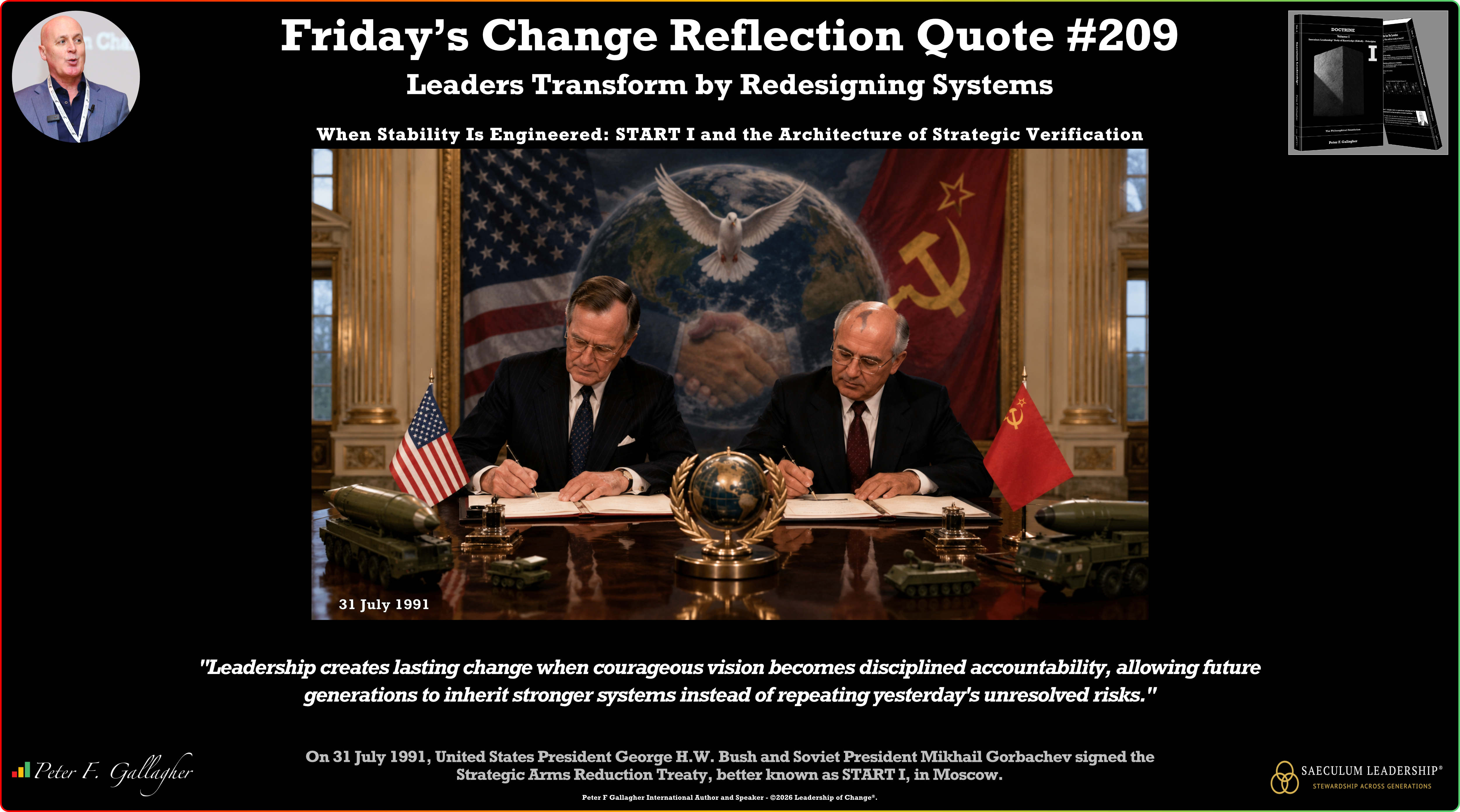
On 31 July 1991, United States President George H.W. Bush and Soviet President Mikhail Gorbachev signed the Strategic Arms Reduction Treaty, better known as START I, in Moscow. It was one of the most significant arms control agreements in modern history, requiring both superpowers to make deep reductions in their deployed strategic nuclear weapons and the systems used to deliver them. More importantly, the treaty established extensive verification measures, inspections and data exchanges that transformed decades of strategic rivalry into a framework built upon transparency, accountability and measured trust.
The signing came during a period of profound geopolitical change. The Cold War was drawing to a close, the Soviet Union was undergoing unprecedented political and economic reform, and long-established assumptions about global security were being challenged. Rather than allowing uncertainty to fuel greater instability, both leaders recognised that the future demanded a different approach to managing power and reducing existential risk. Their willingness to negotiate demonstrated that sustainable security is achieved not only through military capability but also through credible leadership, disciplined dialogue and institutional commitment.
START I represented far more than an agreement to reduce weapons. It fundamentally altered the way two global powers managed one another's strategic relationship. It shifted the emphasis from competition without limits towards governance supported by evidence, transparency and shared responsibility.
The treaty also illustrated that meaningful change requires more than ambitious vision. It demands mechanisms that translate intention into sustained behaviour. Inspection regimes, reporting obligations and structured oversight mechanisms procedures ensured that commitments could be measured rather than simply declared. This transformed confidence from political rhetoric into operational practice, providing a foundation for future international arms reduction efforts.
More than three decades later, START I remains an enduring reminder that some of history's greatest leadership achievements are measured not by victories over opponents, but by the courage to redesign systems that reduce future risk. It demonstrated that genuine leadership seeks to create conditions where future generations inherit greater stability than those who came before them.
Within the Saeculum Leadership® Framework, this became a defining Signal: enduring leadership transforms relationships by redesigning the systems that shape future behaviour rather than preserving inherited conflict.
From a Saeculum Leadership® perspective, START I represents a Knowledge Architecture Signal because it embedded trust, verification and accountability into the institutional architecture of global security, influencing generations beyond the immediate political moment.
Saeculum Leadership® Lessons: This moment illustrates the deeper discipline of leadership: the work of strengthening the systems that determine how power behaves. Saeculum Leaders change systems before expecting people to change their behaviour, creating conditions where progress becomes sustainable. They recognise that trust grows through accountability, transparency and evidence rather than aspiration alone. Saeculum Leaders convert vision into enduring reality through disciplined governance, not through disciplined rhetoric. They understand that courageous decisions today often prevent greater crises for future generations. Saeculum Leaders create institutions that preserve responsible behaviour long after individual leaders have left the stage. Leaders Transform by Redesigning Systems.
“Leadership creates lasting change when courageous vision becomes disciplined accountability, allowing future generations to inherit stronger systems instead of repeating yesterday's unresolved risks.”
From the Canon — Practice 5: The Practice of System Stewardship: System Stewardship is the discipline through which leaders strengthen the architectures that outlive them. It is the continual commitment to redesign systems so they become more stable, transparent and resilient. Saeculum Leaders understand that institutions rarely collapse because of a single failure. They decay when systems remain unexamined, untested or unreinforced.
START I stands as one of the defining examples of System Stewardship in modern geopolitical history. It shows that existential risk cannot be managed through personality, sentiment or goodwill — it must be constrained by systems built to outlast the people who built them. Bush and Gorbachev did not simply agree to trust one another; they constructed a structure that would hold even if trust between their successors did not.
System Stewardship requires leaders to recognise that inherited systems often contain hidden risks. START I redesigned the architecture through which two nuclear superpowers observed, verified and interpreted one another's behaviour. It replaced opacity with engineered transparency and embedded accountability where trust alone was insufficient.
Saeculum Leaders practise System Stewardship by strengthening systems before they fail. They redesign structures so future leaders cannot easily dismantle essential safeguards for short-term advantage. They understand that stability is not inherited; it is deliberately constructed through disciplined stewardship. START I demonstrates that leadership protects the future by redesigning the systems that shape it.
The Stewardship Reflection Lens:
What are we inheriting?
We inherit strategic systems shaped by decades of rivalry and mistrust, carrying embedded risks that escalate rapidly when assumptions fail.
How should we steward it?
Stewardship requires leaders to strengthen verification, transparency and accountability, keeping risk-reduction systems independent of political volatility and short-term pressure.
What legacy are we creating?
Leaders who build verification into how power is regulated leave behind a legacy where risk is constrained by design, not hope.
Further Reading: Saeculum Leadership® Body of Knowledge (SLBoK). Saeculum Leadership®: Doctrine – Volume I.
Peter F. Gallagher is the Founder–Architect of Saeculum Leadership®, a doctrine of generational stewardship that equips leaders to strengthen what they inherit and shape what future generations receive. A 20-book author, global keynote speaker, and trusted advisor to boards, CEOs, and executive leadership teams, he helps organisations strengthen leadership capability, institutional stewardship, and transformational change in an increasingly complex world.
For further insights please visit our websites: https://www.a2b.consulting https://www.peterfgallagher.com Amazon.com: Peter F Gallagher: Books, Biography, Blog, Audiobooks, Kindle
Saeculum Leadership® Body of Knowledge (SLBoK): Volumes 1-10.A-E & I-V
~ Leadership of Change® Volume 1 - Change Management Fables
~ Leadership of Change® Volume 2 - Change Management Pocket Guide
~ Leadership of Change® Volume 3 - Change Management Handbook
~ Leadership of Change® Volume 4 - Change Management Leadership
~ Leadership of Change® Volume 5 - Change Management Adoption
~ Leadership of Change® Volume 6 - Change Management Behaviour
~ Leadership of Change® Volume 7 - Change Management Sponsorship
~ Leadership of Change® Volume 8 - Change Management Charade
~ Leadership of Change® Volume 9 - Change Management Insanity
~ Leadership of Change® Volume 10 - Change Management Dilenttante
~ Leadership of Change® Volume A - Change Management Gamification - Leadership
~ Leadership of Change® Volume B - Change Management Gamification - Adoption
Keywords: Business Strategy, Change Management, Leadership
 Best Supply Chain AI Tools in 2026: SCM SENSEI AI and Ask Lora Compared
 Making Silos Permeable
 The Corix Partners Friday Reading List - October 2, 2026
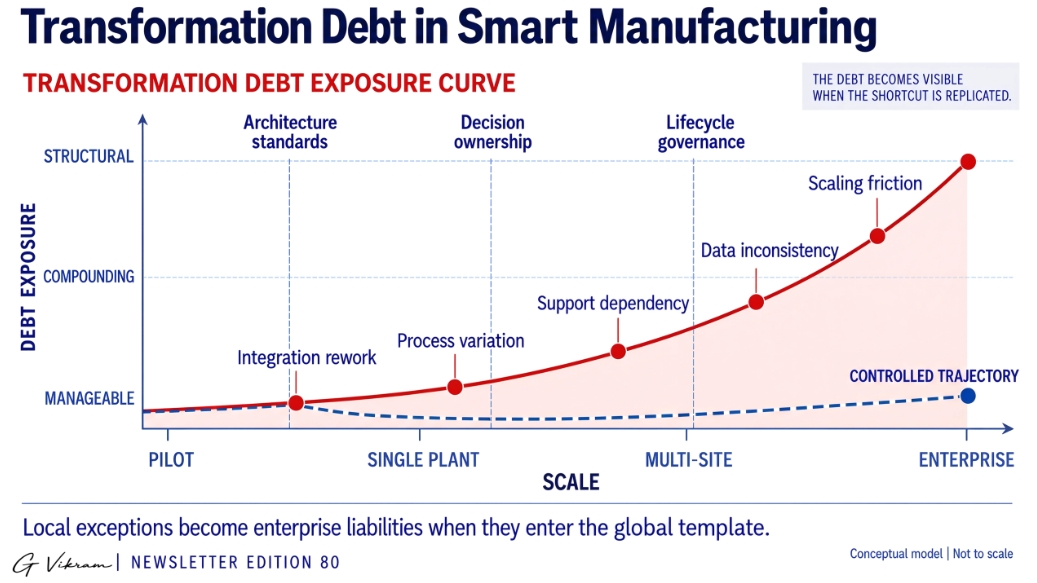 The most dangerous debt in a smart factory isn’t financial.
 Why mission changes everything, leadership lessons from two boardrooms