Jan19
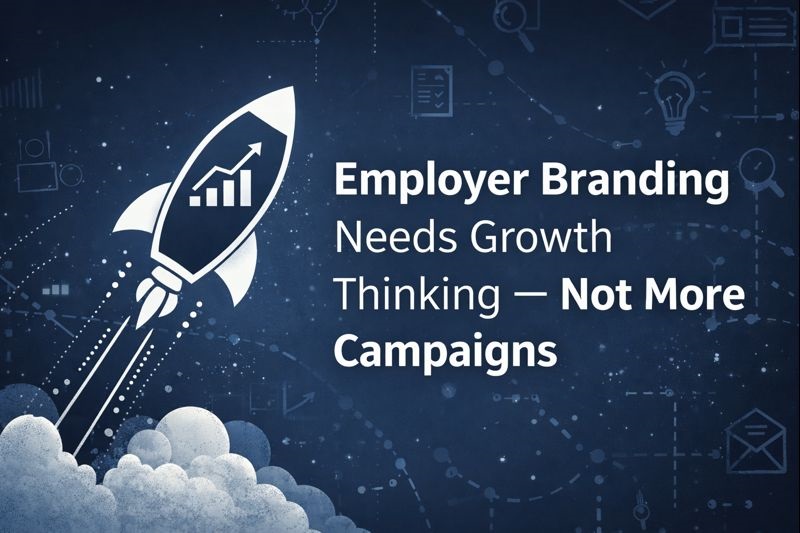
For years, employer branding has borrowed its logic from marketing campaigns: visibility, reach, storytelling, and carefully crafted messages. The result is often polished content that looks right, but teaches very little about what actually works.
Growth Hacking approach offers a different path.
Not growth hacking in the sense of “faster hiring” or “more applications,” but faster learning: understanding what truly drives interest, trust, and action among potential and current employees.
This is where growth hacking, when applied responsibly, becomes a powerful capability for employer branding.
Growth hacking has a reputation problem. It is often associated with shortcuts, manipulation, or aggressive optimization. That approach has no place in employer branding. But at its core, growth hacking is simply:
A structured way to test assumptions through small, reversible experiments.
Employer branding desperately needs this mindset. Most EB challenges are not execution problems. They are assumption problems:
Growth thinking challenges those assumptions with evidence.
Employer branding operates across a long and complex journey:
Yet most EB efforts optimize isolated touchpoints instead of the system. Growth thinking forces a different question: Where does interest actually form — and where does it disappear?
Instead of launching another campaign, growth-oriented EB teams run micro-experiments at specific points in the journey.
Unlike marketing A/B tests, EB growth experiments are usually simple and qualitative-heavy:
None of these are campaigns. All of them are learning mechanisms.
Traditional employer branding metrics focus on visibility:
Growth-oriented EB looks elsewhere — into what is often called the dark funnel:
These signals are slower, harder to automate, and far more valuable. They indicate trust, not just attention.
Growth thinking only works if it becomes systematic.
That means:
In practice, this often takes the form of simple tools:
The goal is not optimization, the goal is organizational learning.
Employer branding today operates in an environment of:
In this context, polished messaging is no longer a competitive advantage. Credibility is.
Growth thinking helps employer branding reconnect with reality:
Or put simply:
Strong employer brands don’t grow because they speak better. They grow because they learn faster. Growth hacking does not replace employer branding strategy, it strengthens it.
When employer branding adopts growth thinking, content becomes a by-product of reality, not a substitute for it, and that is where sustainable employer brands are built.
By Tom Laine
Keywords: Future of Work, HR, Marketing
 You are not your diagnosis
 Is GenAI good for anything?
 “I didn’t write an award acceptance speech because I didn’t expect to win.”
 AI Is Exposing the Data Problems Humans Used to Hide
 "The AI may in fact be conscious." Really?