Jan19
For over a century, the concept of wireless power transmission resided in the realm of visionary speculation and laboratory curiosity. Nikola Tesla, the father of the modern electrical age, famously dreamed of a "World Wireless System" where the Earth and its atmosphere would act as conductors, delivering energy to any point on the globe without a single foot of copper wire.1 Today, that dream is being realized not as a single global monolith, but as a sophisticated suite of technologies—lasers, ultrasonics, and radio-frequency harvesting—that are poised to untether our most advanced intelligence: Agentic AI.
The recent breakthroughs from researchers at the University of Helsinki and the University of Oulu represent a paradigm shift in how we power autonomous systems. By using high-intensity ultrasonic sound waves to create "acoustic wires"—channels of low-density air that guide electrical sparks—science has found a way to "beam" physical electricity.
For Agentic AI, this is the missing piece of the physical-layer puzzle. Until now, the "autonomy" of an AI agent was strictly limited by its battery capacity (the "Battery Tax"). In complex Multi-Agent Systems (MAS), such as a swarm of drones or a robotic banking security team, the need to return to a charging dock creates a massive operational gap. Wireless power transfer (WPT) allows these agents to move from "rechargeable" to "perpetual."
The impact on aerospace and formation flight is particularly profound. In a multi-agent aerial environment, traditional refuelling or recharging is a dangerous and complex maneuver. Wireless power changes the fundamental physics of the mission:
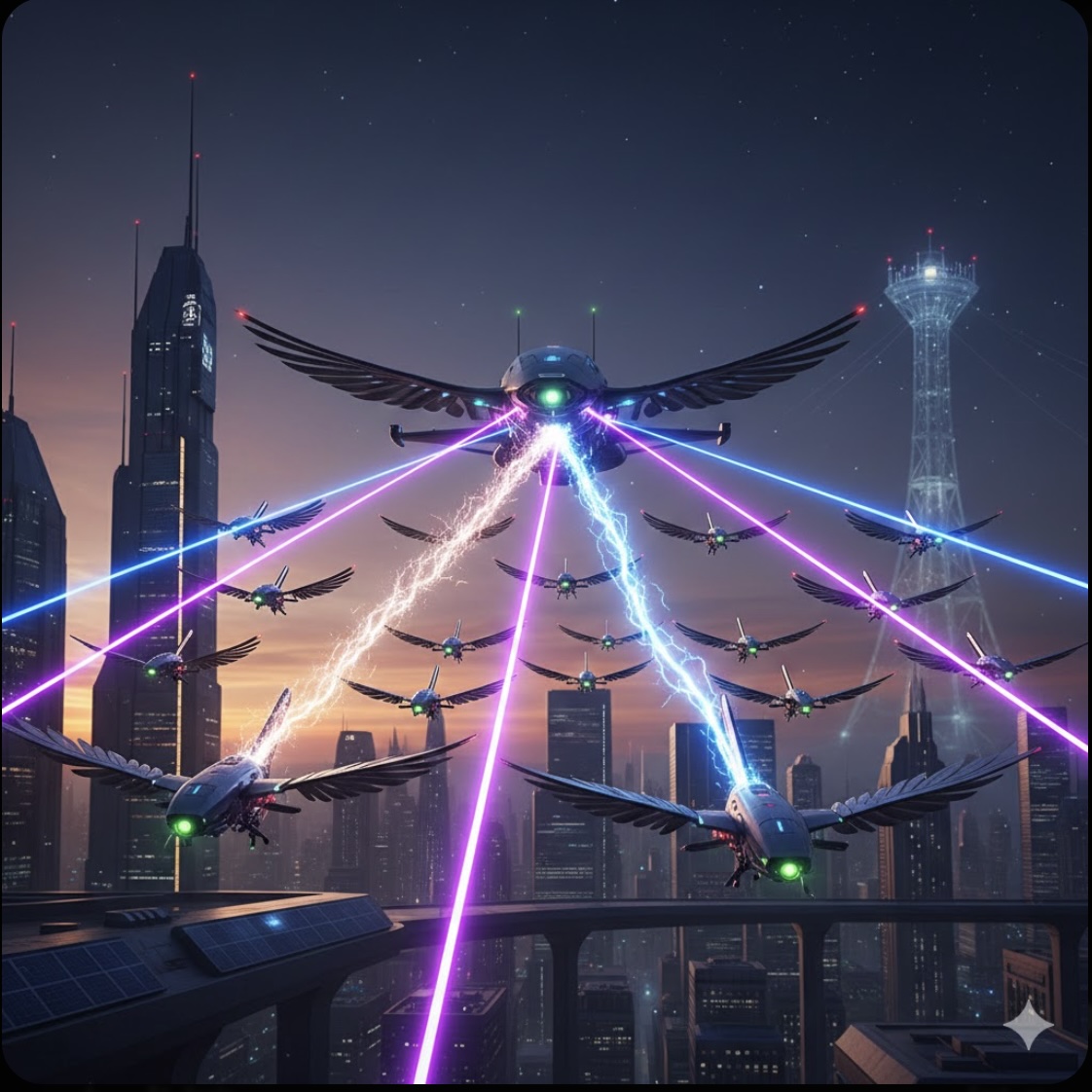
Formation-Based Recharging: A lead aircraft, acting as a "power hub," could use laser-based "power-by-light" systems to transmit energy to smaller trailing agents. This ensures that the formation can remain aloft indefinitely, optimized by AI to minimize drag and maximize energy reception.
Galvanic Isolation in High-Voltage Zones: In aerospace testing and nuclear environments, physical wires are a liability. Wireless energy provides a "firewall for physics," allowing AI monitoring agents to operate in high-radiation or high-voltage zones without the risk of a surge traveling back through a cable to fry the central processing unit.
If wireless power gives AI freedom, AI gives wireless power efficiency. The greatest challenge of WPT has always been alignment; even a slight movement can cause the energy beam to miss its mark.
Modern Agentic AI serves as the real-time "pilot" for these energy beams. Using machine learning-driven beamforming, the AI can predict the trajectory of a moving drone or robot and micro-adjust the ultrasonic or laser emitter in milliseconds. This transforms a "dumb" broadcast into a high-precision, goal-oriented delivery system.
In 1926, Tesla predicted a world where a man could carry a device in his pocket, powered and connected wirelessly, capable of seeing and hearing across the world. While we have achieved the "connected" part through Wi-Fi and 5G, we are only now achieving the "powered" part.
The transition to a cable-free infrastructure is more than a convenience; it is the birth of perpetual autonomy. By combining the raw power of Finnish "acoustic wires" with the cognitive reasoning of Agentic AI, we are finally building the world Tesla saw: a world where energy is as ambient and accessible as the air we breathe.
The Secret of Nikola Tesla's Wireless Power
This video explores the practical engineering behind laser-based power beaming and how it is being used to keep drones in the air for kilometres at a time, bringing Tesla's theories into the 21st-century sky.
Keywords: Agentic AI, Generative AI, Predictive Analytics
 You are not your diagnosis
 Is GenAI good for anything?
 “I didn’t write an award acceptance speech because I didn’t expect to win.”
 AI Is Exposing the Data Problems Humans Used to Hide
 "The AI may in fact be conscious." Really?