Sep04
FCRQ214 Leadership Learning!
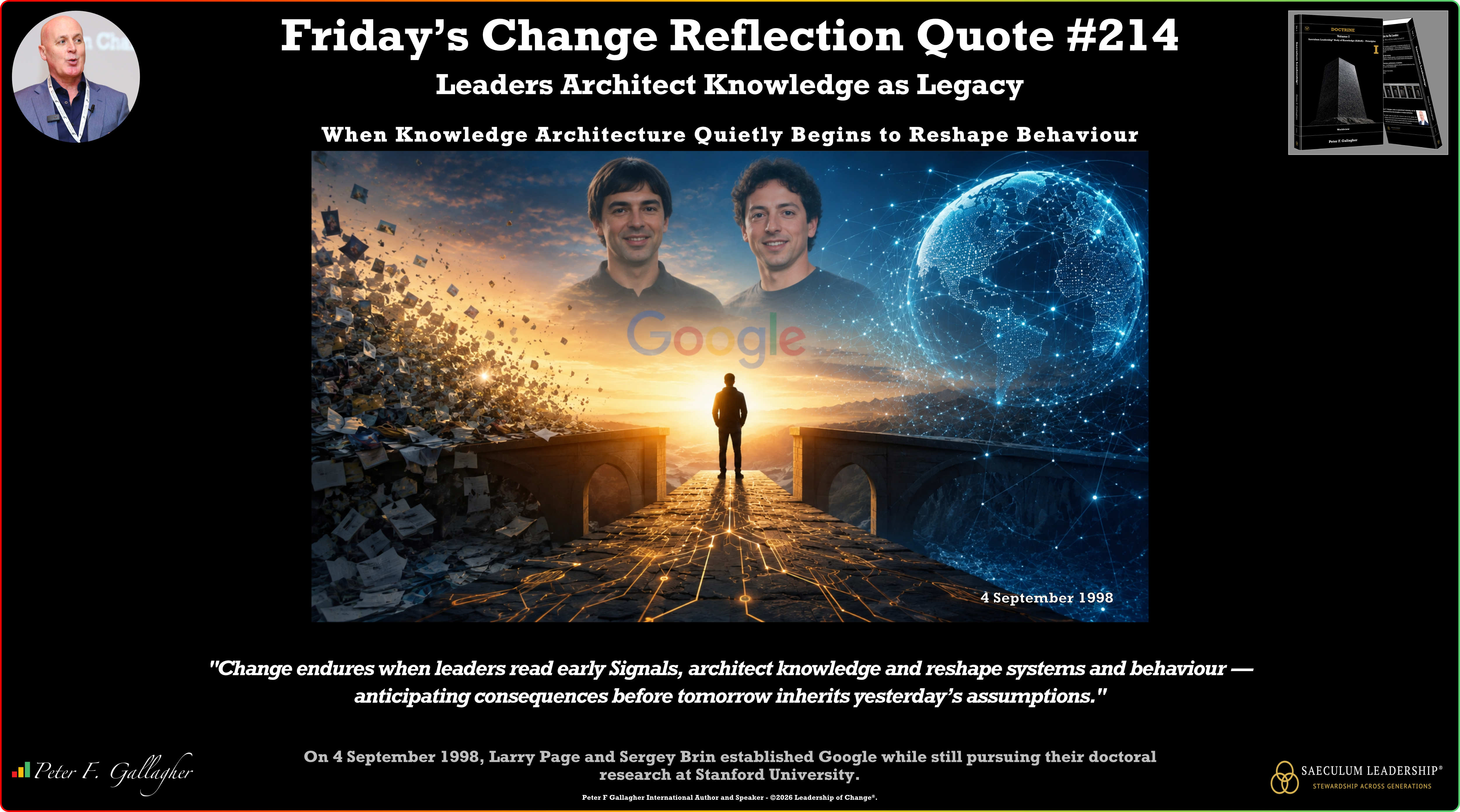
On 4 September 1998, Larry Page and Sergey Brin established Google while still pursuing their doctoral research at Stanford University. What began as an academic effort to improve how information could be discovered would eventually influence how billions of people accessed knowledge. The significance of Google’s emergence lies not merely in the creation of a successful technology company. Its deeper importance lies in changing the architecture through which information could be found, ranked, interpreted and increasingly used.
Page and Brin had developed PageRank while pursuing graduate research at Stanford University. Their approach examined relationships between web pages, using the structure of links to help determine relevance across the expanding World Wide Web. By changing how relevance was determined, the architecture influenced what people noticed, explored and ultimately considered important. Stanford records describe their work as developing from a research project into Google during 1998.
At that moment, the internet contained an expanding volume of information, but information alone did not create useful knowledge. The emerging challenge was helping people identify what mattered within an increasingly complex information environment. Google therefore represented an important architectural turning point because it addressed how knowledge could be organised and accessed at scale.
This distinction offers an important leadership insight. Major change does not always begin when leaders announce a new direction. Sometimes change begins when somebody redesigns the system through which people understand their environment and make decisions. Once behaviour begins adapting around a new architecture, the consequences can extend far beyond the original invention.
Google did more than improve search. It changed expectations about how quickly relevant information could be discovered and accessed. It reshaped assumptions about speed, accessibility and the availability of information. Individuals, organisations and institutions increasingly operated within an environment where relevant information could be discovered faster, accessed more widely and incorporated into decisions more readily. Architecture influenced behaviour, while changed behaviour created demand for further architectural change.
This demonstrates why leaders must look beyond visible events to recognise the underlying architectures already shaping future behaviour. Policies, strategies and communications remain important, but they are not the only forces shaping organisational direction. The systems through which knowledge moves can quietly influence decisions before leaders fully recognise their strategic significance.
The lesson is particularly relevant during periods of accelerating technological change. Leaders who focus exclusively on today’s visible tools may miss the deeper architectural transformation occurring beneath them. The critical question concerns how technology changes the architecture through which knowledge is created, shared, interpreted and converted into action.
Saeculum Leadership recognises that significant turning points often begin as Signals before their full consequences become visible. Google represented a Knowledge Architecture Signal because it changed the structures through which information was discovered, relevance was determined and knowledge was accessed — ultimately influencing behaviour, expectations and possibilities.
Saeculum Leadership® Lessons: This turning point invites a deeper leadership reflection on how knowledge architecture quietly shapes behaviour long before its consequences become visible. Saeculum Leaders change knowledge architecture before circumstances force behaviour to adapt without sufficient strategic direction. They recognise early Signals and act before emerging systems become established constraints on future organisational choices. Saeculum Leaders examine underlying architecture because visible events often reveal deeper behavioural changes already moving through systems. They shape systems that reinforce new behaviour until changed practices become embedded in organisational knowledge and operations. Saeculum Leaders anticipate how present decisions transmit knowledge, shape behaviour and create consequences beyond immediate leadership horizons. Leaders Architect Knowledge as Legacy.
“Change endures when leaders read early Signals, architect knowledge and reshape systems and behaviour — anticipating consequences before tomorrow inherits yesterday’s assumptions.”
From the Canon — Practice 5 — System Stewardship. Saeculum Leaders strengthen the systems that transmit knowledge, shape behaviour and outlast individual decisions. Google’s founding on 4 September 1998 illustrates how stewardship operates not at the level of tools, but at the level of architecture. When Page and Brin transformed an academic research project into a search engine, they were not merely improving access to information — they were redesigning the system through which people interpret their environment. System Stewardship teaches that leaders must recognise when emerging architectures begin influencing behaviour before their consequences become visible.
Stewardship requires examining how knowledge flows, how relevance is determined and how decisions are shaped by underlying structures. The leader’s responsibility is therefore not simply to manage knowledge, but to steward the architecture through which knowledge becomes consequential. Google’s PageRank model demonstrated how, once architecture changes, behaviour can adapt around it and become increasingly difficult to reverse. Saeculum Leaders intervene early, strengthening systems that support clarity, coherence and informed action. They understand that organisational stability depends less on statements and more on the invisible frameworks guiding how people learn, decide and act.
By stewarding knowledge architecture, leaders create systems that transmit their judgement beyond their tenure. What they build becomes part of what future leaders inherit. They shape systems that reinforce new behaviour, prevent drift and transmit disciplined understanding across generations. This is the work of leaders who build what tomorrow will inherit rather than simply preserving what yesterday left behind.
The Stewardship Reflection Lens:
What are we inheriting? We inherit systems already shaping how people interpret their environment and make decisions.
How should we steward it? We steward systems by strengthening the architectures that transmit clarity, relevance and disciplined knowledge.
What legacy are we creating? We create legacy when the systems we build continue guiding behaviour long after our leadership ends.
Further Reading: Saeculum Leadership® Body of Knowledge (SLBoK). Saeculum Leadership®: Doctrine – Volume I.
Peter F. Gallagher is the Founder–Architect of Saeculum Leadership®, a doctrine of generational stewardship that equips leaders to strengthen what they inherit and shape what future generations receive. A 21-book author, global keynote speaker, and trusted advisor to boards, CEOs, and executive leadership teams, he helps organisations strengthen leadership capability, institutional stewardship, and transformational change in an increasingly complex world.
For further insights please visit our websites: https://www.a2b.consulting https://www.peterfgallagher.com Amazon.com: Peter F Gallagher: Books, Biography, Blog, Audiobooks, Kindle
Saeculum Leadership® Body of Knowledge (SLBoK): Volumes 1-10.A-E & 0, I-V
~ Leadership of Change® Volume 1 - Change Management Fables
~ Leadership of Change® Volume 2 - Change Management Pocket Guide
~ Leadership of Change® Volume 3 - Change Management Handbook
~ Leadership of Change® Volume 4 - Change Management Leadership
~ Leadership of Change® Volume 5 - Change Management Adoption
~ Leadership of Change® Volume 6 - Change Management Behaviour
~ Leadership of Change® Volume 7 - Change Management Sponsorship
~ Leadership of Change® Volume 8 - Change Management Charade
~ Leadership of Change® Volume 9 - Change Management Insanity
~ Leadership of Change® Volume 10 - Change Management Dilenttante
~ Leadership of Change® Volume A - Change Management Gamification - Leadership
~ Leadership of Change® Volume B - Change Management Gamification - Adoption
Keywords: Business Strategy, Change Management, Leadership
 Two Clocks, One Truck: The Army's Need for Speed Meets New Defense Sourcing Rules
 Sustainable Transformation: The Elephant and The Mouse In The Room
 The Price of Standing Alone: Strategic Autonomy in a World Where Nobody Can Do It Alone
 The Potter’s Hands: Why Great Leaders Shape Environments, Not People
 The Corix Partners Friday Reading List - October 16, 2026