Jan18
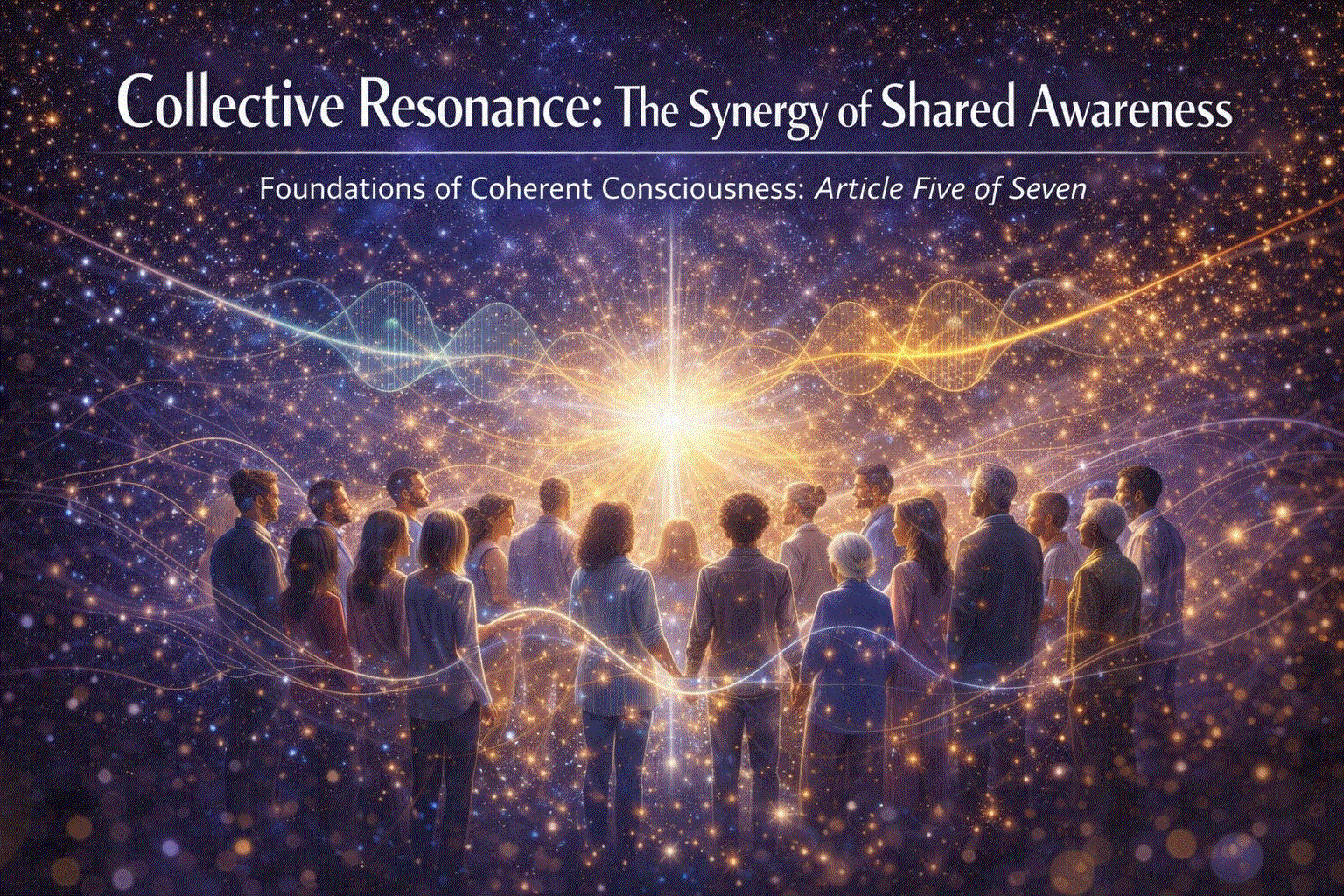
If consciousness is sustained through coherence rather than generated by isolated structures, then it cannot be confined to the individual alone. Coherence, by its nature, is relational. It emerges wherever systems synchronize, align, and participate in shared patterns of meaning. This invites a larger question: how does consciousness behave when coherence is shared across people?
Human experience already offers clues.
Moments of deep connection—whether in music, sport, ceremony, collaboration, or crisis—often carry a palpable sense of “more than me.” Time seems to stretch or compress. Communication becomes intuitive. Action flows without deliberation. Participants frequently describe these experiences as collective, unified, or field-like, even though individuality remains intact.
These are not anomalies. They are expressions of collective resonance.
In systems science, resonance occurs when multiple oscillators synchronize, reinforcing one another rather than competing. This principle applies across domains: pendulums align, heart rhythms entrain, fireflies synchronize their light. When coherence emerges, the system behaves as a whole rather than as fragmented parts.
Human beings are no exception.
Each individual is already a coherence system—biological, neurological, emotional. When individuals interact under the right conditions—shared intention, safety, rhythm, and meaning—their internal coherence can couple. The result is not fusion or loss of self, but phase alignment across distinct participants.
This helps explain why groups can think, feel, and act in ways that no single member could generate alone.
Collective intelligence, group flow states, and emergent creativity arise not from hierarchy or control, but from relational alignment. When communication is clean and attention is shared, information moves with minimal friction. Decision-making accelerates. Trust increases. Meaning becomes self-reinforcing.
Importantly, collective resonance does not require uniformity.
Just as harmony in music depends on distinct notes rather than sameness, coherent groups preserve diversity while aligning around shared rhythms. Difference becomes an asset rather than a threat when coherence is high. This is why the most resilient teams, cultures, and movements are those that balance individuality with shared purpose.
The same hydrogen-mediated principles explored earlier remain at work here.
Human bodies are water-rich systems sensitive to emotional tone, breath, posture, and environmental cues. Mirror neurons, vocal rhythms, facial expressions, and subtle physiological signals allow coherence to spread rapidly across groups. These are not abstract social constructs; they are embodied, biological processes that enable shared states of awareness.
This reframes social phenomena in powerful ways.
Conflict can be understood as disrupted coherence rather than moral failure. Polarization reflects competing rhythms that cannot entrain. Healing and reconciliation become processes of restoring resonance rather than enforcing agreement. Leadership shifts from command-and-control to coherence stewardship—holding conditions that allow alignment to emerge.
At larger scales, collective resonance shapes culture itself. Narratives, rituals, symbols, and shared values function as coherence carriers, enabling millions of individuals to participate in common fields of meaning across time and space. When these carriers are healthy, societies adapt and evolve. When they fragment, confusion and instability follow.
Seen this way, consciousness is not merely personal, nor purely abstract. It is distributed, relational, and scalable. It arises wherever coherence is sustained—within individuals, among groups, and across civilizations.
This realization carries responsibility.
If our inner coherence contributes to collective fields, then personal regulation is not a private matter alone. How we attend, speak, listen, and act shapes the resonance we share. Citizenship, in this sense, becomes an act of consciousness participation.
In the next article, we will extend this understanding further—beyond groups and societies—to the planetary scale. We will explore how shared coherence relates to water, air, ecosystems, and the living systems that sustain human life itself.
Collective resonance is not an abstraction. It is already happening—whenever alignment replaces noise, and relationship replaces fragmentation.
By Zen Benefiel
Keywords: Future of Work, Leadership, Sustainability
 You are not your diagnosis
 Is GenAI good for anything?
 “I didn’t write an award acceptance speech because I didn’t expect to win.”
 AI Is Exposing the Data Problems Humans Used to Hide
 "The AI may in fact be conscious." Really?