At a Glance
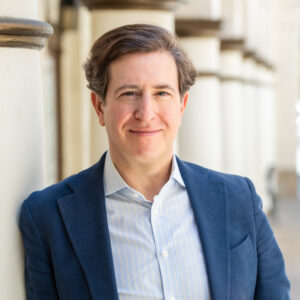
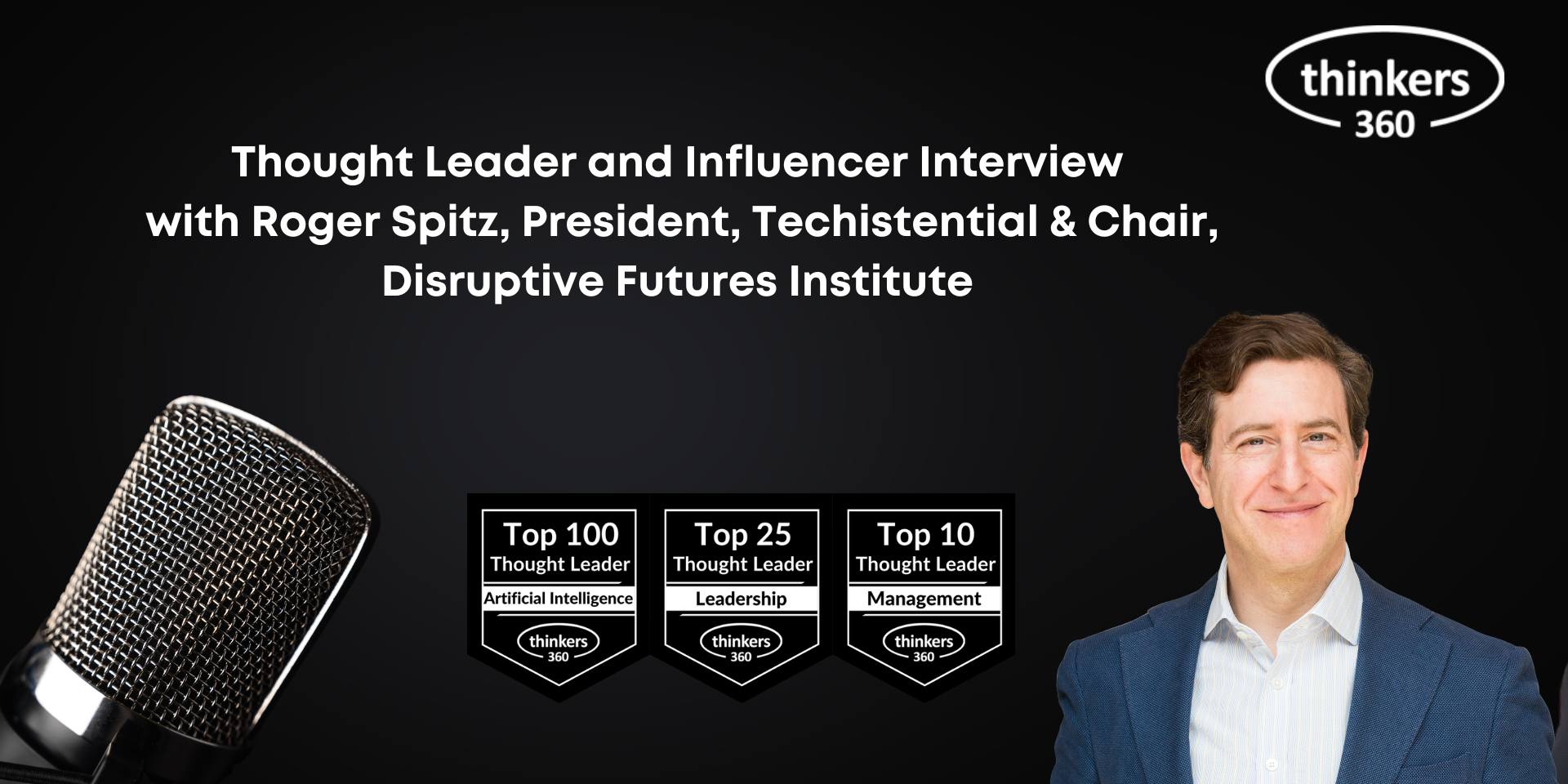
Roger Spitz, President, Techistential & Chair, Disruptive Futures InstituteFocus Areas: AI, Business Strategy, Management, Leadership Thinkers360 In-Depth Profile & Portfolio: Roger Spitz Bestselling Book: “Disrupt With Impact: Achieve Business Success in an Unpredictable World”, CNN Interview: “Can AI Predict the Future?” Roger Spitz CNN Interview Highlighted Content: Disruptive Futures Institute Names “Metaruptions” 2026 Word of the Year, Foresight is Dead. Long Live Foresight. How Can Futurists Shape a Future Already Colliding with the Present?. Thinkers360 Leaderboards: Thinkers360 Top Voices North America 2025, Top 50 Global Thought Leaders and Influencers on Creativity 2025. |
Thought Leader and Influencer Interview
Thinkers360 thought leader interviews profile prominent members of the Thinkers360 community who embody the power of ideas in their work. In this edition, we speak with Roger Spitz, President of Techistential and Chair, Disruptive Futures Institute.
Roger, is an award-winning author, futurist speaker, and global authority on systemic disruption, the future of leadership, and strategic foresight. He advises CEOs, boards, and investors on navigating uncertainty, anticipating disruption, and creating sustainable value. A trusted advisor to the World Economic Forum’s Global Foresight Network, Roger is also a leading voice on artificial intelligence, decision-making, and climate foresight. He is the author of five bestselling and award-winning books, including Disrupt With Impact, and is internationally recognized for shaping how organizations lead and thrive in an unpredictable world.
Roger is featured in Thinkers360 Top Voices North America 2025 and Top 50 Global Thought Leaders and Influencers on Creativity 2025, among other distinctions.
Brands, Organizations & Startups: Sign up to find and work with advisors, analysts, authors, influencers and speakers in your niche and to amplify your own executives, thought leaders, and content among our opt-in B2B decision maker, analyst and influencer community with 100M+ followers on social media combined! We specialize in B2B thought leadership marketing, B2B influencer marketing, B2B strategic marketing, and B2B analyst and influencer relations putting your brand in front of active B2B buyers, analysts and influencers worldwide. Our enterprise clients average 10X ROI on amplification! – Explore membership today!
Thought Leaders, Analysts & Influencers: To join the world’s largest opt-in B2B thought leader community and influencer marketplace, participate in our thought leadership leaderboards, earn our world-renowned digital award badges and credentials, blog on the #1 thought leadership blog on the Web, and build, amplify and monetize your professional brand – Sign-up today!
Readers & Writers: To contribute your own content and to browse amazing content – including articles/blogs, books, interviews, podcasts and videos, from our opt-in B2B thought leader, analyst and influencer community – Join Thinkers360 today!
Thinkers360: Could you please share some insights into your background and areas of expertise?
RS : My background sits at the intersection of investment banking and existential philosophy, which eventually led me toward strategic foresight. I spent two decades advising on strategic transactions, including serving as Global Head of Technology M&A at BNP Paribas. Over that period, I worked on more than 50 transactions totaling $25 billion, launched the bank’s U.S. technology M&A practice in San Francisco, and helped establish its European Technology & Digital platform in London and Paris.
Although that career offered stability, I was increasingly drawn to questions rooted in complexity, agency, and contingency – ideas that have influenced me since studying Heidegger and Kierkegaard. These interests made the shift toward foresight feel natural.
Today my work centers on what I call Techistentialism, which explores the interplay between technology, complexity, and existential philosophy. I focus on artificial intelligence, systemic change, and how organizations navigate uncertainty. I serve as President of Techistential and Chair of the Disruptive Futures Institute, and I’ve written five books, including The Definitive Guide to Thriving on Disruption and Disrupt With Impact. Much of my practice explores how organizations operate in an UN-VICE world: one that is UNknown, Volatile, Intersecting, Complex, and Exponential.
Thinkers360: What are your current responsibilities, and could you describe a typical day?
RS: My focus centers on building capacity for resilience and foresight. I lead the Disruptive Futures Institute, a global education platform and think tank focused on making future preparedness accessible. I also serve as a venture partner at Berkeley SkyDeck and Vektor Partners, working with founders and investors across AI and deep tech. In parallel, I contribute to the World Economic Forum’s Global Foresight Network and the AI Global Alliance.
A “typical day” is hard to define, but most days involve moving between detail and context:
- Scanning and Sensemaking: I look for weak signals rather than the loudest trends. This often involves reading widely, observing how developments in fields like BioTech and AI converge, and noticing shifts in geopolitics, geoeconomics, technological, and societal assumptions.
- Advising and Teaching: I work with CEOs, boards, and investors on strategic decisions related to anticipating disruption and creating sustainable value, often drawing on the Disruptive Futures Institute’s AAA framework (Antifragile, Anticipatory, Agility).
- Ecosystem Engagement: I regularly interact with academic groups, think tanks, and startups. This includes work with the DFI Nature & Climate Academy and ongoing research and writing collaborations.
Thinkers360: What is the most rewarding aspect of your current role?
RS: I love shaping systems and contributing to outcomes that cause a meaningful impact. My earlier career in banking was significant and purposeful, but foresight allows for a deeper alignment between philosophy and practice.
I’m particularly drawn to the “Inspiration” dimension of our 6 i’s framework (Intuition, Inspiration, Imagination, Improvisation, Invention, and Impossible). Inspiration often emerges at the intersections of disciplines, where we can turn foresight into tangible systems innovation.
A powerful example of this is my collaboration with LuxCS, Brazil’s first voluntary carbon market (VCM) certifier. Through the Disruptive Futures Institute and Techistential, I spent years working with LuxCS to transform the VCM landscape. We focused on improving both the perception and effectiveness of carbon offset programs by applying cultural, technical, and regulatory levers. While market growth was important, we fostered a commitment to conservation, performance, and quality assurance. This meant strengthening market integrity while democratizing access for everyone from local landowners to global buyers.
Thinkers360: How do you leverage the Thinkers360 platform to achieve your professional goals?
RS: Platforms like Thinkers360 support cross-pollination and expand access to ideas. I enjoy helping others develop foresight capabilities of their own, and I engage with the platform in several ways in that regard.
For instance, the Disruptive Futures Institute was built to be global and accessible, and Thinkers360 helps extend that reach. Innovation often comes from encountering different viewpoints, and the Thinkers360 ecosystem helps me connect with diverse thinkers.
Thinkers360 is one of the most respected B2B thought leadership platforms. It uses a patented algorithm to assess organizational influence based on original, research-backed outputs – including articles, talks, case studies, and frameworks – which allows leaders to showcase their work to interested organizations.
It is always an honour to be recognized by Thinkers360 for the originality of our frameworks, the practicality of our tools, and our deep interdisciplinary approach – blending strategy with systems thinking, complexity science, anticipatory leadership, design fiction, and Eastern philosophy.
Editor’s Note: See Roger Spitz’s profile to work with him directly.
RS: I look for brand collaborations that are built on strategic alignment and shared values rather than on transactional goals. I work best with organizations that see disruption as continuous and that are willing to view business models as interconnected systems – particularly when addressing climate, energy, or broader transitions. Additionally, I value clarity, candor, and constructive disagreement. Healthy collaboration allows room for real debate.
I prefer partners who want to experiment and build systems that benefit from volatility rather than simply withstand it. How can we make an impact together despite – or thanks to – inevitable shocks?
If someone is seeking a linear forecast or a predetermined answer, the collaboration is unlikely to be productive. But if they’re willing to explore alternative futures and ask “why?”, “what if?”, and “so what?”, there is usually meaningful work to do together.
Thinkers360: What is your key piece of advice for aspiring thought leaders?
RS: Advice is becoming less replicable. Relying on experts and their advice is less helpful now than ever, and their helpfulness continues to decrease. We are not arguing for the systematic dismissal of expertise; rather, we can no longer delegate our decisions and rely on experts alone for all the answers. In the words of the Royal Society, nullius in verba (“take nobody’s word for it”).
In contrast to advice, our UN-VICE (UNknown, Volatile, Intersecting, Complex, Exponential.) is not a suggestion of behavior or a mandate. Instead, our UN-VICE is a way to decipher changing circumstances imaginatively. All advice should be carefully considered, combined with an emphasis on developing and trusting our own capabilities.
In our increasingly UN-VICE world, the value of recommendations is rapidly decreasing. Systemic disruption has devalued ad-vice; instead, we offer our best UN-VICE. Inspired by Richard Feynman, we must explore unanswered questions, rather than adhering to unquestionable answers.
Zen Master Suzuki Roshi said “In the beginner’s mind there are many possibilities, but in the expert’s there are few.” Our UN-VICE draws from the three stages of the Japanese martial arts concept shuhari. In the first stage, shu, the student masters the established fundamentals. In the second stage, ha, the learner practices and experiments with novel approaches, guided by their own unique perspectives. In the third stage, ri, they break loose from confining rulebooks to adapt freely to any situation. Shuhari is a journey, a continuous process of learning, experimenting, and letting go.
Thinkers360: What are the main risks and opportunities associated with using AI in strategic decision-making?
RS: At the Disruptive Futures Institute, we frame AI in strategic decision-making through the concept of Techistentialism – the recognition that technological and existential conditions are inseparable. Just as existential philosophy emphasizes human agency, choice, and contingency, Techistentialism examines how these qualities are challenged by our increasingly autonomous technological systems. AI is no longer a neutral tool; it shapes outcomes and influences decisions, raising questions about whether humans retain the freedom to act and define their own essence in a rapidly evolving world.
AI offers opportunities to extend human capabilities – from revealing patterns at scale to accelerating drug discovery through “infinite” simulations. When integrated thoughtfully, it can support decision-making that is Anticipatory, Antifragile, and Agile (AAA), enabling organizations to connect short-term actions with long-term strategy while preserving human judgment and creativity. In this sense, AI becomes a partner in exploration, not a replacement for human agency.
At the same time, the risks are existential. Delegating prescriptive decisions to algorithms can erode human skills and judgment, leading to what we call “superstupidity” – a reliance on technology without understanding its limits or consequences. Errors in complex systems, misalignment, or poor data can cascade into irreversible outcomes, curtailing our ability to exercise choice and act meaningfully. The existential risk today is not that AI becomes superintelligent, but that humans begin to behave like idle machines, losing curiosity, critical thinking, and the capacity to engage with systemic complexity. Managing AI responsibly, therefore, requires preserving human oversight, nurturing ongoing learning, and maintaining the space for contingency, agile sense-making, and creative decision-making.
RS: In the early stages of COVID-19, BlueDot, a Canadian company that uses natural language processing and machine learning to monitor the spread of diseases, detected the virus before the US Center for Disease Control.Neural networks trained to find first signs of breast cancer using large numbers of mammographic images proved effective for early and accurate detection. Companies scrape social media sites to detect emerging brands and competitors before they reach peak visibility. Geospatial analytics mine digital imagery to predict trends ranging from crop yields to construction rates of Chinese buildings.
AI already surpasses the human ability to detect trends. We see AI superiority in detection, collection, and interpretation at scale. This complicated domain involves linear environments where cause-and-effect relationships are understandable and expertise can solve the given problem using defined parameters.
The complex domain, however, is characterized by deep uncertainty, nonlinear dynamics, and interconnected feedback loops, where cause-and-effect can only be understood in retrospect. Patterns become increasingly hard to interpret, and critically, there is no instruction manual. Complex challenges – such as emerging technologies, climate change, geopolitical dynamics, and societal shifts – require emergent practices and a process of discovery.
In analyzing the evolution of machine involvement, one thing is clear: AI is playing a greater role at every stage of the decision-making process. AI is taking over areas that we previously thought were too important to entrust to machines.
This said, irrationality may be our edge. It may be that, because humans do not algorithmically calculate, that we are able to spontaneously tap into kinesthetic, emotional, or other decision-making modes. In this way, our irrationality and emotional decision-making could give us an edge over computers, especially in complex environments.
###
Join us on Thinkers360 — Connecting Global Brands with the World’s Foremost Thought Leaders, Analysts and Influencers for Game-Changing Results!
Thinkers360 is the world’s first, largest and premier B2B thought leader and influencer marketplace — including academics, advisors, analysts, authors, consultants, executives, influencers and speakers — with over 100M followers on social media combined. We are differentiated by our unique patented algorithms that measure thought leadership and authentic influence looking far beyond social media alone.
Brands, Organizations & Startups: Sign up to find and work with advisors, analysts, authors, influencers and speakers in your niche and to amplify your own executives, thought leaders, and content among our opt-in B2B decision maker, analyst and influencer community with 100M+ followers on social media combined! We specialize in B2B thought leadership marketing, B2B influencer marketing, B2B strategic marketing, and B2B analyst and influencer relations putting your brand in front of active B2B buyers, analysts and influencers worldwide. Our enterprise clients average 10X ROI on amplification! – Explore membership today!
Thought Leaders, Analysts & Influencers: To join the world’s largest opt-in B2B thought leader community and influencer marketplace, participate in our thought leadership leaderboards, earn our world-renowned digital award badges and credentials, blog on the #1 thought leadership blog on the Web, and build, amplify and monetize your professional brand – Sign-up today!
Readers & Writers: To contribute your own content and to browse amazing content – including articles/blogs, books, interviews, podcasts and videos, from our opt-in B2B thought leader, analyst and influencer community – Join Thinkers360 today!
Want to find and work with the world’s premier B2B advisors, analysts, authors, consultants, influencers and speakers (including access to our unique thought leader profiles and portfolios, in-depth reports and analytics, warm personal introductions, and our zero-transaction fee speaker bureau)?
Contact us to discuss any of your project needs at info@thinkers360.com
For advertising and sponsorship opportunities, please contact info@thinkers360.com.