Jan16
Boards operate under sustained pressure. Decisions are made with incomplete information, competing priorities, and limited time for reflection. In this environment, the ability to surface challenge before decisions harden becomes a governance capability rather than a cultural preference.
Recent discussions with Board Chairs, including a Chair roundtable delivered with NEDonBoard, reinforced a consistent pattern. When boards struggle to challenge, escalate, or decide well, the cause is rarely a lack of competence or commitment. The constraint sits in the conditions created around the table.
Psychological safety at board level matters because it shapes what enters the decision space and what remains unspoken. It determines whether emerging risks are surfaced early or absorbed silently into delivery. It influences whether governance enables judgement or replaces it with process. For Chairs, this is not an abstract leadership topic. It is a structural and behavioural responsibility embedded in how the board is designed and led.
Psychological safety at board level is not a mindset and not a cultural aspiration. It is an outcome produced by design, behaviour, and discipline.
Boards that fail to surface challenge usually operate within structures that quietly suppress it. Board size influences airtime and accountability. Oversized board packs prioritise consumption over judgement. Process can either create space for debate or displace it when it substitutes for thinking.
Chairing itself is a capability. The role is to enable challenge without losing focus, contain debate without neutralising dissent, and close decisions without shutting learning down. This requires active listening, synthesis of competing perspectives, and disciplined redirection from operational detail back to board-level judgement.
Where these conditions are absent, silence is misread as alignment and procedural order is mistaken for effectiveness.
The manifestation is rarely dramatic. It appears through ordinary board mechanics.
Discussion drifts into detail that belongs outside the boardroom. Time pressure shortens exploration. Directors self-censor to preserve pace or harmony. Risk issues are framed as delivery problems rather than decision signals.
Behaviour reinforces the pattern. Making issues personal narrows debate quickly. Inquisitiveness builds insight. Nosiness erodes trust. Empathy supports governance. Sympathy clouds judgement. These distinctions matter because they shape whether directors feel able to contribute without being exposed.
Role clarity is equally decisive. Conflicts of interest distort challenge. Blurred boundaries between Chair and Chief Executive weaken both roles and reduce productive tension. Authority must remain clean for candour to survive.
What happens outside the boardroom also matters. Deliberate off-board conversations enable sharper on-board debate. Avoiding them increases the likelihood of performative discussion or unresolved tension in the meeting itself.
Risk does not accumulate through a single failure of courage. It accumulates through repetition.
Each meeting where challenge is deferred narrows future debate. Each decision taken without testing assumptions increases delivery fragility. Each instance where process replaces judgement reinforces the pattern.
Self-awareness emerges as a recurring constraint. How directors show up under pressure shapes the quality of governance. Emotional intelligence at board level is not optional. The Chair is the primary lever for enabling reflection, moderating behaviour, and resetting dynamics when pressure distorts contribution.
Over time, silence becomes structural. By the time issues surface, options are limited and consequences are larger.
Governance has power when it supports judgement rather than replacing it. Board effectiveness is measured by the quality of decisions made under uncertainty, not procedural compliance.
For Chairs, psychological safety is not about comfort. It is about making challenge usable before decisions are locked in. This requires attention to board design, disciplined chairing behaviour, and clarity of roles inside and outside the room.
When these elements align, boards gain earlier insight, better escalation, and stronger decision ownership. When they do not, risk migrates into execution where it becomes harder to govern.
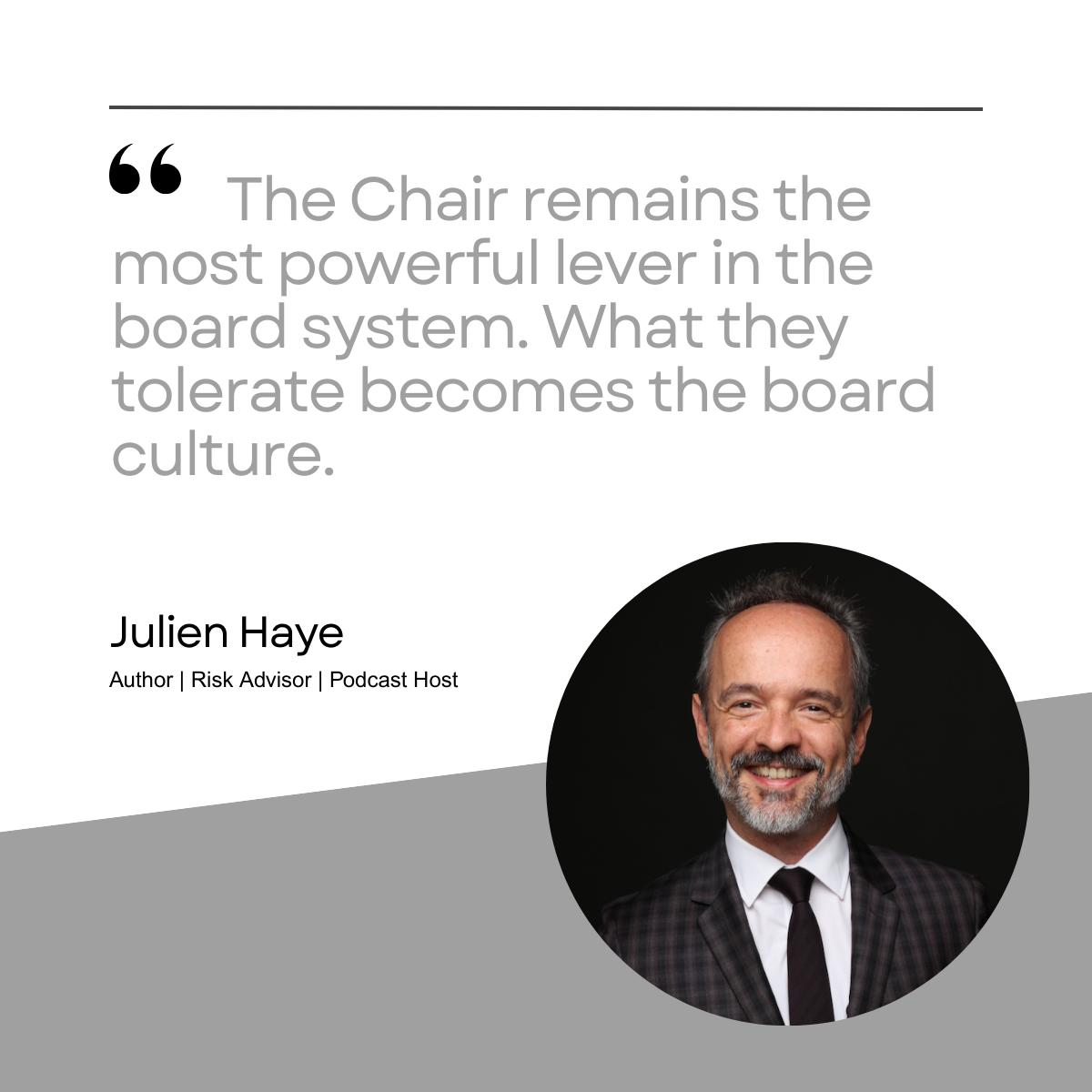
The Chair remains the most powerful lever in that system because they shape the conditions under which governance either enables or suppresses judgement.
Boards do not fail because directors lack intent. They fail when the system teaches them to stay silent.
Psychological safety at board level is produced deliberately through design, behaviour, and disciplined leadership. When Chairs treat it as a governance capability, challenge becomes usable, decisions improve, and risk is addressed while it is still malleable.
By Julien Haye
Keywords: Culture, Leadership, Management
 You are not your diagnosis
 Is GenAI good for anything?
 “I didn’t write an award acceptance speech because I didn’t expect to win.”
 AI Is Exposing the Data Problems Humans Used to Hide
 "The AI may in fact be conscious." Really?