Jan16
FCRQ181 Leadership Learning!
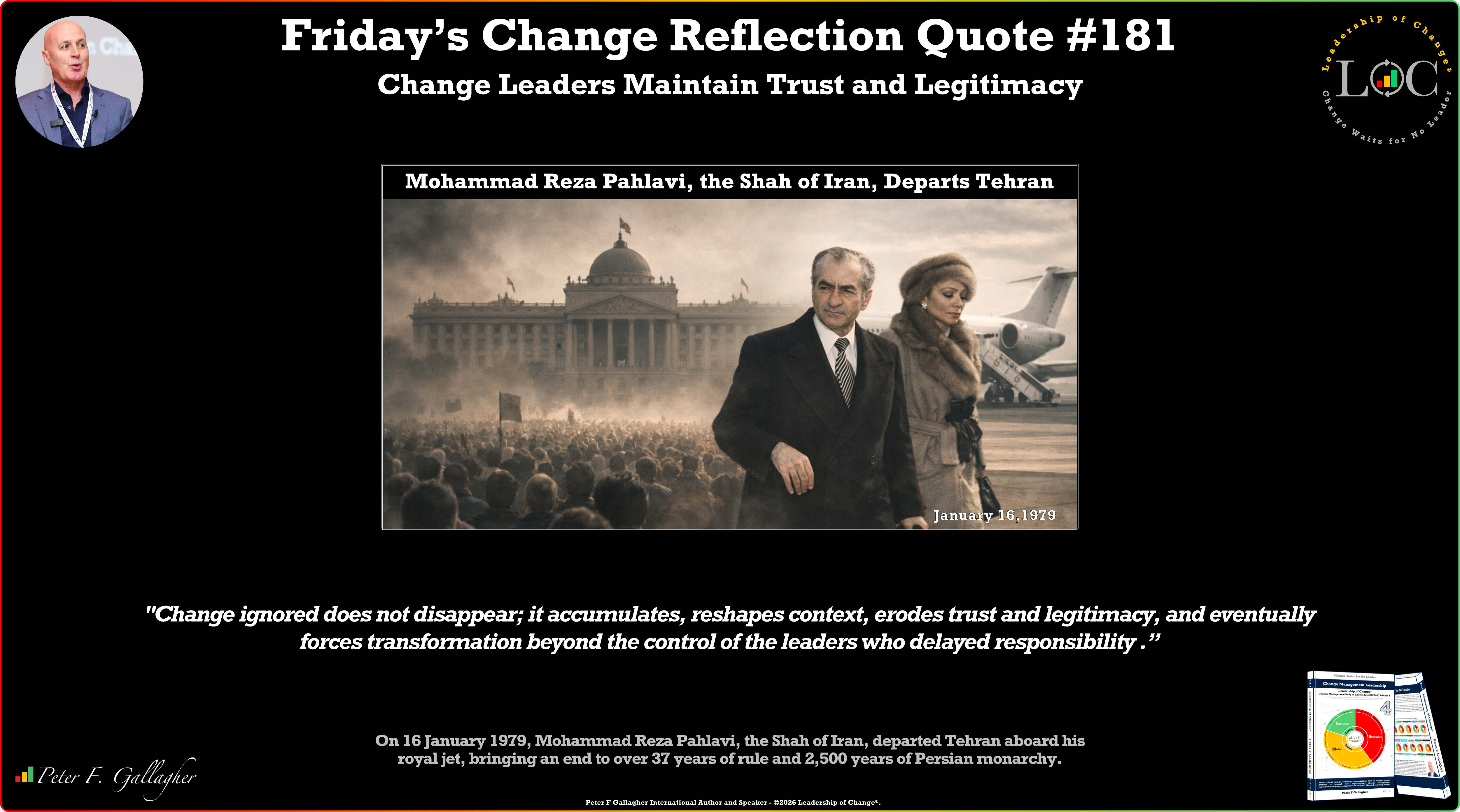
On 16 January 1979, Mohammad Reza Pahlavi, the Shah of Iran, departed Tehran aboard his royal jet, bringing an end to over 37 years of rule and 2,500 years of Persian monarchy. The departure followed months of escalating demonstrations, strikes, and civil unrest that had paralysed the nation and undermined the foundations of his authority. He assumed power in 1941 after the Allied powers forced the abdication of his father, Reza Shah, whose pro-German sympathies during World War II had alarmed Britain and the Soviet Union. His reign became characterised by ambitious modernisation programmes, including land reforms, women's suffrage, and rapid industrialisation funded by oil revenues. In 1953, a CIA and MI6-backed coup overthrew Prime Minister Mohammad Mossadegh, who had nationalised Iran’s oil industry. The Shah was reinstated with expanded powers, deepening public resentment and embedding foreign influence at the heart of Iran’s governance. However, these reforms were accompanied by increasing authoritarianism through SAVAK, the secret police, which became notorious for suppressing political dissent. The White Revolution of the 1960s, whilst bringing economic development, alienated traditional religious authorities and rural populations who felt disconnected from the pace and nature of change being imposed from above. By 1978, economic inequality had widened despite oil wealth, whilst corruption was perceived as rampant among the elite, creating a revolutionary situation. Religious leaders, particularly Ayatollah Ruhollah Khomeini exiled in France, gained influence through cassette recordings distributed throughout mosques. The urban middle class, intellectuals, and bazaar merchants united with religious conservatives in opposition. When government forces fired upon demonstrators in September 1978, killing over a hundred in what became known as Black Friday, the fragile legitimacy of the regime shattered irreversibly. The final months of 1978 witnessed general strikes that crippled oil production, the lifeblood of the Iranian economy. Civil servants refused to work, and the military's loyalty wavered. Western allies, particularly the United States, remained uncertain, caught between supporting a strategic partner and recognising inevitable collapse. The Shah's attempts at conciliation, including appointing opposition figures to government positions, came too late to stem the tide. When the Shah left Iran for what was officially described as a holiday to Egypt, few believed he would return. His departure created a power vacuum that Khomeini swiftly filled, returning from exile on 1 February 1979 to establish the Islamic Republic. The revolution transformed not only Iran but reshaped regional geopolitics for decades. The events of January 1979 reveal profound truths about institutional fragility and the limits of imposed transformation. The Shah's departure marked not merely the end of a dynasty but the culmination of systemic failures in governance, communication, and legitimacy. What appeared from outside as sudden collapse had been building through years of accumulated grievances, suppressed voices, and widening gaps between rulers and ruled. The Shah’s departure was a Signal — a moment that revealed the fragility of imposed transformation and the consequences of ignoring accumulated grievance. It marked a Saeculum shift, where one generational order collapsed and another emerged. Leaders of change must learn to read such signals early and lead with the humility, foresight, and cultural resonance that Saeculum LeadershipTM demands. The revolution illustrated how economic progress alone cannot substitute for political participation, how repression breeds resistance, and how institutions that lose touch with those they govern become hollow structures vulnerable to collapse under unified opposition.
Change Leadership Lessons: The Shah's fall offers enduring lessons about the architecture of sustainable transformation. Leaders of change succeed when they seek input from affected groups before finalising plans rather than imposing predetermined solutions on those they serve. They must create safe channels that allow people to raise concerns without fear of retribution or career damage from speaking truthfully. Change leaders build credibility through consistent follow-through on commitments over time, making it possible to implement difficult changes when circumstances demand swift action. They design benefit distribution to create broad stakeholder support by ensuring that improvements reach diverse groups rather than concentrating advantages among the privileged. Leaders of change ground transformation in values that resonate authentically by connecting to genuine needs and cultural contexts rather than imposing externally driven programmes. Change Leaders Maintain Trust and Legitimacy.
“Change ignored does not disappear; it accumulates, reshapes context, erodes trust and legitimacy, and eventually forces transformation beyond the control of the leaders who delayed responsibility.”
Application. Change Leadership Responsibility 1 - Articulate a Change Vision: The fall of the Shah demonstrates how organisations falter when leaders anchor future direction in imposed modernisation agendas rather than authentic societal realities. Articulating a credible change vision requires leaders to define the future experience the organisation is committed to deliver before widespread resistance forces reactive concessions. When leaders ground vision in stakeholder insight and cultural awareness, they create coherence, discipline, and alignment across the organisation. This approach does not deny uncertainty or complexity. It acknowledges them while remaining unequivocal about direction. A disciplined change vision becomes the reference point that guides judgement, exposes misalignment, and prevents strategic drift as conditions evolve. Leadership of change demands that leaders use vision to anchor transformation in shared values, ensuring organisational energy flows towards futures shaped by understanding rather than imposition.
Final Thoughts: Sustainable transformation requires leaders who maintain legitimacy through continuous dialogue, transparent decision-making, and equitable benefit distribution. As AI and digital transformation accelerate organisational change, the risk of imposed, technology-driven solutions disconnected from human needs increases exponentially. Leadership that maintains trust amidst disruption remains the enduring differentiator between transformation that succeeds and change that collapses under the weight of accumulated grievance.
Further Reading: Change Management Leadership - Leadership of Change® Volume 4.
For further reading please visit our websites: https://www.a2b.consulting https://www.peterfgallagher.com Amazon.com: Peter F Gallagher: Books, Biography, Blog, Audiobooks, Kindle
Leadership of Change® Body of Knowledge Volumes: Change Management Body of Knowledge (CMBoK) Books: Volumes 1, 2, 3, 4, 5, 6, 7, 8, 9, 10, A, B, C, D & E available on both Amazon and Google Play:
~ Leadership of Change® Volume 1 - Change Management Fables
~ Leadership of Change® Volume 2 - Change Management Pocket Guide
~ Leadership of Change® Volume 3 - Change Management Handbook
~ Leadership of Change® Volume 4 - Change Management Leadership
~ Leadership of Change® Volume 5 - Change Management Adoption
~ Leadership of Change® Volume 6 - Change Management Behaviour
~ Leadership of Change® Volume 7 - Change Management Sponsorship
~ Leadership of Change® Volume 8 - Change Management Charade
~ Leadership of Change® Volume 9 - Change Management Insanity
~ Leadership of Change® Volume 10 - Change Management Dilenttante
~ Leadership of Change® Volume A - Change Management Gamification - Leadership
~ Leadership of Change® Volume B - Change Management Gamification - Adoption
Keywords: Business Strategy, Change Management, Leadership
 You are not your diagnosis
 Is GenAI good for anything?
 “I didn’t write an award acceptance speech because I didn’t expect to win.”
 AI Is Exposing the Data Problems Humans Used to Hide
 "The AI may in fact be conscious." Really?