



Strategic Risk Leader | Advisor | Author | Speaker | Board Chair & NED
Julien Haye is a strategic risk leader and trusted board advisor with over 26 years of experience in financial services and purpose-driven organisations. He is the Managing Director of Aevitium LTD, where he helps boards and executives embed risk as a driver of strategy, culture, and sustainable performance.
Julien’s expertise spans enterprise risk management, governance frameworks, operational resilience, and regulatory readiness, with a strong focus on building high-integrity control environments and cultures of psychological safety. He has supported global institutions, fintech scale-ups, and non-profits, combining regulatory insight with behavioural science to deliver practical transformation.
He is the author of The Risk Within, host of the CPD-accredited RiskMasters podcast, and creator of the Risk Governance Principles Library. A regular keynote speaker and industry contributor, Julien influences the debate on risk, compliance, and ethical leadership through conferences, advisory boards, and thought leadership platforms.
As an independent chair and trustee, Julien brings governance expertise to organisations in financial services, housing, and the non-profit sector, ensuring resilient strategies and accountable decision-making.
Available For: Advising, Authoring, Consulting, Influencing, Speaking
Travels From: London
Speaking Topics: Risk Management, Strategy, Culture, Diversity and Inclusion
| Julien Haye | Points |
|---|---|
| Academic | 10 |
| Author | 496 |
| Influencer | 73 |
| Speaker | 181 |
| Entrepreneur | 336 |
| Analyst | 0 |
| Total | 1096 |
Points based upon Thinkers360 patented algorithm.

Tags: Coaching, Diversity and Inclusion, Leadership
Tags: Culture, Diversity and Inclusion, Leadership
Tags: Culture, Diversity and Inclusion, Leadership
Tags: Culture, Diversity and Inclusion, Leadership
Tags: Culture, Diversity and Inclusion, Leadership
Tags: Culture, Diversity and Inclusion, Leadership
Tags: Culture, GRC, Risk Management
Tags: Culture, GRC, Risk Management
Tags: Culture, GRC, Risk Management
Tags: Culture, GRC, Risk Management
Tags: Culture, GRC, Risk Management
Tags: Culture, GRC, Risk Management
Tags: Culture, GRC, Risk Management
Tags: Culture, GRC, Risk Management
Tags: Culture, GRC, Risk Management
Tags: Culture, GRC, Risk Management
Tags: Culture, GRC, Risk Management
Tags: Culture, GRC, Risk Management
Tags: Culture, GRC, Risk Management
Tags: Culture, GRC, Risk Management
Tags: Culture, GRC, Risk Management
Tags: Culture, GRC, Risk Management
Tags: Culture, GRC, Risk Management
Tags: Culture, GRC, Risk Management
Tags: Culture, GRC, Risk Management
Tags: Culture, GRC, Risk Management
Tags: Culture, GRC, Risk Management
Tags: Culture, GRC, Risk Management
Tags: Culture, GRC, Risk Management
Tags: Culture, GRC, Risk Management
 Decision Timing Risk: When Delay Is Mistaken for Diligence
Tags: Business Strategy, Leadership, Risk Management
 Accountable. But Empowered?
Tags: GRC, Leadership, Risk Management
 Why Risk Strategy Starts with Trust
Tags: Culture, GRC, Risk Management
 Enterprise Awareness: How Boards See What No Function Can See Alone
Tags: Finance, GRC, Risk Management
The Cost of Unconnected Governance
Tags: GRC, Management, Risk Management
 When Recovery Isn't Enough
Tags: Business Continuity, GRC, Risk Management
 The hidden cost of leadership blind spots in risk decisions
Tags: GRC, Leadership, Risk Management
 Silence Is Still The Most Dangerous Signal In Risk Management
Tags: GRC, Leadership, Risk Management
 J Haye Risk Leadership Weekly: The Risks Your Teams See But Don’t Raise
Tags: Leadership, Risk Management
 J Haye Risk Leadership Weekly: The Gap Between How You Operate And What Risk Reporting Shows
Tags: GRC, Leadership, Risk Management
 J Haye Risk Leadership Weekly: A Board-level Test for Decision Ownership, Speed, and Consistency
Tags: GRC, Leadership, Risk Management
 J Haye Risk Leadership Weekly: The hidden cost of treating past decisions as current standards
Tags: GRC, Leadership, Risk Management
 J Haye Risk Leadership Weekly: When Decision Architecture Fails to Enforce Analytical Thinking
Tags: GRC, Leadership, Risk Management
 J Haye Risk Leadership Weekly: Why Authorised Risk Can Still Undermine Strategy
Tags: Culture, Leadership, Risk Management
 Non-Financial Risk as the Cultural Transmission System
Tags: Culture, Leadership, Risk Management
 Why Risk Escalation Fails and How Control Replaces Transparency
Tags: Culture, Leadership, Risk Management
 Leaders Don’t Experience Risk Culture
Tags: Culture, Leadership, Risk Management
 Season's Greetings
Tags: Culture, Leadership, Risk Management
 Third-Party Risk Management Policy: Framework, Standards, and Examples
Tags: Business Strategy, GRC, Risk Management
 How to Design and Implement a Risk Strategy
Tags: Business Strategy, GRC, Risk Management
 This Week on Aevitium: 13 Areas Every CRO Cant Afford to Miss
Tags: Culture, Leadership, Risk Management
 This Week on Aevitium: Resilience Fails for This One Reason — and It’s Not Tech.
Tags: Culture, GRC, Risk Management
 This Week on Aevitium: Is Your Strategy Built on Sand? The Risk Capacity Test
Tags: Culture, GRC, Risk Management
 This Week on Aevitium: Is Risk Tolerance the Missing Link Between Governance and Execution?
Tags: Culture, GRC, Risk Management
 This Week on Aevitium: Why Risk Appetite Still Sits on the Shelf
Tags: Business Strategy, Culture, Risk Management
 This Week on Aevitium: What Would Change if Risk Identification Was Treated as a Strategic Advantage?
Tags: Business Strategy, Culture, Risk Management
Tags: Business Continuity, GRC, Risk Management
Tags: GRC, Leadership, Risk Management
Tags: GRC, Leadership, Risk Management
Tags: Entrepreneurship, Leadership, Risk Management
Tags: Finance, Leadership, Risk Management
Tags: Creativity, Culture, Leadership
 Resilient Risk Management: How Risk Leadership Enables Agility
Tags: GRC, Leadership, Risk Management
 The Risk Within
Tags: Culture, Leadership, Risk Management
Tags: Culture, Leadership, Risk Management
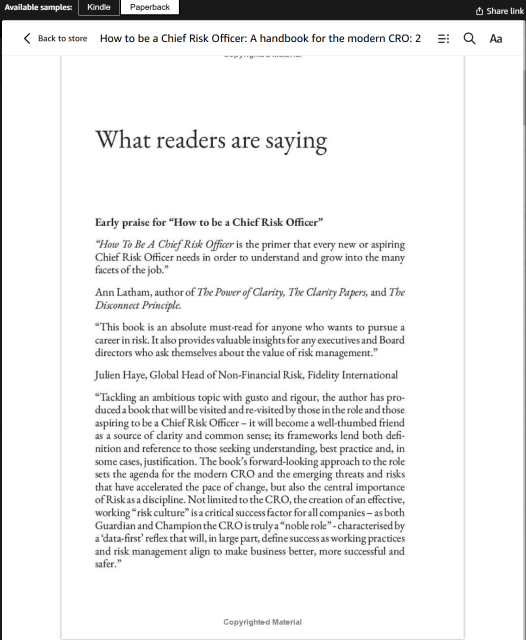 How to be a Chief Risk Officer
Tags: Health and Safety, Leadership, Risk Management
Tags: FinTech, Risk Management, Startups
Tags: Culture, GRC, Risk Management
Tags: Entrepreneurship, Risk Management, Startups
Tags: Business Strategy, Entrepreneurship, Startups
 Aevitium LTD Wins Rising Star Award at London Regional UK StartUp Awards 2024
Tags: Entrepreneurship, GRC
 LGBT Great's Top 100 Gamechangers 2022
Tags: Diversity and Inclusion
Tags: Diversity and Inclusion
Tags: GRC, Risk Management, Supply Chain
Tags: Business Continuity, GRC, Risk Management
Tags: GRC, Leadership, Risk Management
Tags: Business Continuity, GRC, Risk Management
Tags: Culture, Diversity and Inclusion, Leadership
Tags: Diversity and Inclusion, Leadership, Management
Tags: Diversity and Inclusion, Innovation, Leadership
Tags: GRC, Leadership, Risk Management
Tags: Diversity and Inclusion, HR, Risk Management
Tags: Culture, GRC, Risk Management
Tags: Culture, GRC, Risk Management

Tags: Culture, GRC, Risk Management

Tags: Culture, GRC, Risk Management

Tags: Culture, GRC, Risk Management

Tags: Culture, GRC, Risk Management

Tags: Culture, GRC, Risk Management

Tags: Culture, GRC, Risk Management

Tags: Culture, GRC, Risk Management
 Operational Resilience, Risk Management and Crisis Decision-Making with Bruce McIndoe
Tags: Culture, GRC, Risk Management
 Risk Culture and Decision-Making: Leadership Lessons for Chief Risk Officers and Boards with Leroy Roberts
Tags: Culture, Leadership, Risk Management
 C-Suite Leadership & Risk Management with Jennifer Geary
Tags: GRC, Leadership, Risk Management
 Fraud, Identity, and Risk Management: Building Trust Without Friction with Iremar Brayner
Tags: GRC, RegTech, Risk Management
 Risk Transformation, AI & Cultural Change with Samantha Regan
Tags: GRC, Risk Management, Transformation
 The Evolving Role of Risk Management Leadership with Jeff Simmons
Tags: GRC, Leadership, Risk Management
 Strategic Risk, ESG & Risk Leadership in Infrastructure with Søren Agergaard Andersen
Tags: Business Strategy, Finance, Risk Management

Tags: Business Strategy, Culture, Risk Management
Tags: Business Strategy, Culture, Risk Management

Tags: Business Strategy, Culture, Risk Management

Tags: Business Strategy, Culture, Risk Management

Tags: Business Strategy, Culture, Risk Management

Tags: Business Strategy, Culture, Risk Management

Tags: Business Strategy, Culture, Risk Management
Tags: Business Strategy, Culture, Risk Management
Tags: Business Strategy, Culture, Risk Management
 #17 - Flip the Odds: How to Hack Probability and Achieve Bigger Goals
Tags: Risk Management
 Continuing Professional Development (CPD) Trainer
Credential ID #405234
Tags: GRC, Leadership, Risk Management
Tags: Finance, GRC, Risk Management
Tags: GRC, Leadership, Risk Management
Tags: Finance, Leadership, Risk Management
Tags: Culture, Diversity and Inclusion, Finance
Tags: Culture, Diversity and Inclusion, Leadership
Tags: Culture, Diversity and Inclusion, Leadership
 Operational Resilience Training Course
Tags: Business Continuity, GRC, Risk Management
 ICAAP lifecycle and implementation (September 2026)
Tags: Business Strategy, GRC, Risk Management
 Scenario analysis and ICAAP reporting (July 2026)
Tags: Business Strategy, GRC, Risk Management
 Non-financial risk management
Tags: Culture, GRC, Risk Management
 CPD Masterclass - The Risk Within: Leading Risk with Clarity, Culture, and Foresight
Tags: Culture, Leadership, Risk Management
Tags: Finance, GRC, Risk Management
Tags: Finance, GRC, Risk Management
Tags: Culture, GRC, Risk Management
Tags: GRC, Leadership, Risk Management
Tags: Business Continuity, Business Strategy, Risk Management
 ICAAP lifecycle and implementation
Tags: Finance, GRC, Risk Management
Tags: Culture, GRC, Risk Management
Tags: Business Strategy, GRC, Risk Management
Tags: Finance, GRC, Risk Management
 CPD - Compliance Fundamentals Training Course
Tags: Finance, GRC, Risk Management
 Non-financial risk management
Tags: Finance, GRC, Risk Management
Tags: Business Strategy, GRC, Risk Management
Tags: Culture, GRC, Risk Management
 Compliance & Cross-Border Payments
Tags: Finance, FinTech, Risk Management
Tags: Business Strategy, GRC, Risk Management
Tags: Business Strategy, GRC, Risk Management
Tags: Education, Finance, Leadership



Tags: Culture, GRC, Risk Management

Tags: Culture, GRC, Risk Management
Tags: Culture, GRC, Risk Management
Tags: Culture, GRC, Risk Management

Tags: Culture, Leadership, Risk Management

Tags: Culture, GRC, Risk Management

Tags: Culture, Leadership, Risk Management

Tags: Culture, GRC, Risk Management

Tags: Culture, Leadership, Risk Management

Tags: Culture, GRC, Risk Management
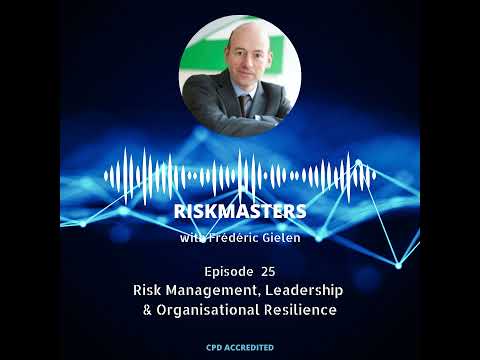
Tags: Culture, GRC, Risk Management
Tags: Finance, GRC, Risk Management
Tags: Education, Leadership, Risk Management
Tags: Culture, Leadership, Risk Management
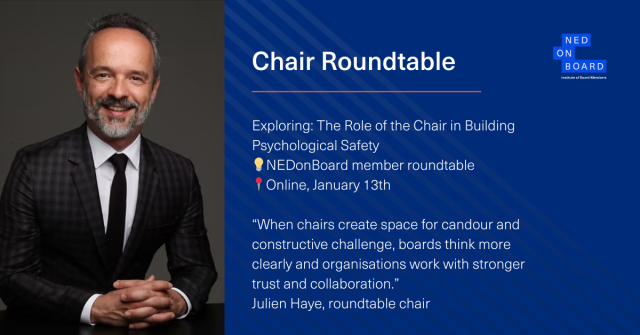 The Role of the Chair in Building Psychological Safety
Tags: Culture, GRC, Leadership
Tags: Culture, GRC, Risk Management
 Safe Teams, Bold Decisions: Empowering Through Risk
Tags: Culture, Leadership, Risk Management
 Seeing What You’re Missing: Leadership Blind Spots in Risk Escalation
Tags: Culture, Leadership, Risk Management
 Why Your Risk Strategy Starts with Trust
Tags: Culture, Leadership, Risk Management
Tags: Business Continuity, GRC, Risk Management
 How to Build Resilient Charities and Non-Profits?
Tags: Business Strategy, GRC, Risk Management
Tags: Finance, GRC, Risk Management
 When Operational Resilience and Consumer Duty collide
Tags: Business Continuity, Business Strategy, Risk Management
 The Role of the Manager is Dead! Discuss.
Tags: Culture, Leadership, Risk Management
Tags: Business Continuity, GRC, Risk Management
Tags: Business Continuity, GRC, Risk Management





















Date : August 21, 2025
Date : October 06, 2025
Date : October 06, 2025
 Why Psychological Safety Is a Governance Capability, Not Just a Cultural Ideal
Psychological safety is often discussed as a leadership or workplace culture topic. Organisations frequently associate it with employee engagement, wellbeing, or team performance.
Its influence extends much further.
Psychological safety shapes how information moves through organisations, how decisions are challenged, and how emerging risks become visible. It influences whether concerns are raised early, whether assumptions are questioned, and whether leaders receive an accurate picture of the realities surrounding strategic and operational decisions.
For boards, executives, and risk leaders, psychological safety should be viewed not only as a cultural aspiration but as a governance capability.
Most organisations generate more information than leaders can realistically process.
Concerns emerge within frontline teams. Operational pressures create workarounds. Weak signals appear long before incidents become visible. Alternative viewpoints develop around strategic initiatives, transformation programmes, and emerging risks.
The challenge is rarely whether information exists.
The challenge is whether information travels.
As information moves through management layers, it can become delayed, softened, selectively escalated, or filtered altogether. Individuals may hesitate to raise concerns because they fear negative consequences, believe their input will not influence outcomes, or assume others have already raised the issue.
When this occurs, decision-makers can develop a false sense of certainty. Governance structures remain active. Reporting continues. Yet the quality of information supporting decisions gradually deteriorates.
This is where psychological safety becomes critical.
Many organisations unintentionally reward alignment more than challenge.
Meetings that conclude quickly may be interpreted as efficient. A lack of disagreement may be viewed as evidence of strong alignment. Teams that avoid difficult conversations can appear collaborative on the surface.
The reality is often more complex.
Constructive challenge helps organisations test assumptions, identify blind spots, and understand uncertainty more completely. It improves decision quality by ensuring leaders are exposed to a broader range of perspectives before significant decisions are made.
Psychological safety creates the conditions that make this possible.
When individuals feel able to challenge respectfully, raise concerns, and admit uncertainty, organisations gain access to information that would otherwise remain hidden. Decisions become more robust because they are informed by a fuller understanding of risks, opportunities, and operational realities.
The objective is not conflict. The objective is better decisions.
One of the most valuable ways to understand psychological safety is through the concept of signal flow.
Risk management depends on the ability to identify, interpret, and act upon signals that indicate changing conditions, emerging threats, or weaknesses in existing assumptions. These signals often originate closest to day-to-day operations.
Their value depends on whether they reach decision-makers before they develop into larger problems.
Strong psychological safety supports this process. It encourages early escalation, open discussion, and constructive challenge. Weak psychological safety can result in information becoming progressively filtered as it moves through the organisation.
The consequences extend beyond risk management.
Signal flow influences strategy execution, transformation initiatives, operational resilience, innovation, and organisational learning. In each case, leaders depend on timely, accurate information to make effective decisions.
A recent LinkedIn poll conducted among risk, governance, and compliance professionals provides an interesting perspective. Among respondents, 51% identified "raising concerns early" as the area where psychological safety creates the greatest value in risk management. A further 26% selected "challenging decisions."
Together, these responses accounted for more than three-quarters of all votes.
The findings suggest that practitioners primarily associate psychological safety with information visibility and decision quality rather than collaboration or team cohesion alone.
This reinforces an important point: psychological safety creates value by improving the flow of information that organisations rely upon to govern effectively.
Boards rarely receive direct evidence that psychological safety is weakening.
Instead, the signs often emerge through organisational patterns:
Escalations arriving later than expected
Repeated leadership surprises
Recurring audit findings
Limited challenge during critical decisions
Similar issues resurfacing despite remediation efforts
Directors should therefore ask questions that focus on information quality rather than employee sentiment alone:
Where might important information be filtered before reaching the board?
How effectively does challenge operate across the organisation?
Which issues are consistently escalated late?
Where are concerns most likely to remain unspoken?
How effectively are lessons converted into organisational learning?
These questions provide a more practical view of whether psychological safety is supporting effective governance.
Psychological safety is often viewed through a cultural lens.
Its implications are far broader.
The ability to raise concerns, challenge assumptions, share information, and learn from experience influences how organisations adapt under pressure. It shapes how quickly emerging risks become visible and how effectively leaders respond to changing conditions.
In this sense, psychological safety sits at the intersection of governance, decision-making, organisational learning, and resilience.
The organisations best positioned to navigate uncertainty are often not those with the most controls or the most reporting. They are the organisations that create environments where information flows openly, challenge improves decisions, and learning remains continuous.
Psychological safety may begin with culture.
Its impact extends across the entire governance system.
Read the full article: https://www.aevitium.com/post/psychological-safety-in-risk-management
Tags: Culture, Leadership, Risk Management
 When Delay Becomes Risk: The Missing Dimension in Decision Governance
Most organisations believe they manage risk effectively. Risk frameworks assess likelihood and impact, governance forums review exposure, and leadership teams track performance through dashboards and indicators. From a structural perspective, the system appears comprehensive and well established.
Yet an important dimension often remains unaddressed: how risk evolves over time between recognising a signal and taking action.
Risk is not static. It develops as conditions shift, assumptions weaken, and decisions are delayed. What appears manageable at one point in time can become constrained and costly if action is deferred. Despite this, most governance frameworks are not designed to capture this dynamic. They provide a clear view of what risk is, but a limited view of when it must be acted upon.
This creates a structural blind spot.
Traditional risk frameworks were designed to classify and report exposure. Their strength lies in standardisation. Likelihood and impact can be compared, aggregated, and monitored across the organisation, supporting consistency and oversight. Time, however, does not fit easily within this structure. Its relevance varies by context, decision type, and external conditions, making it difficult to codify in a uniform way.
As a result, governance systems tend to provide a static view of a dynamic reality. Organisations can recognise emerging exposure while still missing the moment when it can be influenced.
Every strategic and operational decision creates a window in which it can be shaped. At that point, there is sufficient clarity to act and sufficient optionality to influence the outcome. Over time, this balance changes. Uncertainty may reduce, yet optionality declines. The cost of intervention increases and the ability to adjust or reverse the decision diminishes.
By the time a decision appears fully understood, it is often already constrained.
This dynamic is rarely made explicit within governance frameworks. Signals are typically interpreted as risk indicators or emerging issues. In practice, many of these signals represent something earlier. They indicate that the assumptions underpinning a decision are beginning to shift. If these signals are not translated into timely action, exposure accumulates.
Risk develops not only from adverse events, but from delay.
This has direct implications for governance design. Responsibility cannot be limited to identifying and reporting risk. It must extend to ensuring that decisions are taken while meaningful options remain available. This requires clarity over who is accountable for recognising when assumptions are weakening, who triggers escalation, and who ensures that decisions are taken within an appropriate timeframe.
Without this clarity, delay becomes systemic. Accountability diffuses across functions and committees, and decisions are deferred until conditions force action. At that point, governance remains active, yet influence over outcomes has already diminished.
Embedding time into governance does not require additional complexity. It requires a shift in focus. Assumptions underpinning major decisions must remain visible after approval, and signals that indicate change must be linked to clear escalation triggers. Decision authority must remain connected to the responsibility for acting on those signals within an appropriate timeframe. In doing so, governance aligns more closely with how risk actually develops in practice.
Effective leadership in this context is not defined by speed. Acting too early without sufficient clarity can create instability. Acting too late embeds exposure that becomes increasingly difficult to manage. Decision discipline lies in acting at the point of highest leverage, where uncertainty remains manageable and options are still available.
Organisations rarely fail because they act too early. They fail because they act after the decision window has closed.
Understanding and governing this dynamic positions time not as a secondary consideration, but as a central dimension of risk management and strategic leadership.
Read the full article on Aevitium LTD: https://www.aevitium.com/post/decision-timing-risk
Tags: GRC, Leadership, Risk Management
 Strategic Uncertainty Governance: Why Strategy Creates Risk Before It Creates Results
Most organisations believe they manage uncertainty effectively.
Strategic planning processes identify opportunities, financial projections define expectations, and risk frameworks monitor emerging exposure. Boards review dashboards, executives track performance, and governance committees assess whether risks remain within acceptable limits. From a governance perspective, the system appears comprehensive.
Yet an important question often remains unanswered: who owns the uncertainty embedded in strategic decisions?
Uncertainty is frequently treated as something that emerges after strategy has been implemented, typically through operational risk events, market volatility, or performance deviation. In reality, uncertainty originates earlier. It arises at the moment the organisation commits to a strategic direction. Whenever leadership allocates capital, launches transformation programmes, or enters new markets, it does so based on assumptions about how the future will unfold. These assumptions may concern customer behaviour, technological evolution, competitive dynamics, or the organisation’s own execution capabilities.
Because these assumptions cannot be fully validated at the moment decisions are made, uncertainty is not simply a downstream consequence of strategy. It is created by the strategic commitment itself.
Governance systems, however, often focus primarily on monitoring performance once strategy is underway. Financial dashboards, operational indicators, and risk reports provide valuable insight into whether initiatives are delivering expected outcomes. These mechanisms strengthen oversight and provide early visibility into emerging exposure. Yet they primarily monitor outcomes rather than the assumptions that produced them. By the time performance indicators reveal that something has changed, the organisation may already be deeply committed to an inedaquate strategic path.
This dynamic reflects how governance responsibilities are commonly structured. Strategy teams define ambition and identify opportunities. Executive leadership allocates capital and approves investment decisions. Risk functions monitor exposures through established frameworks and reporting systems. Boards oversee results through performance and risk dashboards. Each of these elements performs an important role within the governance architecture.
However, none of them consistently maintains ownership of the uncertainty embedded in the strategic commitment itself. Strategy functions focus on opportunity and positioning. Risk functions focus on exposure and control frameworks. Boards focus on outcomes and organisational performance. Between these layers, the assumptions that justified the strategic decision may gradually fade from attention. Uncertainty remains present throughout the life of the strategy, yet responsibility for governing it becomes diffuse.
This creates a structural challenge that can be described as a monitoring paradox. Many organisations invest heavily in infrastructure designed to increase visibility over risk exposure. Risk registers, key risk indicators, and governance dashboards provide detailed insight into operational and financial developments. As these systems become more sophisticated, leadership gains increasing visibility over emerging issues.
Paradoxically, this visibility can reinforce the belief that risk is being effectively governed even when governance influence over the assumptions underlying strategy remains limited. Monitoring frameworks observe how exposure evolves after decisions have been made. They rarely influence the moment when strategic commitments are authorised.
If uncertainty originates in strategic commitments, ownership logically follows the authority that authorises those commitments. Strategic exposure does not arise primarily from failures in monitoring systems. It arises when leaders commit the organisation to a course of action based on expectations about how markets, competitors, technologies, and organisational capabilities will evolve.
The authority to make such commitments typically sits with executive leadership teams and, for the most consequential decisions, with the board. Risk functions play a critical role in informing these decisions through scenario analysis, challenge, and insight. However, the responsibility for the uncertainty embedded in strategic commitments ultimately remains with those who authorise the decision.
Recognising this relationship changes how organisations think about governance. Strategic oversight cannot be limited to monitoring results once strategy is in motion. Leadership forums must also retain visibility over the assumptions that underpin major commitments and remain attentive to signals that those assumptions may be evolving.
Strengthening governance in this area does not require eliminating uncertainty. Uncertainty is inseparable from strategic ambition and organisational adaptation. Instead, organisations can govern uncertainty more deliberately by ensuring that the assumptions supporting strategy remain visible throughout the life of the strategic commitment.
Several practices support this approach. Strategic planning processes can explicitly articulate the assumptions underpinning major initiatives. Organisations can monitor signals that indicate whether these assumptions remain valid as market conditions evolve. Governance frameworks can establish escalation mechanisms that prompt leadership reconsideration when conditions shift materially. Finally, board and executive discussions can periodically revisit the premises that justified strategic commitments rather than focusing exclusively on performance outcomes.
For boards, this perspective broadens the scope of oversight. Directors remain responsible for reviewing performance and risk exposure, yet effective governance also requires visibility over the assumptions that sustain the organisation’s strategic direction. Questions such as which assumptions underpin major initiatives, how those assumptions are monitored, and when they were last revisited can provide valuable insight into the resilience of the strategy itself.
Strategy and uncertainty cannot be separated. Every strategic commitment embeds expectations about the future that cannot be fully verified in advance. When governance systems focus primarily on monitoring results, these assumptions may gradually fade from leadership attention. Aligning ownership of uncertainty with decision authority restores coherence to the governance cycle.
Leaders remain accountable not only for the outcomes produced by strategy but also for the assumptions that sustain it. In this sense, governing uncertainty is not simply a technical exercise within risk management. It is a central dimension of strategic leadership.
Read the full article on Aevitium LTD - https://www.aevitium.com/post/strategic-uncertainty-governance
Tags: GRC, Leadership, Risk Management
 When Risk Governance Fails: The Hidden Gap Between Decisions and Accountability
Most organisations believe they understand who owns risk.
Risk frameworks assign responsibilities across business units and functions. Committees review exposures. Escalation protocols ensure that issues are reported. Risk registers catalogue threats and mitigation actions. From a governance perspective, accountability appears clearly defined.
Yet when major failures occur, the problem is rarely that ownership was missing.
The problem is that the individuals responsible for managing risk were not the individuals who took the decisions that created it.
Strategic initiatives, product launches, outsourcing arrangements, and technology transformations routinely reshape an organisation’s risk profile through decisions taken in commercial and operational forums. By the time these changes appear in risk dashboards or governance reports, the underlying commitments have often already been made.
This creates a structural tension in many governance frameworks. Risk ownership sits in one part of the organisation, while decision authority sits in another.
Understanding this distinction helps explain why many risk frameworks operate effectively as monitoring systems while struggling to shape outcomes.
Risk ownership and decision accountability serve different governance functions.
Risk ownership defines responsibility for monitoring and managing exposure within a specific domain. Risk owners maintain risk registers, oversee controls, monitor indicators, and escalate emerging concerns.
Decision accountability, by contrast, sits with individuals who possess authority to commit the organisation to a course of action. These decisions often reshape the organisation’s risk profile.
Examples include decisions to:
launch new products
expand into new markets
outsource operational functions
adopt new technologies
accelerate delivery timelines
Each of these choices alters the organisation’s exposure to operational, financial, regulatory, or reputational risks.
Risk owners typically analyse and monitor these exposures. Decision-makers determine whether the organisation proceeds with the initiative.
When this distinction is not recognised, governance frameworks may appear clear while responsibility for outcomes becomes difficult to locate.
Risk governance is often treated as a framework design challenge.
Organisations invest heavily in policies, reporting structures, and ownership assignments. These elements remain important, yet they do not determine how risk is actually accepted within the organisation.
In practice, risk exposure is shaped primarily by the structure of organisational decision-making.
Strategic initiatives, investment decisions, operational changes, and technology transformations determine how the organisation’s risk profile evolves. Governance frameworks may reveal the implications of these decisions, yet they do not necessarily influence the moment when the decision is taken.
Effective risk governance therefore depends not only on the design of frameworks but also on the architecture of decisions.
Where risk insight enters decision forums early, governance can shape outcomes. Where it enters late, it typically focuses on mitigation and monitoring.
Most large organisations maintain extensive infrastructure for identifying and monitoring risk.
This often includes:
risk registers
Risk and Control Self-Assessments (RCSAs)
key risk indicators
escalation protocols
These mechanisms improve visibility across the organisation and provide structure for managing exposure.
However, monitoring systems primarily observe risk once it becomes visible.
They rarely intervene at the moment when strategic or operational decisions are made.
As monitoring systems become more sophisticated, organisations may gain increasingly detailed information about exposure. Paradoxically, this visibility can reinforce the belief that risk is being effectively controlled.
In reality, governance frameworks may be highly effective at observing risk while remaining less effective at shaping the decisions that create it.
Risk exposure rarely originates from a single formal approval.
More often it emerges gradually through a series of operational and strategic decisions taken across different parts of the organisation.
Individually, these decisions may appear reasonable:
accelerating product launches to capture market demand
outsourcing processes to improve efficiency
entering new jurisdictions to expand growth
implementing technology platforms to support scale
Each initiative is assessed in isolation.
Yet each decision also alters the organisation’s risk profile.
Over time, the accumulation of these choices can significantly reshape exposure. Organisations may find themselves operating with higher levels of operational complexity, regulatory exposure, or technological dependency than originally intended.
Governance processes frequently assess each initiative separately, making the cumulative shift less visible.
Assigning risk ownership is often treated as the cornerstone of effective governance.
However, ownership alone does not guarantee influence.
For risk ownership to function as an operational control rather than a reporting mechanism, three conditions must be present:
Risk owners must have authority to challenge decisions that affect exposure.
The organisation must allocate resources to implement mitigation actions.
Risk owners must have visibility into the initiatives that generate risk.
When these conditions are absent, risk ownership becomes primarily administrative.
Risk owners maintain documentation, monitor indicators, and escalate developments, yet have limited ability to influence the underlying drivers of exposure.
This creates a form of symbolic governance. Responsibility for risk appears clearly defined, while authority to influence decisions sits elsewhere.
If risk exposure is primarily created through decisions rather than through failures of control, the effectiveness of the risk function depends on where it participates in the decision lifecycle.
In many organisations, risk functions enter the discussion after initiatives have already been designed.
At that stage, commercial momentum and organisational commitments often favour implementation. Risk oversight therefore focuses on mitigation rather than shaping the direction of the initiative.
A more effective model positions the Chief Risk Officer and the risk function earlier in strategic discussions.
Participation in areas such as strategy development, capital allocation, transformation programmes, and major operational decisions allows risk insight to inform initiatives before key assumptions become embedded.
In this model, risk leadership contributes to the design of organisational choices rather than simply reviewing their consequences.
For boards, the implications extend beyond reviewing risk reports.
Directors are responsible for ensuring that the organisation’s governance arrangements align strategy with its capacity to absorb risk. This requires visibility not only over risk exposure but also over the decision architecture that creates it.
Boards should therefore ask several critical questions:
Which decisions materially reshape the organisation’s risk profile?
How are these decisions assessed against risk appetite?
Who is responsible for managing the resulting exposure?
Do those individuals have the authority and resources required to act?
When authority, ownership, accountability, and resources are aligned, governance becomes embedded within the organisation’s decision processes.
Many organisations invest significant effort in building sophisticated risk frameworks.
Ownership is assigned, policies are documented, dashboards are produced, and escalation mechanisms are defined.
Yet governance structures can gradually become disconnected from the way decisions are actually made.
When this occurs, risk frameworks continue to function while their influence over the conditions that generate risk weakens.
Effective risk governance therefore requires more than monitoring exposure.
It requires ensuring that the individuals who shape the organisation’s direction also carry clear responsibility, authority, and resources for managing the risks that follow.
In the end, governing risk effectively means governing how decisions are made.
Tags: GRC, Leadership, Risk Management
 Governing Reputational Exposure Before It Becomes Impact
Senior leaders increasingly describe reputational risk as visible, proportionate, and actively governed. Potential impacts are discussed and escalation routes exist. Many boards receive regular reporting and assurance. That assessment is often sincere and, from the vantage point of senior forums, frequently justified.
Boards and executive committees engage with reputational risk through designed governance structures. Judgement is mediated through formal papers, impact assessments, and anticipated regulatory or stakeholder reaction. Accountability is exercised through escalation protocols and documented decisions. From this position, reputational risk appears tangible, discussable, and manageable. The difficulty is that this is not the only experience of the system.
Elsewhere in the organisation, reputational exposure is created through ordinary decisions taken under delivery pressure, commercial urgency, and regulatory interpretation. These decisions are rarely framed as reputational at the time they are made. They are assessed locally as lawful, proportionate, and defensible in isolation. Over time, they accumulate into exposure that sits outside the organisation’s direct control. The challenge for senior leaders is not indifference to reputational risk. It is that governance typically encounters reputational risk after exposure has already been formed.
Reputational risk is commonly governed through its consequences. Frameworks focus on how an organisation may be judged once scrutiny arises, whether through media attention, stakeholder pressure, or increased supervisory oversight.
This framing is understandable. Reputational harm is external, difficult to quantify in advance, and shaped by perception rather than internal metrics. Impact can be documented, escalated, and explained. Exposure cannot.
The problem is timing.
Impact becomes visible only after attention turns outward. Exposure is created earlier, through decisions that rely on assumptions about tolerance, context, and interpretation that sit beyond the organisation’s control. By the time reputational impact is discussed at senior levels, the decisions that created vulnerability are often already embedded. This is why reputational risk can appear well governed while remaining structurally unconstrained.
The gap does not emerge through misconduct or crisis. It forms through ordinary governance mechanics. Decisions that carry reputational exposure are assessed locally against policy, appetite, and precedent. Concerns may be raised around optics or defensibility, yet remain informal and judgement-based rather than anchored to explicit decision authority. Where no formal boundary is breached, approvals proceed.
As similar decisions are repeated, exposure start building up. Reporting remains stable because no single decision appears material. From senior forums, reputational risk appears controlled. From within delivery, strategic flexibility narrows. Both perspectives are rational responses to the system. The problem is that governance allows reassurance to form at the top while exposure builds below, without requiring those realities to meet.
Reputational risk does not accumulate because people fail to escalate. It accumulates because escalation is framed around impact rather than exposure. Under sustained business pressure, organisations adapt. Decisions are justified incrementally. Exceptions become precedents. Narrative becomes more important than constraint. Escalation remains possible, yet increasingly tied to the likelihood of external attention rather than the creation of vulnerability.
From above, indicators improve and issues appear contained. From within delivery, options narrow and dependency on explanation increases. By the time scrutiny arrives, the organisation is managing reaction rather than shaping choice. Silence in this context is not ignorance. It is experience.
This dynamic raises an uncomfortable question for risk leaders. Reputational risk is often treated as a secondary consequence of other risks rather than as a primary exposure in its own right. Risk functions are asked to assess impact, support escalation, and advise on response. They are rarely positioned to influence decisions before commitments are made.
The distinctive value of the risk function lies in making exposure visible earlier. That means identifying patterns rather than incidents, tracing how informal judgement substitutes for governance, and showing how repeated defensible decisions accumulate strategic constraint. It requires shifting the conversation from how the organisation might be judged to whether it is prepared to stand behind its choices if judgement occurs.
Risk functions cannot remove reputational uncertainty. What they can do is ensure it is confronted while choice still exists.
Strong oversight of reputational impact matters, but it is not sufficient. Effective governance requires visibility of how reputational exposure is created through approvals, exceptions, and repeated decisions, not only how impact is managed once scrutiny increases. It requires escalation to operate as a decision input rather than a reaction mechanism.
Reputational risk does not fail everywhere. It fails at specific points of decision, justification, and commitment. Those points are visible long before external attention arrives. The leadership task is not to improve prediction of reputational reaction, but to govern exposure early enough to preserve strategic freedom.
Reputational risk is managed too late when it is framed as an outcome rather than a choice. Organisations do not lose control of reputation because leaders are inattentive. They lose it when governance allows exposure to accumulate without forcing decisions to be constrained.
Impact explains what happened. Exposure determines whether it had to.
Tags: Risk Management, Business Strategy, GRC
 Leaders Don’t Experience Risk Culture
Senior leaders increasingly describe risk culture as open, constructive, and proportionate. Escalation is encouraged. Challenge is invited. Governance appears to function as intended.
That assessment is often sincere and, from the top of the organisation, frequently justified.
Boards and executive committees engage with risk through designed structures. Discussion occurs in scheduled forums, supported by aggregated reporting and prepared narratives. Accountability is mediated through role authority and shared governance. From this vantage point, risk feels visible, contained, and manageable.
The difficulty is that this is not the only experience of the system.
Elsewhere in the organisation, risk is encountered through delivery pressure, competing priorities, and personal exposure. Escalation is not abstract. It carries consequences that shape how people decide whether, when, and how to raise concerns. Over time, this creates a second, equally coherent experience of risk culture, one that is learned through outcome rather than intent.
The challenge for senior leaders is not a lack of commitment to good risk culture. It is that governance rarely forces these experiences to meet.
Risk culture is not defined by what leaders say about risk. It is defined by what happens after someone raises it.
Organisations teach risk behaviour through escalation, response, and consequence. Policies, frameworks, and tone create permission. Experience determines whether that permission is used.
When early escalation leads to friction, delay, or personal exposure without changing outcomes, the system teaches restraint. When late escalation arrives with solutions attached and is received more easily, the system teaches caution. These lessons are rarely articulated, yet they shape behaviour far more powerfully than any formal statement.
This is why risk culture can appear healthy at senior levels while becoming selective and constrained in delivery. The issue is not misalignment of values. It is asymmetry of experience.
The gap does not emerge through dramatic failure. It forms through ordinary governance mechanics.
Issues surface informally long before they become formal. As they move upward, they are reframed, aggregated, and contextualised against performance narratives. What feels consequential at the frontline becomes bounded and manageable by the time it reaches senior forums.
For executives, this produces reassurance. For delivery teams, it increases exposure. Each escalation changes how individuals are perceived, how much justification is required, and how much disruption is tolerated. Over time, people learn what kind of risk is safe to raise, how complete an issue must be before escalation, and when it is better handled locally.
Both perspectives are rational responses to the system. The problem is that governance allows reassurance to form at the top while adaptation occurs below, without requiring those realities to intersect.
Risk does not accumulate because people fail to escalate.
It accumulates because escalation becomes costly.
Under sustained pressure, organisations adapt. Issues are held while more information is gathered. Judgement is delayed until uncertainty can be reduced. Workarounds preserve momentum. Escalation remains possible, yet increasingly selective.
From above, indicators improve and issues appear contained. From within delivery, effort and fatigue accumulate. Signals weaken. By the time escalation occurs, options are narrower and consequences are larger.
Silence in this context is not ignorance. It is experience.
This dynamic raises an uncomfortable question for risk leaders.
Many organisations expect the risk function to “own” risk culture. In practice, culture is shaped far beyond the function’s control. Performance incentives, leadership behaviour, and governance design all play decisive roles.
The distinctive value of the risk function lies elsewhere.
Its role is to expose where governance teaches the wrong lesson. That means surfacing patterns rather than incidents, experience gaps rather than compliance gaps. It means tracing how escalation actually travels, where it slows, and how personal exposure changes along the way.
Risk cannot enforce behaviour or create psychological safety on its own. What it can do is make visible the distance between reassurance and reality early enough for leaders to act.
Strong tone from the top matters. It creates permission. It does not create alignment on its own.
Alignment occurs when leaders experience risk friction directly, not only through reports. When escalation is treated as a decision input rather than an interruption. When consequence is shared rather than absorbed silently below.
Risk culture does not fail everywhere. It fails at specific points of escalation, handoff, and consequence. Those points are visible long before incidents occur.
The leadership task is not to restate values, but to test whether governance produces the same experience of risk across levels.
Risk culture disappoints when intent and experience diverge without being reconciled.
Organisations do not fail because leaders do not care about risk. They fail when the system teaches people to be careful about raising it.
Consequences teach faster than messages because you only need to feel them once.
Tags: Culture, Leadership, Risk Management
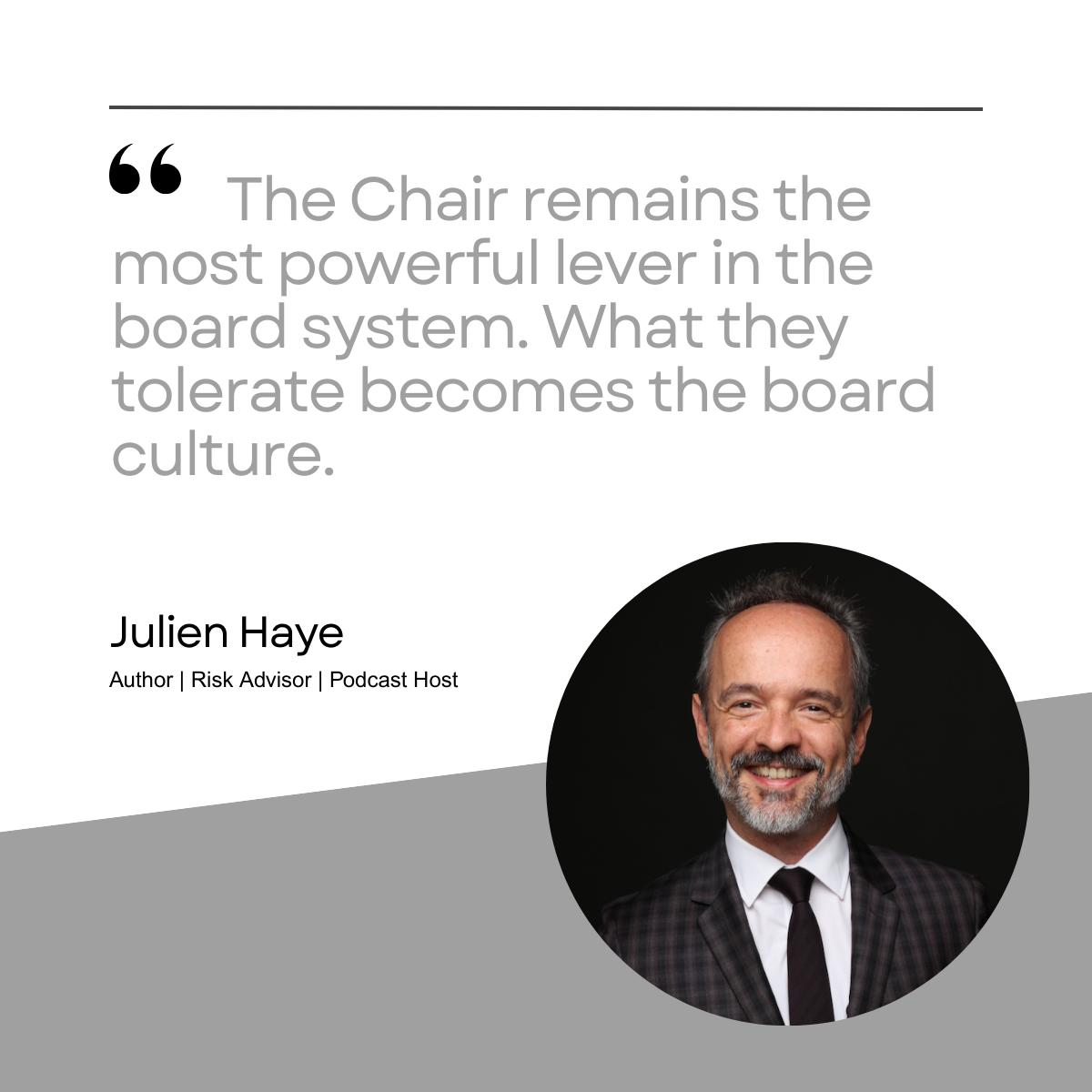 The Board Chair as the Primary Lever of Psychological Safety
Boards operate under sustained pressure. Decisions are made with incomplete information, competing priorities, and limited time for reflection. In this environment, the ability to surface challenge before decisions harden becomes a governance capability rather than a cultural preference.
Recent discussions with Board Chairs, including a Chair roundtable delivered with NEDonBoard, reinforced a consistent pattern. When boards struggle to challenge, escalate, or decide well, the cause is rarely a lack of competence or commitment. The constraint sits in the conditions created around the table.
Psychological safety at board level matters because it shapes what enters the decision space and what remains unspoken. It determines whether emerging risks are surfaced early or absorbed silently into delivery. It influences whether governance enables judgement or replaces it with process. For Chairs, this is not an abstract leadership topic. It is a structural and behavioural responsibility embedded in how the board is designed and led.
Psychological safety at board level is not a mindset and not a cultural aspiration. It is an outcome produced by design, behaviour, and discipline.
Boards that fail to surface challenge usually operate within structures that quietly suppress it. Board size influences airtime and accountability. Oversized board packs prioritise consumption over judgement. Process can either create space for debate or displace it when it substitutes for thinking.
Chairing itself is a capability. The role is to enable challenge without losing focus, contain debate without neutralising dissent, and close decisions without shutting learning down. This requires active listening, synthesis of competing perspectives, and disciplined redirection from operational detail back to board-level judgement.
Where these conditions are absent, silence is misread as alignment and procedural order is mistaken for effectiveness.
The manifestation is rarely dramatic. It appears through ordinary board mechanics.
Discussion drifts into detail that belongs outside the boardroom. Time pressure shortens exploration. Directors self-censor to preserve pace or harmony. Risk issues are framed as delivery problems rather than decision signals.
Behaviour reinforces the pattern. Making issues personal narrows debate quickly. Inquisitiveness builds insight. Nosiness erodes trust. Empathy supports governance. Sympathy clouds judgement. These distinctions matter because they shape whether directors feel able to contribute without being exposed.
Role clarity is equally decisive. Conflicts of interest distort challenge. Blurred boundaries between Chair and Chief Executive weaken both roles and reduce productive tension. Authority must remain clean for candour to survive.
What happens outside the boardroom also matters. Deliberate off-board conversations enable sharper on-board debate. Avoiding them increases the likelihood of performative discussion or unresolved tension in the meeting itself.
Risk does not accumulate through a single failure of courage. It accumulates through repetition.
Each meeting where challenge is deferred narrows future debate. Each decision taken without testing assumptions increases delivery fragility. Each instance where process replaces judgement reinforces the pattern.
Self-awareness emerges as a recurring constraint. How directors show up under pressure shapes the quality of governance. Emotional intelligence at board level is not optional. The Chair is the primary lever for enabling reflection, moderating behaviour, and resetting dynamics when pressure distorts contribution.
Over time, silence becomes structural. By the time issues surface, options are limited and consequences are larger.
Governance has power when it supports judgement rather than replacing it. Board effectiveness is measured by the quality of decisions made under uncertainty, not procedural compliance.
For Chairs, psychological safety is not about comfort. It is about making challenge usable before decisions are locked in. This requires attention to board design, disciplined chairing behaviour, and clarity of roles inside and outside the room.
When these elements align, boards gain earlier insight, better escalation, and stronger decision ownership. When they do not, risk migrates into execution where it becomes harder to govern.
The Chair remains the most powerful lever in that system because they shape the conditions under which governance either enables or suppresses judgement.
Boards do not fail because directors lack intent. They fail when the system teaches them to stay silent.
Psychological safety at board level is produced deliberately through design, behaviour, and disciplined leadership. When Chairs treat it as a governance capability, challenge becomes usable, decisions improve, and risk is addressed while it is still malleable.
Tags: Culture, Leadership, Management
 2026 Risk Mega Trends: How Ordinary Decisions Exhaust Organisational Resilience
Modern organisations are no longer surprised by volatility. Geopolitical tension, regulatory pressure, technology change, and operational disruption have become permanent features of the landscape. Most leadership teams enter 2026 well aware of the external forces shaping their risk environment.
Yet material failures continue to occur in organisations that believed themselves prepared.
The reason is not that risk mega trends are misunderstood. It is that their internal consequences are underestimated. External pressure now converts into loss through ordinary decisions made under constraint, rather than through dramatic shocks or unforeseen events.
In 2026, the defining risk is not what organisations face. It is how much strain they quietly absorb before intervention occurs.
What Risk Mega Trends Really Mean in 2026
Risk mega trends are large-scale, long-term shifts that reshape how organisations manage risk. They emerge from technological change, economic volatility, regulatory accumulation, and geopolitical tension. They operate globally, persist over time, interact with one another, and influence governance and strategy at the highest levels.
In that context, most organisations now identify and track external mega trends. They assess cyber exposure, regulatory change, climate risk, AI adoption, and third-party dependency. These risks appear in strategy papers, emerging risk registers, and board discussions.
What is less visible is how sustained exposure to these trends alters decision-making inside the organisation. Under pressure, familiar risks do not escalate cleanly. They accumulate through deferrals, workarounds, and local trade-offs that appear reasonable in isolation.
In 2026, mega trends matter less for what they introduce and more for how they stress governance, capacity, and escalation over time.
From External Pressure to Internal Risk Dynamics
External mega trends do not fail organisations directly. They transmit pressure into operating models, governance processes, and leadership behaviour.
As pressure builds, execution risk overtakes strategic risk. Transformation programmes overlap. Regulatory commitments stack up. Delivery capacity becomes the constraint. Strategy remains ambitious while resilience quietly erodes.
Data increasingly substitutes for judgement. Aggregated reporting replaces direct challenge. When data quality or interpretation weakens, decisions are delayed, reassurance grows, and leaders operate closer to limits than they realise.
Assurance expands in response to complexity. Reviews multiply. Reporting increases. Yet activity masks fragility. Remediation slips without triggering intervention because processes appear intact.
Risk appetite frameworks exist, but often govern compliance rather than real trade-offs. Exceptions accumulate. Boundaries stretch. Tolerance is redefined informally rather than escalated deliberately.
Information becomes smoother as it travels upward. Uncertainty is normalised. Tension is reduced. Over time, senior decision-makers see stability where strain is already concentrated.
None of these dynamics reflect recklessness or failure of intent. They reflect how organisations behave when external pressure is constant and capacity is finite.
How Failure Accumulates Unbeknown To Management
Risk in 2026 rarely fails at the moment a decision is taken. It fails in the space between decisions.
Across the organisation, small concessions are made to maintain momentum. Fixes are deferred. Dependencies deepen. Controls are relaxed temporarily. Each decision sits within tolerance. Each is documented. Each appears justified at the time.
What is missing is a portfolio-level view of how these concessions combine.
Governance reviews issues one by one. Risk focuses on thresholds. Assurance focuses on process. Delivery focuses on progress. No single forum owns the question of how much resilience has already been consumed.
By the time a routine issue escalates, the organisation discovers that its margin for error has already been used. The failure feels sudden only because the accumulation that caused it was never visible.
Three Priorities for Governing Mega Trends in Practice
Leading organisations respond differently to this reality. They do not add frameworks. They redesign how pressure is surfaced and governed.
First, they force visibility of accumulated strain.
They bring deferrals, exceptions, and workarounds together and examine them as a portfolio. The question shifts from “Are issues managed?” to “How much capacity have we already consumed?”
Second, they treat risk appetite as a decision discipline.
Rather than a static statement, appetite is used to frame real trade-offs between ambition, capacity, and dependency. Decisions that stretch resilience require explicit agreement, not silent tolerance.
Third, they separate activity from effectiveness.
Assurance is used to test whether controls still function under pressure, not merely whether processes are followed. Findings provoke decisions rather than provide comfort.
The Role of Boards, Executives, and CROs
Boards influence outcomes less by approving risk than by challenging deferral. Their leverage lies in demanding visibility of cumulative strain and asking when intervention becomes necessary.
Executives shape risk through momentum. Their effectiveness is measured by how early constraints are surfaced rather than how long they are absorbed silently.
CROs create impact not by tightening frameworks, but by making the aggregate effect of ordinary decisions visible and difficult to ignore.
In 2026, influence comes from interrupting momentum before resilience is exhausted.
A Forward-Looking Risk Discipline
Risk management in 2026 is no longer defined by foresight alone. It is defined by the ability to reconcile competing views, surface accumulated strain, and intervene early enough to preserve optionality.
External mega trends will continue to shape the environment. What will differentiate outcomes is how organisations govern themselves under sustained pressure.
Those that treat alignment as an operational discipline remain resilient.
Those that assume it discover too late that their frameworks were sound, but their capacity was already spent.
Read the full article here:
https://www.aevitium.com/post/2026-risk-mega-trends
Tags: GRC, Leadership, Risk Management
 Anti-Fragile Risk Management: Turning Volatility into Strategic Advantage
Modern organisations face volatility that rarely pauses. Economic shifts, rapid technology change, and global interdependence expose systems to constant pressure. Traditional risk frameworks protect stability but seldom help organisations grow through disruption.
Resilience helps organisations recover after a shock. Anti-fragility enables them to improve because of it. The difference defines how effectively leadership teams convert disruption into insight and foresight.
The idea originates from Nassim Taleb’s Antifragile: Things That Gain from Disorder, which expands on concepts from The Black Swan and Fooled by Randomness. Taleb described systems that thrive on stress and evolve through exposure to uncertainty.
Applied to risk management, anti-fragility links structure, behaviour, and data into one learning system. Instead of measuring success by stability, it measures progress by how quickly organisations adapt, apply lessons, and refine governance.
An anti-fragile organisation identifies patterns in volatility, not just incidents. Each event becomes information that improves appetite calibration, control design, and leadership awareness. Boards and Chief Risk Officers (CROs) use this feedback to make faster, evidence-based adjustments.
Resilience and robustness help systems resist shocks and stay the same. Anti-fragility adds a higher purpose: learning. The most mature organisations integrate learning directly into their oversight cycles.
Poll data from Aevitium’s recent surveys show why this shift matters. Seventy-one percent of professionals said cultural resistance most limits adaptability under pressure. Twenty-two percent cited rigid controls. The insight is clear: most frameworks fail not because of design but because of how they are used.
Anti-fragile risk management focuses on culture as much as control. Transparency, curiosity, and accountability ensure that information travels quickly and decisions follow evidence, not hierarchy. When people feel safe to escalate early, governance becomes anticipatory rather than reactive.
Technology accelerates this evolution. Predictive analytics, scenario modelling, and continuous monitoring give leaders earlier visibility of emerging risks. Automation frees time for interpretation and judgement. Artificial intelligence detects weak signals that manual reviews miss.
Data becomes strategic when combined with behaviour. A fintech organisation that integrates escalation data with incident trends can identify where culture supports early warning and where delays persist. These insights strengthen both operational and cultural resilience.
Boards and executives can begin embedding anti-fragility through three practical priorities:
1. Integrate Learning into Governance
Add structured learning reviews to board and executive cycles. Discuss not only what happened but how quickly lessons were identified and applied. Make adaptation a performance measure.
2. Link Appetite and Culture
Refresh risk appetite statements to reflect adaptability, not only tolerance. Encourage open discussion of uncertainty and curiosity about weak signals. Recognise early escalation as a strength.
3. Measure Improvement from Stress
Track metrics that show growth through volatility: adaptation velocity, lesson conversion rate, and escalation timeliness. Use these indicators to assess governance maturity.
Boards define the conditions for learning. Their oversight should connect strategic intent, risk appetite, and cultural visibility. CROs translate these principles into daily practice, integrating behavioural insight with operational data.
Effective anti-fragile governance focuses on speed of learning, not only on residual risk. Each disruption becomes a feedback cycle that strengthens both foresight and execution. The outcome is a governance model that develops clarity through challenge.
Anti-fragile risk management reframes volatility as a teacher. It builds organisations that adapt faster, govern smarter, and learn continuously. When culture, technology, and governance align, risk management evolves from protection to progress.
Organisations that master this discipline turn uncertainty into strategic advantage. They create a leadership culture that gains from disorder, linking performance, trust, and resilience in one continuous learning system.
Read full article here: https://www.aevitium.com/post/anti-fragile-risk-management
Tags: Leadership, Culture, Risk Management
 Operational Risk as a Strategic Discipline
Operational risk is one of the most significant exposures boards and executives face. It can halt service delivery, erode trust, and trigger regulatory attention. Yet it also provides one of the strongest opportunities to strengthen governance and build resilience.
The Operational Risk Management Framework: Identify, Mitigate & Monitor article shows how leading organisations turn operational risk into foresight. It highlights the importance of ownership, culture, and capacity as the foundations of a mature operational risk environment. When these elements are aligned, risk management becomes a source of confidence and strategic advantage.
Operational risk management works best when it is integrated into daily decision-making. High-performing organisations align governance, culture, and capacity to ensure that ownership is visible and escalation is timely.
This approach transforms operational risk into a leadership discipline that supports execution and strengthens organisational trust. Clarity of accountability, simplicity of control, and open dialogue create the conditions for foresight and adaptability.
Industry data continues to show why this shift matters.
The next stage of maturity will depend on how effectively organisations translate these insights into real-time monitoring, decision support, and accountability loops.
Executives can embed operational risk as a strategic discipline by focusing on three priorities.
Clarify Ownership and Accountability: Assign ownership at the right level and define clear escalation pathways. Accountability must be visible and reinforced through leadership behaviour.
Simplify Controls and Processes: Streamline control frameworks and remove duplication. A focused control environment directs assurance where it adds the most value and improves engagement across teams.
Strengthen Culture and Behaviour: Operational resilience depends on how people act. Leadership tone, trust, and psychological safety ensure that weak signals are raised early and decisions reflect reality.
Boards are increasingly expected to demonstrate that operational risk frameworks work in practice. Effective oversight means understanding how ownership, culture, and capacity interact.
Boards that link operational risk to risk appetite, tolerance, and capacity create alignment between ambition and resilience. They gain visibility on how the organisation performs under stress and can act before limits are tested.
Technology and data now shape how operational risk is managed. Integrated dashboards, AI-assisted monitoring, and automated control testing give leaders a real-time view of resilience and capacity. These tools turn operational data into insight and foresight.
When technology supports ownership and behaviour, it enhances the quality of decisions and reinforces governance credibility.
Operational risk management is a continuous discipline that reflects how organisations lead and learn. Its strength lies in clear ownership, consistent behaviour, and data that supports timely decisions.
When boards and executives integrate strategy, governance, and culture, operational risk becomes more than a safeguard. It becomes a capability that protects value, strengthens resilience, and builds lasting trust.
Tags: Culture, Risk Management, GRC
 Why Risk Strategy Starts with Trust
Risk strategies often fail because cultures are fragile. Too often, silence delays escalation, hesitation hides signals, and decisions are made on incomplete information.
In my work with boards, executives, and risk leaders, I see the same pattern: organisations build detailed frameworks but neglect the foundation that makes them work — trust. Without psychological safety, those frameworks remain theoretical.
High-performing organisations treat trust as a strategic capability. It becomes the invisible infrastructure that ensures risks are surfaced, escalated, and acted upon when it matters most.
This article is based on insights from my recent webinar, “Why Your Risk Strategy Starts with Trust”, where over 100 professionals explored the link between psychological safety and risk visibility. You can watch the full recording here - The Risk Within Ask the Author Q&A.
Psychological safety is often misunderstood as “being nice” or avoiding conflict. In reality, it is about creating the conditions where people feel safe to challenge assumptions, raise concerns, and share weak signals without fear of repercussion.
In The Risk Within, I define psychological safety as a shared belief that it is safe to speak up, ask for help, or admit mistakes. This belief shapes what people say under pressure and how quickly issues come to light.
When psychological safety is strong:
Risks are escalated earlier.
Decisions reflect reality, not silence.
Leadership alignment strengthens governance outcomes.
When it is absent, risks are buried, signals are ignored, and frameworks fail to deliver.
In recent polls with risk professionals, several themes emerged:
45% of middle managers said lack of leadership backing prevents escalation.
57% identified resistance to change as the biggest cultural barrier.
66% pointed to silence and conformity as the most dangerous cultural signals of risk blindness.
These figures highlight a core truth: culture, not process, defines whether risk frameworks succeed.
Leaders can strengthen trust and risk visibility by making three practical shifts:
Make leadership support observable
People watch what leaders do more than what they say. Model inquiry, thank candour, and close the loop when issues are raised.
Remove ambiguity from escalation
Clarity matters. Define thresholds, channels, and expectations so people know what good escalation looks like.
Treat silence as data
Periods of “no escalation” in dynamic environments are not reassuring. They are a signal to ask: What are we not hearing, and why?
For risk functions, this is not about becoming softer. It is about becoming more strategic. Functions framed only as compliance cost centres will always be first in line when budgets are cut. Functions positioned as enablers of trust and decision-making resilience are seen as essential to growth and stability.
This requires a shift in mindset: from enforcing policy to enabling transparency, challenge, and foresight.
Risk strategy starts with trust because trust determines whether frameworks are lived or ignored. The most resilient organisations do not just build processes. They build cultures where candour is rewarded, escalation is safe, and silence is treated as a risk signal.
Tags: Culture, Leadership, Risk Management
 Business Orderly Wind-Down: From Compliance Obligation to Strategic Discipline
Every organisation faces an inevitable question: how would we close responsibly if required?
Business failures are rarely sudden. They are preceded by capital erosion, regulatory strain, or a gradual loss of strategic momentum. Yet too many boards only consider closure at the point of crisis, rather than treating it as part of the governance cycle. The reality is stark: in the UK nearly 12% of businesses closed in 2022, and across the EU fewer than half of new enterprises survive five years. In the US, around one in twelve firms closes annually.
Preparedness is not only about continuity, but also about closure. Supervisors in the UK, EU, and US expect firms to maintain credible wind-down plans that are both funded and feasible. Organisations that treat wind-down as a strategic discipline signal maturity to regulators, clients, and investors. In our experience, it also sharpens leadership discipline in running the business as a going concern.
What Makes Wind-Down Orderly?
An orderly wind-down means closing a business in a solvent, controlled, and transparent manner. It requires protecting clients and creditors, safeguarding employees, and ensuring obligations are fulfilled without market disruption.
The Prudential Regulation Authority defines orderly wind-down as “the capability to execute a full or partial wind down of trading activities in an orderly fashion… minimising the adverse effect firm failure could have on financial stability.” The emphasis is on feasibility, funding, and systemic safety.
From Theory to Practice: The Lifecycle
Credible wind-down readiness is built in three phases:
This lifecycle mirrors operational resilience. Resilience ensures continuity under disruption; wind-down ensures responsible closure when continuity is no longer viable.
Sector-Specific Pressures
What High-Performing Organisations Do Differently
From Obligation to Strategic Discipline
Wind-down planning is not a mark of failure. It is the ultimate test of governance maturity. Boards and founders that approach closure as a strategic discipline protect clients, preserve trust, and demonstrate foresight.
By embedding wind-down planning into risk and governance frameworks, organisations strengthen resilience in business-as-usual and prove that even at the point of exit, leadership remains accountable.
For more information, you can find a detailed article here - https://www.aevitium.com/post/orderly-wind-down
Tags: Business Continuity, Business Strategy, Risk Management
 The Five-Step Roadmap to Operational Resilience
Operational resilience has become one of the most pressing priorities for boards and executives. Disruptions are no longer rare events. They are constant features of today’s operating environment. The test of leadership is not whether a policy exists, but whether critical services can continue when systems fail, resources are stretched, and multiple problems demand attention at once.
In my work with boards and CROs, I find the same pattern: most organisations have resilience frameworks, but they are often treated as compliance exercises. High-performing organisations take a different approach. They treat resilience as a strategic capability that safeguards clients, strengthens confidence, and turns disruption into advantage.
So, what does this look like in practice? A clear, structured roadmap helps leaders focus on what matters most.
1. Identify What Matters Most
Map critical services end to end, define intolerable harms to clients and markets, and assign ownership to accountable leaders.
2. Define and Test Tolerances
Set measurable thresholds for disruption and run severe but plausible scenarios across people, technology, and third parties.
3. Strengthen Core Capabilities
Build incident response and crisis playbooks, integrate oversight of change, cyber, and supply chain risk, and align resilience with culture and leadership accountability.
4. Embed Into Governance
Ensure resilience features in board reporting, link escalation thresholds to executive decision triggers, and enable oversight functions to provide assurance.
5. Monitor and Evolve Continuously
Use dashboards and key indicators to track resilience, apply test–learn–adapt cycles after each disruption, and benchmark maturity against global standards.
Resilient organisations show consistent signs: recovery times improve with reduced client impact, escalation occurs early with clear triggers, scenario testing drives board-level action, and supply chain risks are actively managed. Most importantly, cross-functional reviews become more candid and solution-focused.
Operational resilience is not just about regulatory expectations. It is about protecting what matters most and enabling organisations to deliver under pressure. The sooner resilience becomes embedded in governance and strategy, the sooner it becomes a competitive edge.
If you are interested in benchmarking your own organisation’s readiness, I have created a short Operational Resilience Assessment to help boards and executives identify strengths, gaps, and next steps.
Tags: Business Continuity, GRC, Risk Management
Location: Virtual or In-Person Fees: Available on-demand
Service Type: Service Offered
Location: Virtual or in-person Fees: Available on-demand
Service Type: Service Offered
 The Role of the Manager is Dead! Discuss.
Location: Online Date : November 05, 2026 - November 05, 2026 Organizer: First Ascent
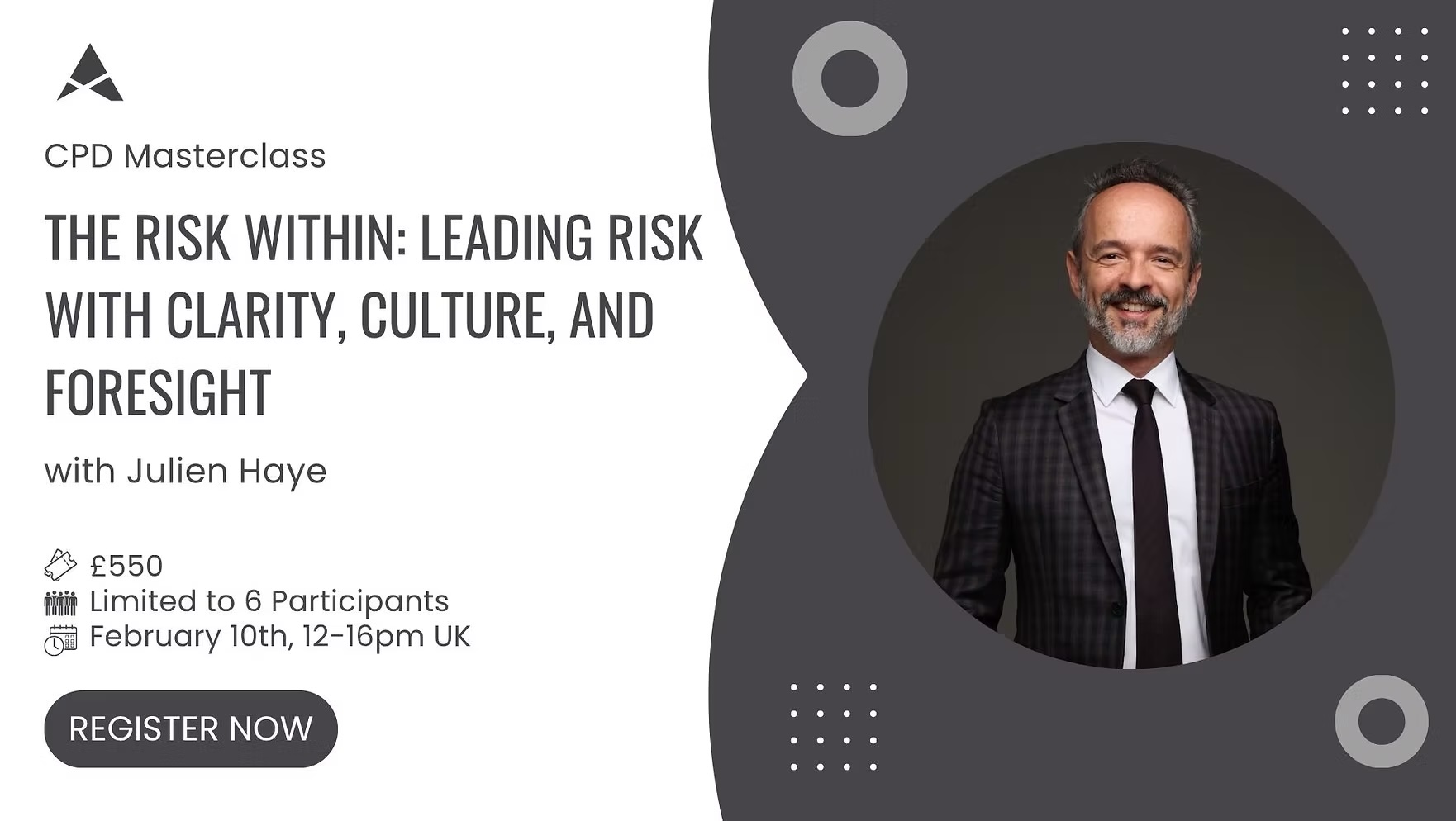 CPD Masterclass - The Risk Within: Leading Risk with Clarity, Culture, and Foresight
Location: Aevitium LTD Online Webinar Date : February 10, 2026 Organizer: Aevitium LTD
 Safe Teams, Bold Decisions: Empowering Through Risk
Location: https://us06web.zoom.us/j/83731945699?pwd=AAwH0WsrsdSqpboNZbyYMtGHMNDvV3.1 Date : November 19, 2025 - November 19, 2025 Organizer: Aevitium LTD
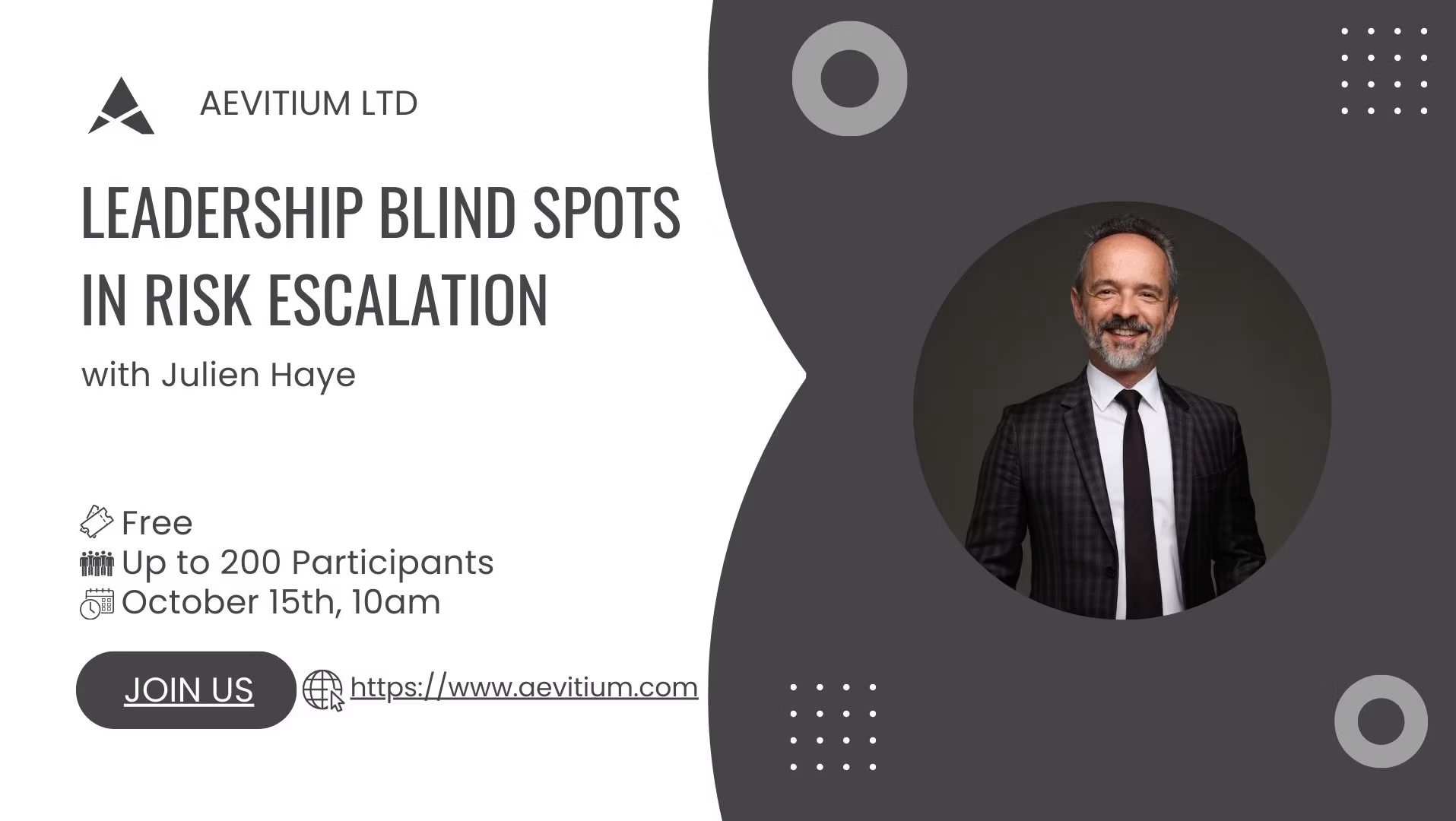 Seeing What You’re Missing: Leadership Blind Spots in Risk Escalation
Location: Aevitium LTD Online Webinar Date : October 15, 2025 - October 15, 2025 Organizer: Aevitium LTD
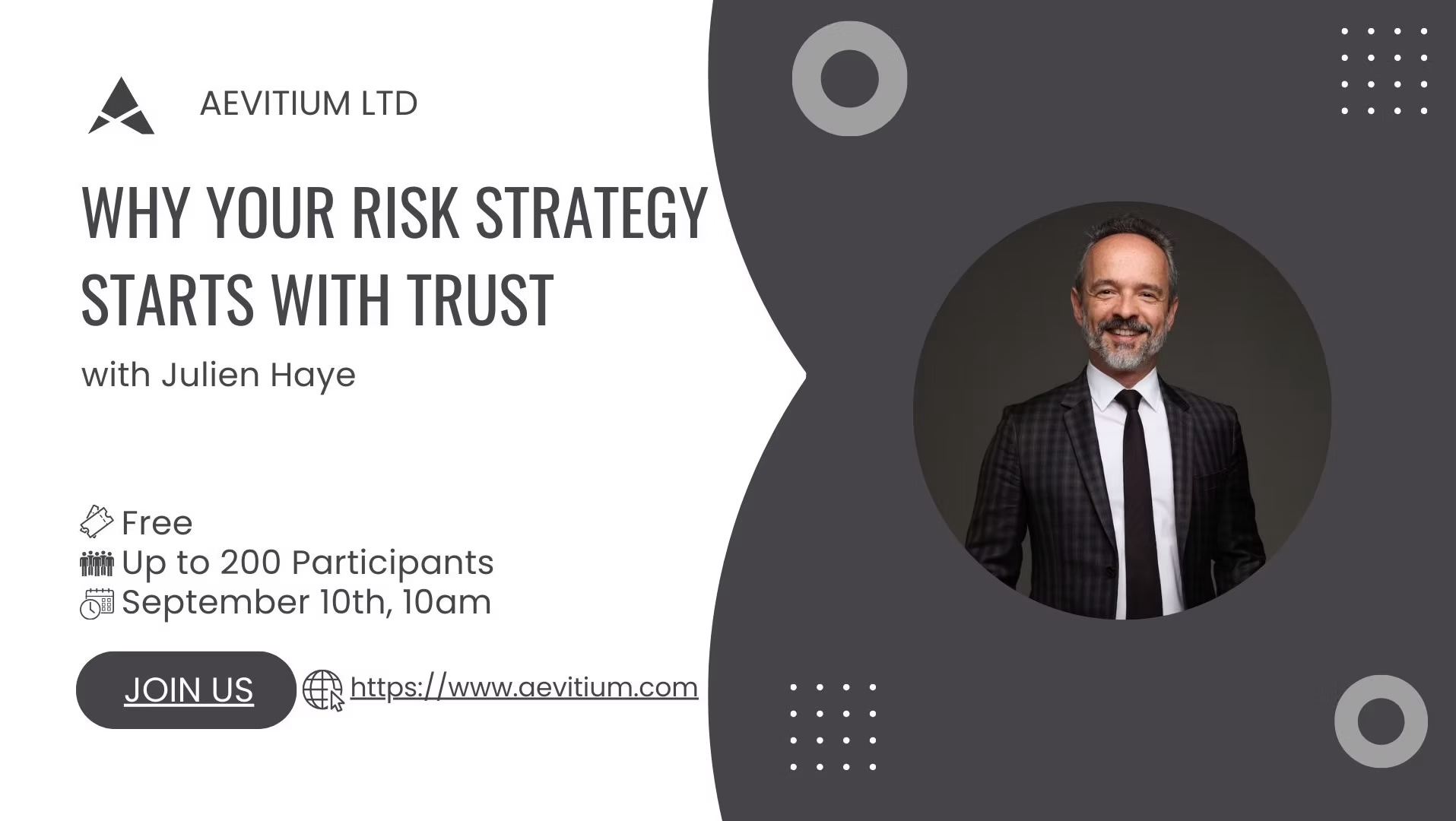 Why Your Risk Strategy Starts with Trust
Location: Online Date : September 10, 2025 - September 10, 2025 Organizer: Aevitium LTD

 Risk Culture & Psychological Safety in FCA-Regulated FirmsThe Role of the Manager is Dead! Discuss.Resilient Risk Management: How Risk Leadership Enables AgilityThe Role of the Manager is Dead! Discuss.



 CEFPRO Advisory Board

 UK Startup Awards 2026 - Finalist
 OpRisk Europe