Mar26
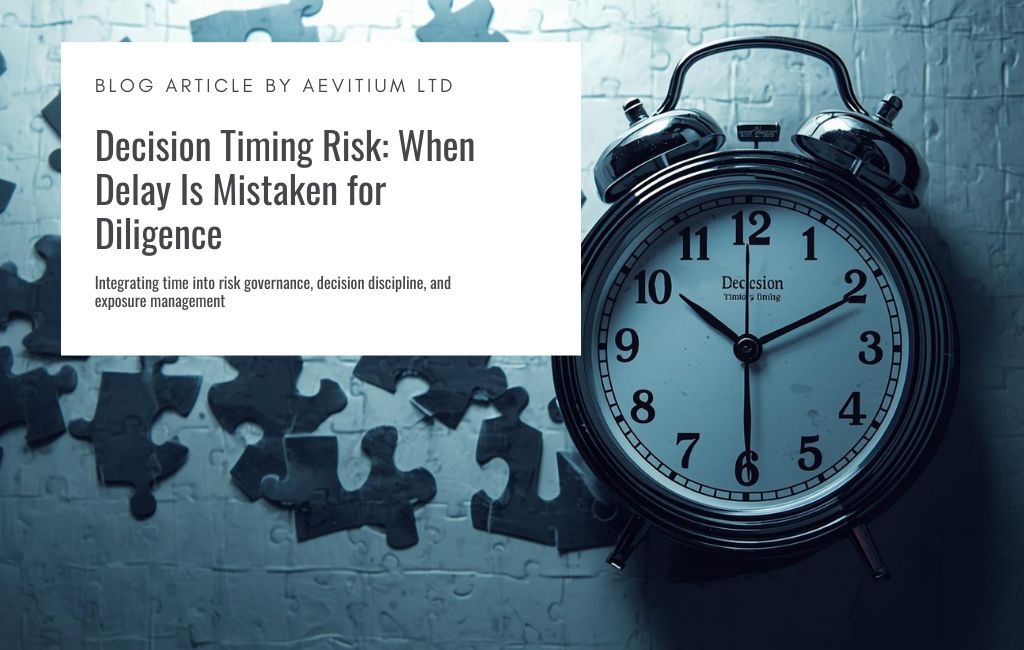
Most organisations believe they manage risk effectively. Risk frameworks assess likelihood and impact, governance forums review exposure, and leadership teams track performance through dashboards and indicators. From a structural perspective, the system appears comprehensive and well established.
Yet an important dimension often remains unaddressed: how risk evolves over time between recognising a signal and taking action.
Risk is not static. It develops as conditions shift, assumptions weaken, and decisions are delayed. What appears manageable at one point in time can become constrained and costly if action is deferred. Despite this, most governance frameworks are not designed to capture this dynamic. They provide a clear view of what risk is, but a limited view of when it must be acted upon.
This creates a structural blind spot.
Traditional risk frameworks were designed to classify and report exposure. Their strength lies in standardisation. Likelihood and impact can be compared, aggregated, and monitored across the organisation, supporting consistency and oversight. Time, however, does not fit easily within this structure. Its relevance varies by context, decision type, and external conditions, making it difficult to codify in a uniform way.
As a result, governance systems tend to provide a static view of a dynamic reality. Organisations can recognise emerging exposure while still missing the moment when it can be influenced.
Every strategic and operational decision creates a window in which it can be shaped. At that point, there is sufficient clarity to act and sufficient optionality to influence the outcome. Over time, this balance changes. Uncertainty may reduce, yet optionality declines. The cost of intervention increases and the ability to adjust or reverse the decision diminishes.
By the time a decision appears fully understood, it is often already constrained.
This dynamic is rarely made explicit within governance frameworks. Signals are typically interpreted as risk indicators or emerging issues. In practice, many of these signals represent something earlier. They indicate that the assumptions underpinning a decision are beginning to shift. If these signals are not translated into timely action, exposure accumulates.
Risk develops not only from adverse events, but from delay.
This has direct implications for governance design. Responsibility cannot be limited to identifying and reporting risk. It must extend to ensuring that decisions are taken while meaningful options remain available. This requires clarity over who is accountable for recognising when assumptions are weakening, who triggers escalation, and who ensures that decisions are taken within an appropriate timeframe.
Without this clarity, delay becomes systemic. Accountability diffuses across functions and committees, and decisions are deferred until conditions force action. At that point, governance remains active, yet influence over outcomes has already diminished.
Embedding time into governance does not require additional complexity. It requires a shift in focus. Assumptions underpinning major decisions must remain visible after approval, and signals that indicate change must be linked to clear escalation triggers. Decision authority must remain connected to the responsibility for acting on those signals within an appropriate timeframe. In doing so, governance aligns more closely with how risk actually develops in practice.
Effective leadership in this context is not defined by speed. Acting too early without sufficient clarity can create instability. Acting too late embeds exposure that becomes increasingly difficult to manage. Decision discipline lies in acting at the point of highest leverage, where uncertainty remains manageable and options are still available.
Organisations rarely fail because they act too early. They fail because they act after the decision window has closed.
Understanding and governing this dynamic positions time not as a secondary consideration, but as a central dimension of risk management and strategic leadership.
Read the full article on Aevitium LTD: https://www.aevitium.com/post/decision-timing-risk
By Julien Haye
Keywords: GRC, Leadership, Risk Management
 You are not your diagnosis
 Is GenAI good for anything?
 “I didn’t write an award acceptance speech because I didn’t expect to win.”
 AI Is Exposing the Data Problems Humans Used to Hide
 "The AI may in fact be conscious." Really?