May22
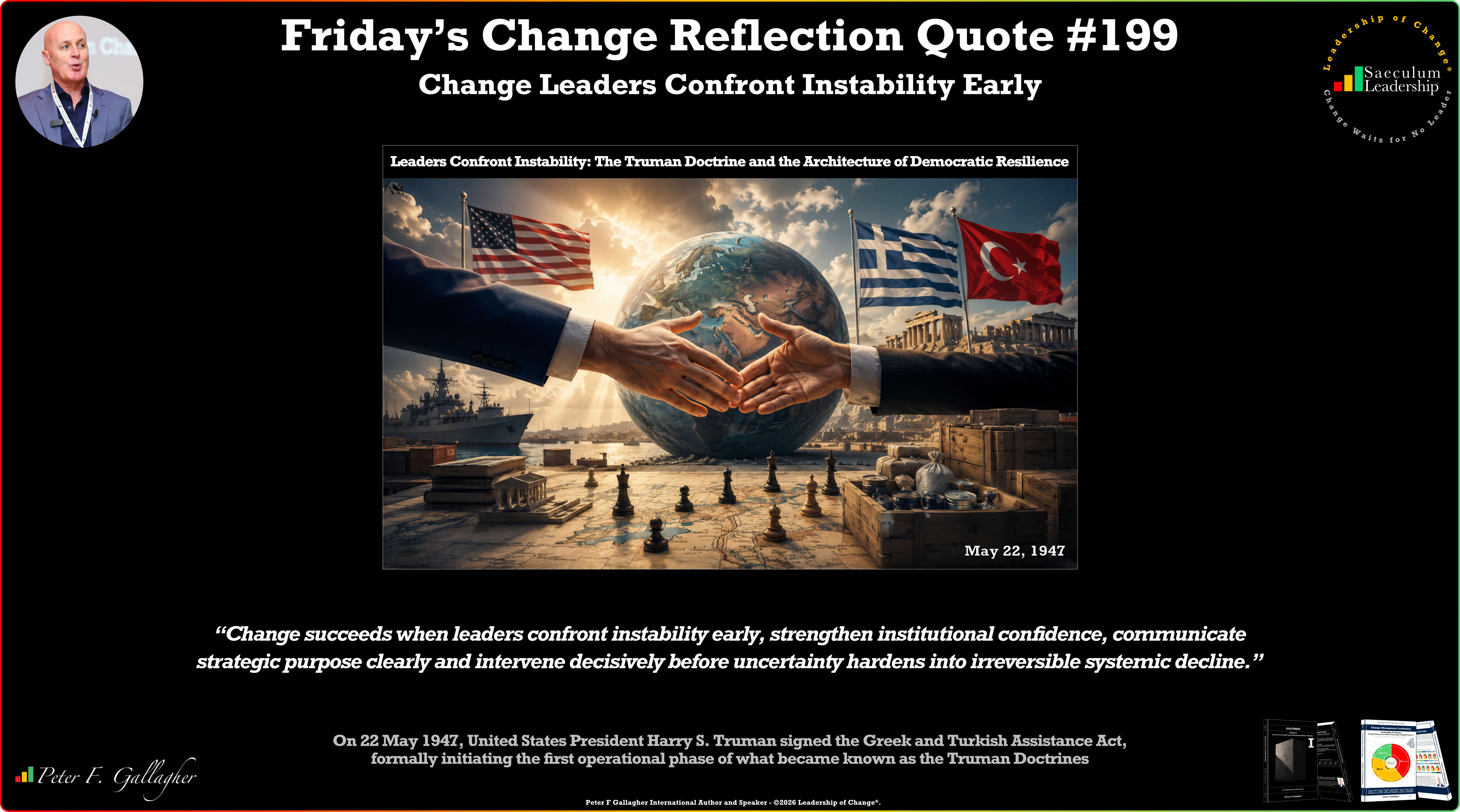
On 22 May 1947, United States President Harry S. Truman signed the Greek and Turkish Assistance Act, formally initiating the first operational phase of what became known as the Truman Doctrine. The legislation authorised extensive American military and economic support to Greece and Turkey during a period of escalating instability following the Second World War. At the time, Britain had informed Washington that it could no longer sustain financial and military assistance to Greece, where civil conflict and political fragmentation threatened governmental collapse. Turkey simultaneously faced mounting geopolitical pressure linked to Soviet regional ambitions.
The Act represented a decisive shift in American foreign policy from relative post war retrenchment towards sustained international engagement. It signalled that the United States was prepared to intervene economically, politically and militarily to prevent the expansion of Soviet influence across strategically important regions. Although framed as support for democratic stability, the legislation also reflected growing fears that economic hardship, weakened institutions and exhausted governments created fertile conditions for ideological extremism and geopolitical realignment.
The significance of the legislation extended well beyond Greece and Turkey. It marked the beginning of a new strategic doctrine centred upon containment, alliance building and long-term geopolitical positioning. The Act established a precedent for large-scale American involvement in foreign governmental resilience, influencing later policies connected to Europe, Asia and the broader Cold War order. It also demonstrated how financial assistance increasingly became an instrument of strategic influence rather than solely humanitarian support.
The legislation emerged during a period when many nations remained structurally weakened by war damage, inflation, food shortages and social dislocation. In this environment, governments faced growing pressure to restore legitimacy while simultaneously confronting ideological competition between democratic capitalism and Soviet communism. The legislation illustrated how external intervention could become deeply connected to domestic governance, institutional resilience and international power projection.
The decision also reflected a broader recognition that military victory alone does not secure lasting stability. Economic exhaustion, political uncertainty and weakened public confidence can rapidly undermine national recovery if leadership institutions fail to respond decisively. The Act therefore became one of the defining geopolitical turning points of the twentieth century, helping shape the strategic architecture that dominated international relations for decades.
The event remains historically significant because it demonstrated how rapidly global leadership priorities can shift when emerging threats expose institutional fragility. It also showed how governments increasingly relied upon integrated political, economic and military responses to stabilise complex international environments during periods of systemic uncertainty. This moment also stands as a Saeculum Leadership® Signal, revealing how emerging instability forces nations to redefine their strategic purpose and accept the responsibilities of system stewardship. It marked the point at which short‑term crisis management evolved into a generational doctrine shaping the long arc of international order.
Change Leadership Lessons: The lesson of 1947 was not simply geopolitical intervention, but the recognition that instability ignored eventually becomes systemic crisis. History records the withdrawal. Change leadership explains why recognising failure before collapse matters. Leaders of change recognise emerging instability early and respond decisively before fragmented conditions evolve into wider systemic disruption. They strengthen institutional resilience to sustain confidence and prevent political or economic pressures accelerating organisational decline. Change leaders coordinate economic, political and operational responses rather than relying upon isolated actions focused solely upon immediate symptoms. They communicate strategic intent clearly to reinforce legitimacy, alignment and sustained commitment during periods of uncertainty and transformation. Leaders of change understand that decisions taken during crisis frequently establish enduring precedents shaping future institutional behaviour. Change Leaders Confront Instability Early.
“Change succeeds when leaders confront instability early, strengthen institutional confidence, communicate strategic purpose clearly and intervene decisively before uncertainty hardens into irreversible systemic decline.”
Application - Change Leadership Responsibility 1 – Articulate the Change Vision:
The growing instability surrounding Greece and Turkey during 1947 demonstrated that post war recovery alone could not guarantee long-term geopolitical stability. Economic exhaustion, political division and expanding ideological pressure created conditions where uncertainty threatened to undermine fragile institutions across strategically important regions. Effective change leadership therefore required leaders capable of articulating a clear and credible vision that explained both the risks of inaction and the necessity for coordinated international support.
A meaningful change vision provides more than reassurance during uncertain conditions. It establishes strategic clarity by defining why existing approaches are no longer sustainable, what future conditions must be secured and how disciplined cooperation can prevent wider systemic deterioration. The Greek and Turkish Assistance Act reflected an emerging recognition that stability required a broader strategic direction connecting economic recovery, institutional resilience and geopolitical security into a coherent long-term direction.
Leaders were required to communicate that containment was not solely a military objective, but part of a wider strategic effort to preserve governmental stability, public confidence and international balance during a period of accelerating global uncertainty. This demanded clarity of purpose capable of aligning governments, institutions and populations behind sustained action rather than fragmented short-term reaction.
That responsibility remains central today. People maintain commitment to change when leaders explain complexity with honesty, establish a credible future direction and connect immediate pressures to a larger vision of resilience and stability. Effective change leadership therefore transforms uncertainty into coordinated purpose, ensuring disruption becomes the catalyst for disciplined renewal rather than prolonged fragmentation or strategic decline.
Final Thoughts: The Greek and Turkish Assistance Act marked far more than a regional intervention; it initiated a generational shift towards containment, alliance structures and long-term geopolitical competition that shaped the Cold War era. AI now accelerates how leaders identify institutional fragility, model emerging instability and detect systemic risk, whilst simultaneously increasing the speed of misinformation, ideological influence and strategic disruption across societies. Leaders of change must therefore recognise instability early, strengthen institutional resilience and coordinate disciplined action before fragmented pressures evolve into irreversible systemic decline.
For insights on navigating organisational change, feel free to reach out at Peter.gallagher@a2B.consulting.
For further reading please visit our websites: https://www.a2b.consulting https://www.peterfgallagher.com Amazon.com: Peter F Gallagher: Books, Biography, Blog, Audiobooks, Kindle
Leadership of Change® Body of Knowledge Volumes: Change Management Body of Knowledge (CMBoK) Books: Volumes 1, 2, 3, 4, 5, 6, 7, 8, 9, 10, A, B, C, D & E available on both Amazon and Google Play:
~ Leadership of Change® Volume 1 - Change Management Fables
~ Leadership of Change® Volume 2 - Change Management Pocket Guide
~ Leadership of Change® Volume 3 - Change Management Handbook
~ Leadership of Change® Volume 4 - Change Management Leadership
~ Leadership of Change® Volume 5 - Change Management Adoption
~ Leadership of Change® Volume 6 - Change Management Behaviour
~ Leadership of Change® Volume 7 - Change Management Sponsorship
~ Leadership of Change® Volume 8 - Change Management Charade
~ Leadership of Change® Volume 9 - Change Management Insanity
~ Leadership of Change® Volume 10 - Change Management Dilenttante
~ Leadership of Change® Volume A - Change Management Gamification - Leadership
~ Leadership of Change® Volume B - Change Management Gamification - Adoption
Keywords: Business Strategy, Change Management, Leadership
 Two Clocks, One Truck: The Army's Need for Speed Meets New Defense Sourcing Rules
 Sustainable Transformation: The Elephant and The Mouse In The Room
 The Price of Standing Alone: Strategic Autonomy in a World Where Nobody Can Do It Alone
 The Potter’s Hands: Why Great Leaders Shape Environments, Not People
 The Corix Partners Friday Reading List - October 16, 2026