Jun06
David was a high-performing professional in finance: gregarious, productive, well-regarded by everyone around him. Then two small strokes affected a region deep in his brain called the basal ganglia. He stopped working. He stopped socializing. He sat in a chair doing nothing, all day. He wasn’t depressed. He wasn’t grieving. He was, as his neurologist would later write, completely indifferent to his own predicament.
That case stayed with Masud Husain, Professor of Neurology and Cognitive Neuroscience at the University of Oxford and author of Our Brains, Our Selves: What a Neurologist’s Patients Taught Him About the Brain. The case stayed with him as a lesson about what motivation is, and what it is not.
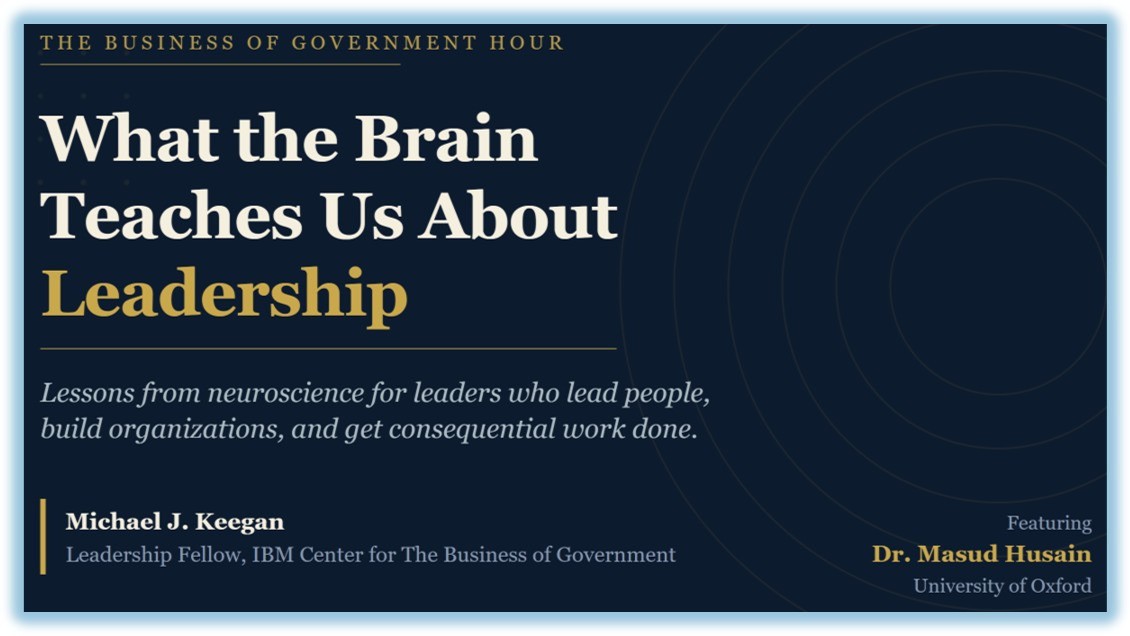
I recently had the opportunity to speak with him on The Business of Government Hour about what the science of the brain means for those of us who lead people, build organizations, and try to get consequential work done.
Prof. Husain spent thirty years as a practicing neurologist before writing this book. What he observed over that time was not simply the medical dimension of brain disorders. He saw how those disorders stripped people of their sense of self, their place in a community, their ability to connect with others. That observation sits at the heart of everything he writes, and it carries direct implications for leaders.
Leaders tend to operate on an implicit assumption: the people around them have stable, predictable personalities. We talk about individual character, personal drive, and consistent performance as if they were fixed traits. Prof. Husain's work challenges that assumption at its root.
“The self is the sum, if you like, of the emergent activity of many different brain systems,” he told me.
“Systems that look after attention, perception, language, understanding concepts, motivation, empathy, and so on. The way in which that self, that person will behave, might differ a lot in terms of the negotiations that are going on between these different brain systems in terms of what is prioritized and what emerges.”
This is not a soft philosophical claim. The same person will perform differently depending on context, environment, the people around them, the mission they are asked to serve, and the degree to which they feel invested. Leaders who treat human behavior as a fixed variable miss the degree to which they shape that variable every single day.
The most persistent myth in organizational culture: motivation is a matter of character. The productive employee is motivated. The underperformer is lazy. Accountability, in this view, is the solution.
“For David,” he explained, “the investment of five minutes worth of physical effort was not worth the rewarding outcome of listening to great music. Nothing was sufficiently rewarding to warrant the action.”
The basal ganglia, the deep brain structures that link motivation signals to action, had been disrupted. His motivation didn't weaken. It vanished.
He was treated successfully with dopamine, the neurotransmitter central to this motivation-to-action circuit.
When a team member appears disengaged, the first question might be whether that person finds the potential outcome of their work sufficiently rewarding to warrant the effort. If the answer is no, a leader needs to understand why. “Maybe in this task, they’re not invested,” Prof. Husain said. “They’re not invested in the mission. They’re not invested in thinking that this is going to be something that’s going to shift the needle.
The leader's job is to make the work worth believing in, for the organization and for the people doing it.
This is discipline, not a personality assessment.
Prof. Husain introduced a concept every leader should internalize -- reward discounting. Reward discounting (often called delay discounting or temporal discounting) describes the psychological and behavioral tendency to devalue a reward simply because it will be received in the future rather than immediately. The longer you have to wait for something, the less valuable it subjectively feels in the present moment. For example, a six-month project with no intermediate feedback asks something of the human brain that the brain is not designed to provide without help.
“If you have a project that’s going to take six months to complete and you get no feedback along the way that you’re actually hitting the right kind of milestones, that your boss is really pleased about the way you’ve succeeded in getting to this one stage, then it’s asking a lot for a brain which is normally discounting rewards.”
The prescription is concrete. Acknowledge progress at visible intervals. Confirm that milestones matter. Tell people when they are doing well, not only when the project ends. Prof. Husain cited Gallup research: organizations whose workers feel genuinely invested in their mission see productivity increases of around 20 percent. That number is not produced by adding resources. It is produced by leadership behavior.
Sometimes leaders may absorb myths from the culture around them and act on those myths. Two in particular deserve correction notes Husain.
The first is dopamine. Popular culture treats it as a pleasure chemical, a reward hit triggered by scrolling, eating, or receiving praise. “Today, dopamine is not thought to be something that gives us pleasure,” Prof. Husain said. “It is actually an important neurotransmitter in this calculus about motivation and action.” Dopamine drives the evaluation of whether an outcome is worth the effort required to pursue it. It persists across the vertebrate kingdom, from the lamprey to the human being, because that calculus is essential to survival. Leaders who rely on reward-and-response management systems maybe working from a flawed model.
The second myth is multitasking. Many professionals wear it as a badge of effectiveness. The evidence runs in the opposite direction. “For most cognitively demanding tasks, what we’re having to do is switch resources rapidly between one task and another,” Prof. Husain explained. “Having to switch, doing task switching, has a cost. A cognitive cost, a performance cost, but it also makes people fatigued. And fatigue is one of the worst things you want if you want your workforce to be motivated.” Structuring work to allow sustained focus is not a luxury. It is a condition for quality output.
A third myth runs deeper than the others. It is the assumption people in organizations function like machines executing rational commands. Leaders design processes, set targets, and expect outputs, as if the inputs were interchangeable.
Prof. Husain put it directly: “It is [seemingly] attractive to [some] to think about human beings effectively like machines or computers executing tasks. What we’ve learned is that the brain is really built to seek meaning, purpose, to have agency, to feel like we are doing something that matters while making connections with others in a team effort.”
His research on decision-making under uncertainty confirmed the point experimentally. Most people make decisions with significant bias, shaped by past experiences, emotional state, and confirmation tendencies. A patient with bilateral frontal damage turned out to be the most rational decision-maker in the study population. He behaved more like a computer than a human. The anomaly illuminates the norm according to this perspective that human decision-making is far more than purely rational.
For leaders building accountability systems and oversight structures, this has design implications. Systems that assume rational actors and punish deviation from expected performance may consistently misread their own data.
When I asked Prof. Husain about design principles for institutions seeking to protect the quality of consequential decisions, his answer centered on one concept: agency.
“The incentives that really motivate a workforce are not always the simple things like money or holidays. It’s also feeling like they’re doing something with purpose, that they believe in it and they actually were part of doing this, that they have agency. That’s a really important part of this: to feel that your workforce really has agency. They feel like they’re a part of this.”
Agency is not a morale initiative. The brain that feels it has no influence over outcomes will discount future rewards, reduce effort allocation, and withdraw from the mission. The brain that feels genuine ownership over the work will invest in proportion to that sense of ownership. Leaders who treat agency as a sentiment to manage maybe misidentifying it. It is a structural condition they need to create.
Two of Husain's clinical cases extend these lessons into the domain of identity and organizational belonging.
The first is a patient called Michael, a humorist who lost his semantic memory, his knowledge of concepts and the meanings attached to words. His episodic memory remained intact. He recalled the events of his life. But the conceptual framework through which those events had meaning was eroding. The first sign was that he stopped telling jokes. His grandson would tell him a joke. He was unable to follow it. Humor, Prof. Husain explained, depends on the conceptual associations attached to words. Without those associations, the pivot disappears.
For leaders, this points to something less obvious. Shared conceptual vocabulary is not incidental to organizational function. When a team operates from different definitions of quality, accountability, mission, or success, the shared language looks functional but is hollow. The words are present. The shared meaning is not.
The second case is Trish, whose episodic memory was corrupted by Alzheimer's disease. She did not recognize her own husband during a vacation. She confabulated a coherent explanation for the situation she found herself in, filling gaps in her experience with plausible but false memories. And she was in denial. She refused to acknowledge anything was wrong.
Prof. Husain described the eventual shift: “It was only after many months when I was chatting to her alone that she kind of broke down and said, look, I understand there is a problem, but I’ve just been very frightened about the fact that this is a dementia that I’ve got.” That moment of acknowledgment, he noted, was liberating. The people around her finally had an explanation. Her relationships could recalibrate around reality rather than around a fiction she had constructed.
Leaders encounter versions of this dynamic. Organizations and individuals both have the capacity to confabulate, to fill gaps in understanding with confident but inaccurate narratives. Creating conditions where honest acknowledgment is possible, where people are not required to maintain a coherent fiction about their own performance or their organization's trajectory, is a leadership function as much as a clinical one.
Husain's counsel for leaders integrating AI and navigating complex organizations was direct: “Leaders have to do more than set targets and manage processes. They’ve got to make whatever the outcome and mission they are seeking real and that it matters. They have to give people enough trust and agency to use their judgment. The key thing is that identity and purpose are central to how we function.”
Government leaders face this challenge in a particular form. Public institutions depend on people doing difficult work under pressure, often without high levels of external recognition. The conditions the brain requires, purpose, agency, connection, visible progress, and a sense that one's actions matter, have to be built deliberately into how those institutions are led and structured.
The neuroscience does not offer a formula. What it offers is a more accurate model of the people doing the work. This more accurate model, grounded in thirty years of patient care and rigorous research, should inform how leaders think about performance, accountability, motivation, and organizational design.
Keywords: Leadership
 AI Is Exposing the Data Problems Humans Used to Hide
 "The AI may in fact be conscious." Really?
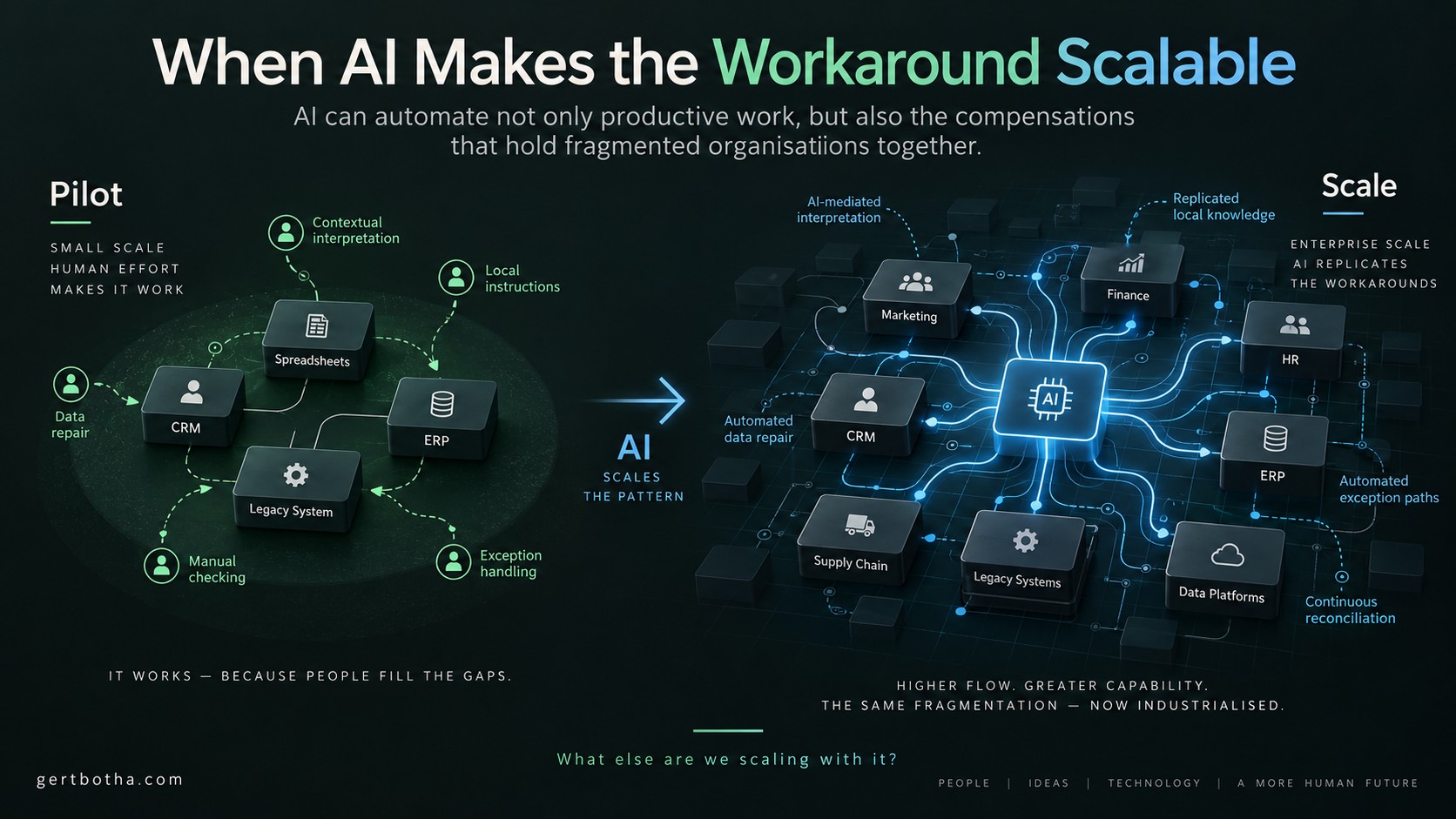 When AI Makes the Workaround Scalable
 The Age of Continuous Shocks: Why the coming downturn will be decided in your supply chain
 Friday’s Leader Reflection Quote – Saeculum Leadership Leaders Accept Decisions Create Responsibilities