Aug07
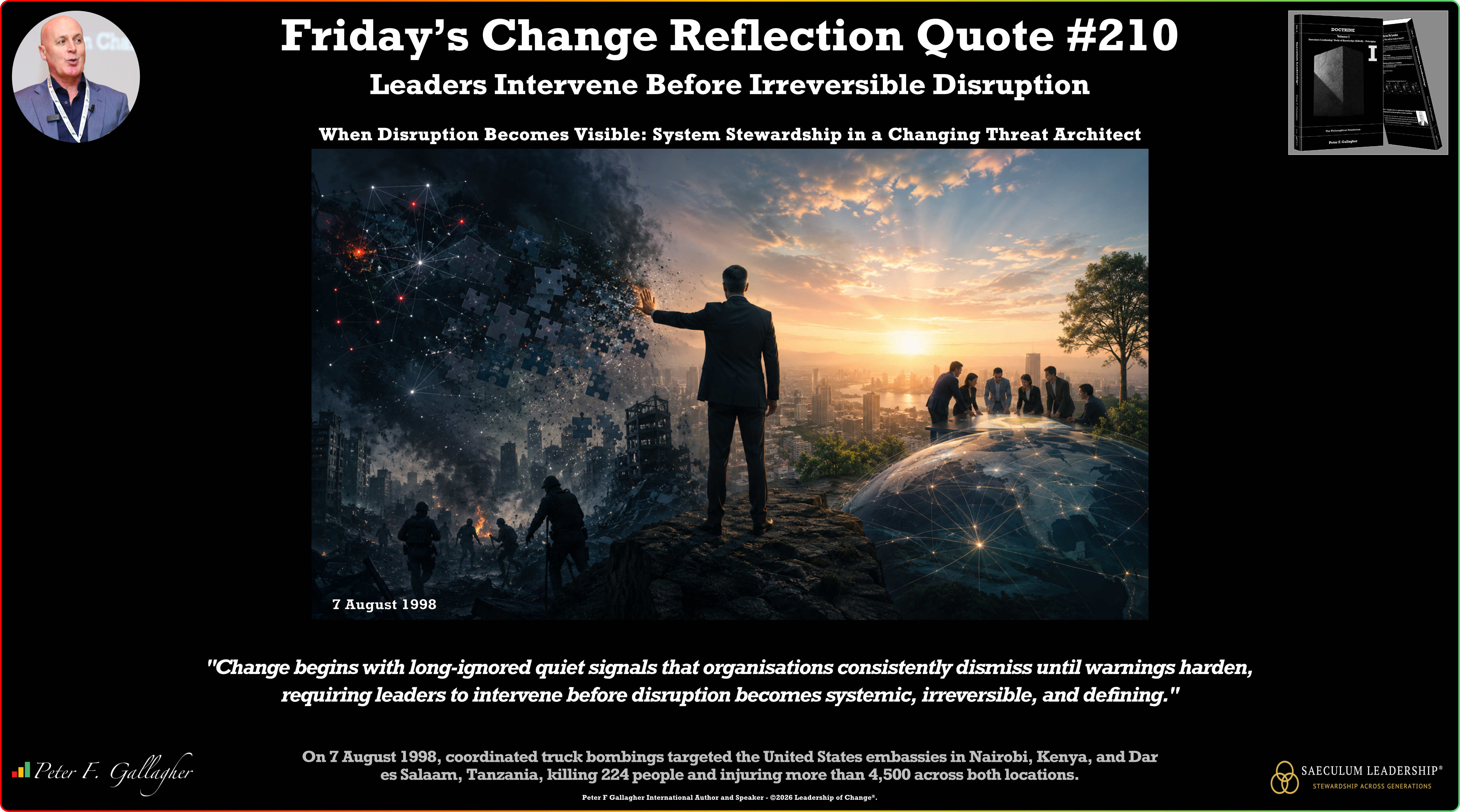
On 7 August 1998, coordinated truck bombings targeted the United States embassies in Nairobi, Kenya, and Dar es Salaam, Tanzania. The attacks killed 224 people, including 12 Americans, and injured more than 4,500 people across both locations. The attacks were significant because they demonstrated how a transnational threat could operate across borders, target diplomatic institutions and create consequences extending far beyond the immediate locations. They also represented a profound challenge to established assumptions about security, intelligence, organisational preparedness and the changing architecture of global risk.
The Nairobi bombing caused particularly extensive destruction, with nearby buildings collapsing and many casualties resulting from secondary fragmentation and structural damage. The Dar es Salaam attack occurred minutes later, demonstrating the deliberate coordination and geographical reach behind the operation.
The historical importance therefore extends beyond the immediate tragedy and the enormous human cost. The bombings exposed a changing threat environment in which conventional organisational boundaries were increasingly inadequate for understanding emerging risks.
The attacks became a defining moment in the evolution of international counterterrorism, reshaping intelligence cooperation and foreshadowing many of the strategic challenges that became globally recognised after September 2001. The FBI deployed more than 900 personnel and worked with international partners to recover evidence, identify victims and pursue those responsible.
This response illustrates an important distinction between reacting to an event and learning from what the event reveals about the system. Effective leadership requires leaders to examine the conditions that allowed a threat to develop, connect knowledge across organisational boundaries, and recognise patterns before they become crises.
The deeper leadership challenge concerns the relationship between signals and knowledge. Information may exist across different agencies, locations and professional communities without becoming shared understanding. When fragmented information remains disconnected, organisations can possess intelligence without possessing sufficient knowledge to anticipate what may follow. The bombings reshaped how leaders understood international security.
For change leaders, the enduring lesson is that major disruption rarely begins when the visible event occurs. It begins earlier, through signals that may appear disconnected, inconvenient or insufficiently important.
Leadership must therefore extend beyond responding effectively after disruption becomes visible. It requires creating the conditions in which signals are recognised, knowledge is connected, assumptions are challenged and intervention occurs before the emerging pattern becomes systemic.
The lasting significance lies not only in what happened, but in what the attacks revealed about the changing architecture of global risk. Leadership must continually adapt its understanding of threats, systems and interdependencies.
The turning point was therefore a shift from viewing security through isolated events towards recognising interconnected signals and emerging systemic threats.
Saeculum Leadership® asks leaders to recognise the Signal within disruption, because the decisive change often begins before the crisis becomes visible.
Saeculum Leadership® Lessons: This sequence of events stands as a clear turning point that exposed the limits of static defensive postures against determined non-state actors. Saeculum Leaders change their understanding when emerging signals reveal that established assumptions no longer explain the system. They connect fragmented knowledge so that isolated information becomes meaningful understanding capable of informing future decisions. Saeculum Leaders challenge assumptions before familiar thinking becomes embedded within systems that are already undergoing fundamental change. They recognise interconnected signals because apparently separate events can reveal deeper transformations occurring across wider systems. Saeculum Leaders intervene before emerging disruption becomes systemic, irreversible or significantly more costly to correct.Leaders Intervene Before Irreversible Disruption.
“Change begins with long‑ignored quiet signals that organisations consistently dismiss until warnings harden, requiring leaders to intervene before disruption becomes systemic, irreversible, and defining.”
From the Canon — Practice 5: The Practice of System Stewardship: System Stewardship is the discipline through which leaders strengthen the architectures that outlive them. It is the commitment to redesign systems so they become more stable, transparent and resilient. Saeculum Leaders understand that institutions rarely collapse because of a single failure; they decay when signals are ignored, knowledge remains fragmented and assumptions go unchallenged.
The East African Embassy Bombings demonstrate this principle clearly. The threat did not emerge suddenly — it evolved through quiet, distributed signals that were visible but not connected. Intelligence existed across agencies and regions, yet the system lacked the architecture to transform fragmented information into shared understanding.
This is the essence of System Stewardship:
The bombings revealed that inherited systems often contain hidden risks that only become visible when disruption is already irreversible. Conventional boundaries and static defensive postures were insufficient for understanding emerging transnational threats. The system was not failing because leaders lacked information; it was failing because the architecture could not convert information into anticipation.
The Stewardship Reflection Lens:
What are we inheriting? We inherit systems shaped by long‑ignored signals and outdated assumptions, carrying risks that escalate rapidly when disruption becomes visible.
How should we steward it? Stewardship requires leaders to connect knowledge, strengthen transparency and challenge assumptions, keeping risk‑reduction systems resilient against volatility and short‑term pressure.
What legacy are we creating? Leaders who intervene early and redesign how power is regulated leave behind a legacy where risk is constrained by architecture, not hope.
Further Reading: Saeculum Leadership® Body of Knowledge (SLBoK). Saeculum Leadership®: Doctrine – Volume I.
Peter F. Gallagher is the Founder–Architect of Saeculum Leadership®, a doctrine of generational stewardship that equips leaders to strengthen what they inherit and shape what future generations receive. A 21-book author, global keynote speaker, and trusted advisor to boards, CEOs, and executive leadership teams, he helps organisations strengthen leadership capability, institutional stewardship, and transformational change in an increasingly complex world.
For further insights please visit our websites: https://www.a2b.consulting https://www.peterfgallagher.com Amazon.com: Peter F Gallagher: Books, Biography, Blog, Audiobooks, Kindle
Saeculum Leadership® Body of Knowledge (SLBoK): Volumes 1-10.A-E & I-V
~ Leadership of Change® Volume 1 - Change Management Fables
~ Leadership of Change® Volume 2 - Change Management Pocket Guide
~ Leadership of Change® Volume 3 - Change Management Handbook
~ Leadership of Change® Volume 4 - Change Management Leadership
~ Leadership of Change® Volume 5 - Change Management Adoption
~ Leadership of Change® Volume 6 - Change Management Behaviour
~ Leadership of Change® Volume 7 - Change Management Sponsorship
~ Leadership of Change® Volume 8 - Change Management Charade
~ Leadership of Change® Volume 9 - Change Management Insanity
~ Leadership of Change® Volume 10 - Change Management Dilenttante
~ Leadership of Change® Volume A - Change Management Gamification - Leadership
~ Leadership of Change® Volume B - Change Management Gamification - Adoption
Keywords: Leadership, Change Management, Business Strategy
 Consumer vs. enterprise AI agents
 Best Supply Chain AI Tools in 2026: SCM SENSEI AI and Ask Lora Compared
 Making Silos Permeable
 The Corix Partners Friday Reading List - October 2, 2026
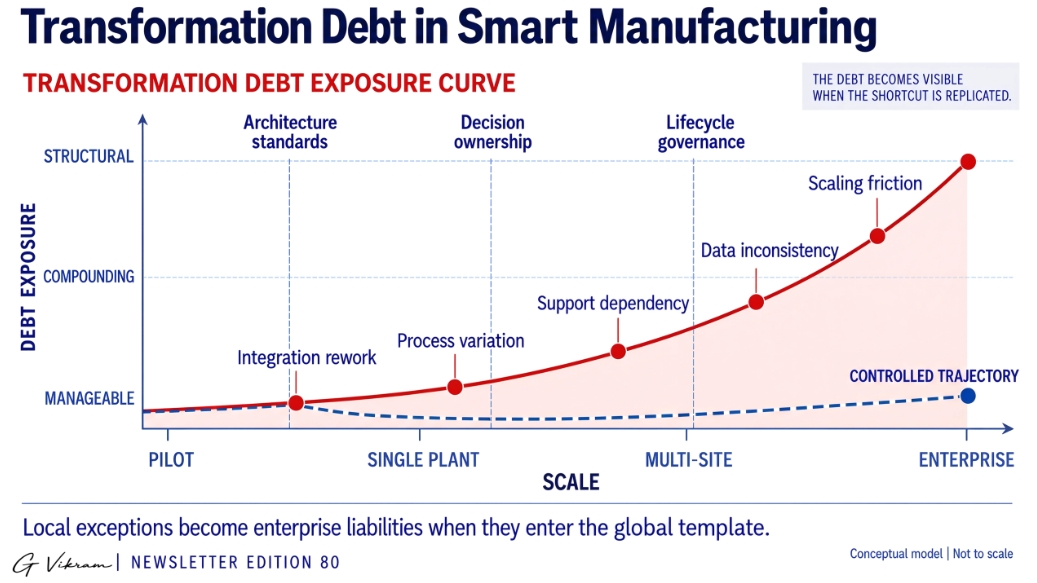 The most dangerous debt in a smart factory isn’t financial.