Jun09

Most companies are built on a clear organizational structure. Operations. Finance. HR. Sales. Marketing. Customer service. Each function has a leader, a defined role, and a place on the org chart.
That structure creates accountability and clarity. Until it starts creating friction.
As organizations grow, the same structure that once helped the business operate efficiently can begin to slow it down. Information gets trapped inside departments. Decisions move up the chain instead of being solved by the people closest to the issue. Teams become highly focused on optimizing their own function, sometimes at the expense of the broader business.
No one intentionally creates silos. But over time, silos are exactly what many organizations end up with.
The issue is not that departments exist. The issue is how rigidly organizations separate them.
More companies are beginning to rethink how work gets done. Not by eliminating structure, but by creating stronger collaboration across it. Instead of relying exclusively on hierarchy, they are building networks of teams that work across functions with more transparency, shared ownership, and communication.
This is no some trendy management theory, it is a practical way to move faster and solve problems more effectively.
In many organizations, work still moves in a sequence. One department completes its task and hands it off to the next. Marketing generates leads. Sales closes the business. Customer service handles issues after the sale. Finance manages billing and reporting.
Each department may perform its role well, but the handoffs often create gaps. Information gets filtered. Assumptions go unchallenged. And when something breaks down, the focus becomes identifying which department caused the problem.
A more collaborative approach shifts the focus away from handoffs and toward shared ownership.
Instead of working independently, cross-functional teams stay connected throughout the process. They understand how their decisions affect the larger business outcome, not just their own area of responsibility.
Consider the client experience. In many organizations, responsibility for that experience is fragmented across multiple departments. Sales owns the relationship early. Operations takes over implementation. Customer service handles ongoing concerns and so on.
From the client’s perspective, the experience can feel disconnected, even when every department is performing competently.
Now imagine a small, cross-functional team focused specifically on improving the client experience from beginning to end. Someone from sales. Someone from operations. Someone from customer service. Someone from finance.
Their goal is to provide excellent service and improve efficiency as a whole.
When people collaborate this way, they identify communication breakdowns faster, solve problems more effectively, and develop a broader understanding of how the business actually operates.
But this shift requires leaders to lead differently.
In traditional hierarchies, leaders often act as coordinators and decision-makers. Information flows up to them, and decisions flow back down.
In more collaborative organizations, leaders become connectors instead of controllers.
Their role is to ensure the right people are working together, that information is shared openly, and that teams have enough trust and clarity to make decisions without constant escalation.
For many companies, this is difficult.
Not because they oppose collaboration, but because hierarchy has reinforced a different leadership style for years. Letting go of control, encouraging open dialogue, and trusting others to make decisions requires a significant mindset shift.
This does not mean structure disappears. Accountability still matters. Roles still matter.
But the org chart becomes a roadmap for collaboration, not a barrier to it.
As business challenges become more interconnected, organizations that collaborate effectively across functions gain an enormous advantage. The companies that move fastest, solve problems best, and create the strongest client experiences are rarely the ones with the most rigid silos.
They are the ones where people work together to fulfill the mission and goals of the company.
Keywords: Entrepreneurship, HR, Leadership
 “I didn’t write an award acceptance speech because I didn’t expect to win.”
 AI Is Exposing the Data Problems Humans Used to Hide
 "The AI may in fact be conscious." Really?
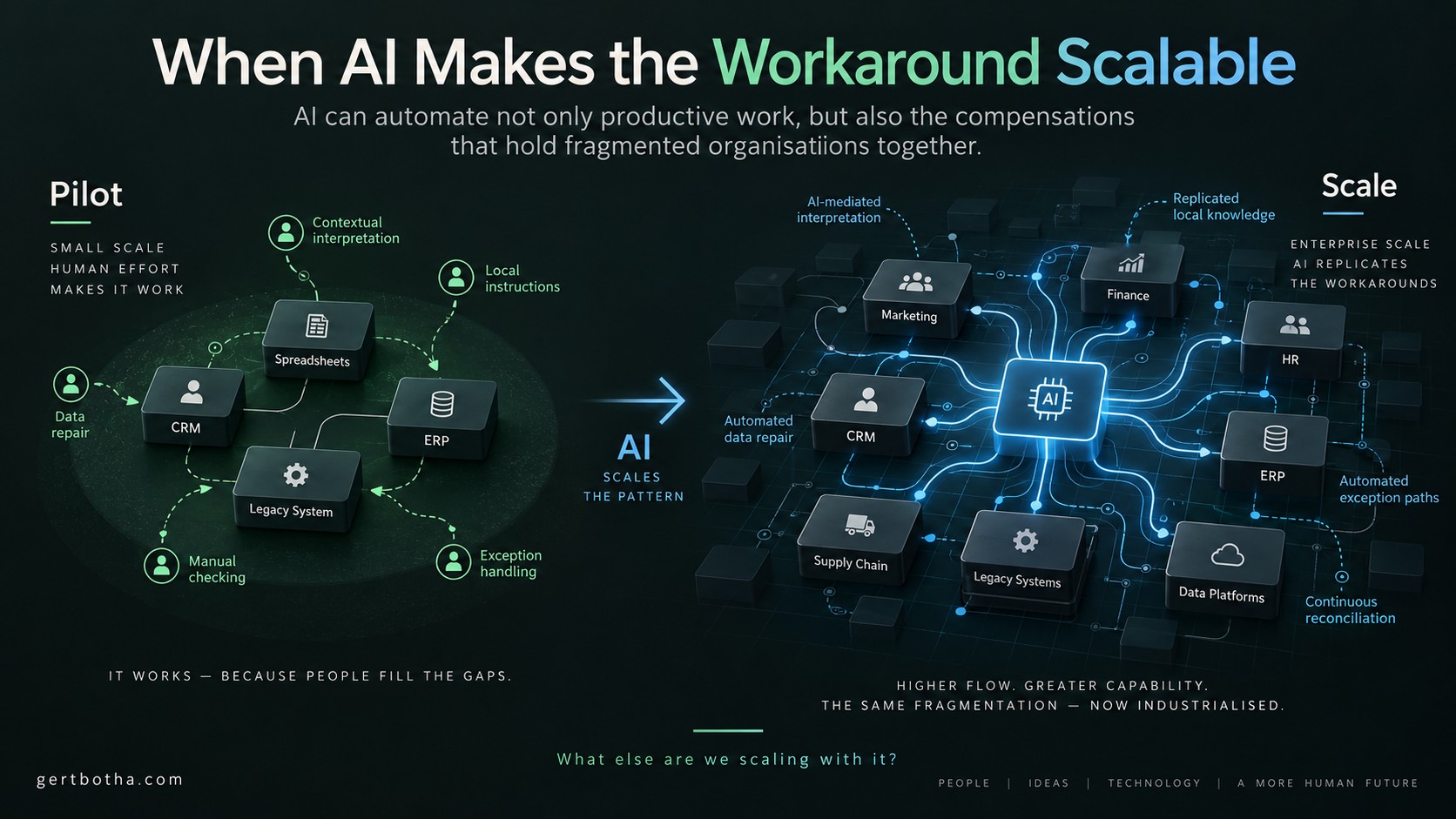 When AI Makes the Workaround Scalable
 The Age of Continuous Shocks: Why the coming downturn will be decided in your supply chain