Jun10

Sponsored By GTM AI
For a decade, the story of go-to-market technology was addition. Every team added another tool: a sequencer, an intent provider, a conversation-intelligence platform, an enrichment service, a scheduling app. The result is the sprawling stack most revenue organisations run today, where each tool solves a slice of the problem and none of them agree on the basics, starting with who the customer actually is.
That era of addition is ending. The interesting movement now is consolidation, and it is happening at a layer most leaders do not think about: the data underneath the tools.
Why the centre of gravity is shifting
Two forces are pushing in the same direction. The first is fatigue. Buyers have learned that another point tool rarely fixes a structural problem, and that integrations promised on a slide often arrive as brittle data syncs that quietly drift out of date. The second, and more decisive, is AI. As teams move from using AI to draft messages toward using agents to take action, the constraint stops being the interface and becomes the information the agent is allowed to act on.
An agent that prioritises accounts, drafts outreach, or routes a lead does not pause to sanity-check a stale record the way a person does. It acts on whatever it is given, instantly and at scale. That changes the economics of data quality. Information that was merely inconvenient when humans did the work becomes a liability the moment software acts on it autonomously.
The unglamorous problem under the stack
The root issue is entity resolution: the work of recognising that scattered records across many systems describe the same real company or person. A single account can appear under several names, with duplicates, conflicting attributes, and no link between them. Each tool holds a fragment, and no tool holds the whole. Reporting drifts, routing misfires, and forecasts wobble, and none of it announces itself as a data problem. It surfaces as a strategy, marketing, or operations problem with a shared hidden cause.
Manual reconciliation does not hold, because the underlying systems regenerate the mess faster than anyone can clean it. Buying another tool usually adds another silo. The durable move is to resolve the records a business already has into one dependable, current view of each customer and account, and to let every system reference that.
What consolidation actually looks like
The pattern emerging is a layer that sits beneath the existing stack rather than replacing it. It reconciles the duplicates, maintains one resolved record per entity, and exposes that record to the tools, and increasingly the AI agents, that need it. In practice this is what amounts to a context graph for GTM: a single resolved foundation that connects fragmented records so the same customer reads consistently wherever the work happens. When every tool and agent references the same reconciled truth, the stack stops contradicting itself, automation acts on accurate inputs, and teams stop arguing about whose numbers are right.
This is a quieter idea than the latest model release, but it is where durable advantage is forming. A capable model is something any competitor can license. A resolved, verified view of your own market is not, and it is precisely what determines whether an AI initiative produces something useful or something confidently wrong.
The takeaway for go-to-market leaders
The instinct, when results disappoint, is to add a tool or adopt a smarter model. The more defensible instinct is to look one layer down and ask whether the information everything else depends on is accurate, resolved, and current. The organisations that get this right will not necessarily have the most software or the largest budgets. They will be the ones whose systems, and whose agents, actually know who their customers are.
The stack spent a decade growing outward. The next phase of advantage comes from consolidating inward, onto data that can be trusted. As more of the go-to-market motion shifts from people working screens to agents acting on instructions, that foundation stops being a back-office concern and becomes the thing that decides who pulls ahead.
Keywords: AI, Agentic AI
 “I didn’t write an award acceptance speech because I didn’t expect to win.”
 AI Is Exposing the Data Problems Humans Used to Hide
 "The AI may in fact be conscious." Really?
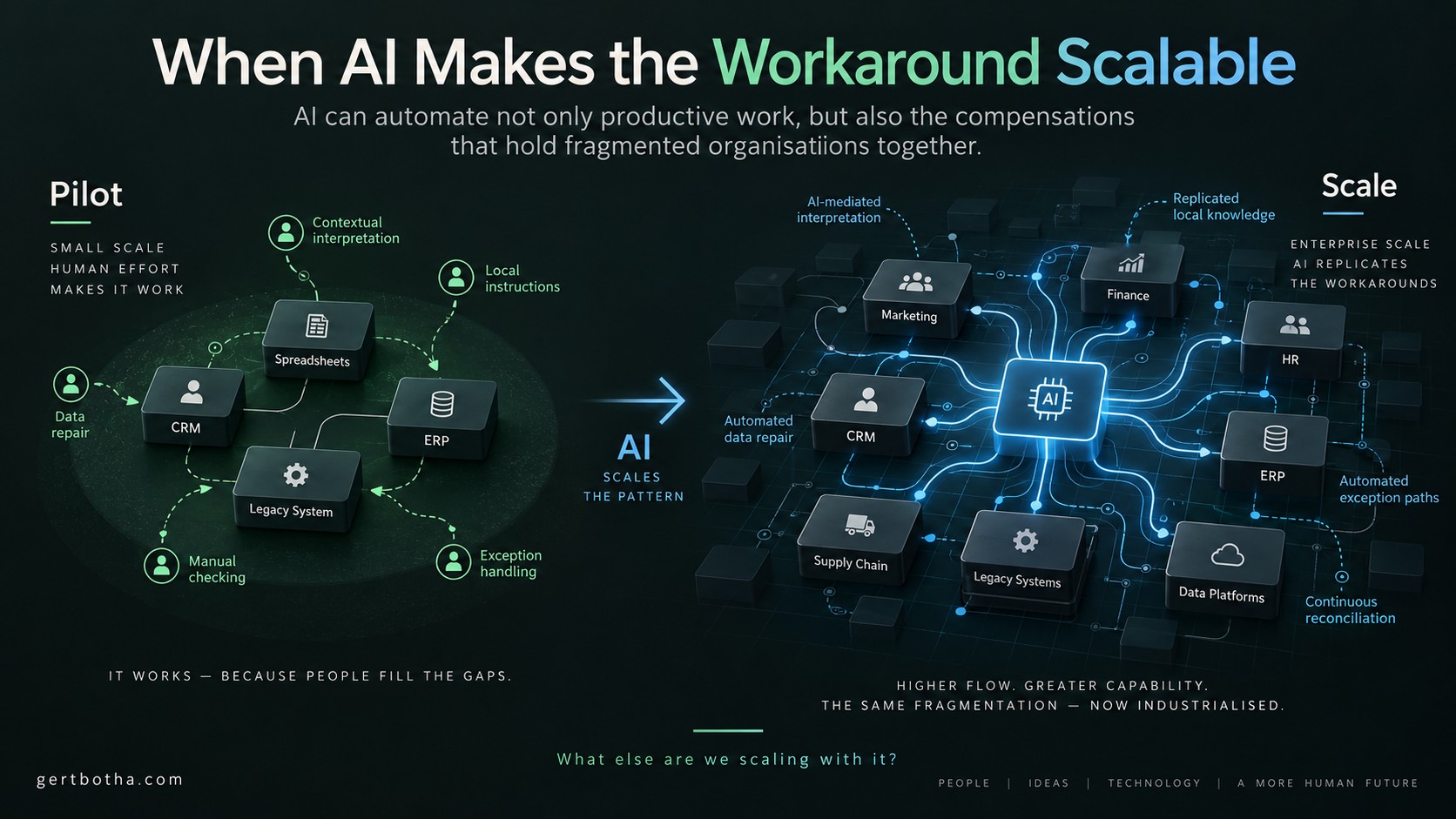 When AI Makes the Workaround Scalable
 The Age of Continuous Shocks: Why the coming downturn will be decided in your supply chain