May25
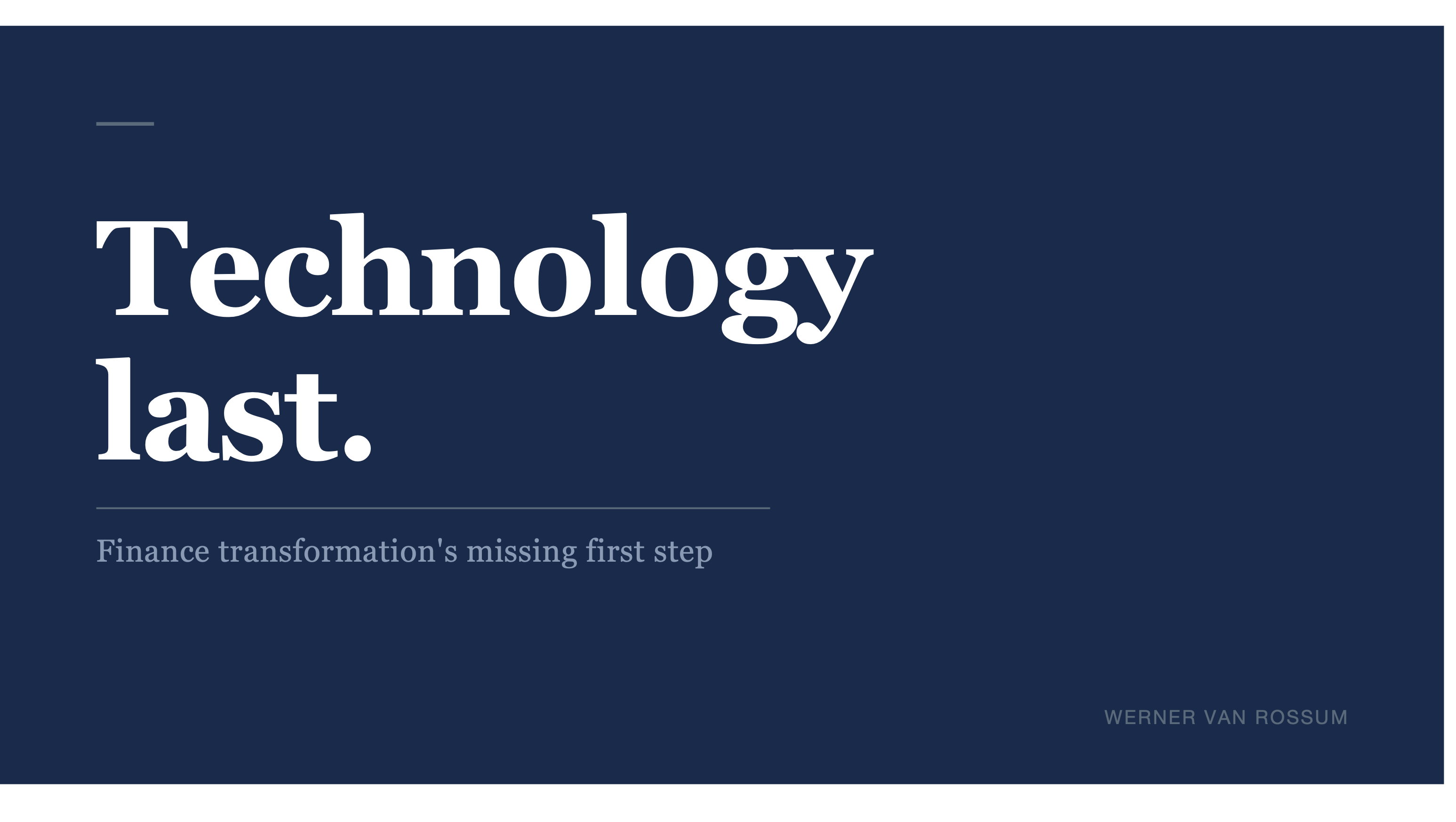
I have led finance transformation programs spanning multiple continents and businesses, covering billions of dollars in annual operations, and involving some of the most complex ERP and analytics environments in the energy sector. I have seen a pattern emerge consistently: most programs get the sequence wrong even before the first vendor is selected.
Many finance transformation programs start with technology. They build the business case around platform selection, and structure the program around technical implementation milestones. The new system and visualizations go live. The data flows. And then, six months after go-live, finance and business leadership teams sit in a room having a conversation that is remarkably similar to the ones they were having before the transformation began.
This is not an isolated experience. Gartner predicts that by 2027, more than 70% of recently implemented ERP initiatives will fail to fully meet their original business goals, with as many as 25% failing catastrophically. That failure rate has held steady for years. The technology worked. The transformation, in the deeper sense, did not. In almost every case, the root cause is the same: the organization deployed in the wrong order.
Most financial system transformation strategies are not strongly aligned with overall business strategy, because the conversation starts with technology. This sequencing feels logical. You need something to build toward, and the technology that is a clear cost driver, supported by well-versed IT departments or consultants experienced in IT project management, provides the most tangible target.
The problem is that technology is the wrong starting point. Not because platforms do not matter. They matter enormously. But the decisions that determine whether a finance transformation actually changes how an organization makes decisions are governance decisions, not technology decisions. Governance decisions made after platform selection are constrained by the platform's architecture rather than by the organization's decision-making requirements.
In the programs I have led, the most reliable predictor of transformation success was not the technology selection, but if the organization had done the hard work of governance clarification before the system design started. McKinsey research supports this: when senior leaders actively model the behaviors a transformation requires, success rates are 5 times higher. That is fundamentally a leadership and governance commitment that must be made before the technology selection starts.
Governance clarification means answering three specific questions that fundamentally change the outcome of transformation programs.
The first question to answer is which decisions require enterprise-wide consistency in the information that supports them, and which can tolerate local variation. This sounds straightforward, but in practice it requires senior leaders from across the business to negotiate on questions of information authority that involve power, accountability, and organizational identity. It involves aligning an organization on which key performance indicators carry the highest strategic value. It is uncomfortable. It takes longer than expected, and the value of getting this right first is irreplaceable.
The second question relates to whether the decision structures, meeting rhythms, and escalation rules of the organization are designed to support decisions, or they simply accumulated over time. In most organizations, forums, review layers, and reporting cycles were each created for a reason. Few were designed as a coherent system. Finance functions that produce technically correct analysis and deliver it timely into a structurally unchanged decision environment are rarely able to change the outcome. The quality of information and the structure of decision-making must be designed together.
The final question is what good looks like for those who will use this information to make decisions, not for those who produce it, or those who want to showcase their achievements. Finance functions are skilled at designing outputs that satisfy internal production logic or are tailored to the needs of individual managers. The more difficult challenge is to prepare appropriately detailed analysis that focuses on action-oriented insight, with the aim of improving performance. The gap between those two design requirements is where most transformation value is lost.
Lastly, governance clarification must also produce an answer to the harder question of what gets left behind. Most large organizations carry years of accumulated exceptions, local metric definitions, and custom workarounds. Each originated for a reason, and most have outlived it. A platform migration that carries this forward does not reduce complexity but formalizes it. Before a vendor is selected, the organization needs a principled position on what it is willing to retire, not just what it plans to build.
The sequence that produces sustained transformation benefits is the reverse of what many programs follow. The first step is governance clarification, and it should be done well before a platform is selected. The organization needs to resolve which decisions require enterprise consistency, what the optimal decision cadence is, what good information looks like from the perspective of those making consequential decisions, and what legacy complexity is to be eliminated. This work is political as much as it is analytical, and it requires the CFO to take decisions that some parts of the business will resist. Done well, it produces a set of design principles that become the building blocks of the successful finance transformation.
After that, operating model and metric harmonization become meaningful. The organization can define the performance indicators that require enterprise-wide consistency, the data structures that will support them, and the processes that connect reporting to actual decision moments. Programs that skip this step or run it in parallel with technology deployment end up with an operating model design driven by what the platform can do rather than what the organization needs.
The technology deployment follows from this foundation. Platform selection becomes a question focused on the outcome the organization needs to achieve. The technology team has requirements derived from governance and operating model design rather than from a generic capability assessment, and configuration decisions have a principled basis. Vendors and implementation partners can be evaluated against specific criteria. The go-live represents the culmination of a deliberate design process rather than the start of an organic one.
The sequence described differs from how many transformation programs are initiated. Technology vendors, system integrators, and program management offices all have strong incentives to move quickly to platform selection. Fit-to-standard thinking suggests that business processes can simply be adopted from the platform. The business case is easier to quantify around technology, and the implementation timeline is easier to structure and manage around familiar milestones. The CFO who insists on governance clarification first will face pressure to move faster.
CFOs who hold the line on this sequence will consistently deliver transformations that improve how their organizations make decisions. Those who yield to the pressure to start with technology tend to end up with a better, more automated reporting infrastructure and unchanged decision quality. The difference comes down to whether transformation is treated as a design challenge or an implementation exercise. Implementation produces better tools, but design produces better decisions. When strategy is sound and technology works but results still fall short, the cause is almost always a design choice that was never made explicitly. That is the CFO's work to do, and it starts before the technology selection and implementation.
Keywords: Finance, GRC, Transformation
 Two Clocks, One Truck: The Army's Need for Speed Meets New Defense Sourcing Rules
 Sustainable Transformation: The Elephant and The Mouse In The Room
 The Price of Standing Alone: Strategic Autonomy in a World Where Nobody Can Do It Alone
 The Potter’s Hands: Why Great Leaders Shape Environments, Not People
 The Corix Partners Friday Reading List - October 16, 2026