Aug14
FCRQ211 Leadership Learning!
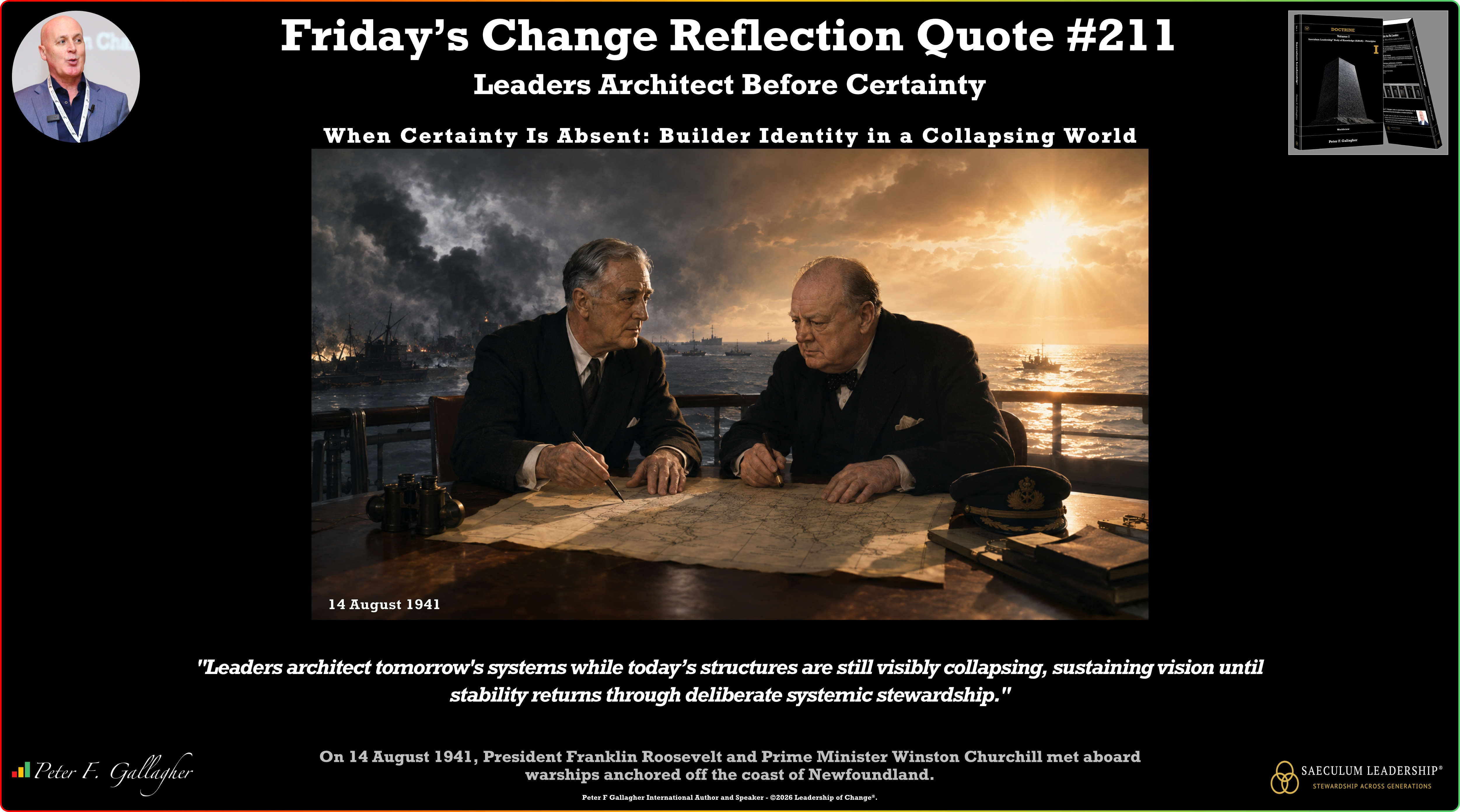
On 14 August 1941, President Franklin Roosevelt and Prime Minister Winston Churchill met aboard warships anchored off the coast of Newfoundland. Their meeting took place at Placentia Bay, aboard HMS Prince of Wales and USS Augusta, over four days of private conference. Britain stood alone against Germany, while the United States remained officially neutral and still four months from entering the war. Neither leader knew how the conflict would end, yet together they issued eight principles intended to shape the peace that would eventually follow. These covered self-determination, free trade, disarmament, and the renunciation of territorial gain, laying groundwork for a future order. Historians regard the declaration, later named the Atlantic Charter, as an early foundation for the United Nations. It carried no formal legal status at the time, yet its principles shaped agreements that followed for decades. Eighty years later, a copy of the charter was presented to a serving president at a G7 summit.
The significance lies not only in the document’s content, but in the timing of its articulation, drafted while the outcome of the war remained uncertain. Most leaders wait for stability before committing publicly to a future direction, treating clarity as a precondition for planning. Roosevelt and Churchill instead built the next system’s scaffolding while the current one was still visibly collapsing around them. This required holding two positions simultaneously: naming present danger honestly while committing openly to a defined future state. Few contemporaries recognised the charter's weight, since it resolved nothing militarily and bound neither government to specific action. Its value emerged only afterwards, once the principles it named became the scaffolding for institutions still standing today.
Placentia Bay illustrates why timing can determine whether important principles merely describe a future or help shape it. A leader who waits for consensus before articulating direction cedes the shaping of outcomes to circumstance instead. Roosevelt and Churchill accepted the discomfort of stating unfinished intentions publicly before events had validated them. That willingness to commit under uncertainty is the quality this reflection seeks to examine in the passage below. It marks the point where vision was chosen deliberately, not received passively once stability finally returned.
Saeculum Leaders do not wait for stability; they architect the next system while the current one is still collapsing.
Saeculum Leadership® Lessons: Architectural influence can precede institutional authority. Saeculum Leaders change direction before a crisis resolves, choosing to architect rather than merely react to events. They hold two truths simultaneously, naming present danger honestly while committing openly to a defined future direction. Saeculum leaders do not always need formal authority over the eventual system to articulate principles that others subsequently adopt. They build coalitions around shared principles long before full political consensus has been reached or confirmed. Saeculum Leaders understand that timing often defines a decision's legacy more than its stated content. Leaders Architect Before Certainty.
“Leaders architect tomorrow's systems while today's structures are still visibly collapsing, sustaining vision until stability returns through deliberate systemic stewardship.”
From the Canon — Practice 10: The Practice of Builder Identity. Builder Identity is the discipline through which leaders see themselves as architects of the next order rather than managers of the existing one. Saeculum Leaders understand that identity precedes action: those who believe they are builders commit to designing future systems even when conditions remain unstable or outcomes remain uncertain.
Placentia Bay demonstrates this principle clearly. Roosevelt and Churchill met at a moment when Britain stood alone, the United States remained neutral, and the war’s direction was unresolved. Yet they chose to articulate the scaffolding of the post‑war world long before victory was assured. Their eight principles did not change the battlefield or guarantee success; they expressed a commitment to a future order that did not yet exist.
This is the essence of Builder Identity:
The Atlantic Charter revealed that enduring leadership is defined not by reacting to events but by shaping the architecture that will outlast them. Roosevelt and Churchill acted as builders, committing publicly to a future order that did not yet exist and could not yet be proven. Leadership does not begin when certainty arrives. Leadership begins when someone accepts responsibility for shaping what comes next.
The Stewardship Reflection Lens:
What are we inheriting? We inherit systems shaped by earlier uncertainty, carrying assumptions and vulnerabilities that may remain invisible until disruption exposes them.
How should we steward it? Stewardship requires recognising what is changing, choosing direction before certainty exists, and deliberately strengthening the systems through which the future will be built.
What legacy are we creating? We create a legacy when the principles we establish today give those who follow us a stronger foundation from which to build tomorrow's institutions.
Further Reading: Saeculum Leadership® Body of Knowledge (SLBoK). Saeculum Leadership®: Doctrine – Volume I.
Peter F. Gallagher is the Founder–Architect of Saeculum Leadership®, a doctrine of generational stewardship that equips leaders to strengthen what they inherit and shape what future generations receive. A 21-book author, global keynote speaker, and trusted advisor to boards, CEOs, and executive leadership teams, he helps organisations strengthen leadership capability, institutional stewardship, and transformational change in an increasingly complex world.
For further insights please visit our websites: https://www.a2b.consulting https://www.peterfgallagher.com Amazon.com: Peter F Gallagher: Books, Biography, Blog, Audiobooks, Kindle
Saeculum Leadership® Body of Knowledge (SLBoK): Volumes 1-10.A-E & 0, I-V
~ Leadership of Change® Volume 1 - Change Management Fables
~ Leadership of Change® Volume 2 - Change Management Pocket Guide
~ Leadership of Change® Volume 3 - Change Management Handbook
~ Leadership of Change® Volume 4 - Change Management Leadership
~ Leadership of Change® Volume 5 - Change Management Adoption
~ Leadership of Change® Volume 6 - Change Management Behaviour
~ Leadership of Change® Volume 7 - Change Management Sponsorship
~ Leadership of Change® Volume 8 - Change Management Charade
~ Leadership of Change® Volume 9 - Change Management Insanity
~ Leadership of Change® Volume 10 - Change Management Dilenttante
~ Leadership of Change® Volume A - Change Management Gamification - Leadership
~ Leadership of Change® Volume B - Change Management Gamification - Adoption
Keywords: Business Strategy, Change Management, Leadership
 Two Clocks, One Truck: The Army's Need for Speed Meets New Defense Sourcing Rules
 Sustainable Transformation: The Elephant and The Mouse In The Room
 The Price of Standing Alone: Strategic Autonomy in a World Where Nobody Can Do It Alone
 The Potter’s Hands: Why Great Leaders Shape Environments, Not People
 The Corix Partners Friday Reading List - October 16, 2026