Mar26
Still Measuring Hormuz’s Impact—Another Warning Emerges at Bab-el-Mandeb
The world is still assessing the unfolding impact of disruption around the Strait of Hormuz.
And yet, even before a full-scale closure or prolonged escalation, the early effects are already visible across global shipping and energy markets.
It has not taken a complete shutdown to trigger disruption.
The mere threat has been sufficient.
Freight markets have reacted first—because they always do.
Rates have begun to climb, reflecting both immediate risk and forward uncertainty. War-risk premiums and insurance costs have surged sharply, particularly for vessels operating in sensitive zones. Owners and operators are recalibrating exposure, tightening vessel availability, and reassessing routing decisions.
Charterers are moving early. Traders are hedging. Insurers are repricing.
And in parallel, energy markets are showing increasing volatility—responding not only to actual supply shifts, but to the perception of risk embedded in one of the most critical arteries of global oil flow.
This is the defining nature of a chokepoint.
It does not require closure to create impact.
It only requires uncertainty.
++++
But while the global focus remains heavily anchored on Hormuz—
another warning is beginning to take shape along a second, equally critical maritime corridor.
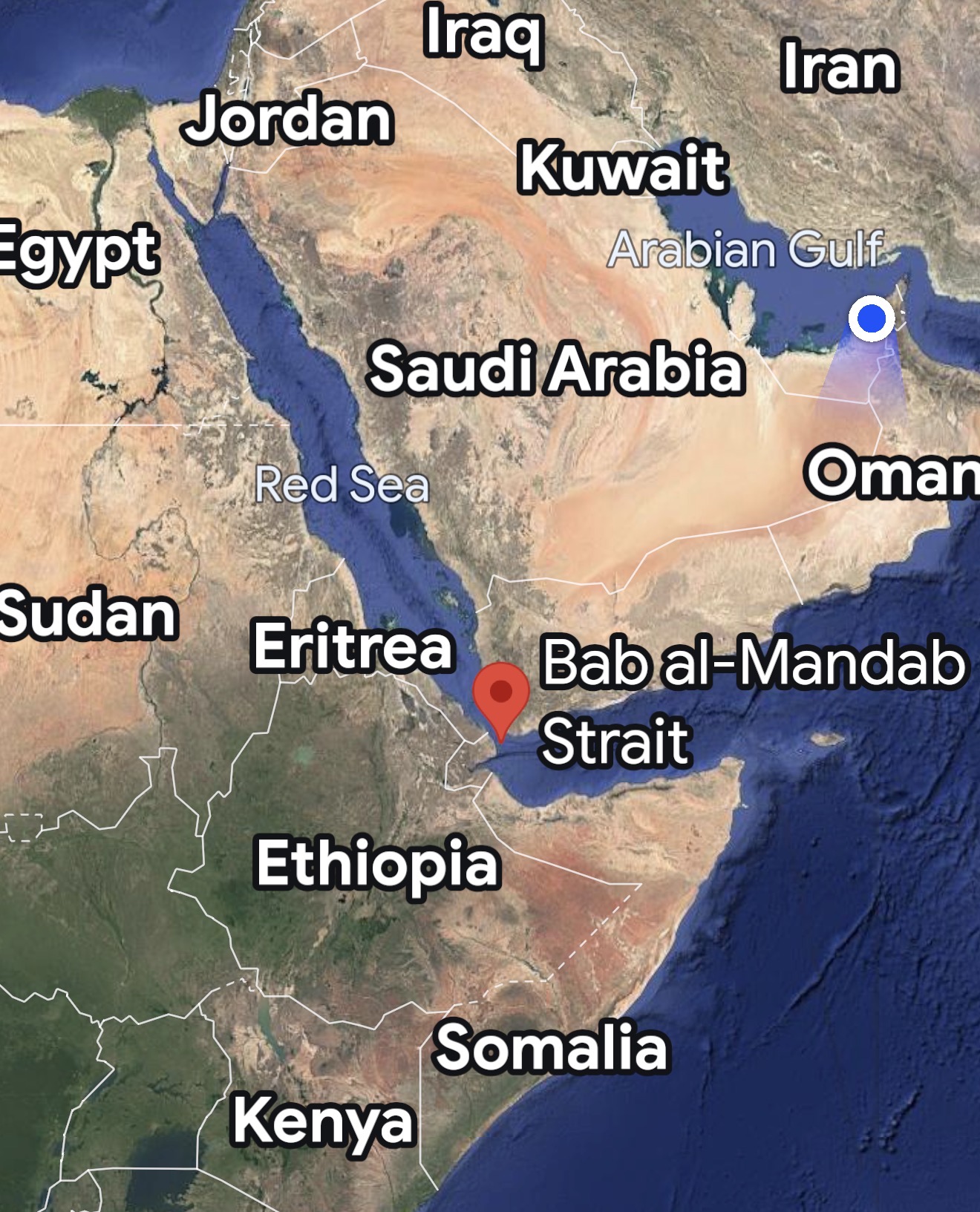
The Bab-el-Mandeb.
Positioned at the southern gateway of the Red Sea, this narrow passage serves as the vital connector between the Indian Ocean and the Suez Canal—linking Asia, the Middle East, and Europe in one of the most heavily trafficked trade routes in the world.
If Hormuz is the gateway of energy,
Bab-el-Mandeb is the gateway of trade itself.
And the distinction matters.
++++
Unlike Hormuz, whose significance is largely concentrated around crude oil and energy flows, Bab-el-Mandeb carries a far broader economic footprint.
It is not just about oil.
It is the route through which a substantial portion of global container traffic moves between Asia and Europe—linking manufacturing hubs to consumer markets. It supports the steady movement of dry bulk cargo—grains, fertilizers, coal, iron ore, and industrial raw materials that underpin both developed and emerging economies.
It is also a key corridor for refined petroleum products, LNG derivatives, and petrochemical flows—feeding industries, transportation systems, and energy networks across continents.
In essence, Bab-el-Mandeb is not just a passage for commodities.
It is a passage for continuity.
It carries finished goods, intermediate inputs, and essential resources that sustain global supply chains.
It carries the rhythm of global commerce.
++++
And that is precisely where the risk begins to compound.
Because if disruption at Hormuz is fundamentally an energy shock,
then disruption at Bab-el-Mandeb becomes a system-wide trade shock.
The consequences are immediate—and far-reaching.
If vessels are unable to safely transit through the Red Sea corridor, the only viable alternative is rerouting around the Cape of Good Hope.
On paper, this appears to be a logistical adjustment.
In reality, it is a structural disruption.
Voyages are extended by 10 to 20 days, depending on vessel class and routing. This elongation of travel time effectively reduces the available global fleet capacity, as ships remain tied up for longer durations.
A vessel that previously completed, for example, six voyages in a given period may now complete only four.
The result is not merely delay—it is a compression of supply in shipping capacity.
And when supply compresses in a system that is already finely balanced, freight rates respond sharply.
++++
This is not limited to one segment.
Container shipping sees increased transit times and cascading schedule disruptions, affecting port rotations and delivery commitments.
Tanker markets experience both ton-mile inflation and volatility in positioning, particularly for clean petroleum products.
Dry bulk shipping—often considered less sensitive to geopolitical shocks—begins to reflect pressure through longer voyages, reduced efficiency, and tighter vessel supply.
In effect, the entire maritime ecosystem begins to recalibrate.
++++
And these are only the first-order effects.
The second-order effects are where the real economic implications begin to surface.
Extended voyage times translate directly into higher fuel consumption. Increased insurance premiums and operational risks are passed through the value chain. Inventory cycles become longer and less predictable.
For manufacturers, this means higher input costs and potential production delays.
For retailers, it means delayed inventory replenishment and increased working capital requirements.
For consumers, it eventually translates into higher prices.
This is how a maritime disruption becomes an inflationary force.
Not overnight.
But steadily, persistently, and across sectors.
++++
This is the underlying vulnerability that globalisation has created.
Over decades, the global economy has optimized for efficiency—leveraging specialization, scale, and interconnected supply chains to reduce costs and maximize output.
But in doing so, it has also concentrated risk.
A significant portion of global trade now depends on a handful of narrow maritime passages—Hormuz, Bab-el-Mandeb, the Suez Canal, and a few others.
These are not just geographic features.
They are systemic pressure points.
And when even one of them faces disruption, the effects ripple across continents.
When two are under simultaneous stress, the system itself begins to feel the strain.
++++
Hormuz is already demonstrating what an energy-linked chokepoint can do.
Even without full disruption, it has triggered pricing adjustments, operational caution, and strategic repositioning across markets.
Bab-el-Mandeb, however, introduces a different dimension.
It is not just about the price of oil.
It is about the flow of goods.
And unlike energy markets, which have some degree of storage buffers and strategic reserves, global trade operates on far tighter timelines and leaner inventories.
The margin for disruption is smaller.
The recovery is slower.
++++
This dual pressure—energy at Hormuz and trade at Bab-el-Mandeb—reveals a deeper structural reality.
The world remains highly dependent on maritime corridors that were never designed to absorb prolonged geopolitical stress.
And yet, they are expected to function seamlessly in an increasingly fragmented and uncertain global environment.
This is not just a shipping issue.
It is a global economic issue.
++++
What we are witnessing is not merely a regional tension.
It is a stress test of the global logistics architecture.
A reminder that efficiency without resilience carries inherent risk.
And a signal that diversification—whether in sourcing, routing, or supply chain design—is no longer optional.
It is essential.
++++
For shipping, the implications are immediate.
Operators must navigate not just physical routes, but risk landscapes. Decision-making becomes more complex—balancing safety, cost, time, and contractual obligations.
For traders and energy players, volatility becomes the norm rather than the exception.
For policymakers, the challenge is even broader—ensuring stability in a system where disruption in one corridor can cascade into multiple sectors.
++++
And yet, amid all this complexity, one principle remains constant.
Markets react to reality.
But they react even faster to expectation.
The expectation of disruption is often enough to trigger real economic consequences.
And that is exactly what we are seeing.
++++
Hormuz has already shown us the early impact of this dynamic.
Bab-el-Mandeb is now emerging as the next point of concern.
Individually, each represents a critical node in global trade and energy flows.
Together, they expose how tightly coupled—and how fragile—the system can become under pressure.
++++
The lesson here is not one of alarm, but of awareness.
Global trade will continue. Shipping routes will adapt. Markets will recalibrate.
But the cost of disruption—whether measured in time, freight, or inflation—will not disappear.
It will be absorbed, redistributed, and ultimately reflected across economies.
++++
In global shipping, warnings rarely remain theoretical.
They tend to materialize—often faster than expected, and often with broader consequences than initially anticipated.
And today, while the world continues to measure the impact at Hormuz—
Bab-el-Mandeb stands as a clear and present reminder of what could come next.
Keywords: Ecosystems, Sustainability
 FROM THE AISLE Field Notes on AI Implementation
 The Hybrid Team: Rethinking RACI When Some of Your Team Members Are Machines
 Two Clocks, One Truck: The Army's Need for Speed Meets New Defense Sourcing Rules
 Sustainable Transformation: The Elephant and The Mouse In The Room
 The Price of Standing Alone: Strategic Autonomy in a World Where Nobody Can Do It Alone