
May21
By Mike Hicks, Principal Solutions Analyst, Cisco ThousandEyes
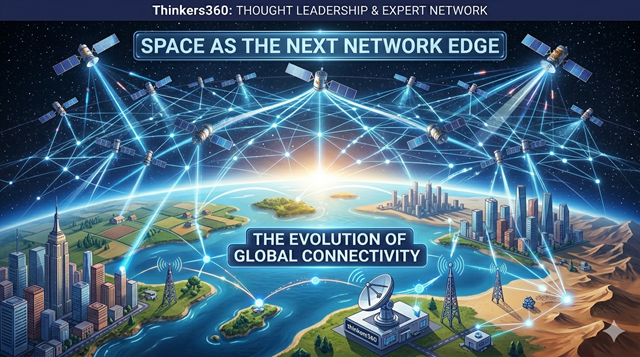
Space as the Next Network Edge: The Evolution of Global Connectivity
Satellite constellations are already transforming global connectivity, extending the Internet’s reach to nearly every corner of the planet. Now, as conversations turn toward compute in orbit, the focus is expanding from connectivity alone to how distributed infrastructure will shape the future of digital services.
But what does it really mean for connectivity when infrastructure extends beyond Earth? The answer is crucial, because space isn’t just another deployment site, it introduces fundamentally different opportunities and constraints that challenge how modern digital services are designed and delivered.
Understanding Space Infrastructure
Space will not replicate the data center environments we know today. Constraints like launch capacity, radiation, power generation, cooling, and physical size mean orbital compute resources will likely be smaller and more specialized than hyperscale infrastructure on Earth.
Rather than lifting existing data centers into orbit, space is likely to inspire new forms of distributed compute and storage nodes, designed to complement terrestrial systems.
Because these distributed resources need to work together seamlessly, connectivity becomes the critical enabler. In other words, the real shift isn’t about relocating data centers to space. It’s about extending the distributed architecture of the Internet itself.
The Opportunity Lies in Distribution
For decades, application architecture has evolved to improve user experience. Content delivery networks moved content closer to users. Cloud platforms introduced elasticity and geographic redundancy. Edge computing pushed processing toward the point of data creation. Space introduces another dimension to this model.
Rather than relocating entire applications, organizations will likely distribute functions across multiple environments, including terrestrial clouds, edge infrastructure, and space‑based platforms, all depending on what makes architectural sense.
Satellite-based Earth observation systems, for example, generate enormous volumes of imagery and sensor data. Processing portions of that data in orbit before transmitting results back to Earth could reduce bandwidth requirements and accelerate insights.
Other use cases may involve distributing cached content, supporting connectivity in remote environments, or enabling services for moving platforms such as ships, aircraft, and industrial operations.
What matters most is that space becomes another place where parts of a service can run, alongside existing terrestrial and cloud infrastructure.
Orbital Connectivity Follows Different Rules
Designing systems that rely on orbital infrastructure also requires understanding how satellite connectivity differs from terrestrial networks.
Satellite constellations are dynamic by nature. Satellites move continuously, requiring constant handoffs between spacecraft and ground stations. Network paths change continuously as satellites move and the routing topology shifts with them. Even when performance is strong, these dynamics introduce behaviors that traditional network architectures were not built to accommodate. Latency profiles differ too. Low-Earth orbit constellations operate at a fraction of the altitude of geostationary satellites, which matters, but a 20–40ms round-trip is still not terrestrial fiber.
Bandwidth characteristics also differ. Satellite connectivity is often asymmetric, with significantly more capacity for downloading data than sending it back upstream. Power constraints and radio transmission requirements make large uplink transfers more expensive than their terrestrial equivalents.
These realities mean that not every workload belongs in space. Instead, the most effective architectures will carefully consider which components should run where, based on latency sensitivity, data volume, and operational constraints.
The Internet Is Extending Its Reach
Today's Internet already spans continents and oceans through vast terrestrial and subsea infrastructure. Satellite networks aren't a future concept, they are operational now, delivering connectivity globally and extending reach to places where traditional infrastructure is difficult or impossible. Future orbital compute may yet introduce new processing and storage capabilities as well.
For service architects, this means digital platforms may soon operate across a combination of terrestrial fiber infrastructure, subsea cable systems, wireless access networks, hyperscale cloud environments, edge compute platforms, and satellite constellations or other orbital systems.
From a user’s perspective, however, none of this complexity is visible. They simply expect the service to work. But when a single user interaction may traverse a local access network, a regional ISP backbone, a subsea cable system, a cloud region, and potentially a satellite link, performance issues can emerge anywhere along that path - from congestion on a terrestrial route to disruptions at a satellite ground station.
So while space‑based compute infrastructure may still be years away from large‑scale deployment, the architectural questions it raises are already relevant today. Understanding how these pieces interact will be the key to building resilient digital services, whether the infrastructure supporting them sits in a data center, at the network edge, or hundreds of kilometers above the Earth.
###
Keywords: Data Center
 “I didn’t write an award acceptance speech because I didn’t expect to win.”
 AI Is Exposing the Data Problems Humans Used to Hide
 "The AI may in fact be conscious." Really?
 When AI Makes the Workaround Scalable
 The Age of Continuous Shocks: Why the coming downturn will be decided in your supply chain