Mar14
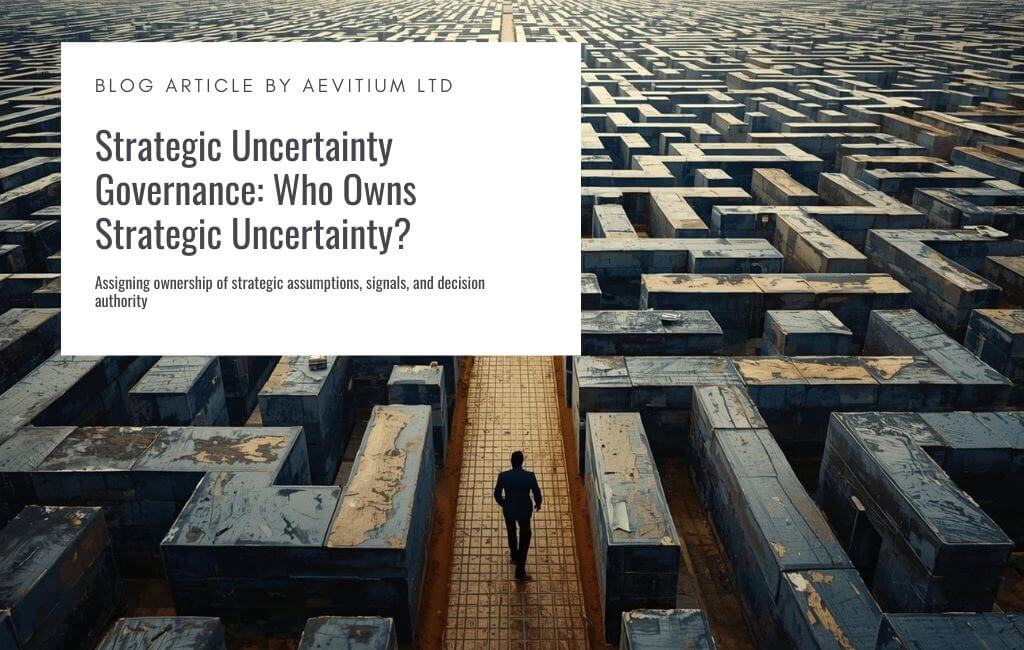
Most organisations believe they manage uncertainty effectively.
Strategic planning processes identify opportunities, financial projections define expectations, and risk frameworks monitor emerging exposure. Boards review dashboards, executives track performance, and governance committees assess whether risks remain within acceptable limits. From a governance perspective, the system appears comprehensive.
Yet an important question often remains unanswered: who owns the uncertainty embedded in strategic decisions?
Uncertainty is frequently treated as something that emerges after strategy has been implemented, typically through operational risk events, market volatility, or performance deviation. In reality, uncertainty originates earlier. It arises at the moment the organisation commits to a strategic direction. Whenever leadership allocates capital, launches transformation programmes, or enters new markets, it does so based on assumptions about how the future will unfold. These assumptions may concern customer behaviour, technological evolution, competitive dynamics, or the organisation’s own execution capabilities.
Because these assumptions cannot be fully validated at the moment decisions are made, uncertainty is not simply a downstream consequence of strategy. It is created by the strategic commitment itself.
Governance systems, however, often focus primarily on monitoring performance once strategy is underway. Financial dashboards, operational indicators, and risk reports provide valuable insight into whether initiatives are delivering expected outcomes. These mechanisms strengthen oversight and provide early visibility into emerging exposure. Yet they primarily monitor outcomes rather than the assumptions that produced them. By the time performance indicators reveal that something has changed, the organisation may already be deeply committed to an inedaquate strategic path.
This dynamic reflects how governance responsibilities are commonly structured. Strategy teams define ambition and identify opportunities. Executive leadership allocates capital and approves investment decisions. Risk functions monitor exposures through established frameworks and reporting systems. Boards oversee results through performance and risk dashboards. Each of these elements performs an important role within the governance architecture.
However, none of them consistently maintains ownership of the uncertainty embedded in the strategic commitment itself. Strategy functions focus on opportunity and positioning. Risk functions focus on exposure and control frameworks. Boards focus on outcomes and organisational performance. Between these layers, the assumptions that justified the strategic decision may gradually fade from attention. Uncertainty remains present throughout the life of the strategy, yet responsibility for governing it becomes diffuse.
This creates a structural challenge that can be described as a monitoring paradox. Many organisations invest heavily in infrastructure designed to increase visibility over risk exposure. Risk registers, key risk indicators, and governance dashboards provide detailed insight into operational and financial developments. As these systems become more sophisticated, leadership gains increasing visibility over emerging issues.
Paradoxically, this visibility can reinforce the belief that risk is being effectively governed even when governance influence over the assumptions underlying strategy remains limited. Monitoring frameworks observe how exposure evolves after decisions have been made. They rarely influence the moment when strategic commitments are authorised.
If uncertainty originates in strategic commitments, ownership logically follows the authority that authorises those commitments. Strategic exposure does not arise primarily from failures in monitoring systems. It arises when leaders commit the organisation to a course of action based on expectations about how markets, competitors, technologies, and organisational capabilities will evolve.
The authority to make such commitments typically sits with executive leadership teams and, for the most consequential decisions, with the board. Risk functions play a critical role in informing these decisions through scenario analysis, challenge, and insight. However, the responsibility for the uncertainty embedded in strategic commitments ultimately remains with those who authorise the decision.
Recognising this relationship changes how organisations think about governance. Strategic oversight cannot be limited to monitoring results once strategy is in motion. Leadership forums must also retain visibility over the assumptions that underpin major commitments and remain attentive to signals that those assumptions may be evolving.
Strengthening governance in this area does not require eliminating uncertainty. Uncertainty is inseparable from strategic ambition and organisational adaptation. Instead, organisations can govern uncertainty more deliberately by ensuring that the assumptions supporting strategy remain visible throughout the life of the strategic commitment.
Several practices support this approach. Strategic planning processes can explicitly articulate the assumptions underpinning major initiatives. Organisations can monitor signals that indicate whether these assumptions remain valid as market conditions evolve. Governance frameworks can establish escalation mechanisms that prompt leadership reconsideration when conditions shift materially. Finally, board and executive discussions can periodically revisit the premises that justified strategic commitments rather than focusing exclusively on performance outcomes.
For boards, this perspective broadens the scope of oversight. Directors remain responsible for reviewing performance and risk exposure, yet effective governance also requires visibility over the assumptions that sustain the organisation’s strategic direction. Questions such as which assumptions underpin major initiatives, how those assumptions are monitored, and when they were last revisited can provide valuable insight into the resilience of the strategy itself.
Strategy and uncertainty cannot be separated. Every strategic commitment embeds expectations about the future that cannot be fully verified in advance. When governance systems focus primarily on monitoring results, these assumptions may gradually fade from leadership attention. Aligning ownership of uncertainty with decision authority restores coherence to the governance cycle.
Leaders remain accountable not only for the outcomes produced by strategy but also for the assumptions that sustain it. In this sense, governing uncertainty is not simply a technical exercise within risk management. It is a central dimension of strategic leadership.
Read the full article on Aevitium LTD - https://www.aevitium.com/post/strategic-uncertainty-governance
By Julien Haye
Keywords: GRC, Leadership, Risk Management
 You are not your diagnosis
 Is GenAI good for anything?
 “I didn’t write an award acceptance speech because I didn’t expect to win.”
 AI Is Exposing the Data Problems Humans Used to Hide
 "The AI may in fact be conscious." Really?