Jul17
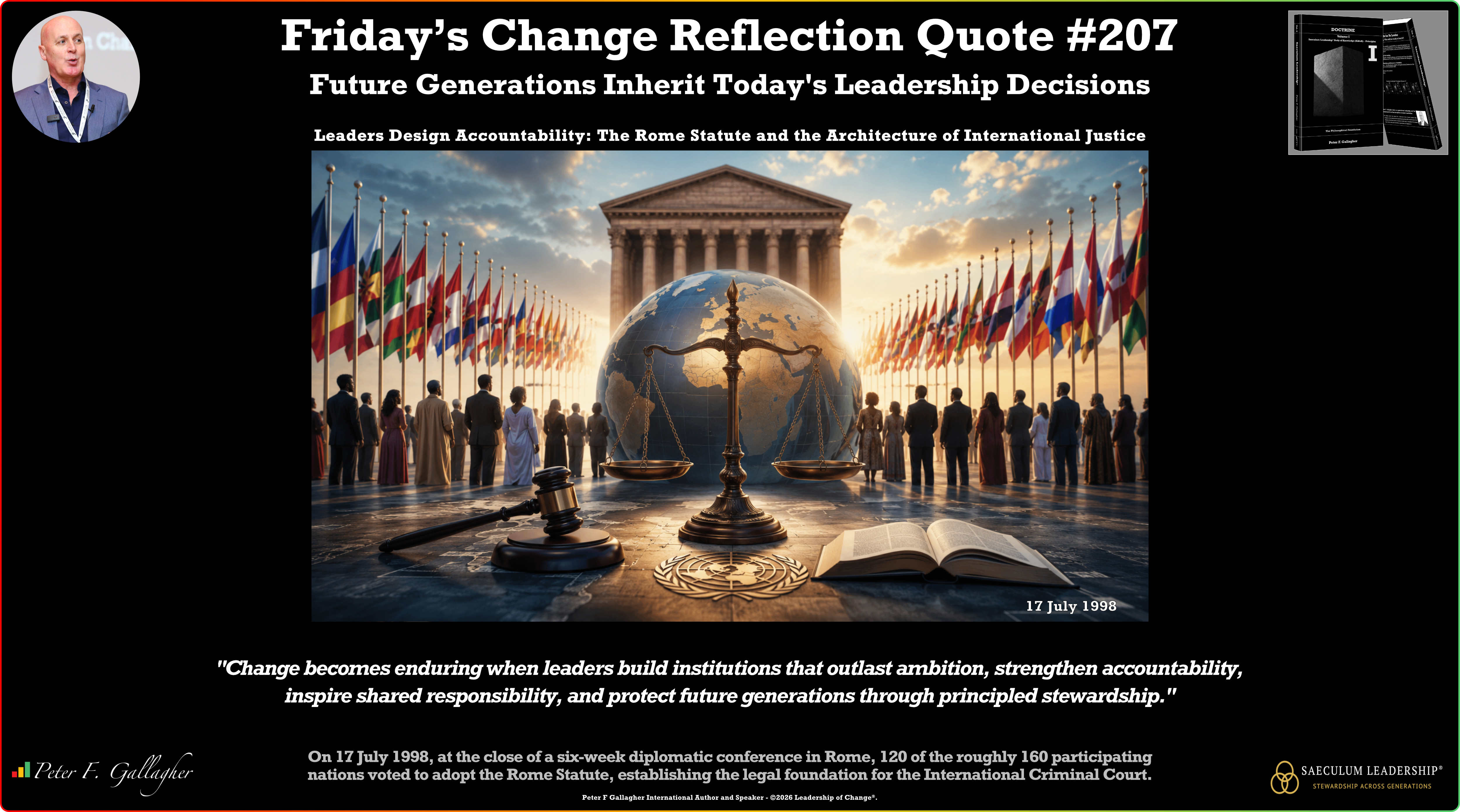
On 17 July 1998, at the close of a six-week diplomatic conference in Rome, 120 of the roughly 160 participating nations voted to adopt the Rome Statute, establishing the legal foundation for the International Criminal Court. The agreement marked one of the most significant developments in modern international law since the creation of the United Nations after the Second World War. It reflected a deliberate shift from national discretion to shared global responsibility, signalling that genocide, crimes against humanity, war crimes and, later, the crime of aggression should no longer depend solely upon the willingness or ability of individual states to prosecute those responsible.
The Statute did not emerge overnight. It followed decades of legal scholarship, diplomatic negotiation and lessons drawn from conflicts that exposed weaknesses in existing international mechanisms of justice, reinforcing the reality that such crises were recurring patterns rather than isolated anomalies. The tribunals established for the former Yugoslavia and Rwanda demonstrated both the value of international accountability and the limitations of creating temporary institutions in response to each new crisis. Many governments, legal experts and international organisations recognised that a permanent judicial institution could provide greater consistency, legitimacy and continuity.
The adoption of the Statute represented a remarkable diplomatic achievement. Nations with different legal traditions, political systems and strategic interests negotiated a framework that required leaders to balance national sovereignty with international responsibility without collapsing the integrity of the emerging architecture. While not every country supported every provision, and some major powers chose not to ratify the treaty, the agreement nevertheless established an enduring legal architecture that continues to influence international relations, humanitarian law and discussions concerning state accountability.
The International Criminal Court was designed to operate according to the principle of complementarity. National courts retain primary responsibility for investigating and prosecuting serious international crimes, with the Court intervening only when states are unwilling or genuinely unable to fulfil those obligations — reinforcing the principle that leaders must strengthen domestic institutions before relying on international safeguards. This principle reinforced the idea that international institutions should strengthen, rather than routinely replace, domestic systems of justice.
The significance of 17 July 1998 extends well beyond the establishment of a single institution. It demonstrated that enduring governance is built through carefully designed frameworks rather than temporary reactions to immediate crises. The Rome Statute became an important reference point for governments, legal practitioners and international organisations seeking greater consistency in the application of justice across national boundaries. It also illustrated how institutional architecture becomes a generational inheritance, shaping expectations and behaviour long after the original negotiators have left the stage.
Viewed through a broader historical perspective, the Rome Statute represents more than a legal milestone; it marks a transition from episodic responses to a durable system capable of addressing the persistent nature of human conflict. It signifies a deliberate transition from reactive justice towards a more permanent system of international accountability, reflecting the belief that strong institutions provide greater stability than individual decisions alone.
Saeculum Leadership® Lessons: Saeculum Leaders strengthen institutions because enduring systems preserve accountability beyond the influence and tenure of individual leaders. They unite diverse interests behind a shared purpose because lasting progress depends upon collective commitment rather than temporary agreement. Saeculum Leaders design governance that remains resilient because strong frameworks provide stability during periods of uncertainty and transformation. They recognise that permanent challenges require enduring solutions instead of repeatedly responding to predictable crises. Leaders of changeconsider how today’s decisions become tomorrow's inheritance, strengthening institutions that future generations will depend upon. Future Generations Inherit Today's Leadership Decisions.
“Change becomes enduring when leaders build institutions that outlast ambition, strengthen accountability, inspire shared responsibility, and protect future generations through principled stewardship.”
From the Canon — Practice 5: The Practice of Institutional Stewardship: Every institutional Signal demands stewardship rather than speed. The establishment of the International Criminal Court illustrates that enduring accountability is not created through rapid reaction to crisis, but through the disciplined design of frameworks capable of protecting future generations. Saeculum Leaders recognise that institutions, not intentions, become the true legacy of leadership. Ambition fades, but architecture remains. The Rome Statute demonstrated this principle clearly: leaders negotiated a permanent system of justice not for their own tenure, but for those who would inherit the consequences of unresolved conflict and unprosecuted atrocity.
Institutional stewardship requires resisting short‑term political pressure. The Rome negotiations involved states with competing interests, divergent legal traditions and differing strategic priorities. Yet the architects of the Statute understood that durable governance cannot be shaped by immediate convenience. They prioritised generational responsibility over national ambition, designing a system intended to constrain power consistently across decades rather than respond episodically to each new crisis. This is the essence of stewardship primacy: strengthening what future citizens will depend upon, even when present conditions make consensus difficult.
The ICC also demonstrates how institutions achieve durability when leaders protect their integrity during periods of uncertainty. Its value is greatest when geopolitical conditions are unstable, when domestic systems fail, or when political incentives discourage accountability. Saeculum Leaders anticipate these moments and design frameworks that remain resilient despite external turbulence. By building systems that outlive them, they ensure that justice, responsibility and stability are transmitted across the Saeculum, becoming a lasting inheritance rather than a temporary achievement.
The Stewardship Reflection Lens:
What are we inheriting? We inherit a permanent system of international accountability designed to ensure that justice does not depend solely on the stability or willingness of individual states.
How should we steward it? Leaders should protect the integrity, independence and resilience of institutions that uphold accountability so they remain credible even when geopolitical conditions destabilise.
What legacy are we creating? The choices leaders make today about institutional design and cooperation will determine whether future generations inherit stronger systems of justice or deeper structural fragility.
Peter F. Gallagher is the Founder–Architect of Saeculum Leadership®, a doctrine of generational stewardship that equips leaders to strengthen what they inherit and shape what future generations receive. A 20-book author, global keynote speaker, and trusted advisor to boards, CEOs, and executive leadership teams, he helps organisations strengthen leadership capability, institutional stewardship, and transformational change in an increasingly complex world.
Further Reading: Saeculum Leadership® Body of Knowledge (SLBoK). Saeculum Leadership®: Doctrine – Volume I.
For further insights please visit our websites: https://www.a2b.consulting https://www.peterfgallagher.com Amazon.com: Peter F Gallagher: Books, Biography, Blog, Audiobooks, Kindle
Saeculum Leadership® Body of Knowledge (SLBoK): Volumes 1-10.A-E & I-V
~ Leadership of Change® Volume 1 - Change Management Fables
~ Leadership of Change® Volume 2 - Change Management Pocket Guide
~ Leadership of Change® Volume 3 - Change Management Handbook
~ Leadership of Change® Volume 4 - Change Management Leadership
~ Leadership of Change® Volume 5 - Change Management Adoption
~ Leadership of Change® Volume 6 - Change Management Behaviour
~ Leadership of Change® Volume 7 - Change Management Sponsorship
~ Leadership of Change® Volume 8 - Change Management Charade
~ Leadership of Change® Volume 9 - Change Management Insanity
~ Leadership of Change® Volume 10 - Change Management Dilenttante
~ Leadership of Change® Volume A - Change Management Gamification - Leadership
~ Leadership of Change® Volume B - Change Management Gamification - Adoption
Keywords: Business Strategy, Change Management, Leadership
 Consumer vs. enterprise AI agents
 Best Supply Chain AI Tools in 2026: SCM SENSEI AI and Ask Lora Compared
 Making Silos Permeable
 The Corix Partners Friday Reading List - October 2, 2026
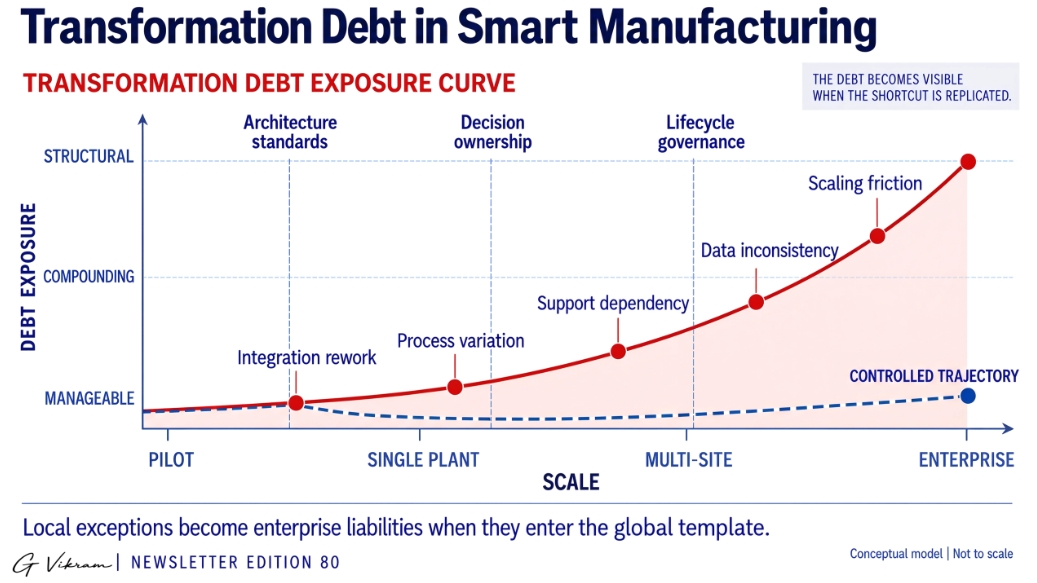 The most dangerous debt in a smart factory isn’t financial.