Aug06

For decades, there was an unspoken rule in corporate procurement. It was never written into policy documents, rarely spoken aloud in boardrooms, but it governed billions in spending decisions year after year: big companies work with big companies. Elephants, as the saying goes, prefer the company of other elephants.
The logic seemed sound. A large organisation signing a multi-year contract with a major vendor could sleep at night. There were account managers, escalation paths, enterprise service agreements, and the comforting reassurance that if something went wrong, there was a legal department on the other end of the phone large enough to fix it. Continuity was the god, and size was its temple.
That era is ending. Not gradually. Not politely. It is ending with the velocity and disruption that AI has brought to every sector it touches. The assumptions that held the elephant economy together are collapsing one by one, and the beneficiaries are not the Accentures or the IBMs. The winners of the next decade will be smaller, faster, smarter, and built for ecosystems rather than for empires.
The preference for scale was rationale for a long time.
Large organisations genuinely needed large suppliers because the complexity of global operations required massive delivery capacity. A multinational rolling out an ERP system across 40 countries needed a partner with 40 country offices. A bank modernising its core infrastructure needed a vendor with deep pockets and long warranties.
Beyond delivery capacity, there was the question of accountability. In the traditional procurement mindset, supplier risk was mitigated by supplier size. If your vendor had 80,000 employees and a publicly traded balance sheet, they were not going anywhere. Smaller suppliers, meanwhile, were viewed as fragile, founder-dependent, and inherently risky for anything mission-critical.
Contracting reinforced this further. Negotiating and managing complex agreements required legal firepower on both sides. The transaction cost of due diligence, contract negotiation, and ongoing supplier management was so high that it only made economic sense at significant contract values. Small suppliers simply could not absorb the overhead, and large buyers did not want to spread that overhead across hundreds of small contracts.
The result was a self-reinforcing system. The larger the buying organisation, the more it concentrated spend with fewer, larger suppliers. The larger those suppliers grew, the more they locked in clients through proprietary systems, long-term agreements, and switching costs designed to feel like partnership.
What has changed? The honest answer is: almost everything that made size an advantage.
Consider software development. Not long ago, building enterprise-grade software required armies of developers. A credible technology vendor needed hundreds of engineers just to maintain competitive velocity. Today, AI-assisted development has fundamentally altered that equation. A team of ten highly skilled engineers, working with modern AI coding tools, can produce what previously required a team of one hundred. GitHub's own research has shown productivity gains of 55 percent or more among developers using AI pair programming tools. The headcount moat that protected large technology vendors has been largely removed.
Time to market has followed the same trajectory. The cycle from idea to deployable product, which once took eighteen to twenty-four months for complex solutions, is now measured in weeks for agile teams with modern tooling. In contract management specifically, an area I have spent over two decades working in, we are seeing automation compress what was once a six to nine month implementation into a matter of weeks. The argument that a large vendor is more reliable because it has more resources to throw at a problem becomes far less compelling when a smaller team can simply move faster.
Legal and contracting barriers are dissolving at a similar pace. Contract review, once requiring billable hours from expensive law firms or large in-house legal teams, is being transformed by AI-driven contract analysis platforms. Tools that can review, flag risks, suggest amendments, and benchmark clauses against market standards are now accessible to small organisations at a fraction of historical cost.
The same holds for contract management itself. Automated milestone tracking, obligation monitoring, performance scoring, and renewal management are now within reach for buyers of any size. The argument for consolidating with a small number of large suppliers to reduce management complexity is weakening because that complexity can increasingly be handled by intelligent systems rather than armies of contract managers.
Here is what procurement leaders and strategy advisors have systematically underestimated: small and medium-sized enterprises are not the second tier of the economy. They are its engine.
SMEs represent 90 percent of all businesses globally, according to World Bank data. In the European Union, they account for 99 percent of all enterprises and deliver approximately 65 percent of private sector employment. In advanced economies, SMEs generate roughly 55 percent of GDP. These are not niche contributors. They are the majority of economic activity, staffed by the majority of the workforce, producing the majority of value.
More importantly, they are producing the majority of innovation. The EU Innovation Scoreboard consistently finds that SMEs, when measured by innovation output per employee, outperform large enterprises by significant margins. In the United States, the Small Business Administration reports that small businesses generate 16 times more patents per employee than large companies. The assumption that scale breeds innovation is empirically wrong. Scale breeds process, governance, and committee structures that slow innovation down.
The irony is that the very overhead that made large companies seem safe has become their competitive liability. In an environment where speed of decision is more valuable than depth of process, the 12-layer approval chain that a Fortune 500 requires to sign a new supplier is not due diligence. It is drag.
There is a counterargument worth taking seriously. Some large organisations are aware of this challenge and are working to respond. They are creating internal venture labs, partnering with accelerators, spinning off agile subsidiaries, and restructuring operating models to push decision-making downward. The emerging narrative in corporate strategy is that large organisations can become as fast-moving as startups while retaining the financial resources and distribution advantages that scale provides.
This is possible, and it is happening. But the more interesting consequence of this transition is what it does to procurement criteria. An organisation that has genuinely embraced speed as a strategic value can no longer apply old school procurement criteria built for a slow world. If the internal culture is now sprint-based, iterative, and experimental, then the external supplier base needs to match that rhythm.
A startup-paced internal team working through a 26-week RFP process with a tier-one consulting firm is not moving fast. It is simply moving slow in a new outfit. The procurement orthodoxy of preferring large suppliers for continuity will increasingly conflict with the operational reality of organisations that need partners who can co-create, pivot, and ship at the same pace as their internal teams. And lets' now even talk about the "supplier rationalization argument"....
This is where SMEs win by default. They do not have the governance layers that slow down decision-making. Their founders are often directly involved in delivery. Their incentive structure aligns with client outcomes rather than margin protection on a large contract. And their hunger for the work means they bring a level of attention and creativity that a large account team managing fifty clients simultaneously simply cannot replicate.
What is emerging is not just a change in procurement preference. It is a structural rearrangement of the economy itself.
The cost of starting a company has dropped by orders of magnitude. In 2010, launching a software-based business required significant capital investment in infrastructure, development resources, and go-to-market machinery. Today, a credible, scalable product can be built by a small team with AI tools, launched on cloud infrastructure with near-zero fixed cost, and marketed through digital channels without a traditional sales force. The barriers to entry that protected large incumbents have been dramatically lowered.
The consequence is that we will see more companies, not fewer. Smaller companies, more specialised, more focused on specific problems and specific customer segments. Each one more responsive to the experience of the people it serves. Customer experience, supplier experience, and staff experience will become the real competitive differentiators in a world where technical capability is no longer scarce. The organisations that obsess over how it feels to work with them, buy from them, and work for them will attract the best clients, the best partners, and the best talent.
The elephants, meanwhile, face a different trajectory. Their overhead structures were built for a world where scale was an advantage. Their governance processes were designed for risk management in an environment where speed was less important than stability. Their supplier relationships were structured for continuity in a world where change was incremental. Every one of those design choices is now a liability.
This is not a forecast for a distant future. It is a description of a transition already underway. AI is removing the cost, time, and complexity barriers that kept small suppliers out of large contracts. Procurement functions that cling to size as a proxy for quality are already making worse decisions than those that have shifted to evaluating speed, fit, and outcome orientation.
The ecosystems that will define competitive advantage in the next decade will not be built around the largest players. They will be built around the most capable networks of smaller, highly specialised organisations, connected by intelligent contracting, automated performance management, and a shared commitment to customer outcomes.
The age of elephants working with elephants is ending. In its place, something faster, more creative, and more human is taking shape. The SME is not the underdog in this story. It is the main character.
* * *
The author is engaged with CATS CM and has been working in contract management best practices since 2002. He writes and speaks on the intersection of AI, contracting, and the future of business ecosystems.
Keywords: AI, Economics, Ecosystems
 Consumer vs. enterprise AI agents
 Best Supply Chain AI Tools in 2026: SCM SENSEI AI and Ask Lora Compared
 Making Silos Permeable
 The Corix Partners Friday Reading List - October 2, 2026
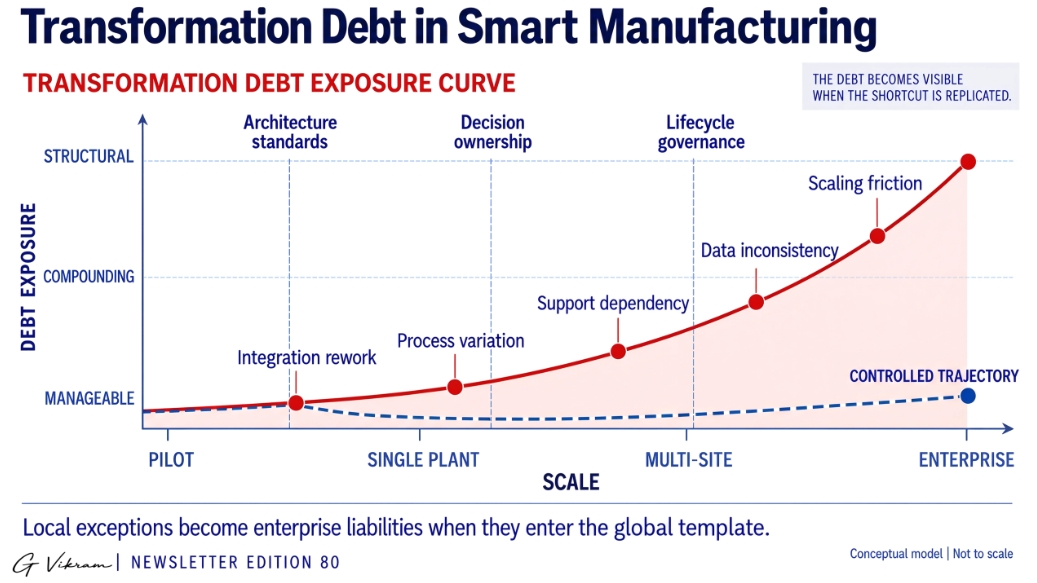 The most dangerous debt in a smart factory isn’t financial.