Oct02
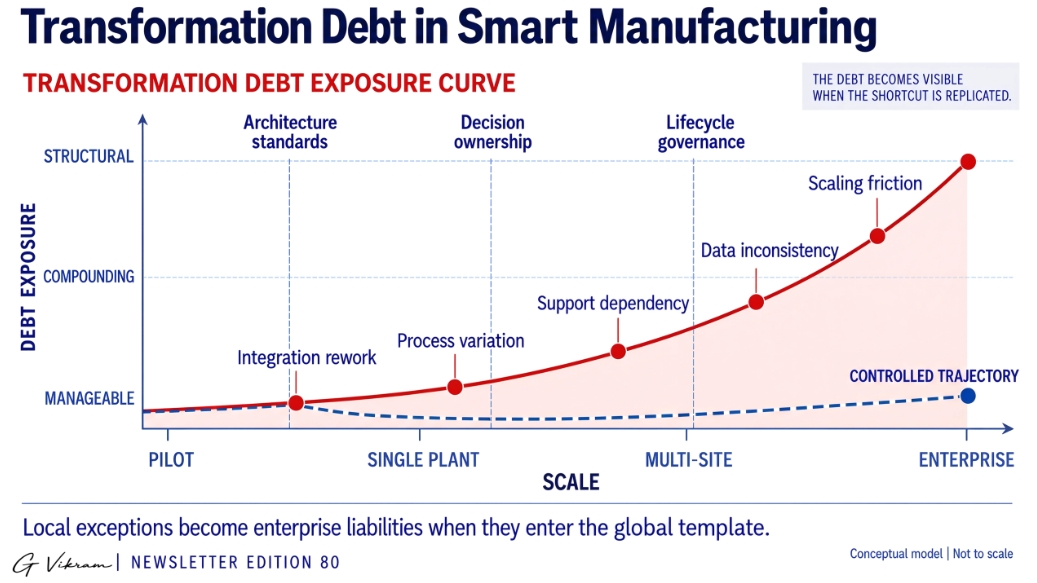
A pilot succeeds. The dashboard works. The machine is connected. The team demonstrates value, and leadership approves the next phase.
Then scaling begins.
What worked for one machine becomes difficult across a line. What worked for one plant requires exceptions at the next. Integrations multiply, data definitions drift, support becomes dependent on a few individuals, and every new site takes longer than expected.
This is transformation debt.
It is the future operational cost created when today’s digital progress depends on shortcuts that were never designed to scale.
Transformation debt is not always the result of poor execution. In many cases, the original shortcut was reasonable. A pilot needed speed. A production problem required an immediate workaround. A local team could not wait for a global standard.
The real issue begins when a temporary decision quietly becomes part of the permanent operating model.
The Debt Becomes Visible When the Shortcut Is Replicated
During a pilot, transformation debt is usually manageable.
The scope is narrow. The team knows the architecture. Data can be corrected manually. A specialist understands the workaround. An unreliable interface can be monitored closely.
The same conditions rarely survive scale.
As the solution moves from pilot to plant, multi-site and enterprise deployment, small compromises begin to compound:
The organisation may believe it is replicating a successful solution. In reality, it may also be replicating every exception hidden inside that solution.
That is why transformation debt often appears late. It is created during experimentation but exposed during replication.
How Transformation Debt Progresses
At pilot stage, speed is valuable. Teams experiment, learn and prove feasibility.
Some exceptions are unavoidable.
The risk is not the exception itself. The risk is failing to document:
A pilot should be allowed to move quickly. It should not be allowed to create invisible commitments.
At plant level, informal knowledge often keeps the solution working.
Engineers know which data points are unreliable. Operators understand when the workflow needs manual intervention. The local IT or OT team knows which interface must be restarted and whom to call when it fails.
This can create a false impression of maturity.
The solution appears stable because experienced people are compensating for its weaknesses. The operating cost exists, but it is hidden inside human effort.
The challenge changes when the solution reaches additional plants.
Each site has different:
Without clear guardrails, every rollout creates another version of the solution.
The organisation is no longer scaling one platform. It is scaling a family of exceptions.
At enterprise level, transformation debt starts affecting investment decisions, cybersecurity, support models, vendor strategy and the ability to introduce new capabilities.
Teams spend more time maintaining inherited complexity than creating value.
At this point, the cost is no longer limited to technology. It appears as:
The transformation has scaled—but so has the debt.
Five Warning Signs Leaders Should Watch
Some site-level discovery is always necessary. But if each plant requires the architecture to be rediscovered, the organisation has not created a repeatable deployment model.
When operational continuity depends on individual memory, knowledge has become a hidden system dependency.
An exception without an owner, review date or retirement plan is no longer temporary. It has become architecture.
If the same KPI means something different at each site, the organisation may have global reporting without global operational meaning.
A scalable solution should reduce the effort required for subsequent deployments. If complexity grows faster than site count, transformation debt is compounding.
Three Leadership Controls That Flatten the Curve
Transformation debt cannot be eliminated completely. It can, however, be made visible, governed and deliberately retired.
Architecture standards: standardise before replication
Before a pilot moves to the next site, define the minimum production architecture.
This should cover more than technology selection. It should clarify:
The objective is not to eliminate local flexibility. It is to prevent local flexibility from silently becoming enterprise complexity.
Decision ownership: give every exception an owner
Every significant deviation should have a named decision owner.
That owner should be responsible for answering:
When everyone is responsible for transformation debt, no one is responsible for it.
Lifecycle governance: retire workarounds before scale
A successful pilot is not automatically ready for enterprise deployment.
Before replication, teams need a deliberate industrialisation stage to:
This step may appear to slow the rollout. In practice, it prevents a much larger delay later.
A Practical Transformation Debt Review
Before approving the next stage of a manufacturing transformation, leadership teams can ask seven questions:
These questions should be asked before scale—not after complexity becomes visible.
The Leadership Shift
Smart manufacturing programmes often measure the speed of deployment.
They should also measure the amount of complexity carried forward.
The objective is not to remove experimentation or force every plant into an inflexible global template. It is to distinguish clearly between:
A local exception becomes an enterprise liability when it enters the global template without visibility, ownership or an exit plan.
The most scalable manufacturing transformation is not necessarily the one that moves fastest during the pilot.
It is the one that reaches the next plant without carrying every shortcut with it.
Leadership takeaway
Before scaling a successful pilot, standardise the architecture, assign ownership to every exception and retire the workarounds that should not become part of the enterprise operating model.
What transformation debt is your organisation carrying from pilot to scale?
By G Vikram
Keywords: Digital Transformation, Manufacturing, AI Governance
 What is that Analytical AI?
 Friday’s Leadership Reflection Quote – Saeculum Leadership Leaders Intervene Before Options Narrow
 The Corix Partners Friday Reading List - October 23, 2026
 RIFLESSIONE SU AI, TECNOLOGIA E PERSONE
 2027 Predictions for Cybersecurity: The Agent Is the New Insider