Oct02

The past few weeks I had the pleasure of talking to two totally different boards. One and NGO the other a listed company. And I saw something in practice I had almost forgotten.
There is this moment when you discover what an organisation is truly made of. Not during the strategy presentations, not during the all-hands where the CEO speaks from a carefully prepared script, and certainly not in the annual report. You discover it in the room where a real problem lands on the table and everyone has to decide what to do about it, a real world lesson.
I have been privileged, over the course of my career in contract management and organisational strategy, to sit in many rooms filled with executives. Two very recent conversations revealed something again. And yes, they happened in entirely different organisations, but they illustrate something that I now consider one of the most consequential truths in leadership: the presence or absence of a strong mission does not just shape culture at the edges. It determines whether an organisation can actually move and execute on purpose and not because of political games.
The first room was inside a non-governmental organisation. A large one, with serious complexity: they serve people experiencing homelessness, drug dependency, psychiatric crises, and the messy overlap of all three. The challenges they face daily would humble most commercial operators. The funding pressures are relentless. The human stakes are as high as stakes get.
I was there to discuss contract management, supplier governance, and the management of their broader ecosystem of partners, care providers, and service agreements. This is not a small subject for an organisation of that type. The supplier and partner network is often what determines whether the right support reaches the right person at the right time.
What struck me was what happened the moment I introduced the opportunity that thinking in Ecosystem and contractmanagment brings. Before I had finished explaining the concept, the leadership team had already moved. Not into discussion about process ownership or governance diagrams. Into the mission. The question that immediately came back to me was: how many more people can we help if we get this right?
That was it. That was the entire frame. Every conversation that followed was organised around that question. Efficiency gains in contract governance translated directly, in their minds, into hours of frontline capacity. Supplier optimisation meant better care pathways. Ecosystem management meant more coherent service delivery for the most vulnerable people they worked with. There were no walls between the operational improvement and the reason the organisation existed.
The second room was inside a publicly listed company. A large one, commercially successful by most measures, with substantial resources, a well-staffed procurement and legal function, and a clear awareness that contract lifecycle management was something they needed to address. They knew the problem.
What happened the moment I introduced the opportunity was a different kind of movement entirely. The first question was not about value. It was about blame. Why had this not been done before? Whose responsibility had it been? The second wave of conversation was about ownership: who would own this now? Would it sit with legal, with procurement, with finance, with operations? The third wave was about roles: what exactly would everyone's involvement look like, and how would that interact with existing reporting lines?
We spent the better part of the session in those three conversations. The opportunity itself, what the organisation might gain, what problems it might solve, what risks it might reduce, sat largely unexamined. It was present, technically, in the room. But it was not what the room was about.
I want to be careful not to romanticise the NGO or caricature the listed company. Both were led by thoughtful people. Both faced genuine complexity in their own right. The listed company had legitimate governance questions to resolve. None of those conversations were inherently wrong or bad.
The difference was in what came first.
In the organisation with a strong mission, the mission acted as a filter, a guide. Every question passed through it automatically. A new initiative was evaluated by whether it served the purpose. That is not a conscious choice that leadership makes in the moment. It is something that has been built into the culture over time, so deeply that it operates without effort. The mission is not a poster on the wall. It is the operating system.
In the organisation without that clarity of purpose, leadership operated on a different default. The default was self-preservation and positional thinking. Not because the people were bad or small-minded. Because in the absence of a shared north star, the most reliable navigational tool available to any individual in an organisation is their own position within it. Career protection is entirely rational when there is nothing larger to be part of.
This is the quiet disaster that plays out inside thousands of organisations every day, and it is particularly visible in the domain I work in. Contract management, supplier relationship management, and contract lifecycle management are areas where the value at stake is enormous and well-documented. Study after study, from the World Commerce and Contracting organisation to the work we have done at CATS CM over more than two decades, confirms that poor contract management destroys value at scale. Missed obligations, underperforming suppliers, untriggered price adjustments, unmanaged risks. The losses are not marginal.
And yet the adoption of structured contract management remains, across much of the corporate world, painfully slow. Organisations invest in platforms, run projects, assign workstreams, and then arrive, three years later, at something that partially functions, is inconsistently used, and has delivered a fraction of the projected value.
The reason is almost never technical. The technology is good. The methodologies are proven. The reason is almost always what I saw in that second boardroom. Internal politics, blurred ownership, and the managerial instinct to protect position rather than drive purpose. Silos without purpose are a killer of progress.
What the NGO had, and what the listed company lacked, was not a better governance model or a more agile process design. It was coherence between leadership intention and organisational energy.
When a mission is strong enough and genuine enough, it creates a kind of gravitational pull. Decisions that align with it are easy. Decisions that do not align with it are uncomfortable. People at every level of the organisation have an intuitive sense of what the organisation is for, and that sense guides behaviour in the thousands of small moments that no governance framework could ever reach.
This is a structural advantage. Not in the way that a competitive moat or a technology edge is a structural advantage. But in the sense that the organisation can apply its full energy to the problem in front of it, rather than spending a significant portion of that energy managing the internal friction generated by positional politics.
For contract management and supplier relationship management specifically, this matters enormously. Effective contract management is not a project. It is a capability that has to be embedded across functions, sustained over time, and continuously improved. It requires legal to work with procurement. It requires procurement to work with operations. It requires senior leadership to hold the standard and protect the process from the short-term pressures that always arrive and always seem more urgent.
None of that works when every function is, at some level, defending its territory. None of that works when the driving question in leadership meetings is who owns what and who gets blamed when it goes wrong.
The obvious answer is: build a stronger mission. And that is not wrong. Organisations that invest seriously in clarity of purpose, that translate that purpose into something operational and specific rather than leaving it as inspirational language, genuinely do perform differently. The research supports this, and my experience in both rooms confirms it.
But mission is not something that can be installed quickly. It is built through decisions made consistently over time, especially the decisions that are costly. The moment a leader chooses the mission over their political comfort, or the moment a team accepts a harder path because it serves the purpose better, is a brick in the foundation of a culture that can actually move.
What can be done more immediately is a version of what the NGO did instinctively: insisting that every major initiative be framed first in terms of value and purpose, before it is framed in terms of ownership and process. This sounds simple. In practice, it requires a leader who is willing to redirect conversations actively and repeatedly, until the habit forms.
It also requires an honest acknowledgement of what career management does to organisations. This is not a comfortable conversation. Most organisations are full of intelligent, qualified people who have learned, rationally, that protecting their position is more reliably rewarded than driving change. That is a systems problem, not a character problem. But it is a systems problem that leadership created and that only leadership can resolve.
The NGO did not have more resources, actually they don't have the MBA graduates as norm in leadership, or more sophisticated processes, or a less complex problem than the listed company. In many respects, it had far less of all. What it had was a reason to exist that was clear enough, and compelling enough, to organise everything around.
That clarity made it faster, more decisive, and more open to change. Not because the people were different. Because the context they operated in was different. The mission gave them permission to move.
Most organisations in the commercial world are not lacking in intelligence, technology, or methodology when it comes to contract management and supplier governance. They are lacking in the one thing that makes all of those assets actually work: a shared understanding of what they are all for, held at every level from the boardroom to the people who sign the contracts and manage the suppliers.
Until that gap is closed, the value will keep sitting in the room, technically present, largely unexamined.
Keywords: Ecosystems, Leadership, Supply Chain
 The Most Dangerous Leader in the Room May Be the One Everyone Depends On
 What is that Analytical AI?
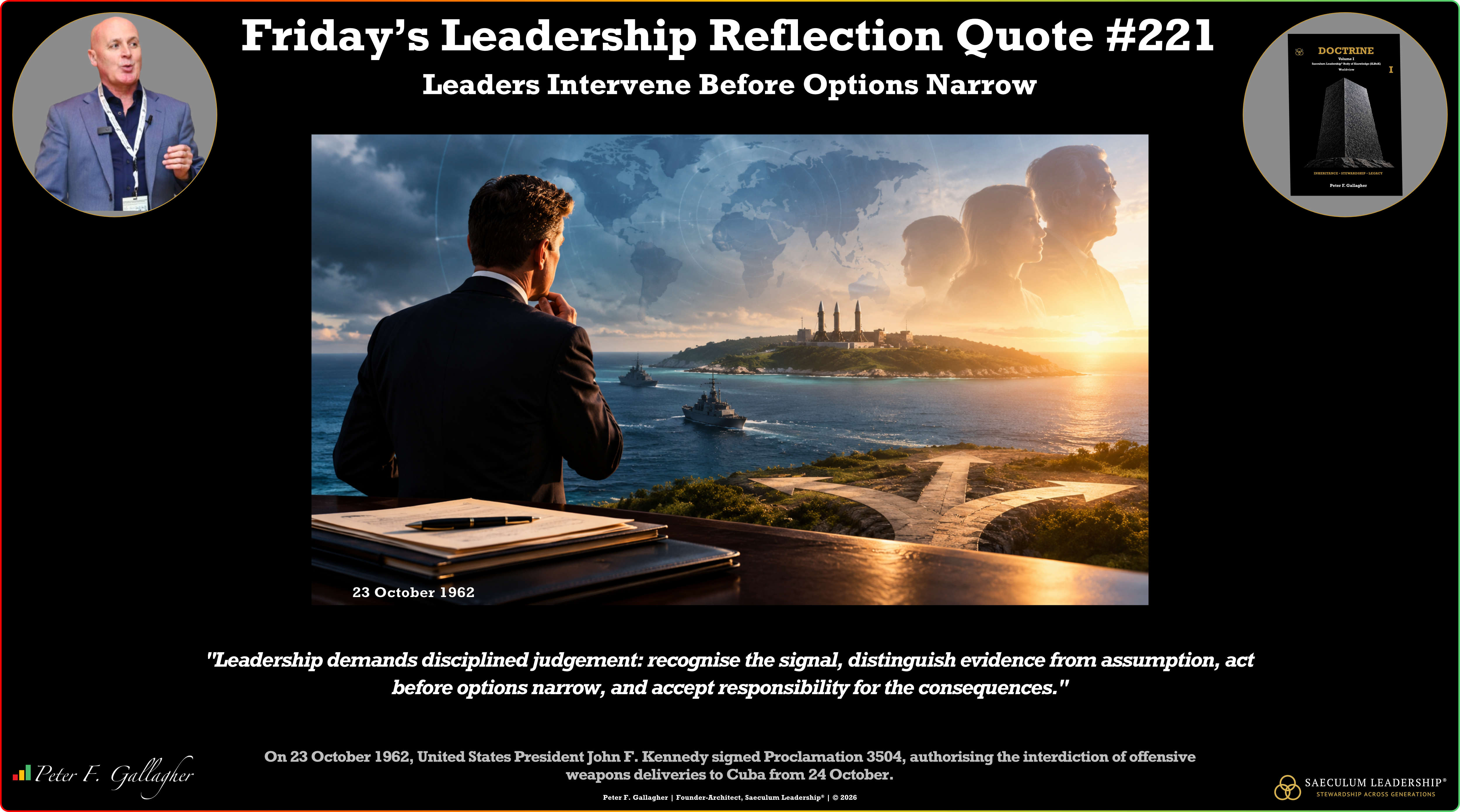 Friday’s Leadership Reflection Quote – Saeculum Leadership Leaders Intervene Before Options Narrow
 The Corix Partners Friday Reading List - October 23, 2026
 RIFLESSIONE SU AI, TECNOLOGIA E PERSONE