Sep30
I have watched the same meeting happen at four different companies.
A CTO or a CDO or a VP of Operations calls a room together to discuss the AI pilot. The pilot has finished. The results are good. Completion rates are up. The model performed well. The demo at the review was genuinely impressive. Everyone in the room agrees that the technology works.
And then six months later, the workflow the pilot was supposed to handle is still being handled by the same person who handled it in 2023. There is now an audit log to prove it.
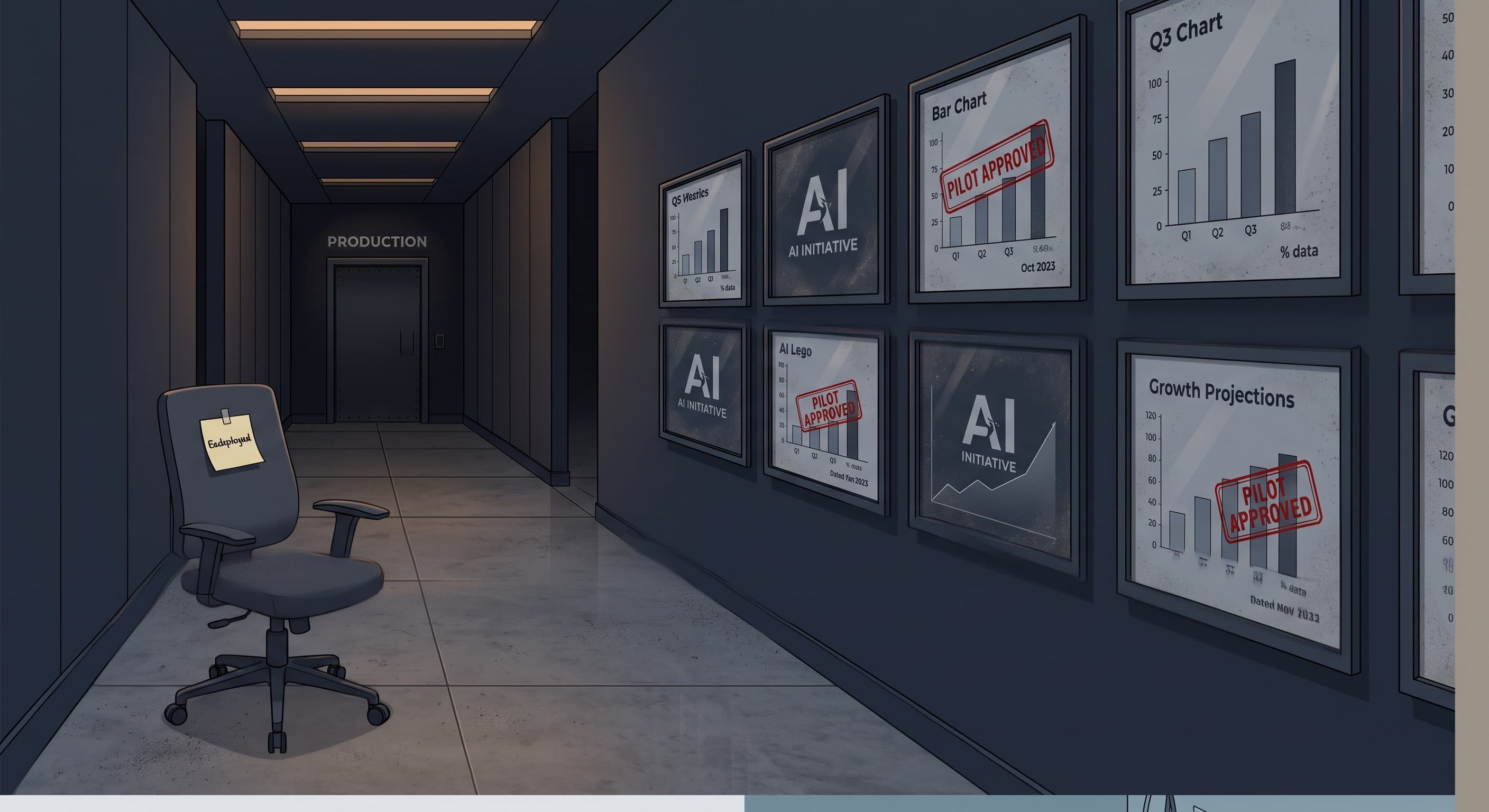
Nobody in that room made a technology mistake. The enterprise AI graveyard is full of pilots that worked exactly as designed. They were designed to prove the model could do the thing, and the model could.
I call this the Pilot Trap. I built the framework in October 2025 after watching a company run two years of AI pilots without a single one reaching production. I have since used it to explain something I could not explain before: why excellent technology produces almost no deployment, and why the organizations with the most sophisticated pilots are sometimes the furthest from having agents in production.
The Pilot Trap runs in five stages: Excitement, Scoping, Sandboxing, Stall, Abandonment.
Stage one, Excitement, is when a senior leader sees a demo. The capability is real. A team is named. The Slack channel gets created. Budget is approved on a phone call.
Stage two, Scoping, is where the first decision happens and nobody notices it is the wrong one. The team picks a use case. The use case is picked for how well it will demonstrate, not how well it will deploy. The pilot boundary is drawn around what the model can do, not around what the workflow requires. Nobody objects, because the only people in the room are people who agreed to be in the room.
Stage three is Sandboxing, and this is where the trap springs. The team builds the pilot in a controlled environment. The environment has none of the integrations, none of the security policies, and none of the people who own production. The pilot works.
And then production calls.
Production calls and brings three friends: IT security, procurement, and legal. IT security wants to know how the agent handles secrets. Procurement wants to know what is in the EULA. Legal wants to know what happens when the agent gets something wrong on a Tuesday in Q3. None of these three were at the demo. None of them were at the Scoping meeting. They are now setting the terms of deployment, and those terms are different from everything the pilot was built against.
Stage four, Stall, is the polite version of failure. The next review moves out a quarter. Then two. The executive sponsor gets absorbed by something else. The team is still on the org chart but their calendars have filled. The vendor is still on the contract but nobody has signed the success criteria.
Stage five, Abandonment, is the version nobody notices. Nobody decides to stop. The pilot is abandoned by the absence of a decision to continue. The CV of one team member lists "shipped AI capabilities" under this quarter. The workload is still being done by the same person it was always done by.
This is the part that took me a while to see clearly.
When I first named the framework, I thought the problem was Sandboxing. Build against production requirements and you avoid the trap. That is true but incomplete.
The real decision happens at Scoping, when the team chooses what to optimize the pilot for. In almost every enterprise AI initiative I have seen fail, the pilot was scoped to answer the question "can this technology do the thing?" rather than "can this technology do the thing in our environment, with our data, connected to our systems, under our policies, with a named human accountable for when it gets something wrong?"
The answer to the first question is almost always yes. That is the trap. The technology works in conditions designed to let the technology work.
Across the four companies, the same six gaps showed up between pilot and production, in roughly the same order.
The Data Gap. Production data is messier and less consistent than the curated dataset the pilot ran on. Every enterprise has this. The model that performs well on clean labeled examples performs differently on the actual logs, the incomplete records, the edge cases that accumulate over years of a real workflow.
The Integration Gap. A working pilot typically connects to one or two systems. A production agent needs considerably more -- each integration requires IT involvement, access review, and latency testing that the pilot timeline did not account for.
The Accountability Gap. In a pilot, if the agent gets something wrong, it is a learning. In production, if the agent gets something wrong, someone's job is on the line. Most organizations that fail to deploy had not named a human owner for agent decisions before the pilot ran. That conversation becomes the blocker.
The Measurement Gap. Pilots track hours saved. That is a fine metric for justifying the pilot. It is not a useful metric for justifying production investment. The value at scale is surge resilience: the ability to handle five times the volume without five times the headcount. If the pilot never measured that, there is nothing to show the CFO.
The Change Management Gap. The people who will use the agent in production were not involved in scoping it. Their workflows were not redesigned around the agent's capabilities. They were handed a tool and told to adopt it. Workflow change does not work that way.
The Economic Gap. The unit economics of a pilot look very different from the unit economics of production. GPU cost, licensing cost, integration cost per transaction: all of these look manageable at pilot scale and different at the scale required to justify the investment.
The organizations that close them do it by making the pilot a production-requirements exercise rather than a capability proof.
The framework does not solve anything by itself. Naming a pattern is not the same as fixing it.
What naming it does is give you something to argue about before the pilot starts, instead of after it ends.
If you put IT security, procurement, and legal in the Scoping meeting, they will tell you exactly what production deployment requires. Their answer will slow the pilot down and narrow the use case, and the sponsor will hate it in month one. It is still cheaper than finding out in month nine, when the same three people are reading the same requirements off a checklist and the budget is already spent.
I have seen this work. I have also seen organizations read the framework and continue to run pilots the way they always have, because the political cost of slowing the pilot in month one is higher than the organizational cost of abandoning it in month nine. That is a real constraint. The framework does not eliminate it.
What it does give a sponsor is the language to push back earlier. "We are not scoping to demonstrate feasibility. We are scoping to validate production readiness."
I work for a vendor, so I will say this carefully. The incentive on our side of the table is a clean pilot that renews. The incentive on the customer side is a deployment that survives contact with legal. Those only line up when the customer forces the production questions into the Scoping meeting, and the customers I have seen do that are still a minority.
The vendors who help customers close the six gaps before the pilot runs are betting on a slower, harder engagement that produces a deployment. The vendors who optimize for the demo are betting on a faster win that produces a slide deck. Both are rational strategies. They have different outcomes.
The Pilot Trap is a pattern I have observed in a specific set of company contexts. It is not universal.
I have seen pilots go to production in 60 days with no stall. Every one of them had a single owner who could sign for security, procurement, and legal in the same meeting. If you are in a company where one person can push something to production by saying so, the trap is different for you. It still exists -- the gap is usually Measurement and Change Management rather than Accountability -- but the stage three stall I described above is less likely.
The pattern I mapped holds more consistently in larger enterprises and in regulated industries where the Accountability Gap is the highest barrier. I would not claim a precise headcount threshold; it is more about organizational complexity than size.
But the pattern I described above is for the more common case.
Kuber Sharma is Senior Director of Product Marketing at UiPath, where he leads go-to-market for enterprise agentic AI. The full Pilot Trap framework -- including the five stages, six gaps, and a production-readiness checklist -- is at kubersharma.com/frameworks/pilot-trap. He writes on enterprise AI deployment and AI governance at kubersharma.com.
By Kuber Sharma
Keywords: Agentic AI, Design, Future of Work
 2027 Predictions for Cybersecurity: The Agent Is the New Insider
 FROM THE AISLE Field Notes on AI Implementation
 The Hybrid Team: Rethinking RACI When Some of Your Team Members Are Machines
 Two Clocks, One Truck: The Army's Need for Speed Meets New Defense Sourcing Rules
 Sustainable Transformation: The Elephant and The Mouse In The Room