



Kuber Sharma is Senior Director of Product Marketing at UiPath, where he leads go-to-market for the Agentic Business Orchestration portfolio, including Autopilot and Maestro. He spent seven years at Microsoft Azure, where he launched over a dozen cloud services, and five years at Salesforce and Tableau, where he named the Zero Copy category, led the Tableau AI relaunch to 150% of pipeline target, and ran the State of Data and Analytics research program. His work sits at the intersection of enterprise AI deployment, product marketing strategy, and organizational readiness. He is the author of four practitioner frameworks for enterprise AI go-to-market: the Pilot Trap (https://kubersharma.com/frameworks/pilot-trap), a five-stage model of why enterprise AI dies between demo and production; the Augmented Marketing Decision Architecture (https://kubersharma.com/frameworks/amda), which sorts marketing decisions into three zones by stakes; the Trust Architecture (https://kubersharma.com/frameworks/trust-architecture), the three layers of trust an enterprise buyer needs before deploying AI; and the Belief Bridge (https://kubersharma.com/frameworks/belief-bridge), the four planks that carry a buyer from what a product does to what they believe it will do for them. All four are published in full with free reference cards at https://kubersharma.com/frameworks. He has keynoted at PMA World Summit, been quoted in IT Pro, COO Insider, CMSWire, and diginomica, and writes at kubersharma.com on enterprise AI governance, category creation, and the craft of launching products that don't have a category yet.
Available For: Advising, Influencing, Speaking
Travels From: Seattle, WA
Speaking Topics: Enterprise AI, Agentic Systems, AI Governance, Product Marketing, GTM Strategy, Category Creation
| Kuber Sharma | Points |
|---|---|
| Academic | 10 |
| Author | 39 |
| Influencer | 147 |
| Speaker | 39 |
| Entrepreneur | 0 |
| Analyst | 0 |
| Total | 235 |
Points based upon Thinkers360 patent-pending algorithm.

Tags: Agentic AI
Tags: Agentic AI
Tags: Agentic AI, IT Leadership
Issued Sep, 2026 – Expired Sep, 2026
Tags: Agentic AI, IT Leadership
Tags: Agentic AI, AI
Tags: Agentic AI, AI
Tags: Agentic AI
Tags: Agentic AI, Marketing
Tags: AI
Tags: AI
Tags: AI
Tags: Agentic AI, AI
Tags: Marketing, AI
Tags: Agentic AI, AI, AI Governance, Digital Transformation, Innovation
Tags: Agentic AI, Marketing, Product Management, Innovation, Digital Transformation
Tags: Agentic AI, AI, AI Governance
Tags: AI, Marketing, Business Strategy
Tags: Agentic AI, AI, Open Source, Digital Transformation, Innovation
Tags: Agentic AI, AI, Emerging Technology, Generative AI, Digital Transformation
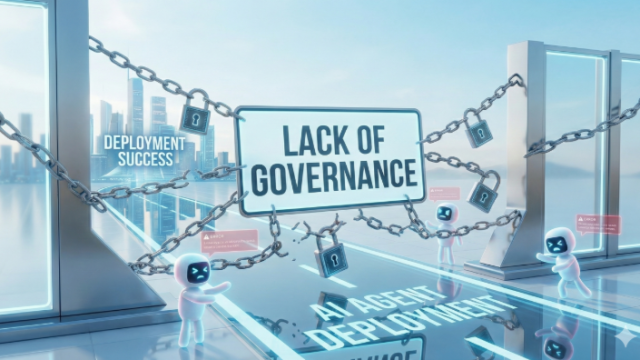 The #1 reason that kills your Agentic rollout.
Tags: Agentic AI
Tags: Agentic AI, AI, AI Governance, Digital Transformation, Emerging Technology, Generative AI, Innovation
Tags: Agentic AI, AI, AI Governance, Digital Transformation, Innovation
Tags: AI
Tags: AI
Tags: AI
Tags: Big Data, Digital Transformation
Tags: Marketing, Product Management, Business Strategy, Innovation, Digital Transformation
Tags: Agentic AI, AI, AI Governance
Tags: Marketing
Tags: Agentic AI, AI, AI Governance
Tags: AI
Tags: Agentic AI, AI, AI Governance
Tags: AI
Tags: AI
Tags: AI
Tags: Marketing
Tags: AI
Tags: Marketing
Tags: AI
Tags: AI
Tags: AI
Tags: AI
Tags: Marketing
Tags: AI
Tags: Marketing
Tags: AI
Tags: AI
Tags: AI
Tags: AI
Tags: Marketing
Tags: Marketing
Tags: AI
Tags: Marketing
Tags: AI
Tags: Agentic AI, IT Leadership
Tags: Marketing
Tags: AI
Tags: AI
Tags: Marketing
Tags: AI
Tags: AI
Tags: Marketing
Tags: Marketing
Tags: Marketing
Tags: Marketing
Tags: AI
Tags: Marketing
Tags: AI
Tags: AI
Tags: AI
Tags: AI
Tags: Marketing
Tags: AI
Tags: AI
Tags: AI
Tags: AI
Tags: AI, Emerging Technology
Tags: Agentic AI, AI
Tags: AI, Business Strategy
Tags: Agentic AI, AI, Marketing
Tags: Agentic AI, AI, AI Governance
Tags: Agentic AI, AI, AI Governance
Tags: Agentic AI, AI, AI Governance
Tags: Agentic AI, AI Governance, Marketing




Date : October 01, 2026
Date : October 01, 2026
Date : September 28, 2026
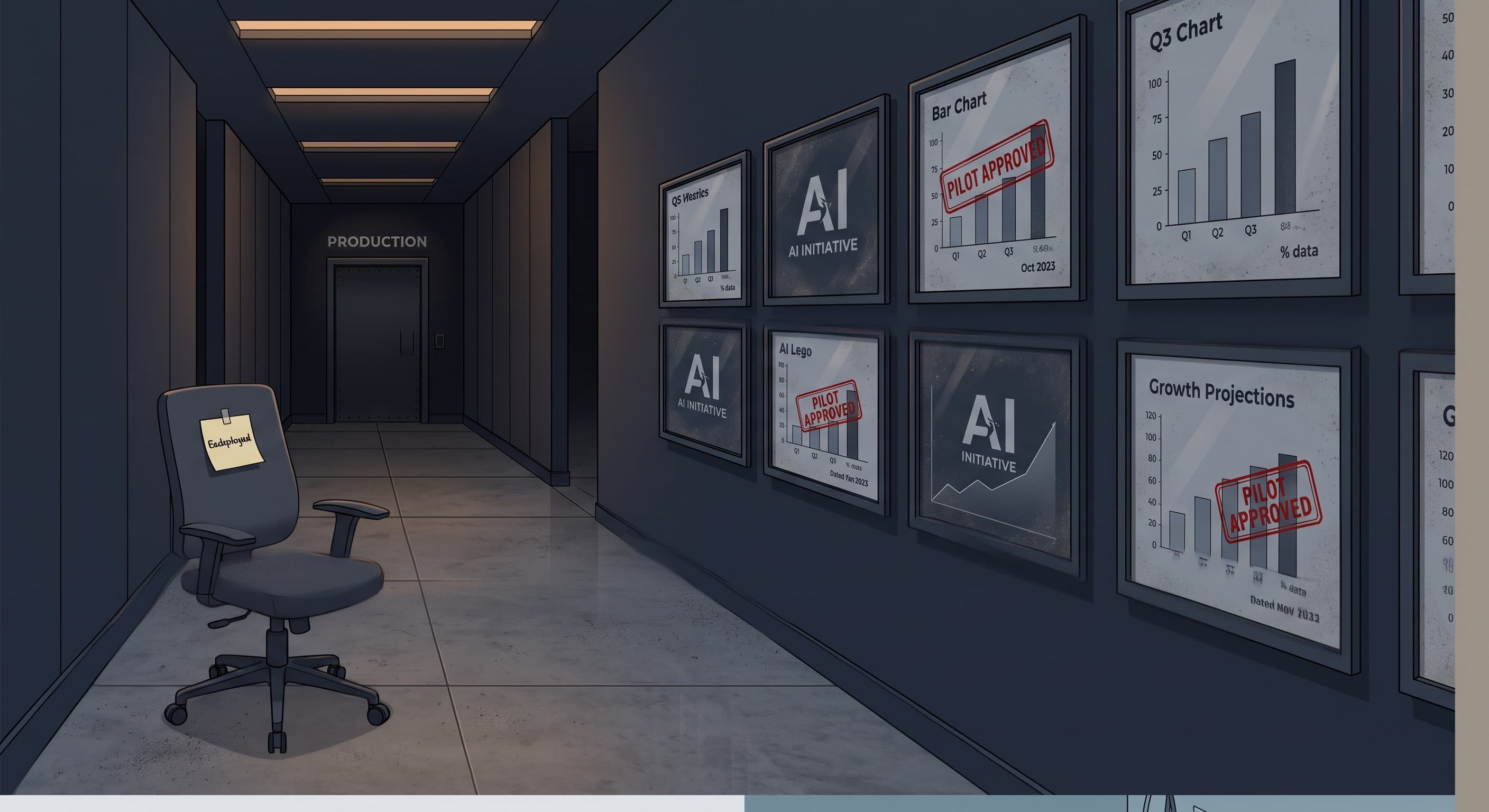 The Graveyard Is Full of Pilots That Worked
I have watched the same meeting happen at four different companies.
A CTO or a CDO or a VP of Operations calls a room together to discuss the AI pilot. The pilot has finished. The results are good. Completion rates are up. The model performed well. The demo at the review was genuinely impressive. Everyone in the room agrees that the technology works.
And then six months later, the workflow the pilot was supposed to handle is still being handled by the same person who handled it in 2023. There is now an audit log to prove it.
Nobody in that room made a technology mistake. The enterprise AI graveyard is full of pilots that worked exactly as designed. They were designed to prove the model could do the thing, and the model could.
I call this the Pilot Trap. I built the framework in October 2025 after watching a company run two years of AI pilots without a single one reaching production. I have since used it to explain something I could not explain before: why excellent technology produces almost no deployment, and why the organizations with the most sophisticated pilots are sometimes the furthest from having agents in production.
The Pilot Trap runs in five stages: Excitement, Scoping, Sandboxing, Stall, Abandonment.
Stage one, Excitement, is when a senior leader sees a demo. The capability is real. A team is named. The Slack channel gets created. Budget is approved on a phone call.
Stage two, Scoping, is where the first decision happens and nobody notices it is the wrong one. The team picks a use case. The use case is picked for how well it will demonstrate, not how well it will deploy. The pilot boundary is drawn around what the model can do, not around what the workflow requires. Nobody objects, because the only people in the room are people who agreed to be in the room.
Stage three is Sandboxing, and this is where the trap springs. The team builds the pilot in a controlled environment. The environment has none of the integrations, none of the security policies, and none of the people who own production. The pilot works.
And then production calls.
Production calls and brings three friends: IT security, procurement, and legal. IT security wants to know how the agent handles secrets. Procurement wants to know what is in the EULA. Legal wants to know what happens when the agent gets something wrong on a Tuesday in Q3. None of these three were at the demo. None of them were at the Scoping meeting. They are now setting the terms of deployment, and those terms are different from everything the pilot was built against.
Stage four, Stall, is the polite version of failure. The next review moves out a quarter. Then two. The executive sponsor gets absorbed by something else. The team is still on the org chart but their calendars have filled. The vendor is still on the contract but nobody has signed the success criteria.
Stage five, Abandonment, is the version nobody notices. Nobody decides to stop. The pilot is abandoned by the absence of a decision to continue. The CV of one team member lists "shipped AI capabilities" under this quarter. The workload is still being done by the same person it was always done by.
This is the part that took me a while to see clearly.
When I first named the framework, I thought the problem was Sandboxing. Build against production requirements and you avoid the trap. That is true but incomplete.
The real decision happens at Scoping, when the team chooses what to optimize the pilot for. In almost every enterprise AI initiative I have seen fail, the pilot was scoped to answer the question "can this technology do the thing?" rather than "can this technology do the thing in our environment, with our data, connected to our systems, under our policies, with a named human accountable for when it gets something wrong?"
The answer to the first question is almost always yes. That is the trap. The technology works in conditions designed to let the technology work.
Across the four companies, the same six gaps showed up between pilot and production, in roughly the same order.
The Data Gap. Production data is messier and less consistent than the curated dataset the pilot ran on. Every enterprise has this. The model that performs well on clean labeled examples performs differently on the actual logs, the incomplete records, the edge cases that accumulate over years of a real workflow.
The Integration Gap. A working pilot typically connects to one or two systems. A production agent needs considerably more -- each integration requires IT involvement, access review, and latency testing that the pilot timeline did not account for.
The Accountability Gap. In a pilot, if the agent gets something wrong, it is a learning. In production, if the agent gets something wrong, someone's job is on the line. Most organizations that fail to deploy had not named a human owner for agent decisions before the pilot ran. That conversation becomes the blocker.
The Measurement Gap. Pilots track hours saved. That is a fine metric for justifying the pilot. It is not a useful metric for justifying production investment. The value at scale is surge resilience: the ability to handle five times the volume without five times the headcount. If the pilot never measured that, there is nothing to show the CFO.
The Change Management Gap. The people who will use the agent in production were not involved in scoping it. Their workflows were not redesigned around the agent's capabilities. They were handed a tool and told to adopt it. Workflow change does not work that way.
The Economic Gap. The unit economics of a pilot look very different from the unit economics of production. GPU cost, licensing cost, integration cost per transaction: all of these look manageable at pilot scale and different at the scale required to justify the investment.
The organizations that close them do it by making the pilot a production-requirements exercise rather than a capability proof.
The framework does not solve anything by itself. Naming a pattern is not the same as fixing it.
What naming it does is give you something to argue about before the pilot starts, instead of after it ends.
If you put IT security, procurement, and legal in the Scoping meeting, they will tell you exactly what production deployment requires. Their answer will slow the pilot down and narrow the use case, and the sponsor will hate it in month one. It is still cheaper than finding out in month nine, when the same three people are reading the same requirements off a checklist and the budget is already spent.
I have seen this work. I have also seen organizations read the framework and continue to run pilots the way they always have, because the political cost of slowing the pilot in month one is higher than the organizational cost of abandoning it in month nine. That is a real constraint. The framework does not eliminate it.
What it does give a sponsor is the language to push back earlier. "We are not scoping to demonstrate feasibility. We are scoping to validate production readiness."
I work for a vendor, so I will say this carefully. The incentive on our side of the table is a clean pilot that renews. The incentive on the customer side is a deployment that survives contact with legal. Those only line up when the customer forces the production questions into the Scoping meeting, and the customers I have seen do that are still a minority.
The vendors who help customers close the six gaps before the pilot runs are betting on a slower, harder engagement that produces a deployment. The vendors who optimize for the demo are betting on a faster win that produces a slide deck. Both are rational strategies. They have different outcomes.
The Pilot Trap is a pattern I have observed in a specific set of company contexts. It is not universal.
I have seen pilots go to production in 60 days with no stall. Every one of them had a single owner who could sign for security, procurement, and legal in the same meeting. If you are in a company where one person can push something to production by saying so, the trap is different for you. It still exists -- the gap is usually Measurement and Change Management rather than Accountability -- but the stage three stall I described above is less likely.
The pattern I mapped holds more consistently in larger enterprises and in regulated industries where the Accountability Gap is the highest barrier. I would not claim a precise headcount threshold; it is more about organizational complexity than size.
But the pattern I described above is for the more common case.
Kuber Sharma is Senior Director of Product Marketing at UiPath, where he leads go-to-market for enterprise agentic AI. The full Pilot Trap framework -- including the five stages, six gaps, and a production-readiness checklist -- is at kubersharma.com/frameworks/pilot-trap. He writes on enterprise AI deployment and AI governance at kubersharma.com.
Tags: Agentic AI, Design, Future of Work
 Why Enterprise AI Deals Die Between Meetings
The pitch goes well. The demo lands clean, the champion nods along and asks the kind of questions that mean they're already imagining it live.
Two days later, the deal goes quiet.
That's not bad luck. I've seen it enough times to call it a pattern, and the pitch is almost never the cause.
After your meeting ends, your champion has to walk down the corridor and explain to their manager, or the CFO who's been burned before, or the IT lead who wasn't in the room, why they think this particular thing would actually work for their company. Not in the abstract, and not for the customer on your slide. For their data, their workflows, and the eleven people who'd have to change how they work.
If they can't make that case, they go quiet. They go quiet, and you never find out why, because the deal died somewhere you weren't.
I've watched this happen across twelve years in enterprise software. The pattern is the same whether the product was a database, a BI tool, or now an AI agent that's supposed to do the analyst's job. The pitch gets you to the room. What you do in the room determines whether your champion can leave the room and keep walking.
In the pitch reviews I've sat in, nobody plans for that walk.
The standard B2B GTM playbook treats belief as a byproduct of proof. Show enough evidence and belief follows. Get the right logo on the slide and the skepticism is supposed to fall away on its own. The deal closes.
The problem is that proof and belief are not the same thing. A buyer can understand that your product generates real results -- and still doubt those results will transfer to their situation. Their situation actually is different from the case study, and nobody in the room did the work of bridging that distance.
That gap -- between "I believe it works" and "I believe it would work for us" -- is where the AI deals I've watched stall tend to stall. That's a messaging failure, and product can't fix it for you.
I built the Belief Bridge in 2022 while preparing for a Tableau Conference keynote. The pieces existed before that -- scattered across pitch decks and positioning docs -- but naming the model and sequencing it deliberately changed how I thought about GTM execution.
The framework has four planks. They go in order. Skip one and you can't reach the next one. There's no shortcut across.
Plank 1: Evidence -- "It works for someone."
This is verifiable proof that results are real. Named customers who'll take a reference call. Benchmarks that show their methodology, and a demo that runs on real data rather than a video of one. The evidence plank is the only one that can't be borrowed from competitors -- your proof has to be yours. Without it, everything else is a claim.
Plank 2: Analogy -- "It is like something I already understand."
Novel products don't come with built-in mental models. Buyers need a reference frame, and the analogy plank provides one. The useful ones point at categories buyers have already lived through, like CRM or the cloud migration they finished three years ago. The ones that fail point at things that never delivered: metaverse, Web3, whatever the last AI wave promised.
A good analogy isn't there to explain the product. It gives the buyer a shelf to put it on.
Plank 3: Proof Point -- "It would work for someone like me."
The proof point is a specific customer whose situation mirrors the prospect's own -- same industry, roughly the same size, and about as far along in the journey as they are. A bank needs a banking proof point. A logistics company needs logistics proof. Generic logos don't do this work. "We work with Fortune 500 companies" fails the moment your prospect thinks "yes, but they have a different problem than mine."
Plank 4: Transfer -- "I can repeat this argument in my next meeting."
This is the plank most vendors skip. And it's the only one the buyer can't build themselves.
Transfer means explicitly connecting the proof point's results to the prospect's specific constraints -- their data situation and the specific workflow they're trying to change. Not "here's how this applies to companies like yours," but "given that your situation is X, the reason you'd see Y is Z."
Without Transfer, the buyer leaves the room with conviction but without the tools to maintain it. They know the product works. What they can't do is explain to their CFO why it would work here.
The quiet moment is my name for what happens after the meeting, when your champion is on their own.
Maybe it's the corridor, maybe it's the next internal review when someone asks "but would this actually work for us?" That question has to be answerable without you in the room.
If your champion can answer it, you've done the Transfer work. If they can't, the deal stalls. They still believe in the product. They just can't make the case in words their stakeholders trust.
The diagnostic question I use: does your champion understand what you do, or do they understand why it would work for their specific situation? Only the second one survives the corridor.
The reason vendors skip Transfer is that the first three planks feel complete. Evidence shows it works, the analogy makes it legible, and a matched proof point makes it plausible for someone like them. It's a coherent story right up to the door.
The buyer's job doesn't end when they leave your meeting. They have to go convince other people.
Every GTM motion I've run or reviewed put the money into the proof point and assumed the buyer would do the transfer. Some do. The ones who manage it were probably going to buy anyway. The ones who don't become the deals you can't explain -- the ones that went silent after a strong meeting.
Use it when your proof assets are strong but deals still go silent after good meetings. That's belief failing, not awareness.
One question tells you which: are you losing deals in the room, or after it? If after, the Transfer plank is what's missing.
The full Belief Bridge diagnostic -- including the questions to stress-test each plank and the patterns that indicate which one is failing -- is at kubersharma.com/frameworks/belief-bridge. All my frameworks are at kubersharma.com/frameworks.
Next time a deal goes silent after a good meeting, don't call the champion. Ask yourself what they could have said in the corridor. If you can't answer that, neither could they.
Kuber Sharma is Senior Director of Product Marketing at UiPath, where he leads GTM for the Agentic Business Orchestration portfolio. Previously at Microsoft Azure and Salesforce/Tableau. He writes about enterprise AI, product marketing, and category creation at kubersharma.com.
Tags: Agentic AI, Design Thinking, Product Management
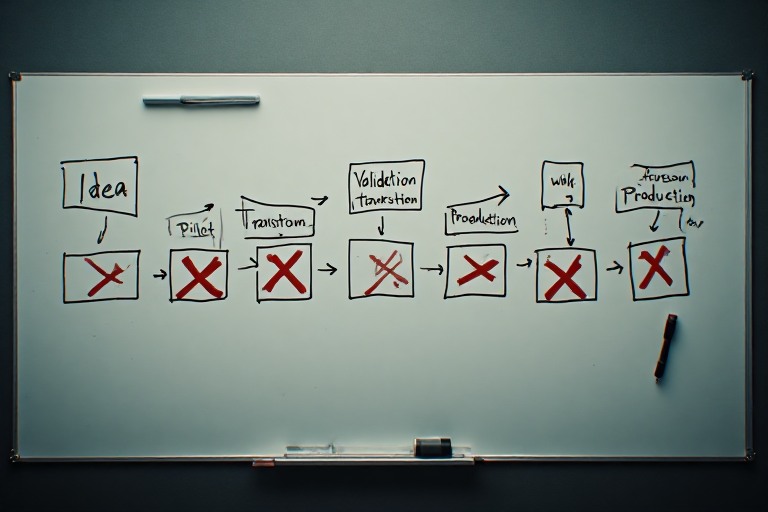 Enterprise AI Dies Between Pilot and Production
The graveyard is not full of failed pilots. It is full of pilots that worked.
That's the thing that took me longest to understand about enterprise AI. The initiatives that end up abandoned, the programs that get quietly defunded, the use cases that never make it to production -- most of them had a successful pilot. The demo worked. The accuracy was good. The business sponsors were impressed.
Then nothing happened for six months. Then someone got reorganized. Then the vendor contract came up for renewal and nobody could articulate the value. Then it died.
I've watched this pattern play out across three companies and twelve years in enterprise software -- at Microsoft Azure, at Salesforce, at UiPath. The shape of the failure is almost always the same. I call it the Pilot Trap.
It is not a technology problem. It is an infrastructure problem. And the infrastructure that fails isn't data or cloud. It's the boring stuff: who owns the thing, who signs off on the output, what happens on Monday when it's wrong. Nobody built any of that, because everyone assumed a good pilot result would carry its own momentum.
It doesn't. Here is the map.
The Five Stages
Enterprise AI initiatives move through five stages on the way from idea to production. Most of them stall somewhere in the middle.
Stage 1: Idea. Someone identifies a use case -- usually a digital transformation lead or the COO's office, and surprisingly often, the vendor. The criteria for selection are almost never "what is the most important problem we have?" They are "what can we show results on quickly?" and "what is the vendor's recommended starting point?" These are not the same question.
Stage 2: Pilot. A small team builds it. It runs on clean data with an IT person sitting two desks away, and the scope has been trimmed until it cannot fail. This is the part that usually works.
Stage 3: Validation. Results are measured. If the numbers look good, the pilot is declared a success. Stakeholders are briefed. A case study is drafted.
Stage 4: Transition. The initiative moves from the innovation team -- or the IT team, or the vendor delivery team -- to the business team that will actually run it. This is the stage that kills more initiatives than any other. Not because of technology. Because of accountability.
Stage 5: Production. The system runs at real scale, on real data, with real users, inside real workflows. This is the destination. Very few initiatives reach it.
The Six Gaps
Between and around these stages are six gaps. Each one is a place where an enterprise AI initiative can stop. Most initiatives fall into at least two.
Gap 0: The Strategic Gap
This exists before Stage 1 begins. Most enterprise AI programs start without a clear answer to: what problem are we solving that we cannot solve another way?
The question sounds obvious. It almost never gets asked. Teams jump to use cases because the pressure to "do something with AI" is high and the time to answer strategic questions is short. The result is a portfolio of pilots that are technically interesting and strategically irrelevant.
Gap 1: The Selection Gap
The use cases that get piloted are the ones that are easy to demonstrate. Invoice processing. A chatbot for the IT help desk. Something that summarizes meetings. Nobody gets fired for picking these. They're cheap to scope and you can show one at the next offsite. They are also rarely the use cases that would move the business.
The cases that matter, the ones where AI changes how the company actually competes or decides things, are harder to pilot. Somebody's process has to change. Somebody has to admit they don't own the workflow they thought they owned. So those get deferred in favor of whatever can be demoed at the next leadership offsite.
Gap 2: The Measurement Gap
Here is a question I've started asking every enterprise AI team I work with: how will you know, twelve months from now, whether this pilot generated business value?
The answer is usually a pilot metric. Accuracy. Hours saved per week. Sometimes a completion rate. These are fine measures of whether the technology works. They are almost never connected to a business outcome that anyone in the C-suite cares about.
A pilot that saves 40 hours per week of analyst time sounds like a win. If those analysts are reassigned to work of equivalent value, it is a win. If the organization doesn't know what to do with the capacity, it is a math exercise that looks good in a slide deck and disappears from the budget the following year.
Gap 3: The Ownership Gap
Pilots are owned by innovation teams, IT teams, or vendor delivery teams. These are not the people who will run the system in production. When the pilot ends, someone has to take it. That someone, usually a business unit that was briefed once in month two, wasn't in the room when the use case was picked or the success criteria were written. They certainly never agreed to own it.
The ownership conversation almost never happens during the pilot. It happens after the pilot succeeds. By then everyone has scattered. The business team is back to its own quarter. The innovation team has a new deck for a new pilot, and the vendor's account exec is thinking about renewal, not rollout.
The Ownership Gap is the moment where a successful pilot becomes nobody's problem.
Gap 4: The Infrastructure Gap
Pilots run on clean data. Production runs on whatever data actually exists.
The pilot ran on a dataset somebody cleaned by hand and an integration somebody built just for it. Production means the ERP with eleven years of inconsistent vendor names, and a workflow that turns out to have four exceptions the pilot team never saw because nobody told them.
This is not a failure of planning. It is a consequence of the deliberate choice to pilot in a controlled environment -- a choice that was correct. The mistake is assuming the infrastructure built for the pilot scales to production without a second project roughly the size of the first.
Gap 5: The Trust Gap
The last gap exists in production. The system is running. The data is there. The workflow is connected. Users have been trained. Then the adoption metrics come in at 30% of projections.
The Trust Gap is the distance between a system that technically works and a system that people will actually act on. Enterprise users have been burned before. They've seen the dashboard that was wrong for a quarter before anyone noticed. They've cleaned up after automations that made more work than they removed. Their skepticism is not irrational. It is institutional memory.
Building trust in an AI system requires something most pilots don't build: a track record. Not a demo. Not a case study. Actual decisions, made by real users, with AI assistance, that turned out well. That takes time. It also takes a named person who owns the outputs and has to answer for the errors, and most enterprise AI programs never appoint one.
What the Pilot Trap Actually Tells You
I built this framework because enterprise AI teams keep solving the wrong problem. They tune the model. They redo the interface. They run the pilot again with a bigger sample. Meanwhile the initiative is dying in a gap that has nothing to do with any of those things.
The companies I've seen get through it didn't have better models. They had a business owner named before the pilot started, and a metric the CFO recognized.
The question worth asking is not how to improve the pilot. It's which gap you're standing in. Most teams can answer in under a minute once they see the list.
The full Pilot Trap diagnostic, including the questions to run against each gap and the patterns I've seen determine outcomes, is at my website. All my frameworks are at kubersharma.com/frameworks.
Six months from now, when the renewal lands on someone's desk and they ask what this thing was worth, the pilot metrics will not answer the question. Decide now who will.
Kuber Sharma is Senior Director of Product Marketing at UiPath, where he leads GTM for the Agentic Business Orchestration portfolio. Previously at Microsoft Azure and Salesforce/Tableau. He writes about enterprise AI, product marketing, and category creation at kubersharma.com.
Tags: Agentic AI, AI, Product Management
 Why Enterprise AI Never Gets Past the Pilot Stage
The Pilot That Never Graduates
There is a pattern playing out in enterprise AI right now that almost everyone in the industry recognizes but nobody has quite named. A company builds a compelling AI pilot. The results are impressive. Leadership is excited. Then nothing. The pilot does not scale. The budget does not expand. The vendor gets ghosted. The internal champion quietly moves to a different project.
This is the Pilot Trap.
The Pilot Trap is not a technology problem. The technology usually works. The pilot usually works. The problem is that a successful pilot and a deployable enterprise system are two completely different things, and most AI vendors conflate them.
Failure Mode 1: The Capability Trap
The most common form of the Pilot Trap is what I call the Capability Trap. The vendor designs the pilot to demonstrate what the AI can do. The demos are impressive. The benchmark results are strong. The use case is well-chosen. The pilot succeeds by every measure the vendor defined.
But the enterprise did not buy capability. The enterprise was buying confidence that the system could be trusted with real data, real workflows, and real consequences. The pilot proved the former and left the latter completely unaddressed.
When the procurement team, the CISO, the data privacy officer, and the head of operations all show up to evaluate the system for full deployment, they are not asking the same questions the pilot was designed to answer. They are asking questions the vendor never prepared for.
The vendor that escapes the Capability Trap builds the pilot to answer both sets of questions simultaneously. Capability is demonstrated. Trust is earned. The governance artifacts are ready before the evaluation team arrives.
Failure Mode 2: The Champion Trap
The second failure mode is subtler. The pilot succeeds because one person inside the enterprise made it succeed. This person had the organizational authority to clear obstacles, the technical credibility to evaluate the results, and the personal conviction to push the project forward.
When the pilot ends and the expansion conversation begins, this person hits a wall. They have to sell the same system to five other stakeholders who were not in the room for the pilot. The CFO wants a business case. The CISO wants a security review. The head of operations wants a change management plan. The legal team wants a data processing agreement. The board wants a risk assessment.
The champion has the conviction but not the artifacts. The vendor won the pilot but lost the champion to an impossible internal sales motion.
The vendor that escapes the Champion Trap treats the internal champion as the first customer, not the last one. They equip the champion to sell across the organization. They pre-build the risk assessments, the security documentation, the business case frameworks. The expansion conversation starts in the pilot phase, not after it.
Failure Mode 3: The Integration Trap
The third failure mode is the most technically specific. The pilot ran in a clean environment. The production data is messier. The existing systems are older. The IT team has requirements the vendor did not know about. The integration that looked straightforward in the demo is six months of engineering work in production.
This is not unusual in enterprise software. But in AI, it lands differently because the value proposition is usually time-to-value and operational efficiency. An AI system that takes eighteen months to integrate has already lost the business case that justified the investment.
The vendor that escapes the Integration Trap designs for the production environment from day one of the pilot. They ask about existing systems before they write a line of code. They document the integration requirements alongside the capability requirements. They have a realistic deployment timeline that the customer can defend to their board.
What Escaping the Pilot Trap Looks Like
The common thread across all three failure modes is that the vendor treated the pilot as the destination when the pilot is actually the beginning of a longer journey. The pilot is where you earn the right to the next conversation. It is not the transaction. It is the trust-building event that makes the transaction possible.
Vendors that escape the Pilot Trap do three things consistently. They design the pilot to answer the expansion team's questions, not just the champion's questions. They treat the internal champion as a sales partner who needs tools and artifacts, not just a point of contact. And they define success metrics for the pilot that map directly to the business case for full deployment.
The result is not just more pilots graduating to full deployment. It is shorter sales cycles, higher win rates on competitive evaluations, and stronger expansion revenue from existing customers. Escaping the Pilot Trap is not just good product design. It is the most important GTM motion in enterprise AI right now.
Tags: Agentic AI, Leadership, Marketing
Location: North America (flexible) Fees: 5000
Service Type: Service Offered
Location: Virtual Fees: 3000
Service Type: Service Offered
Location: Virtual Fees: 2500
Service Type: Service Offered
 Peer Reviewer -- AMA Winter Academic Conference 2027OpenAI's Agent Pause: Experts Split on Model vs DeploymentWhy Context Engineering Is Becoming Martech's Most Contested Control PointThe Graveyard Is Full of Pilots That WorkedWhy Enterprise AI Deals Die Between MeetingsEnterprise AI Dies Between Pilot and Production