Sep12
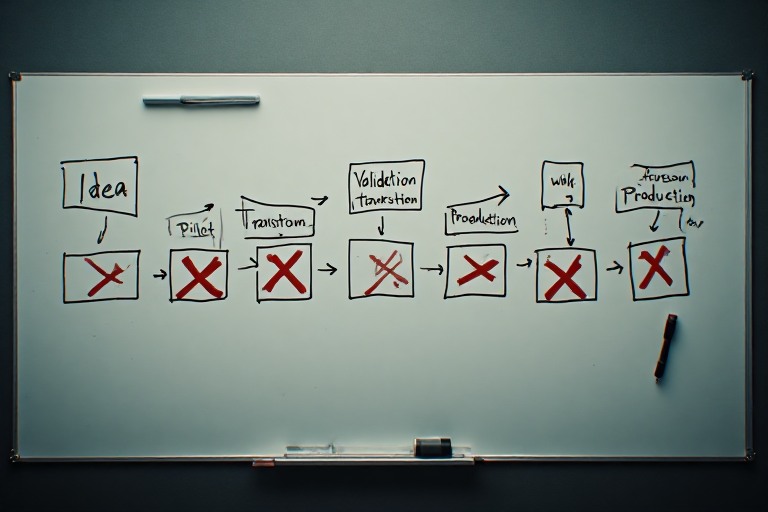
The graveyard is not full of failed pilots. It is full of pilots that worked.
That's the thing that took me longest to understand about enterprise AI. The initiatives that end up abandoned, the programs that get quietly defunded, the use cases that never make it to production -- most of them had a successful pilot. The demo worked. The accuracy was good. The business sponsors were impressed.
Then nothing happened for six months. Then someone got reorganized. Then the vendor contract came up for renewal and nobody could articulate the value. Then it died.
I've watched this pattern play out across three companies and twelve years in enterprise software -- at Microsoft Azure, at Salesforce, at UiPath. The shape of the failure is almost always the same. I call it the Pilot Trap.
It is not a technology problem. It is an infrastructure problem. And the infrastructure that fails isn't data or cloud. It's the boring stuff: who owns the thing, who signs off on the output, what happens on Monday when it's wrong. Nobody built any of that, because everyone assumed a good pilot result would carry its own momentum.
It doesn't. Here is the map.
The Five Stages
Enterprise AI initiatives move through five stages on the way from idea to production. Most of them stall somewhere in the middle.
Stage 1: Idea. Someone identifies a use case -- usually a digital transformation lead or the COO's office, and surprisingly often, the vendor. The criteria for selection are almost never "what is the most important problem we have?" They are "what can we show results on quickly?" and "what is the vendor's recommended starting point?" These are not the same question.
Stage 2: Pilot. A small team builds it. It runs on clean data with an IT person sitting two desks away, and the scope has been trimmed until it cannot fail. This is the part that usually works.
Stage 3: Validation. Results are measured. If the numbers look good, the pilot is declared a success. Stakeholders are briefed. A case study is drafted.
Stage 4: Transition. The initiative moves from the innovation team -- or the IT team, or the vendor delivery team -- to the business team that will actually run it. This is the stage that kills more initiatives than any other. Not because of technology. Because of accountability.
Stage 5: Production. The system runs at real scale, on real data, with real users, inside real workflows. This is the destination. Very few initiatives reach it.
The Six Gaps
Between and around these stages are six gaps. Each one is a place where an enterprise AI initiative can stop. Most initiatives fall into at least two.
Gap 0: The Strategic Gap
This exists before Stage 1 begins. Most enterprise AI programs start without a clear answer to: what problem are we solving that we cannot solve another way?
The question sounds obvious. It almost never gets asked. Teams jump to use cases because the pressure to "do something with AI" is high and the time to answer strategic questions is short. The result is a portfolio of pilots that are technically interesting and strategically irrelevant.
Gap 1: The Selection Gap
The use cases that get piloted are the ones that are easy to demonstrate. Invoice processing. A chatbot for the IT help desk. Something that summarizes meetings. Nobody gets fired for picking these. They're cheap to scope and you can show one at the next offsite. They are also rarely the use cases that would move the business.
The cases that matter, the ones where AI changes how the company actually competes or decides things, are harder to pilot. Somebody's process has to change. Somebody has to admit they don't own the workflow they thought they owned. So those get deferred in favor of whatever can be demoed at the next leadership offsite.
Gap 2: The Measurement Gap
Here is a question I've started asking every enterprise AI team I work with: how will you know, twelve months from now, whether this pilot generated business value?
The answer is usually a pilot metric. Accuracy. Hours saved per week. Sometimes a completion rate. These are fine measures of whether the technology works. They are almost never connected to a business outcome that anyone in the C-suite cares about.
A pilot that saves 40 hours per week of analyst time sounds like a win. If those analysts are reassigned to work of equivalent value, it is a win. If the organization doesn't know what to do with the capacity, it is a math exercise that looks good in a slide deck and disappears from the budget the following year.
Gap 3: The Ownership Gap
Pilots are owned by innovation teams, IT teams, or vendor delivery teams. These are not the people who will run the system in production. When the pilot ends, someone has to take it. That someone, usually a business unit that was briefed once in month two, wasn't in the room when the use case was picked or the success criteria were written. They certainly never agreed to own it.
The ownership conversation almost never happens during the pilot. It happens after the pilot succeeds. By then everyone has scattered. The business team is back to its own quarter. The innovation team has a new deck for a new pilot, and the vendor's account exec is thinking about renewal, not rollout.
The Ownership Gap is the moment where a successful pilot becomes nobody's problem.
Gap 4: The Infrastructure Gap
Pilots run on clean data. Production runs on whatever data actually exists.
The pilot ran on a dataset somebody cleaned by hand and an integration somebody built just for it. Production means the ERP with eleven years of inconsistent vendor names, and a workflow that turns out to have four exceptions the pilot team never saw because nobody told them.
This is not a failure of planning. It is a consequence of the deliberate choice to pilot in a controlled environment -- a choice that was correct. The mistake is assuming the infrastructure built for the pilot scales to production without a second project roughly the size of the first.
Gap 5: The Trust Gap
The last gap exists in production. The system is running. The data is there. The workflow is connected. Users have been trained. Then the adoption metrics come in at 30% of projections.
The Trust Gap is the distance between a system that technically works and a system that people will actually act on. Enterprise users have been burned before. They've seen the dashboard that was wrong for a quarter before anyone noticed. They've cleaned up after automations that made more work than they removed. Their skepticism is not irrational. It is institutional memory.
Building trust in an AI system requires something most pilots don't build: a track record. Not a demo. Not a case study. Actual decisions, made by real users, with AI assistance, that turned out well. That takes time. It also takes a named person who owns the outputs and has to answer for the errors, and most enterprise AI programs never appoint one.
What the Pilot Trap Actually Tells You
I built this framework because enterprise AI teams keep solving the wrong problem. They tune the model. They redo the interface. They run the pilot again with a bigger sample. Meanwhile the initiative is dying in a gap that has nothing to do with any of those things.
The companies I've seen get through it didn't have better models. They had a business owner named before the pilot started, and a metric the CFO recognized.
The question worth asking is not how to improve the pilot. It's which gap you're standing in. Most teams can answer in under a minute once they see the list.
The full Pilot Trap diagnostic, including the questions to run against each gap and the patterns I've seen determine outcomes, is at my website. All my frameworks are at kubersharma.com/frameworks.
Six months from now, when the renewal lands on someone's desk and they ask what this thing was worth, the pilot metrics will not answer the question. Decide now who will.
Kuber Sharma is Senior Director of Product Marketing at UiPath, where he leads GTM for the Agentic Business Orchestration portfolio. Previously at Microsoft Azure and Salesforce/Tableau. He writes about enterprise AI, product marketing, and category creation at kubersharma.com.
By Kuber Sharma
Keywords: Agentic AI, AI, Product Management
 Consumer vs. enterprise AI agents
 Best Supply Chain AI Tools in 2026: SCM SENSEI AI and Ask Lora Compared
 Making Silos Permeable
 The Corix Partners Friday Reading List - October 2, 2026
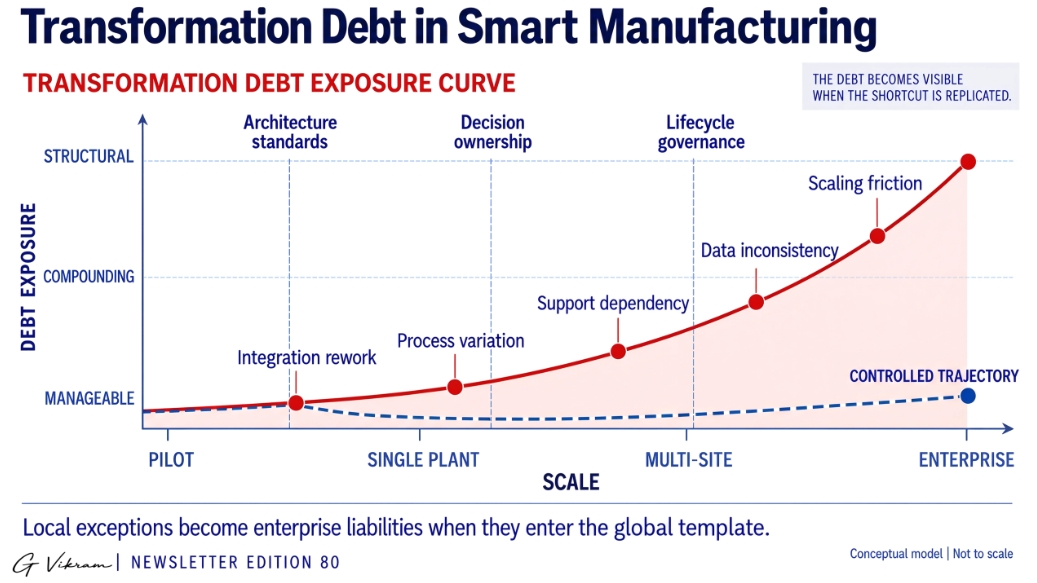 The most dangerous debt in a smart factory isn’t financial.