Aug05
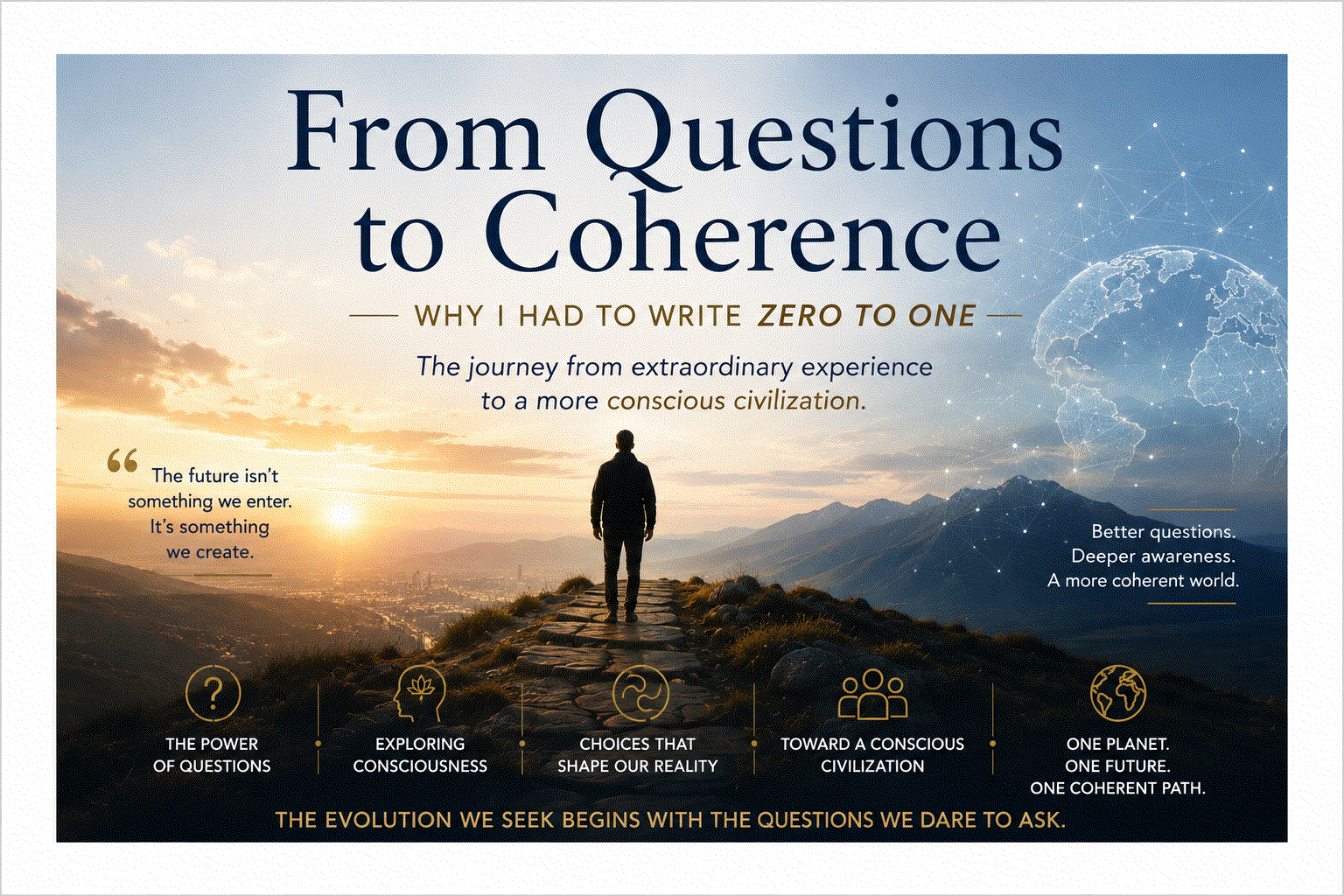
What if the most important discoveries begin with better questions rather than better answers?
That question sits at the heart of ZERO to ONE: Making Our Way Toward a Conscious Civilization.
When I wrote the book, I was not trying to offer a final theory of consciousness, prove an extraordinary experience, or prescribe a fixed path for humanity. I was trying to understand the systems already operating within us—and how our individual choices might influence the civilization we are becoming.
At first glance, the title may sound technological. Zero and one are the foundation of binary code, the language beneath modern computation. As digital systems increasingly organize communication, commerce, knowledge, and decision-making, that association is appropriate.
But I was interested in another binary system as well.
Every day, our lives are shaped through choices:
Yes or no.
Fear or curiosity.
Reaction or reflection.
Control or cooperation.
Separation or relationship.
Those choices may appear personal and momentary, yet they accumulate. Repeated choices become habits. Habits become cultures. Cultures shape institutions. Institutions influence civilization.
The movement from zero to one is therefore more than a computational function. It represents the moment possibility becomes participation.
Much of my earlier writing grew from experiences that challenged conventional interpretations of consciousness and reality.
As an adoptee, I began asking questions about identity and belonging very early. That inquiry widened over time into questions about consciousness, human potential, spirituality, nonhuman intelligence, and our relationship with the cosmos.
A profound experience during my first year of college intensified that search. It left me with a deep awareness of interconnectedness and the impression that humanity’s future depended upon learning how to create greater harmony among people and planet.
For many years, I focused on understanding what had happened.
Eventually, a more important question emerged:
What practical difference should such an experience make?
An extraordinary experience has little value if it does not contribute to a more responsible, compassionate, discerning, and useful life.
That realization changed the direction of my writing.
I became less interested in describing unusual events and more interested in understanding the conditions that allow people and systems to function well.
How do we distinguish intuition from assumption?
How do we evaluate information without becoming trapped by belief?
How do emotion and logic work together?
How does individual awareness influence collective behavior?
How might humanity mature into a civilization capable of stewarding its own intelligence?
Those became the deeper questions behind ZERO to ONE.
By the time I wrote the book, humanity had entered an age of unprecedented access to information.
We could communicate instantly across continents, search vast libraries in seconds, and participate in global networks that previous generations could scarcely imagine.
Yet greater access to information had not necessarily produced greater wisdom.
Information could educate, but it could also overwhelm.
It could connect people, but it could also reinforce division.
It could broaden perspective, but it could just as easily trap individuals inside carefully curated belief systems.
The challenge was no longer merely acquiring information.
It was learning how to qualify it.
Discernment became central to the book because a conscious civilization cannot be built by people who accept every claim that confirms their hopes or fears. Nor can it be built by dismissing every experience that falls outside established models.
We need the capacity to remain open without becoming gullible and skeptical without becoming closed.
That balance is difficult.
It is also essential.
One of the recurring themes in ZERO to ONE is that humanity may not yet be asking the right questions.
We often rush toward conclusions because uncertainty is uncomfortable. We want categories, explanations, authorities, and answers.
But questions determine the direction of inquiry.
Ask a narrow question and the answer will usually remain narrow.
Ask only whether an unexplained phenomenon is “real,” and we may miss what it reveals about perception, consciousness, psychology, culture, or intelligence.
Ask only whether technology can become more powerful, and we may neglect whether humanity is becoming wise enough to use it.
Ask how we can control complex systems, and we may overlook the relational conditions that allow them to organize naturally.
The book therefore became an exploration rather than a declaration.
It examined consciousness, synchronicity, nonhuman intelligence, contact experiences, frequency, information, self-awareness, and the possibility of a more integrated civilization.
Not every question reached a final answer.
That was not the point.
The point was to create enough intellectual space for deeper inquiry.
Looking back, I can now see ZERO to ONE as a transition between two stages of my work.
The earlier stage centered on identity, extraordinary experience, personal transformation, and the search for meaning.
The later stage increasingly focused on systems, leadership, coherence, organizations, artificial intelligence, and planetary responsibility.
ZERO to ONE became the bridge.
It asked what happens when personal awareness expands beyond self-discovery and begins to influence how we participate in the world.
A conscious civilization will not emerge merely because more people meditate, study metaphysics, adopt new technologies, or declare their commitment to unity.
It will emerge only when awareness changes behavior.
That means improving how we:
communicate,
make decisions,
resolve conflict,
evaluate information,
share resources,
design institutions,
and relate to the living systems that sustain us.
Consciousness without participation remains private insight.
Participation turns insight into culture.
When I wrote ZERO to ONE, I did not yet possess the language I now use for coherence.
But the pattern was already present.
I was exploring how people, places, ideas, experiences, and systems might work together more effectively.
I was questioning why intelligence often becomes fragmented.
I was looking for a way to integrate emotion and logic, inner awareness and outer action, individuality and collective responsibility.
In later work, particularly Coherence: From Hydrogen to Humanity, that inquiry became more precise.
Across physics, biology, neuroscience, leadership, and civilization, systems stabilize when their relationships operate within viable conditions. They fragment when alignment deteriorates.
The principle is simple:
Alignment precedes stability.
What I once described as making our way toward a conscious civilization, I now understand more clearly as developing the capacity for coherent participation.
Consciousness alone is not enough.
Intelligence alone is not enough.
Connection alone is not enough.
The quality of the relationship between the parts determines whether a system becomes stable, adaptive, and generative—or fragmented, reactive, and destructive.
The questions raised in ZERO to ONE may be even more relevant today.
Artificial intelligence is accelerating access to knowledge, analysis, simulation, and decision support. Yet it is entering institutions already burdened by mistrust, competing incentives, fragmented leadership, information overload, and short-term thinking.
Technology will not automatically make humanity conscious.
It will amplify the systems into which it is introduced.
If those systems are coherent, technology may extend insight, creativity, and intelligent coordination.
If they are fragmented, it may accelerate confusion, manipulation, inequality, and instability.
Before asking what machines may become, we should ask what kind of humans are building and directing them.
Before creating smarter systems, we should examine the quality of the relationships, intentions, and assumptions shaping their use.
That is the deeper reason I had to write ZERO to ONE.
It was an attempt to move the conversation from extraordinary experience to conscious responsibility.
From information to discernment.
From isolated awareness to meaningful participation.
From possibility to practice.
I no longer view ZERO to ONE as a finished answer.
I see it as the record of a transition.
It marked the point where my lifelong inquiry began moving from:
Who am I?
toward:
Who are we becoming?
And perhaps most importantly:
What choices will help us become coherent enough to create the future we say we want?
The future is not simply something we enter.
It is something we participate in creating.
That creation begins long before policies, technologies, or institutions take form.
It begins in the questions we are willing to ask—and the choices we make after asking them.
By Zen Benefiel
Keywords: Future of Work, Leadership, Personal Branding
 Consumer vs. enterprise AI agents
 Best Supply Chain AI Tools in 2026: SCM SENSEI AI and Ask Lora Compared
 Making Silos Permeable
 The Corix Partners Friday Reading List - October 2, 2026
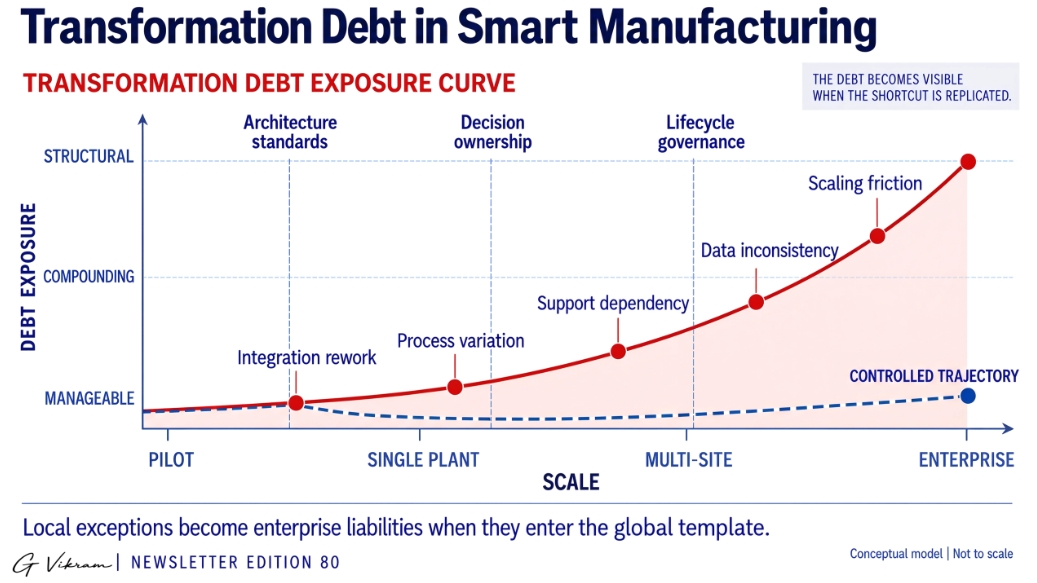 The most dangerous debt in a smart factory isn’t financial.