Aug03
Boards have been governing judgment for a century. Every officer who signs a contract, every manager who approves a budget, every banker who approves a loan is exercising judgment on the company's behalf. We built a full apparatus to oversee it: ledgers that record what happened, budgets that bound what may happen, approval matrices that say who decides what, and auditors who verify all of it.
That apparatus was built around capital allocation, because capital was where consequential judgment left a trail.
The age of AI changes exactly one thing, and it is a big one: consequential judgment has moved into software.
An AI system that approves loan applications or screens candidates is not a tool the way a spreadsheet is a tool. It exercises discretion. It makes decisions. It is, functionally, a new kind of employee — one that never sleeps, cannot be deposed, and can be replicated ten thousand times overnight.
Here is the reassuring part: the values do not change. Fairness, accuracy, transparency, accountability are the same principles you already apply to people.
What changes is enforcement. A person is reviewed quarterly. A machine making ten thousand decisions an hour has produced a quarter's worth of activity before lunch.
The practical work comes down to nine artifacts, and every one of them is something you already run for capital allocation. An AI inventory is your asset register. A decision log is your general ledger. Deployment gates are capital approval. Independent assurance is internal audit.
Capital allocation has a ledger, a budget, an approval matrix, and an auditor. Judgment now needs the same.
Read the full article here: https://www.oaktrussgroup.com/post/why-responsible-ai-is-the-corporate-governance-you-already-trust-just-extended.
By Steven Hill
Keywords: AI, Cybersecurity, AI Governance
 Best Supply Chain AI Tools in 2026: SCM SENSEI AI and Ask Lora Compared
 Making Silos Permeable
 The Corix Partners Friday Reading List - October 2, 2026
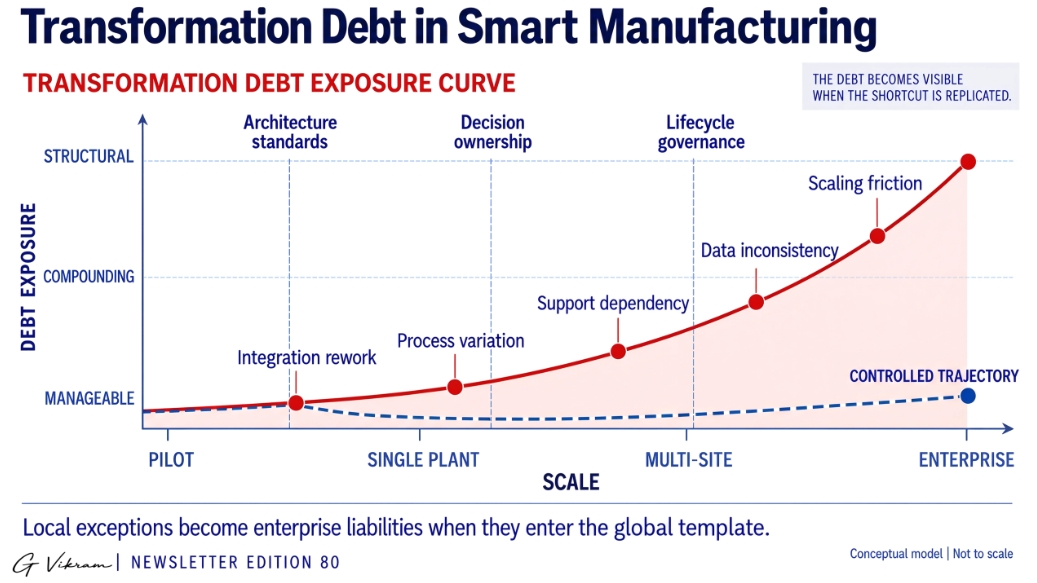 The most dangerous debt in a smart factory isn’t financial.
 Why mission changes everything, leadership lessons from two boardrooms