You've reached your limit for this session. Upgradefor2questions per session /5monthly and deeper insights.
Upgrade for more features
Unlock investment topics functionality via joining any of our paid plans.
Upgrade for more features
Unlock access to Thinkers360 AI to fast-track your search for analysts and influencers.
This feature is available for Enterprise Lite and Enterprise Members Only.
Upgrade for more features
Upgrade to create your own analyst relations newsroom and interact with over 10K B2B analysts and influencers on Thinkers360.
Upgrade for more features
Unlock all social handles for all members via joining any of our paid plans.
Upgrade for more features
Gain a competitive edge with full Company Rankings. Available onEnterpriseandEnterprise Lite.
Unlock Full Rankings
You have been temporarily restricted. Please be more thoughtful when adding content for your portfolio. Your portfolio and digital media kit and should be reflective of the professional image you wish to convey. Accounts may be temporarily restricted if we receive reports of spamming or if the system detects excessive entries.
Publish your original ideas on the Thinkers360 platform!
This feature is available for Pro and Pro-Plus Members Only.
Upgrade for more features
Speaker Bureau functionality whereby individuals can be featured speakers within our Speaker Bureau service and enterprises can find and work with speakers.
This feature is available for Pro, Pro-Plus, Premium and Enterprise Members Only.
Upgrade for more features
Highlight your featured products and services within our company directory for enhanced visibility to active B2B buyers worldwide.
This feature is available for Pro, Pro Plus, Premium and Enterprise Members Only.
Upgrade for more features
You’ve reached your limit for this feature.
Upgrade for more features
Publish on the Web’s #1 Thought Leadership Blog.Join the elite. Ranked the top thought leadership blog by Feedspot (2021–2025), Thinkers360 offers you more than just a platform - it offers authority. Share your insights with our community and tap into a combined network of over 100M followers through our peer-to-peer marketplace.
Upgrade to Publish & Scale Your Reach
You’ve reached your daily limit for entering quotes. Please only add personally-authored content which is reflective of your digital media kit and thought leadership portfolio.
For full access to the Thinkers360 content library, please join ourContent Planor become a contributor by posting your own personally-authored content into the system viaAdd PublicationorImport Publication.
Unlock your personalized dashboard including metrics for your member blogs and press releases as well as all the features and benefits of our member plans!
Upgrade for more features
ExploreFeatures & BenefitsPage
Aug02

Senior professionals spend years developing expertise, managing complex responsibilities, leading teams and contributing to organisational performance. As their careers progress, they are expected to demonstrate stronger judgement, communicate with greater authority and make decisions that influence people, resources and business outcomes.
What receives far less attention is how that capability is understood by others.
An executive may possess extensive knowledge and still be perceived as operational rather than strategic. Another may deliver strong results but struggle to communicate with enough clarity or confidence to be taken seriously in senior discussions. A third may be respected within one organisation but remain almost unknown outside it.
The issue is not always capability. In many cases, it is positioning.
Executive positioning is the cumulative way an executive or senior professional is understood by the people whose perceptions influence their credibility, authority and access to opportunity.
It is shaped by what they know, how they think, the decisions they make, the way they communicate, the results they produce, the relationships they develop and the ideas with which they become associated.
It includes personal branding, visibility and reputation, but it is broader than any one of them. Personal branding influences how a professional presents their value. Visibility determines whether they are seen. Reputation reflects what others have come to believe about them. Executive positioning is the overall place they occupy in the minds of the people evaluating them.
Are they knowledgeable? Can they make difficult decisions? Do they understand the wider business? Can they communicate complex issues clearly? Would people trust them with greater authority?
The answers determine whether an executive is regarded as credible, strategic and ready for greater responsibility.
Inside an organisation, colleagues understand the context surrounding an executive’s work. They observe the decisions made, the problems solved and the value created.
Outside that environment, most of this context disappears.
Recruiters, board members, clients and industry peers must rely on the signals available to them, including career history, documented outcomes, professional relationships, published thinking and the clarity with which the executive’s value can be explained.
When those signals are weak, capable professionals may be misunderstood before their capability is properly evaluated.
One consequence is missed opportunity.
Many senior appointments and board opportunities begin through private discussions, search firms and professional networks. Spencer Stuart reports that new directors represent less than ten per cent of directorships in a typical year. It also notes that, by the time a candidate is contacted, their background and capabilities have usually already been assessed. The subsequent process focuses heavily on the value they can add and how effectively they will operate in the boardroom.
In these environments, a poorly positioned executive may not be rejected after consideration.
They may never enter the consideration set.
A second consequence is being viewed too narrowly.
A marketing executive may be seen primarily as someone who manages advertising despite influencing customer growth and transformation. A finance leader may be associated with reporting and controls while their contribution to strategy and risk remains less visible. A human resources executive may be recognised for people processes but not organisational design or enterprise performance.
The strategic contribution may already exist.
The positioning has failed to communicate its full relevance.
This can leave capable professionals responsible for executing decisions without being invited to shape them.
A third consequence is reduced credibility as a decision-maker.
Senior leadership rarely provides complete information. Executives must evaluate uncertainty, balance competing interests and make choices whose outcomes cannot be guaranteed. A knowledgeable professional who repeatedly avoids taking a position, delays decisions or communicates with excessive uncertainty may be perceived as unready for greater responsibility.
Research on executive presence continues to identify gravitas and communication as central to how senior leadership readiness is assessed. The Center for Creative Leadership also identifies credibility gaps, stakeholder trust and visibility as recurring challenges for senior leaders.
Decisiveness does not mean acting without consultation. It means knowing when sufficient information exists, making a reasoned choice and accepting responsibility for the outcome.
A fourth consequence is that experience becomes generic.
Executives frequently describe themselves as strategic, transformational, innovative or results-driven. These descriptions may be accurate, but they communicate little without evidence.
A leader positioned around growth should be able to explain how growth was created. A transformational executive should be able to identify what changed, why it mattered and what outcomes followed.
Without that evidence, seniority is visible but distinction is not.
A fifth consequence is dependence on the employer’s reputation.
A respected organisation creates immediate credibility. However, it can also create borrowed positioning in which the company is recognised but the executive’s individual contribution remains unclear.
When the professional leaves, the market may know where they worked without understanding what they stood for, what value they created or what problems they can solve.
Poor positioning can also reduce influence.
Modern executives are expected to interpret change, explain complexity and contribute a point of view. Research from Edelman and LinkedIn found that decision-makers use thought leadership to assess the calibre of thinking behind an organisation, particularly when direct experience is unavailable. Although the research concerns B2B buying rather than executive recruitment, it reflects a wider behaviour: when people cannot observe expertise directly, they look for credible evidence of thinking.
When leaders contribute no visible perspective, others have less evidence through which to assess their judgement.
These patterns create what can be described as the executive positioning gap.
The executive positioning gap is the difference between the value a senior professional is capable of creating and the value relevant stakeholders can clearly recognise.
The larger the gap, the greater the likelihood that the executive will be underestimated, misunderstood or overlooked.
The gap may exist because an executive has deep expertise but communicates it poorly. They may produce significant results but fail to document their contribution. They may be respected internally but unknown externally. They may be highly visible but lack enough substance to support that visibility. They may communicate confidently while behaving in ways that weaken trust.
Not every positioning problem can be solved through better presentation.
A polished biography cannot compensate for weak judgement. Visibility cannot compensate for outdated knowledge. Thought leadership cannot compensate for an absence of results. Confidence cannot compensate for poor character.
Strong executive positioning requires both substance and signal. The executive must possess genuine value and make that value clear enough for others to recognise.
Closing the gap requires strengthening executive capability and making that capability easier for relevant stakeholders to understand.
The first step is deciding what the executive should be known for.
A title identifies a role. It does not explain professional distinction.
Effective positioning clarifies the problems the executive is equipped to solve, the environments in which they create value and the perspective they bring to important business challenges.
This does not require reducing a complex career to a narrow label. It requires identifying the consistent thread that makes the executive’s value understandable.
Executives must remain knowledgeable within their discipline while understanding the wider business.
They should be able to connect their function to customers, revenue, profitability, risk, technology, people and strategy.
This is especially important for professionals who are seen as functional rather than strategic. Broader knowledge allows them to contribute beyond implementation and participate credibly in enterprise decisions.
Experience describes what has already been accumulated.
Knowledge must remain current.
Executives are ultimately positioned by the quality of their decisions.
Strong judgement involves identifying what matters, recognising trade-offs and understanding when further analysis will improve a decision and when it will simply delay it.
Decisive leaders recognise which decisions require consultation, which require more evidence and which have already been discussed long enough. They also explain their reasoning, allowing others to evaluate the quality of the thinking behind the outcome.
Executive communication should reduce uncertainty.
Senior professionals must explain complex issues clearly, adapt their message to different audiences, listen carefully and state their position without unnecessary ambiguity.
The Center for Creative Leadership describes communication as a foundational leadership skill because it builds trust, creates alignment and supports better outcomes. It also stresses that words and behaviour must remain consistent.
Authority does not require volume or aggression.
It is created through preparation, precision and composure.
Responsibilities explain what an executive was expected to do.
Evidence demonstrates what happened because they did it.
Executives should communicate the scale of their responsibilities, the problems addressed, the decisions made, their personal contribution and the outcomes achieved.
This may include growth influenced, costs reduced, risks mitigated, customer outcomes improved, markets entered, teams developed or organisational capabilities created.
The objective is not to reduce leadership to numbers. It is to make leadership value easier to evaluate.
Executives should not depend entirely on the visibility of their employer.
They can strengthen their independent reputation through useful articles, research, speaking, mentoring, professional associations and meaningful industry participation.
The purpose is not personal celebrity. It is to ensure their expertise, judgement and contribution can be recognised separately from the organisation they represent.
Thought leadership is useful only when it reveals substance. High-quality contribution should clarify a problem, challenge an assumption or help others think more effectively.
Strong positioning requires exposure to the people who influence opportunity.
Executives should maintain accurate professional information, participate in credible networks and develop relationships with peers, recruiters, board communities, industry bodies and other relevant stakeholders.
The objective is not to be visible everywhere.
It is to be visible where their expertise is useful.
Relationships provide context that profiles cannot. They allow others to observe judgement, reliability and character over time.
Every external claim must be supported by conduct.
An executive cannot credibly position themselves as decisive while avoiding difficult choices, collaborative while taking credit for the work of others, or principled while avoiding accountability.
Communication may establish an expectation.
Behaviour confirms or destroys it.
Executive positioning is sometimes dismissed as self-promotion because it involves visibility, communication and reputation.
That interpretation overlooks its practical purpose.
Executive positioning helps other people understand the value a senior professional is capable of creating. It allows recruiters to recognise where an executive may fit, boards to understand what perspective a potential director may contribute and colleagues to see whether a functional specialist can operate at enterprise level.
The objective is not to make executives appear more capable than they are.
It is to ensure that genuine capability is not hidden behind vague titles, generic descriptions, weak communication or an overreliance on the reputation of an employer.
Closing the executive positioning gap requires more than improving an online profile.
Executives must define what they should be known for, build enterprise-level knowledge, exercise sound judgement, communicate with authority, translate experience into evidence, develop an independent reputation, create relevant visibility and behave consistently with the position they hope to occupy.
The strongest executive positioning does not create value that does not exist.
It makes existing value easier to recognise.
Capability determines what a leader can contribute.
Executive positioning determines whether the people who matter can clearly understand it.
Keywords: Leadership, Personal Branding, Careers
 Best Supply Chain AI Tools in 2026: SCM SENSEI AI and Ask Lora Compared
 Making Silos Permeable
 The Corix Partners Friday Reading List - October 2, 2026
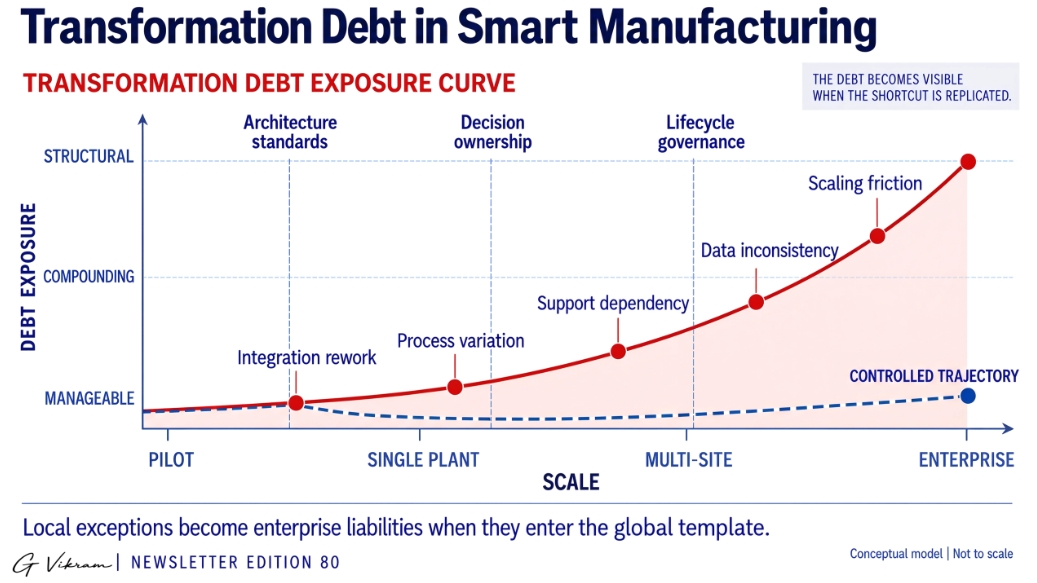 The most dangerous debt in a smart factory isn’t financial.
 Why mission changes everything, leadership lessons from two boardrooms