Jul03
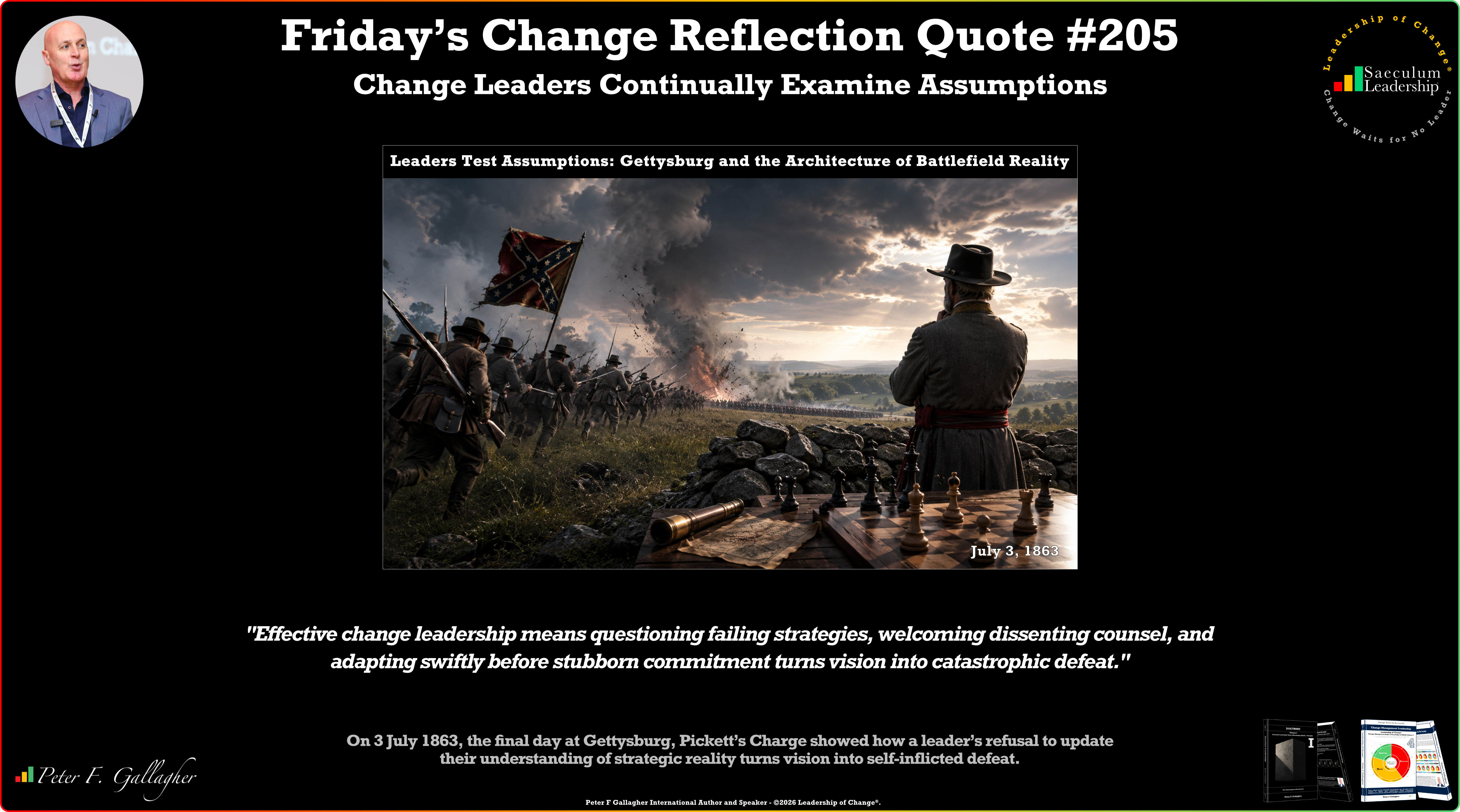
On 3 July 1863, the final day at Gettysburg, Pickett’s Charge showed how a leader’s refusal to update their understanding of strategic reality turns vision into self‑inflicted defeat. The Battle of Gettysburg, fought across three days in Pennsylvania from 1 to 3 July 1863, stands as the largest battle ever fought in North America and is widely regarded as the turning point of the American Civil War. By the third day, Confederate General Robert E. Lee had already launched two days of costly assaults against Union positions without achieving a decisive breakthrough. Union forces, commanded by Major General George Meade, held a strong, consolidated defensive position along Cemetery Ridge, firmly established rather than heavily entrenched in the modern sense.
On the afternoon of 3 July, Lee ordered a massed infantry assault against the centre of the Union line, an attack that became known as Pickett's Charge, named after Major General George Pickett, one of the divisional commanders who led it. Approximately twelve thousand five hundred Confederate soldiers advanced across nearly a mile of open ground under sustained Union artillery and rifle fire. Lieutenant General James Longstreet, one of Lee's most trusted subordinates, had voiced serious reservations about the assault beforehand, believing the ground and Union strength made it unlikely to succeed.
The charge failed within an hour, with Confederate forces suffering losses estimated at over fifty per cent of those who took part. The following day, Lee was forced to withdraw his army from Pennsylvania and retreat towards Virginia, marking the end of the Confederacy’s most ambitious northern offensive. Gettysburg as a whole produced more than fifty thousand combined casualties, making it the bloodiest battle of the war.
The events of that afternoon continue to be studied as a moment where established assumptions about tactics, terrain and enemy strength collided with a rapidly changing battlefield reality. This makes it a rich reference point for examining how leaders assess conditions, weigh dissenting counsel and decide when to act.
Pickett's Charge endures as one of history's clearest examples of a leader committing to a strategy after the strategic reality had already shifted against it. Its significance lies not simply in the scale of the loss, but in the widening gap between an original plan and the conditions unfolding on the battlefield. Great failures seldom arise from a lack of courage. They arise because courage, without continual reassessment of reality, becomes a liability rather than a strength The event remains a powerful reference point for understanding judgement under pressure, the value of dissenting counsel and the danger of failing to re-examine assumptions. It stands as a defining Saeculum Leadership Signal where outdated assumptions crossed the point of irreversible consequence.
Change Leadership Lessons: History repeatedly shows that failure rarely begins with the absence of intelligence. It begins when leaders stop testing their assumptions against changing reality. Leaders of change must continually test their assumptions against shifting conditions, rather than defending a plan formed before circumstances changed. They benefit from listening carefully to trusted advisers who raise doubts, since dismissing dissent removes a valuable opportunity to reconsider a flawed course. Change leaders should resist continuing an approach simply because considerable resources have already been committed to it. They require accurate and timely information so decisions reflect present reality rather than assumptions formed earlier. Leaders of change who acknowledge responsibility openly after failure help preserve trust and allow their organisation to learn and recover. Change Leaders Continually Examine Assumptions.
“Effective change leadership means questioning failing strategies, welcoming dissenting counsel, and adapting swiftly before stubborn commitment turns vision into catastrophic defeat.”
Application - Change Leadership Responsibility 3: Intervene to Ensure Sustainable Change. Pickett's Charge offers a lasting lesson for the responsibility to intervene once a plan has been overtaken by changing circumstances. Sustainable change depends on leaders recognising the moment when a strategy, however carefully prepared, no longer matches the reality unfolding in front of them. Continuing regardless of that mismatch converts confidence into vulnerability. Change leaders face a recurring test: distinguishing between commitment worth defending and commitment that has become a liability. Within organisations, this often surfaces when familiar plans, legacy approaches or long-held assumptions are protected long after evidence shows they are misaligned with present conditions or strategic intent.
Where intervention is delayed, resistance to reconsideration tends to harden. Dissenting views are sidelined, information flow narrows, and leadership becomes increasingly detached from conditions on the ground. Once the consequences of that detachment become visible, the opportunity to change course has frequently already passed.
Genuine intervention begins when leaders recognise that evidence now outweighs commitment to the original plan. Leaders of change must be willing to pause or redirect committed plans, weigh dissenting counsel seriously and adjust before losses become irreversible. Acting decisively, ahead of mounting cost, is what keeps sustainable change achievable rather than merely aspirational.
Final Thoughts: Across successive Saeculum cycles, Pickett's Charge demonstrates that institutions rarely decline because they lack plans. They decline because leaders continue executing yesterday's assumptions after today's reality has already changed. Artificial intelligence now provides continuous visibility into emerging conditions, exposing changing patterns faster than any previous generation of leaders could observe. Yet technology can reveal the signals. Only leadership chooses whether to act. Leaders must deliberately revisit assumptions, encourage informed dissent and continually test strategy against present reality so commitment never outlives the evidence that once justified it.
Peter F. Gallagher, a 20‑book author, consults, speaks, and writes on Saeculum Leadership® and Leadership of Change®. He works exclusively with boards, CEOs, and senior leadership teams to prepare and align them to effectively and proactively lead their organisations through transformation in a rapidly evolving epoch.
For insights on navigating organisational change, feel free to reach out at Peter.gallagher@a2B.consulting.
Further Reading: Change Management Leadership® - Leadership of Change® Volume 4 and Saeculum Leadership®: Doctrine – Volume I.
Peter F. Gallagher, a 20‑book author, consults, speaks, and writes on Saeculum Leadership® and Leadership of Change®. He works exclusively with boards, CEOs, and senior leadership teams to prepare and align them to effectively and proactively lead their organisations through transformation in a rapidly evolving epoch.
For further insights please visit our websites: https://www.a2b.consulting https://www.peterfgallagher.com Amazon.com: Peter F Gallagher: Books, Biography, Blog, Audiobooks, Kindle
Saeculum Leadership® Body of Knowledge (SLBoK): Volumes 1-10.A-E & I-V
~ Leadership of Change® Volume 1 - Change Management Fables
~ Leadership of Change® Volume 2 - Change Management Pocket Guide
~ Leadership of Change® Volume 3 - Change Management Handbook
~ Leadership of Change® Volume 4 - Change Management Leadership
~ Leadership of Change® Volume 5 - Change Management Adoption
~ Leadership of Change® Volume 6 - Change Management Behaviour
~ Leadership of Change® Volume 7 - Change Management Sponsorship
~ Leadership of Change® Volume 8 - Change Management Charade
~ Leadership of Change® Volume 9 - Change Management Insanity
~ Leadership of Change® Volume 10 - Change Management Dilenttante
~ Leadership of Change® Volume A - Change Management Gamification - Leadership
~ Leadership of Change® Volume B - Change Management Gamification - Adoption
Keywords: Business Strategy, Change Management, Leadership
 Two Clocks, One Truck: The Army's Need for Speed Meets New Defense Sourcing Rules
 Sustainable Transformation: The Elephant and The Mouse In The Room
 The Price of Standing Alone: Strategic Autonomy in a World Where Nobody Can Do It Alone
 The Potter’s Hands: Why Great Leaders Shape Environments, Not People
 The Corix Partners Friday Reading List - October 16, 2026