Jul21

SPONSORED POST
Customer service in the UK has felt like an uphill battle lately. From having to wait forty minutes to speak to a broadband provider to having to navigate through three different departments just to track a parcel, the crisis facing the UK's customer service standards is not an exaggeration, but a reality. In fact, research conducted by the Institute of Customer Service found that service failure is costing UK businesses billions of pounds every month, yet customer satisfaction levels are not rising. We’ve all been there, stuck on hold listening to the likes of “your call is important to us.”
But change is finally afoot. Firms all over Britain are ditching the clunky, old-fashioned telephone menu systems for something much more user-friendly, such as integrating conversational AI for customer support. AI-driven voice agents are being used to answer customer questions in a matter of seconds, not hours. This is not just about machines answering phones. This is about creating a system that actually understands what you need when you say it. It’s a move away from queuing and back to your day, and it’s all happening a lot quicker than we think.
We’re all familiar with the classic IVR (Interactive Voice Response) system, where you press 1 for this, 2 for that, and by the time you press 5, you’ve forgotten what you’re even calling for! These were designed for the convenience of the business, not the customer. It’s a filtering system, meant to keep people away from the expensive human support staff, not actually help them.
But conversational AI turns the tables. Instead of pressing buttons, you simply talk or type naturally. And because of this, the technology uses natural language processing, the AI can actually understand the nuance of what you’re really asking. For example, if you say, My internet has been patchy since the storm last night, the AI won’t be searching for the word ‘internet'; it’ll be understanding the intent, the context, and the actual service being requested. It’s not like talking to a machine at all. It’s like having a quick chat with a helpful assistant.
The current crisis facing the customer service sector of the UK has been a culmination of a number of factors. For instance, the current cost of living has meant that consumers have become more value-conscious, and when we spend our hard-earned cash, we expect the service to match the value for money spent. In recent times, it has been reported that almost half of the consumers of the UK have had a poor service experience in the last year, and this has not been a mere nuisance but a systemic failure that has led to service fatigue.
Lack of staffing has also contributed to this problem. Call centers are notorious for being stressful workplaces, and this has led to a high turnover rate. This is where AI comes in, not to replace humans, but to act as a buffer. While AI can handle the 70% of the calls that are routine, such as password resets, tracking updates, and billing questions, humans can focus on the complex, emotionally charged issues that require a real person’s empathetic skills.
You might wonder if all of this is purely theoretical. Well, it’s not. Take a look at companies like Klarna or various utility providers in the UK. These are companies that are currently using AI-based agents to facilitate hundreds of thousands of conversations a year. And the statistics are often pretty staggering, with a 50% improvement in resolution rates without needing to hire a single additional employee.
Here’s what you can benefit from by utilizing AI-driven voice agents in addition to human agents in your customer support team:
This level of efficiency is what will eventually lead to the death of the hold music culture. When a system can authenticate your identity using voice biometrics and process a refund in the time it would have taken a human to simply find your account, the crisis suddenly looks like an opportunity for a complete reboot.
There's a fear that AI will make the customer service experience soulless and robotic. But the reality is the opposite. When the human on the other end isn’t exhausted from answering the same five questions five hundred times a day, they’re actually much better at their job. They’re patient, they’re listening, they’re actually helping.
The goal of AI isn’t to replace humans; it’s to make sure that when you do finally get a human on the phone, they already have all the context. They know who you are, they know what you’ve tried, they know exactly why you’re calling. There’s no need for them to say, ‘Please hold while I check your records.’ The records are already checked. The human agent is ready to be a human again.
It’s easy to be cynical about new tech, and we have all been put off at some point in the past by some dumb chatbot. However, this new generation of chatbots is a far more sophisticated beast. They’re faster and far more helpful. The promise of No More Hold Music isn’t just a catchy headline; it’s the blueprint to fix the system.
The next time you need to change a flight or report a missed delivery, you might find yourself pleasantly surprised. And when that happens, you’ll know that the crisis is finally starting to fade.
Keywords: AI, Customer Experience
 "The AI may in fact be conscious." Really?
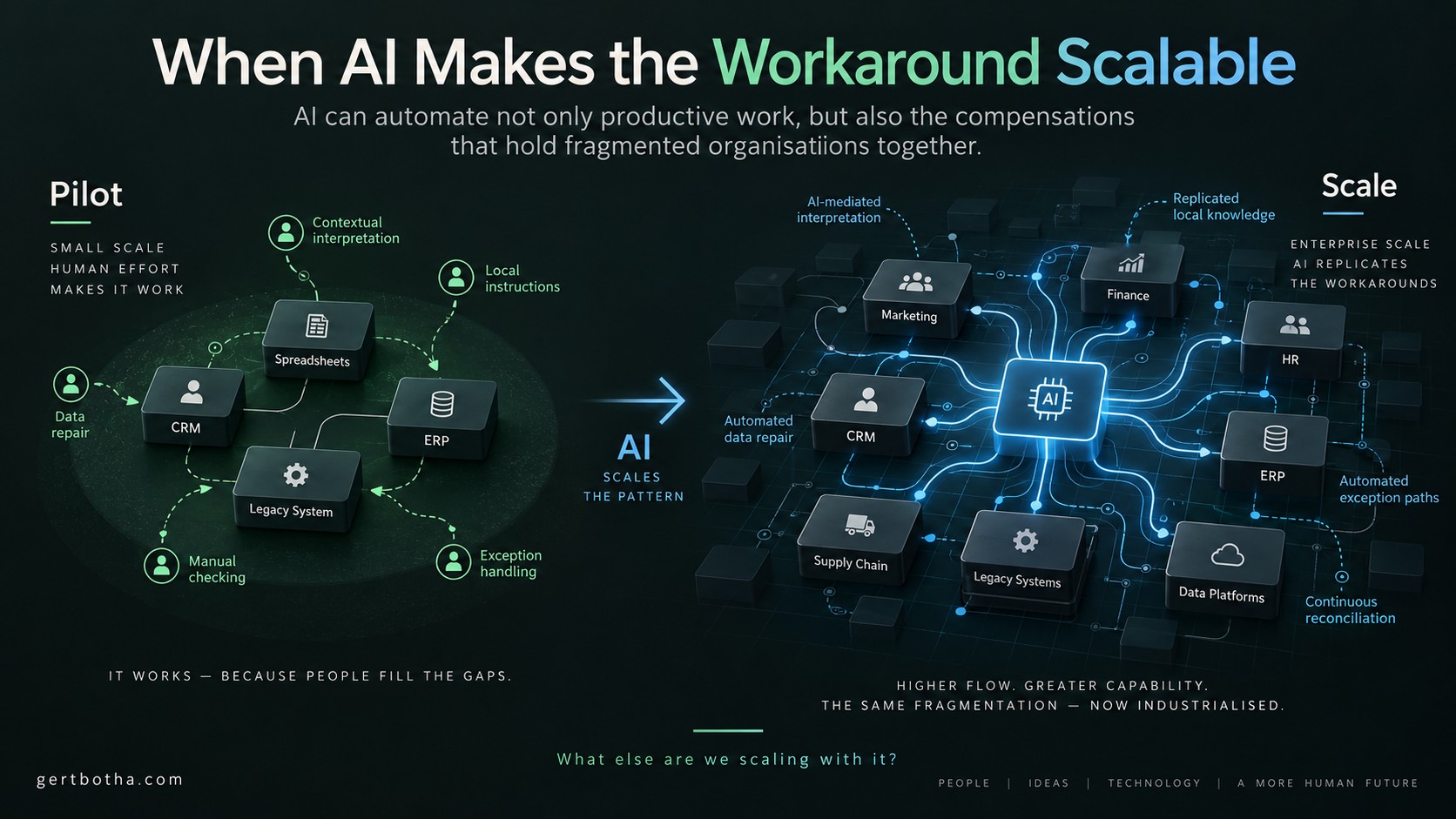 When AI Makes the Workaround Scalable
 The Age of Continuous Shocks: Why the coming downturn will be decided in your supply chain
 Friday’s Leader Reflection Quote – Saeculum Leadership Leaders Accept Decisions Create Responsibilities
 The Corix Partners Friday Reading List - October 9, 2026