Jul21
One piece of advice has survived almost every enterprise sales methodology: dig deeper.
Whether you follow SPIN Selling, Challenger, MEDDPICC or even the 5 Whys, the message is remarkably consistent. Don’t stop at the first problem the customer mentions. Ask better questions. Understand the implications. Keep exploring until you reach the root cause.
I couldn’t agree more.
Those methodologies have shaped how I approach customer conversations, and they remain some of the most valuable tools in enterprise sales. Over the years, however, I found myself facing a different challenge. It wasn’t whether I should dig deeper. It was knowing where to look next.
Enterprise problems rarely reveal themselves in a straight line. Different stakeholders describe the same situation through different lenses. Finance sees one issue. Operations sees another. Leadership often talks about something else entirely. None of them are wrong. They are simply looking at the same problem from different perspectives.
That realization changed the way I approached customer discovery.
Oddly enough, the first lesson had nothing to do with sales.
When I was in Grade 8, wearing glasses suddenly became fashionable in school—or at least that’s how it seemed to me. I thought they made people look smarter, and naturally, I wanted a pair.
There was only one problem : My eyesight was perfectly fine.
So I started telling my father that I couldn’t clearly read what was written on the classroom board. After repeating the story often enough, he took me for an eye test. A short while later, I walked out proudly wearing my first pair of glasses.
Looking back, I probably deserved an Oscar.
Thankfully, enterprise customers don’t invent problems the way I did. Their challenges are genuine. What is often incomplete is the explanation behind those challenges. People naturally describe the symptoms they experience every day because that’s what affects them most. That doesn’t necessarily mean they’ve identified the underlying business problem.
Years later, I would see the same pattern repeatedly in enterprise sales.
Much of my career has been in the telecom industry, where customer meetings often begin with technical discussions. The conversation revolves around network coverage, capacity, latency, dropped calls or service quality. Listening to the first few minutes, it would be easy to conclude that the customer simply needs a technical solution.
As more people join the discussion, however, the picture starts to change.
Operations explains that manual processes are slowing service delivery. Finance highlights rising operating costs. Senior management talks about customer retention, competitive pressure or commitments already made to the board. Suddenly, the network is no longer the centre of the conversation. It is simply where the symptoms became visible.
The technology wasn’t the business problem. It was where the business problem first appeared.
That distinction changed how I listened during customer conversations. Instead of trying to validate the first pain I heard, I started asking myself a different question.
What am I not seeing yet?
Most diagnostic techniques are designed to help us go deeper. They encourage us to build one question on top of another until we reach the underlying cause.
That approach works well when the problem follows a single chain of cause and effect.
Enterprise organisations rarely work that way.
Large organisations are complex systems where strategy, finance, operations and people constantly influence one another. A decision that appears technical may actually be driven by commercial priorities. A budget issue may exist because of a strategic initiative. Resistance to change may have nothing to do with technology and everything to do with organisational incentives.
The challenge is not simply digging deeper.
The challenge is knowing which direction deserves your attention next.
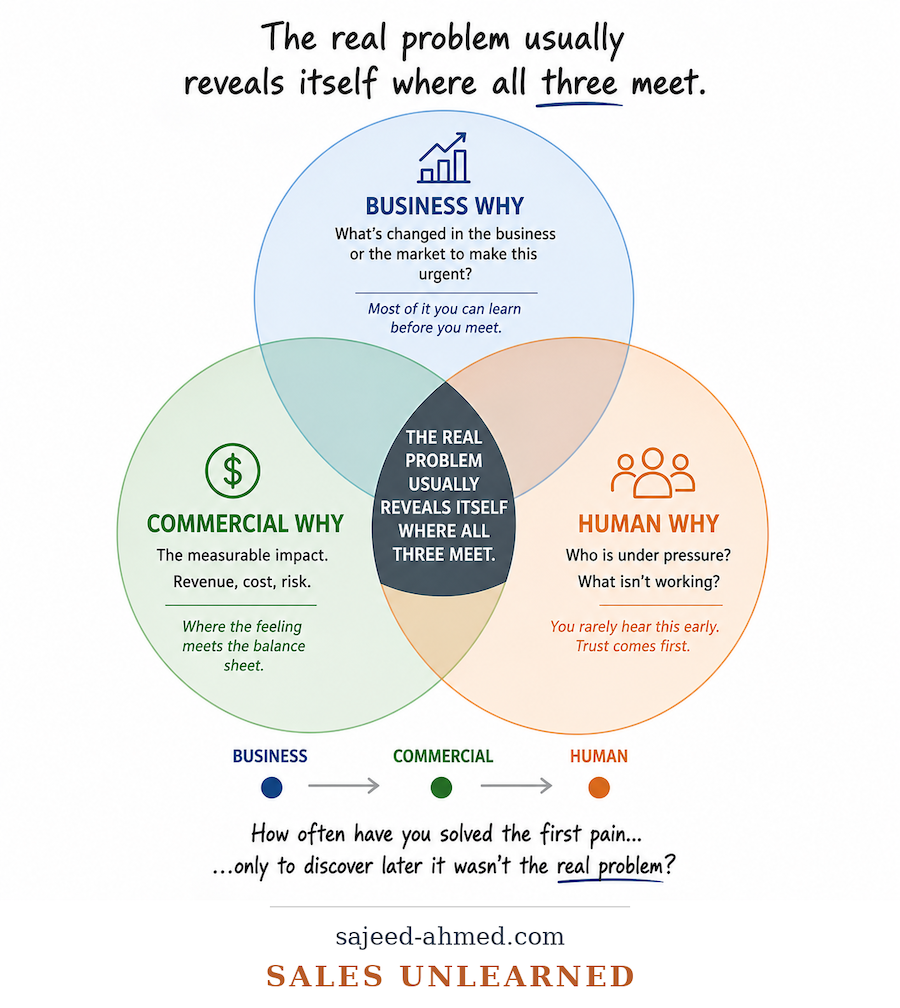
Over time, I realised I was naturally exploring every customer conversation through three different perspectives. I wasn’t consciously following a framework. I was simply trying to understand the complete picture before discussing solutions.
The first perspective is the Business Why.
I want to understand what has changed in the organisation or the market that made this initiative important now. Has a competitor entered the market? Is there a regulatory change? Has the company announced a new strategy, acquisition or product launch? Has customer behaviour shifted?
Many of these answers are available before the first meeting through annual reports, investor presentations, earnings calls and industry news.
Understanding the business context allows every subsequent question to become more meaningful.
The second perspective is the Commercial Why.
Every enterprise initiative eventually has a financial consequence. Revenue, cost, productivity, operational efficiency, customer retention, risk or time-to-market all influence investment decisions.
One question often reveals far more than technical discussions ever can : What happens if nothing changes?
That is usually where the conversation shifts from operational concerns to business value. It is where the feeling meets the balance sheet.
The final perspective is the Human Why.
Every significant enterprise decision affects people. Someone owns the outcome. Someone is accountable for success. Someone is frustrated by the current process. Someone has committed to a delivery date. Someone is protecting their reputation.
These motivations rarely appear during the first meeting. They emerge only after trust has been established, yet they often explain why projects move quickly, stall unexpectedly or fail despite having strong technical and commercial justification.
Ignoring the human dimension often leaves an important part of the story undiscovered.
Most customer conversations begin inside one of these perspectives.
A technical manager usually starts with operational issues. Finance starts with commercial concerns. Senior leadership often begins with strategic priorities.
As conversations continue, the other perspectives gradually emerge. The strategic initiative explains why the project exists. The commercial impact explains why investment is justified.
The human factors explain why progress is easy, or difficult.
Individually, each perspective tells part of the story. Together, they explain the problem the organisation is actually trying to solve.
After two decades in engineering, operations and enterprise sales, I’ve come to appreciate that diagnosis is rarely about asking more questions. It is about asking questions from different perspectives.
Existing sales methodologies already teach us to dig deeper, and I believe they should continue to do so. The lesson that experience taught me is slightly different.
When one line of questioning has taken you as far as it can, don’t just keep digging the same hole. Look somewhere else. The next insight may not be deeper. It may simply be in a different dimension.
Because in enterprise sales, the real problem often sits where the Business Why, the Commercial Why and the Human Why finally come together.
By Sajeed Ahmed
Keywords: Business Strategy, Sales, Telecom
 "The AI may in fact be conscious." Really?
 When AI Makes the Workaround Scalable
 The Age of Continuous Shocks: Why the coming downturn will be decided in your supply chain
 Friday’s Leader Reflection Quote – Saeculum Leadership Leaders Accept Decisions Create Responsibilities
 The Corix Partners Friday Reading List - October 9, 2026