




I work with new-gen founders and technical domain experts who feel awkward about sales.
I help them build a simple, trust-first sales system: clear positioning, better discovery, and consistent prospecting — without “sales voice.”
I bring 20+ years across telecom engineering, service delivery, and enterprise sales, so I teach practical sales that feels honest and repeatable.
Author of Sales Unlearned.
Available For: Advising, Consulting
Travels From: Muscat
| Sajeed Ahmed | Points |
|---|---|
| Academic | 5 |
| Author | 85 |
| Influencer | 15 |
| Speaker | 0 |
| Entrepreneur | 20 |
| Total | 125 |
Points based upon Thinkers360 patent-pending algorithm.

Tags: Business Strategy, Leadership, Sales
 Beyond AI Sales
Tags: AI, Future of Work, Sales
 Enterprise Sales Isn’t What You Think
Tags: Business Strategy, Cloud, Sales
 There Is No Framework.
Tags: Business Strategy, Customer Experience, Sales
 Right Until It Wasn't.
Tags: Construction, Leadership, Sales
 Stop Fearing The No
Tags: Cloud, Customer Experience, Sales
 Relationships Break Before You Notice
Tags: Change Management, Culture, Leadership
 Curiosity With an Agenda Is Not Curiosity
Tags: Business Strategy, Cloud, Sales
 The Sales Conversation Breaker
Tags: Business Strategy, Cloud, Sales
 Excitement Is Not Commitment
Tags: AI, Cloud
 Sales Isn’t Where Reputation Starts. It’s Where Reputation Gets Tested
Tags: Cloud, Sales
 Sales Felt Uncomfortable at First
Tags: Cloud, Sales
 If you can’t explain it to yourself, you can’t sell it to anyone
Tags: Cloud, Sales
 If your buyer needs a translator, you’re losing deals.
Tags: Analytics, Business Strategy, Sales
 Do your words clarify, or decorate?
Tags: Analytics, Business Strategy, Sales
 The Buyer Has the Info. You Need the Insight.
Tags: Analytics, Business Strategy, Sales
 A Proposal Is a Promise
Tags: Analytics, Business Strategy, Sales
 When “No” Becomes the Start
Tags: Cloud, Sales
 The Right Words, Wrong Room
Tags: Analytics, Business Strategy, Sales
 The Trust Leak That Erodes Credibility
Tags: Cloud, Sales
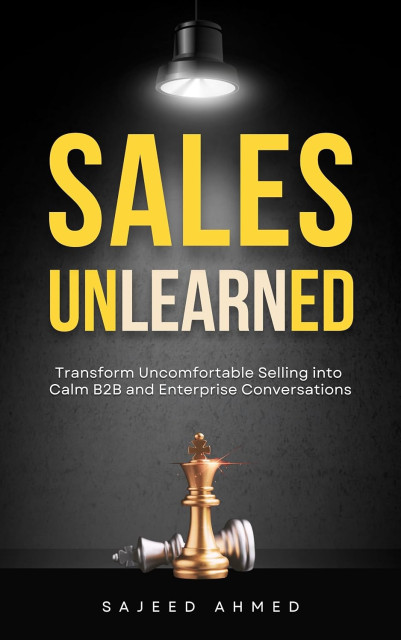 Sales Unlearned
Tags: Business Strategy, Sales
 Polaris Wireless
Tags: Business Strategy, Cloud, Sales
 Ericsson
Tags: Business Strategy, Cloud, Sales



 The Intelligence Comes from Mathematics: Why AI Engineering Is More Than an LLM Wrapper
There is one question I hear almost every time someone demonstrates an AI application. It doesn’t matter whether the application is generating reports, analysing contracts, coaching employees or answering customer questions. Within a few minutes, someone asks, “Which LLM are you using?”
It is a perfectly reasonable question. Large Language Models have transformed artificial intelligence and made AI accessible to millions of people. They have become the public face of modern AI, so it is natural that many people associate the quality of an AI application with the model behind it.
The problem is that the discussion often ends there. It creates the impression that if two organisations use the same LLM, they should achieve similar results. According to McKinsey’s Superagency in the Workplace report, only 1% of organisations believe they have reached AI maturity (Reference: McKinsey – Superagency in the Workplace (2025), despite widespread investment in artificial intelligence. If selecting the right language model were the biggest challenge, that number should be much higher. Clearly, something else separates an impressive AI demonstration from an AI system that consistently delivers business value.
ChatGPT deserves enormous credit for changing how the world thinks about artificial intelligence. It introduced AI to millions of people who had never interacted with machine learning before and demonstrated capabilities that previously felt like science fiction. For many organisations, it became the catalyst for exploring AI projects seriously.
However, artificial intelligence did not begin with ChatGPT, nor did it begin with prompts. Long before Large Language Models became mainstream, organisations were already using AI to detect fraud, recommend products, optimise supply chains, recognise speech, analyse medical images and predict equipment failures. These systems rarely attracted public attention, but they quietly solved real business problems every day.
Generative AI has expanded what machines can do, but it has also unintentionally narrowed how many people think about AI. Today, it is common to reduce an AI application to a prompt and an LLM. That is like judging a modern aircraft solely by the cockpit instruments and displays while ignoring the aerodynamics, engines, flight controls and navigation systems that actually keep it in the air.
While building DealCraft, an AI platform for evaluating enterprise sales conversations, I deliberately started with the Large Language Model. Like many AI engineers, I wanted to understand how much improvement could realistically come from changing the model and refining the prompts before introducing additional layers of intelligence into the system.
For several weeks, I experimented with different language models, rewrote prompts repeatedly and compared how each variation influenced the quality of the evaluation. Better prompts produced better responses, and changing the model occasionally improved consistency. But after a while, each change produced only small improvements. The LLM was doing exactly what it was designed to do, so I realised the next improvement would have to come from somewhere else.
The real breakthrough came when I shifted my attention away from the language model and back to the problem itself. I stopped asking how to make the model generate a better answer and started asking how an experienced enterprise sales leader actually evaluates a customer conversation. That change in perspective completely changed the direction of the project.
Instead of prompt engineering, I found myself working on questions that had nothing to do with the LLM. What evidence should the AI extract from a conversation? Which behaviours genuinely indicate a high-quality enterprise sales discussion? How much should customer discovery influence the final evaluation compared to stakeholder mapping, business value, technical understanding or commercial qualification?
Those weren’t prompt engineering problems. They weren’t language model problems. They were mathematical modelling problems.
The LLM could identify patterns throughout a conversation. It could recognise that business value had been discussed, that stakeholders had been identified or that technical concerns had been raised. Those were useful observations, but they were still only observations.
The difficult part was deciding what those observations actually meant. Should strong customer discovery outweigh excellent product knowledge? If commercial urgency was missing, should the score reduce slightly or significantly? If only half the required evidence existed, how much confidence should the system have in its recommendation?
The language model could not answer those questions because they were never language problems in the first place. They required mathematical models that represented how experienced sales professionals assess opportunities in the real world. Every adjustment to the weighting model, confidence calculation and scoring logic improved the quality of the evaluation far more than another round of prompt engineering.
The LLM produced observations. Mathematics transformed those observations into decisions.
The intelligence comes from mathematics.
Mathematics Turns Data into Decisions
People often describe data as the fuel for AI. I agree. But the engine has to be designed for that fuel.
The same principle applies to artificial intelligence. Raw data is simply a collection of observations until mathematics gives those observations meaning. An AI system might detect twenty different signals in a sales conversation, but someone still has to determine which signals matter, how much they matter and how they should influence the final outcome.
This is where domain expertise becomes software. Years of practical experience are translated into weighting models, scoring functions, confidence calculations and decision rules that a machine can execute consistently. The language model contributes reasoning and pattern recognition, but the mathematical model determines how that reasoning is converted into business decisions that people can trust.
The same principle applies well beyond sales. Credit scoring, fraud detection, recommendation engines, predictive maintenance and medical decision support all rely on mathematical models that convert observations into decisions. Large Language Models have added an extraordinary new capability, but they have not replaced the mathematics that sits underneath intelligent systems.
AI Engineering Is About Turning Expertise into Mathematics
The more AI projects I work on, the more I believe that AI engineering is not primarily about integrating language models. It is about converting human expertise into mathematical models that machines can execute consistently and at scale. The language model becomes one component within a much larger decision system rather than the system itself.
Whether the application evaluates sales conversations, recommends financial products, detects fraud or prioritises customer support cases, the engineering challenge is remarkably similar. Experts naturally understand which factors matter and how those factors influence a decision. AI engineering requires translating that expertise into formulas, weights, probabilities, confidence models and validation rules that software can apply thousands of times without inconsistency.
This part of AI development is rarely visible during product demonstrations because users only see the final answer. They rarely see the months spent understanding the problem, modelling expert judgement, validating assumptions and refining the mathematical relationships that determine how the AI reaches its conclusion. Yet this hidden work often creates far more business value than changing from one language model to another.
We Need to Ask Better Questions
There is nothing wrong with asking which LLM powers an AI application. It is an interesting technical question, and in some situations the answer genuinely matters. It simply should not be the first question or the only question.
A more useful conversation starts by asking how the team decided what the AI should optimise. How were the weighting models developed? What evidence supports the confidence calculations? How were those assumptions validated against real outcomes? How does the system continue learning as new information becomes available?
Those answers reveal far more about the maturity of an AI system than the name of the underlying language model. They also explain why two organisations using exactly the same LLM can produce dramatically different business results.
Final Thoughts
Large Language Models have fundamentally changed artificial intelligence, and there is no doubt they will continue shaping the future of software. They deserve the attention they receive because they have made AI accessible in ways that few technologies ever have. However, reducing every AI application to “just another LLM wrapper” overlooks where much of the real innovation actually happens.
The next time someone demonstrates an AI application, ask which model it uses if you are curious. Then ask a second question that matters even more: Where does the intelligence come from? If the answer begins and ends with the LLM, you are probably looking at a demonstration. If the answer includes mathematical models, data, engineering and domain expertise working together, you are looking at an AI system designed to solve real business problems.
Large Language Models made AI accessible. Mathematics is what makes AI useful.
Tags: AI, Generative AI, Sales
 Why the First Customer Pain Is Rarely the Real Problem in Enterprise Sales
One piece of advice has survived almost every enterprise sales methodology: dig deeper.
Whether you follow SPIN Selling, Challenger, MEDDPICC or even the 5 Whys, the message is remarkably consistent. Don’t stop at the first problem the customer mentions. Ask better questions. Understand the implications. Keep exploring until you reach the root cause.
I couldn’t agree more.
Those methodologies have shaped how I approach customer conversations, and they remain some of the most valuable tools in enterprise sales. Over the years, however, I found myself facing a different challenge. It wasn’t whether I should dig deeper. It was knowing where to look next.
Enterprise problems rarely reveal themselves in a straight line. Different stakeholders describe the same situation through different lenses. Finance sees one issue. Operations sees another. Leadership often talks about something else entirely. None of them are wrong. They are simply looking at the same problem from different perspectives.
That realization changed the way I approached customer discovery.
Oddly enough, the first lesson had nothing to do with sales.
When I was in Grade 8, wearing glasses suddenly became fashionable in school—or at least that’s how it seemed to me. I thought they made people look smarter, and naturally, I wanted a pair.
There was only one problem : My eyesight was perfectly fine.
So I started telling my father that I couldn’t clearly read what was written on the classroom board. After repeating the story often enough, he took me for an eye test. A short while later, I walked out proudly wearing my first pair of glasses.
Looking back, I probably deserved an Oscar.
Thankfully, enterprise customers don’t invent problems the way I did. Their challenges are genuine. What is often incomplete is the explanation behind those challenges. People naturally describe the symptoms they experience every day because that’s what affects them most. That doesn’t necessarily mean they’ve identified the underlying business problem.
Years later, I would see the same pattern repeatedly in enterprise sales.
Much of my career has been in the telecom industry, where customer meetings often begin with technical discussions. The conversation revolves around network coverage, capacity, latency, dropped calls or service quality. Listening to the first few minutes, it would be easy to conclude that the customer simply needs a technical solution.
As more people join the discussion, however, the picture starts to change.
Operations explains that manual processes are slowing service delivery. Finance highlights rising operating costs. Senior management talks about customer retention, competitive pressure or commitments already made to the board. Suddenly, the network is no longer the centre of the conversation. It is simply where the symptoms became visible.
The technology wasn’t the business problem. It was where the business problem first appeared.
That distinction changed how I listened during customer conversations. Instead of trying to validate the first pain I heard, I started asking myself a different question.
What am I not seeing yet?
Most diagnostic techniques are designed to help us go deeper. They encourage us to build one question on top of another until we reach the underlying cause.
That approach works well when the problem follows a single chain of cause and effect.
Enterprise organisations rarely work that way.
Large organisations are complex systems where strategy, finance, operations and people constantly influence one another. A decision that appears technical may actually be driven by commercial priorities. A budget issue may exist because of a strategic initiative. Resistance to change may have nothing to do with technology and everything to do with organisational incentives.
The challenge is not simply digging deeper.
The challenge is knowing which direction deserves your attention next.
Over time, I realised I was naturally exploring every customer conversation through three different perspectives. I wasn’t consciously following a framework. I was simply trying to understand the complete picture before discussing solutions.
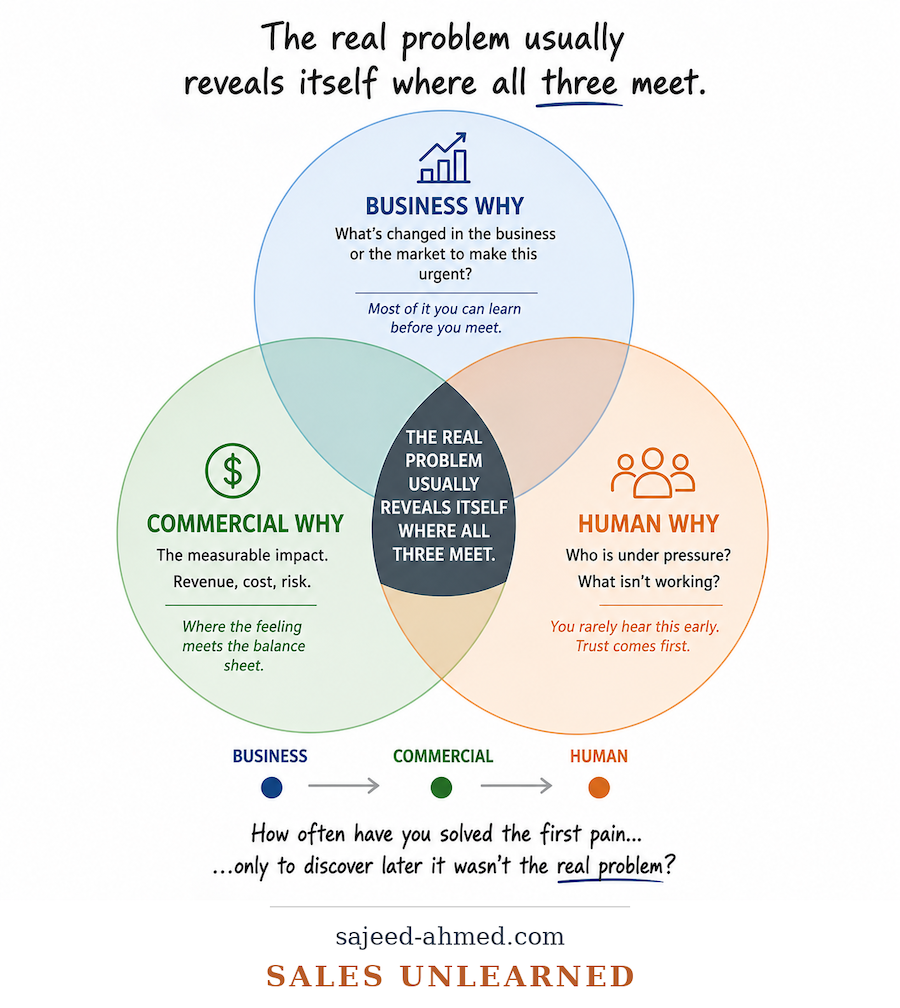
The first perspective is the Business Why.
I want to understand what has changed in the organisation or the market that made this initiative important now. Has a competitor entered the market? Is there a regulatory change? Has the company announced a new strategy, acquisition or product launch? Has customer behaviour shifted?
Many of these answers are available before the first meeting through annual reports, investor presentations, earnings calls and industry news.
Understanding the business context allows every subsequent question to become more meaningful.
The second perspective is the Commercial Why.
Every enterprise initiative eventually has a financial consequence. Revenue, cost, productivity, operational efficiency, customer retention, risk or time-to-market all influence investment decisions.
One question often reveals far more than technical discussions ever can : What happens if nothing changes?
That is usually where the conversation shifts from operational concerns to business value. It is where the feeling meets the balance sheet.
The final perspective is the Human Why.
Every significant enterprise decision affects people. Someone owns the outcome. Someone is accountable for success. Someone is frustrated by the current process. Someone has committed to a delivery date. Someone is protecting their reputation.
These motivations rarely appear during the first meeting. They emerge only after trust has been established, yet they often explain why projects move quickly, stall unexpectedly or fail despite having strong technical and commercial justification.
Ignoring the human dimension often leaves an important part of the story undiscovered.
Most customer conversations begin inside one of these perspectives.
A technical manager usually starts with operational issues. Finance starts with commercial concerns. Senior leadership often begins with strategic priorities.
As conversations continue, the other perspectives gradually emerge. The strategic initiative explains why the project exists. The commercial impact explains why investment is justified.
The human factors explain why progress is easy, or difficult.
Individually, each perspective tells part of the story. Together, they explain the problem the organisation is actually trying to solve.
After two decades in engineering, operations and enterprise sales, I’ve come to appreciate that diagnosis is rarely about asking more questions. It is about asking questions from different perspectives.
Existing sales methodologies already teach us to dig deeper, and I believe they should continue to do so. The lesson that experience taught me is slightly different.
When one line of questioning has taken you as far as it can, don’t just keep digging the same hole. Look somewhere else. The next insight may not be deeper. It may simply be in a different dimension.
Because in enterprise sales, the real problem often sits where the Business Why, the Commercial Why and the Human Why finally come together.
Tags: Business Strategy, Sales, Telecom
 The Question That Closes More Deals Than Any Feature List
Early in my career, I was pitching a major telecom software upgrade — a significant performance improvement, a substantial list of new features, and a fact that I assumed made the decision automatic: the client's current version was approaching end of support. Without the upgrade, their services would be at risk.
To me, this was not a hard sell. It was a formality. I expected approval within days.
The client took weeks.
We sat in review after review, unable to understand the hesitation. The upgrade path was, in our view, the only rational choice. Then, in one meeting, the client's own technical head asked a question that reframed the entire engagement:
"What if this breaks after we switch?"
That single question told me more about enterprise buying behaviour than any training I had received to that point.
We had built our pitch entirely around upside — performance improvements, new capabilities, the risk of staying on an unsupported platform. What we had not addressed was the buyer's actual, unspoken calculation: not "what do we gain," but "what do we stand to lose if this goes wrong."
This is a distinction with real behavioural grounding. Loss aversion — the well-documented tendency for people to weigh potential losses more heavily than equivalent gains — doesn't just apply to individual financial decisions. It shows up powerfully in enterprise buying committees, where the person approving a change is rarely the person who benefits most directly from it, but is often the person who will be held accountable if it fails.
The client's silence wasn't indecision. It was risk-processing that our pitch had never spoken to.
There is a common instinct in sales, particularly when a deal appears self-evidently necessary, to lean on urgency: the current system is unsupported, the risk of inaction is high, the decision should be obvious. This logic is compelling to the seller. It rarely moves the buyer.
Pressure does not resolve fear. If anything, framing a decision as unavoidable can heighten scrutiny of what might go wrong, because the buyer feels they are being pushed toward a risk they haven't had the chance to properly evaluate.
The lesson here is not that urgency is irrelevant. It is that urgency addresses the wrong question. The buyer wasn't asking whether the upgrade was necessary. They were asking whether it was safe.
Once we understood the client's technical head had voiced the real concern in the room, we stopped presenting the case for the upgrade and started addressing the case against a failed migration. We walked through the specific risks involved in the transition, and for each one, the mitigation we had already planned.
Nothing about the underlying offer changed. What changed was that the conversation now matched what the buyer was actually evaluating.
The deal moved within the week.
This is not a story about one telecom deal. It is a pattern that recurs across enterprise sales, and one that a coach reminded me of recently — twenty years into a career built partly on this exact lesson, and still worth relearning.
A few principles worth carrying into any complex sale:
Buyers rarely fear missing an upside as much as they fear owning a downside. A feature list answers "what will we gain." It does not answer "what happens if this goes wrong," which is frequently the more decisive question in the room.
"There is no alternative" is the seller's logic, not the buyer's. Inevitability arguments do not reduce risk anxiety; they can increase it.
A stalled deal is more often an unspoken risk than a missing benefit. When a decision that appears straightforward stalls without explanation, the more useful question is rarely "have we shown enough value," but "what are they afraid might happen, and have we addressed it directly."
Bringing risk and mitigation to the table proactively builds more trust than the pitch itself. Buyers are reassured less by confidence in the outcome and more by evidence that the seller has already thought through what could fail.
Discovery in complex sales is often treated as a checklist — confirm the need, confirm the budget, confirm the timeline. But the more decisive discovery often happens in a single, unscripted question from someone on the buying side who says, plainly, what everyone else in the room has been thinking but hasn't voiced.
The seller's job in that moment is not to have an answer ready. It is to recognise that the real conversation has just started, and that everything discussed before it was, in retrospect, incomplete.
Tags: Risk Management, Sales, Telecom
 When Delay Becomes a Tactic — A Question Worth Having Over Coffee
It started somewhere between the third cup of coffee and an honest disagreement with someone I respect professionally — even when I do not always agree with how they operate.
We were talking about a deal. Late stage. Price alternatives had been tabled. The customer was engaged. The momentum was real. All that was needed was an internal approval and a follow-up email — a day's work at most.
Then the approval did not come.
Days passed. The customer followed up. We followed up internally. More days. Then came the explanation that stopped me cold.
"The delay itself will tell us how serious they are."
The senior professional across from me said it with the calm confidence of someone who had used this move before. And it had probably worked before. In a market with limited competition, where the customer has few alternatives, a deliberate pause can masquerade as leverage.
He was not wrong about the outcome. He was wrong about the ethics.
And that is where the coffee conversation got interesting.
Let me steelman the other side, because intellectual honesty requires it.
In enterprise sales, qualification never really ends. Even at closing stage, signals matter. A customer who chases you is a customer who wants the deal. A customer who goes quiet under pressure may have alternatives you do not know about, or internal champions who are weaker than they appeared.
From that lens, a delayed response is not manipulation — it is a diagnostic. It reveals temperature. It surfaces urgency. And in markets where you hold a structural advantage, using that advantage is not unethical. It is commercial strategy.
Experienced practitioners have closed deals this way for decades. There is a logic to it that cannot simply be dismissed.
Here is where I push back.
There is a difference between reading the temperature of a deal and deliberately engineering a cold room to measure it.
By the time a customer is reviewing price alternatives, the qualification is done. Discovery is complete. The need is established. The relationship has been built — sometimes over years. Introducing artificial friction at that stage is not a diagnostic tool. It is a trust tax imposed on a relationship the customer did not agree to pay.
And here is what troubles me more than the tactic itself.
Momentum in a deal is not just a commercial variable. It is a signal of something more human — that both sides are moving toward something together. When you deliberately slow that down to test the other person's seriousness, you are treating the relationship as a mechanism, not a partnership.
The customer is not a circuit you test with a probe. They are an organisation with internal deadlines, stakeholders waiting for answers, and a champion inside who is being asked uncomfortable questions by their own team.
When you delay, you do not just test their temperature. You raise their internal cost of choosing you.
There is a specific context that makes this tactic even more uncomfortable — when the seller holds a structural advantage.
In competitive markets, relationship quality is often the differentiator. The seller who is trustworthy, responsive, and transparent earns deals that the product alone could not win.
In near-monopoly conditions, that discipline disappears. The advantage becomes an excuse. And tactics that would never survive a competitive environment get dressed up as strategy.
This is where I think the real conversation lives.
Not whether the tactic works — it might.
But what does it cost, invisibly, over time?
The customer who felt managed at closing will remember that feeling at renewal. The internal champion who had to defend the delay to their own organisation will think twice before sponsoring the next project. The relationship that could have compounded into a long-term account calcifies into a transactional one.
Monopoly buys you the deal. It does not buy you what comes after.
We did not resolve it. We were not supposed to.
My colleague had data on his side — patterns from years in the field, deals that proved the tactic worked. I had a different kind of data — the slower, quieter evidence of what relationships look like five years after a deal closes.
What I came away with was not a verdict. It was a question I keep returning to.
If the only reason a tactic works is because the customer cannot easily go elsewhere — is that a strategy, or is it a symptom of something the market has not yet corrected?
Sales attracts criticism for a reason. And a lot of that criticism is fair — because tactics like this one blur the line between strategy and manipulation in ways that are easy to rationalise and hard to defend out loud.
The senior professional I spoke with is not a bad person. He is a product of a system that rewarded certain behaviours for a long time.
But systems change. Markets open. Customers develop memory.
The question worth sitting with — whether you are early in your sales career or twenty years in — is not whether a tactic works today.
It is whether the person you are becoming through the choices you make is someone you will still respect when the market conditions change.
I do not have a clean answer.
Do you?
Tags: Coaching, Leadership, Sales
 Sales Beyond Stereotypes
For a long time, like many people from technical and delivery backgrounds, I saw sales through a narrow lens. I thought of it as the function that reached out, persuaded, followed up, and tried to close.
In simple words, I saw sales mostly as the front-end activity of bringing in business. And if I am honest, somewhere in that image sat the old stereotype too:
The salesperson is someone constantly calling, constantly convincing, and constantly pushing.
That picture was incomplete.
The closer I moved to real sales conversations, especially in complex B2B environments, the more I realized that good sales was not just about getting attention. It was about carrying meaning. It was about helping the market understand why a company exists, what its product is really solving, and why that solution matters in the buyer’s world. That changed the way I looked at the role completely.
Even today, when many people hear the word sales, they still imagine activity before they imagine clarity. They think of cold calls, follow-ups, targets, persuasion, and pressure. Some of that may have shaped the early image of sales, and some of it still exists in certain parts of the profession. But if that is still the full definition we carry, then we are missing the real weight of the role.
The buyer has changed too.
HubSpot reports that 96% of prospects research companies and products before engaging a sales representative, and 71% prefer to do their own research before talking to a rep.
That means sales can no longer rely on being the first source of information. Buyers are arriving later, more informed, and with stronger points of view already in place.
That is why a sales team is not just there to create contact. It is there to create understanding. The job is not only to get in front of customers. The job is to make the company’s value make sense outside the company.
Inside a business, the product usually feels obvious. The people who built it understand it. The leadership team believes in it. The internal language is familiar. But the buyer does not live inside that world. The buyer is dealing with competing priorities, internal pressure, risk, budget questions, and many alternative choices. That is where the sales team becomes more than a commercial function. It becomes the bridge between internal belief and external understanding.
A strong sales team does much more than explain features or present offers. Its deeper role is to carry the product purpose into the market in a way the buyer can actually understand and trust. That means connecting the company’s solution to a real problem, making the value relevant to the buyer’s context, and helping the market see why the offering deserves attention.
This is why I do not see sales as just communication or persuasion. Those skills matter, of course. But they are not enough on their own. A person can communicate well and still confuse the buyer. A person can sound polished and still fail to create confidence. A person can present smoothly and still leave the real meaning unclear.
In fact, buyer expectations now point in the same direction.
Salesforce reports that 86% of business buyers are more likely to buy when sellers understand their goals, yet 59% say most reps do not take enough time to understand those goals. In the same research, 84% of buyers say they expect sellers to act as trusted advisors, but 73% say most sales interactions still feel transactional.
That gap says a lot. The issue is no longer whether a rep can talk. The issue is whether the rep can make the conversation relevant.
What separates strong sales teams is not just their ability to speak. It is their ability to frame. They make value visible. They connect the offer to business reality. They simplify what feels complex. They help the buyer move from vague interest to clear understanding.
This is also where sales has evolved far beyond the old stereotype. Good sales today are not a random hustle. It is not just confidence plus persistence. It is structured work. It requires research, preparation, context, timing, listening, business understanding, and the ability to adapt the message without losing the core purpose.
That is why I sometimes say modern sales feels closer to disciplined problem-solving than many people expect. Not because it is cold or mechanical, but because it has a process. Strong sales teams do not simply repeat what worked last time. They learn and refine. They understand different stakeholders. They prepare better. And they know that deals move not just because somebody followed up hard enough, but because clarity was built well enough.
RAIN Group’s buyer research supports this, too. 92% percent of buyers say they are influenced by sellers who deepen their understanding of needs.
That is a very different picture from the old view of sales as just pitching and persuading. It suggests that the real value of sales now lies in helping buyers think more clearly, not just respond more quickly.
A company can have a very capable product and still struggle in the market. Often, the problem is not the product itself. It is the gap between what the company believes the product means and what the buyer actually understands from the conversation.
If sales is reduced to calling, pitching, and chasing, then the product gets reduced too. It starts to sound like a list of features rather than a meaningful solution. The company may keep increasing activity, but activity alone cannot fix a weak understanding.
That is why sales deserves a much bigger definition. It is not just the team that pushes deals forward. It is the team that helps the market understand why the company matters at all.
For me, this is one of the important unlearning points around sales. Many people still resist the idea of sales because they are reacting to an older image of it. They think sales means being pushy, overly polished, or unnatural. They think it means forcing conversations or pressuring people into decisions.
But the best sales work does not feel like that at all.
At its best, sales is the function that carries product purpose into the market, makes that purpose relevant in the buyer’s world, and helps people understand value clearly enough to take the next step. That is not shallow work. That is not just outreach work. That is one of the most important market-facing roles inside any company that wants to grow.
The old image of sales was a person with a script trying to get a yes.
The modern reality is far more important than that.
A strong sales team helps the market understand, trust, and move. It carries the company’s purpose into real conversations and turns value into something buyers can actually grasp.
And maybe that is the definition we need to update.
Tags: Leadership, Sales, Startups
 Why smart builders ship great products and still struggle to generate revenue
Many smart builders reach a confusing stage. They have built something useful, sometimes even impressive, yet revenue does not move the way they expected. The common assumption is that a good product should sell itself. In practice, it rarely works that way.
This is not a persuasion problem. It is a clarity problem. Selling, at its best, is the value delivery system. It helps the right people understand what you built, why it matters, and when it is relevant to them. When that clarity is missing, buyers do not reject you. They delay the decision because they cannot explain the value to themselves or to others.
Before you do anything outward-facing, it helps to start with internal clarity. Not marketing language. Not positioning statements. Just your own thinking, written clearly enough that someone outside your world can follow it.
Here is a simple Day 1 internal clarity map that I use with builders.
What moment made you build this in the first place? Describe the situation that felt costly, risky, slow, or painful. Avoid listing features. Focus on the moment that created the need.
In plain language, what becomes easier, safer, faster, or simpler because of what you do? This is your capability. If you cannot explain it without technical terms, your buyer will struggle to repeat it.
What evidence do you already have that this problem is real? Proof can be modest. It might be a workaround people already use, repeated complaints you have heard, early interest from a few users, or a small pilot that taught you something.
What lines will you not cross? These boundaries are not just ethical. They are practical. They reduce confusion, build trust faster, and make your selling feel calmer because you are clear about limits.
To make this more concrete, imagine a founder building a medicine-delivery app that connects local pharmacies with nearby customers and supports uploading prescriptions. The origin trigger might be watching sick or elderly people struggle to travel and search multiple pharmacies when they need medicine the same day. The reliable fix is not “an app.” It reduces delays and confusion, so patients and caregivers can get the right medicine quickly without unnecessary trips.
Proof can be small but real. People already place medicine orders through calls and WhatsApp, and pharmacies already deliver, but the process is messy, hard to track, and prone to errors when prescription photos are unclear. Non-negotiables could include delivering prescription medicine only with a valid prescription and partnering only with licensed pharmacies. Those boundaries protect the customer and the business, and they also make the selling conversation easier because trust is built into the rules.
Why does this matter? Because when internal clarity is weak, teams often try to compensate with activity. More outreach, more content, more meetings, more explaining. That can create motion, but it does not create traction. Clarity is what turns movement into revenue.
In the early stages, you do not need perfect messaging. You need clarity that is honest and repeatable. If you can write A1 to A4 in plain language, you will notice something has changed. Your conversations get easier, your outreach gets calmer, and buyers understand your value faster. Revenue tends to follow that kind of clarity.
Tags: Sales
Beyond AI SalesEnterprise Sales Isn’t What You ThinkThere Is No Framework.